
Electrical Fuses Blog
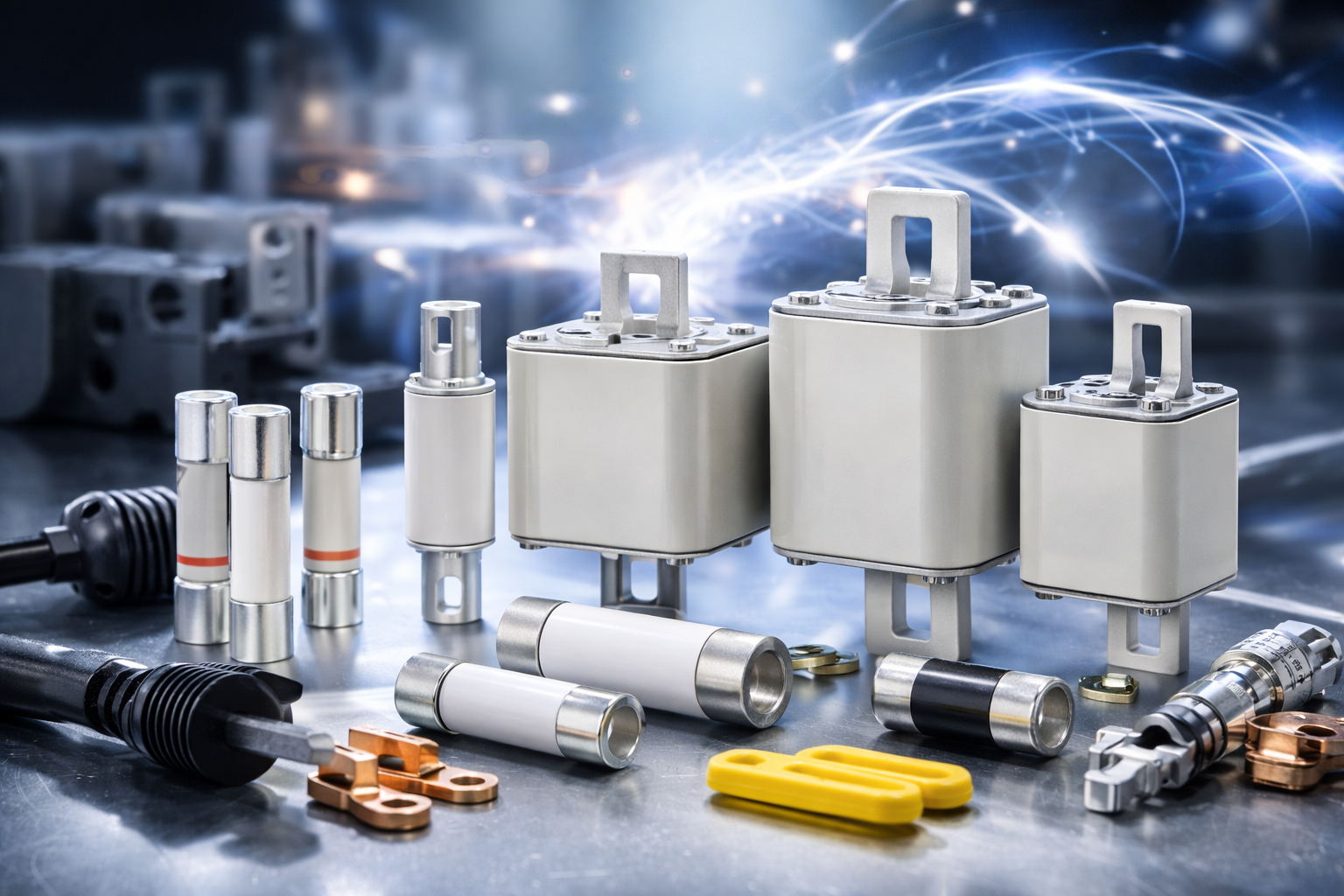
Eaton Bussmann Series Electrical Fuses – Blog & Fachwissen
Im Eaton Bussmann Series Electrical Fuses Blog finden Sie fundiertes Fachwissen rund um elektrische Sicherungen, Überstromschutz und moderne Schutzkonzepte für industrielle und gewerbliche Anwendungen. Diese Kategorie bündelt alle Blogartikel, technischen Beiträge und Praxisguides zu den Sicherungssystemen und Serien von Eaton Bussmann.
Eaton Bussmann zählt weltweit zu den führenden Herstellern von elektrischen Sicherungen, und ihre Serien stehen für Sicherheit, Normkonformität und höchste Zuverlässigkeit in anspruchsvollen elektrischen Systemen.
Was Sie im Eaton Bussmann Sicherungen Blog erwartet
Unsere Blogbeiträge helfen Ingenieuren, Einkäufern, Technikern und Planern dabei, die richtige Sicherungslösung zu finden und technische Zusammenhänge besser zu verstehen.
Themenschwerpunkte dieser Kategorie:
-
🔌 Überblick über Eaton Bussmann Sicherungsserien
-
⚙️ Unterschiede zwischen UL-, IEC- und Spezial-Sicherungen
-
📘 Technische Erklärungen zu Kennlinien, Auslöseverhalten & Bemessungswerten
-
🏭 Anwendungstipps für Industrie, Maschinenbau & Energieverteilung
-
🚗 Beiträge zu EV-, DC- und Hochvolt-Sicherungen
-
🛠 Best Practices für Auswahl, Installation und Wartung
Alle Inhalte sind praxisnah, verständlich aufbereitet und technisch fundiert.
Eaton Bussmann Sicherungsserien im Fokus
Der Blog behandelt regelmäßig verschiedene Eaton Bussmann Series Electrical Fuses, darunter:
-
Industrial Fuses
-
North American (UL) Fuse Series
-
IEC Sicherungsserien
-
High Speed & Semiconductor Fuses
-
EV & DC Sicherungen
-
Supplementary & Specialty Fuses
So erhalten Sie einen umfassenden Überblick über das Eaton Bussmann Portfolio und dessen Einsatzmöglichkeiten.
Fachwissen für sichere elektrische Systeme
Elektrische Sicherungen sind ein zentraler Bestandteil jeder sicheren Stromversorgung. Der Eaton Bussmann Series Electrical Fuses Blog unterstützt Sie dabei, Risiken zu minimieren, Normen einzuhalten und die Lebensdauer Ihrer Anlagen zu verlängern.
Ganz gleich, ob Sie Grundlagenwissen suchen oder tief in spezielle Sicherungsserien eintauchen möchten – hier finden Sie relevante, aktuelle und suchmaschinenoptimierte Inhalte rund um Eaton Bussmann Electrical Fuses.
👉 Jetzt Blogartikel entdecken und Ihr Wissen über Eaton Bussmann Sicherungsserien gezielt erweitern.
- Details
- Category: Electrical Fuses Blog
 bus-ele-cat-1007-flc-2018-sec-02-lv-supp.pdf | [Eaton Bussmann series Full line catalog: Low voltage supplemental fuses and cable limiters] | 4466 kB |
Eaton Bussmann Series Full Line Catalog: Low Voltage Supplemental Fuses and Cable Limiters
Introduction to Eaton Bussmann Low Voltage Supplemental Fuses and Cable Limiters
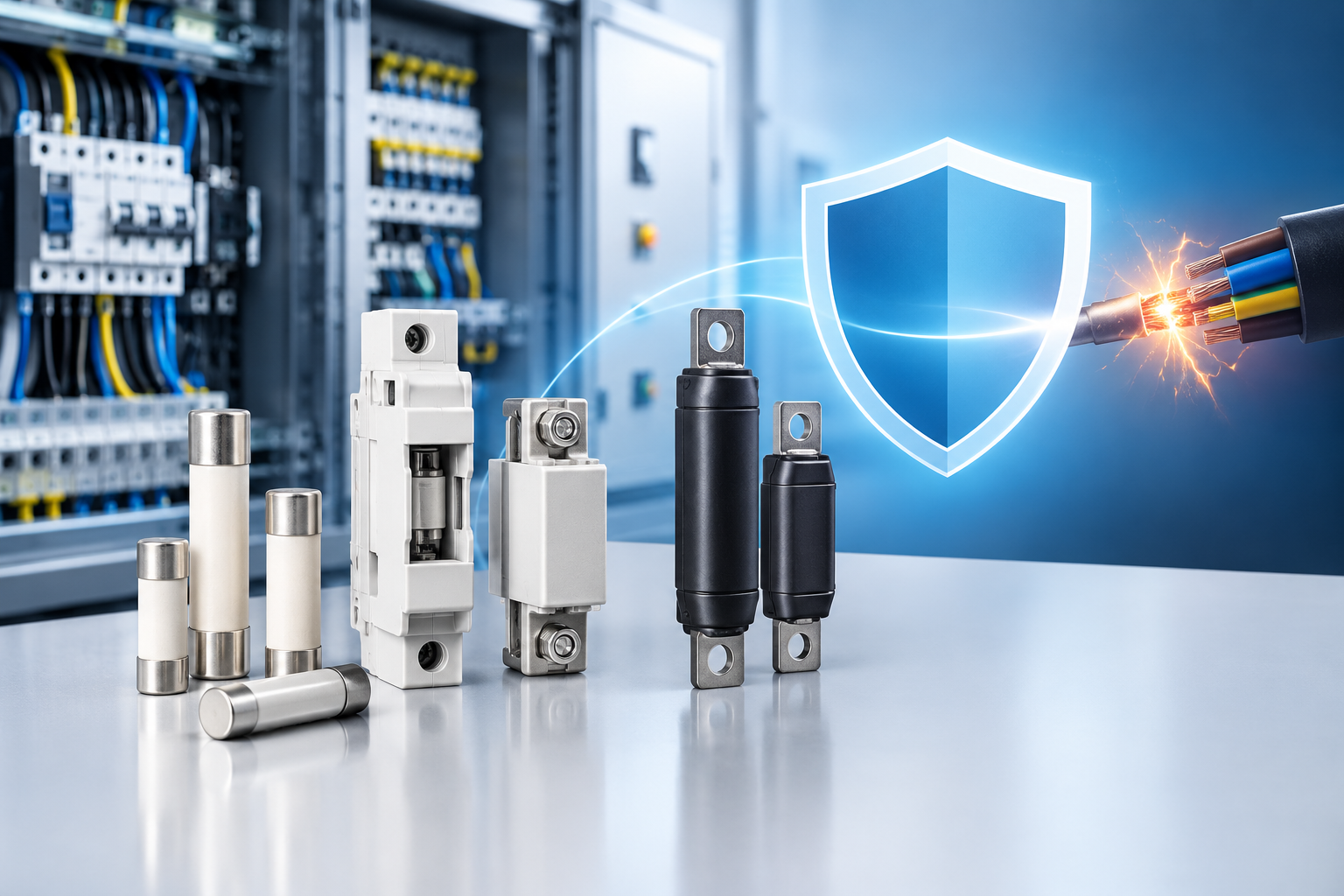
Reliable electrical circuit protection is essential for maintaining the safety, efficiency, and continuity of modern electrical systems. Eaton Bussmann series low voltage supplemental fuses and cable limiters are designed to support effective overcurrent protection across a variety of electrical applications. These components help protect electrical equipment, wiring, and connected circuits against potentially damaging current conditions when correctly selected and installed.
The Eaton Bussmann Series Full Line Catalog for Low Voltage Supplemental Fuses and Cable Limiters provides technical product information to help electrical engineers, panel builders, maintenance professionals, and electrical distributors identify suitable circuit protection solutions for their requirements.
Understanding the available fuse types, electrical ratings, and application considerations can help professionals make informed decisions when designing, maintaining, or upgrading low voltage electrical installations.
What Are Low Voltage Supplemental Fuses?
Low voltage supplemental fuses are overcurrent protection devices used to protect specific components and sections of electrical circuits. They are commonly incorporated into equipment and control systems where additional protection is required alongside the circuit protection provided by the overall installation.
Depending on the product type and application, supplemental fuses can help protect sensitive electrical components against excessive current caused by faults or abnormal operating conditions.
Typical application areas include:
-
Industrial control panels and electrical enclosures
-
Control circuits and automation equipment
-
Power supplies and electrical equipment
-
Electrical and electronic components
-
Auxiliary circuits in industrial installations
Selecting the correct fuse requires consideration of the circuit voltage, expected current, available fault current, interrupting rating, fuse characteristics, and the manufacturer's application requirements.
Understanding Eaton Bussmann Cable Limiters
Cable limiters are specialized protective devices designed primarily to protect conductors and cable systems against excessive fault currents. They are used in applications where the electrical installation and the characteristics of the protected cables require a suitable current-limiting protection solution.
By interrupting fault currents under their specified operating conditions, appropriately selected cable limiters can help reduce the thermal and mechanical stresses that electrical faults place on conductors and connected equipment.
Cable limiters may be relevant in electrical distribution systems and other installations where conductor protection and fault-current management are important design considerations.
When evaluating cable limiters, electrical professionals should verify the applicable voltage rating, current rating, fault-interruption capability, physical dimensions, installation requirements, and coordination with upstream and downstream protective devices.
Key Features and Benefits of Low Voltage Supplemental Fuses and Cable Limiters
The Eaton Bussmann series product range supports a variety of circuit protection requirements. The precise features and benefits depend on the individual product selected.
1. Overcurrent Protection
Fuses are designed to interrupt current when specified operating conditions are exceeded. Choosing a suitable fuse helps protect compatible electrical components and circuits against damaging overcurrent events.
2. Support for Electrical System Reliability
Correctly selected and coordinated circuit protection devices can help limit the effects of electrical faults, reduce equipment damage, and support reliable system operation.
3. Multiple Product Options
The full line catalog provides a product-selection reference for professionals who need to compare available fuse and cable limiter options against their electrical and mechanical requirements.
4. Application-Specific Selection
Different installations have different protection needs. Reviewing product ratings, operating characteristics, and installation requirements helps engineers identify solutions appropriate for their applications.
5. Assistance with Maintenance and Replacement
Technical catalog information can support the identification of replacement components during electrical maintenance. Matching the original device's ratings and specifications is essential to maintaining the intended level of protection.
How to Select the Right Low Voltage Supplemental Fuse
Selecting an appropriate supplemental fuse involves more than matching the current rating. Electrical professionals should evaluate the complete operating and fault conditions of the circuit.
Rated voltage: Confirm that the fuse is suitable for the circuit's operating voltage and the applicable AC or DC conditions.
Rated current: Select a current rating appropriate for the protected equipment, conductor sizing, continuous load, and applicable electrical standards.
Interrupting rating: Ensure that the fuse can safely interrupt the prospective fault current available at its installation point.
Time-current characteristics: Consider the duration and magnitude of expected operating currents, including startup or inrush currents, to help avoid unwanted fuse operation while maintaining adequate protection.
Physical dimensions and mounting: Verify the fuse size, holder compatibility, terminal configuration, and available installation space.
Coordination with other protective devices: Assess how the fuse operates alongside upstream and downstream circuit breakers or fuses to support effective fault isolation.
Applicable standards: Confirm compliance with the relevant electrical codes, product standards, and equipment requirements for the intended installation.
The manufacturer's product documentation should always be consulted before finalizing a fuse selection.
Important Considerations When Selecting Cable Limiters
Cable limiter selection requires careful evaluation of the cable system and the fault conditions it may experience.
Key considerations include:
-
Cable protection requirements: Evaluate conductor material, cross-sectional area, insulation characteristics, installation conditions, and allowable thermal limits.
-
Electrical ratings: Confirm that the cable limiter is appropriate for the system voltage and intended operating conditions.
-
Prospective short-circuit current: Verify that the protective device is suitable for the fault current available at the installation point.
-
Protective device coordination: Review the interaction between cable limiters and other overcurrent protection devices in the distribution system.
-
Installation compatibility: Confirm the required mounting arrangements, terminal connections, and physical dimensions.
-
Manufacturer guidance: Follow the product-specific instructions and application limitations for the selected device.
Proper selection is important because an incorrectly rated or unsuitable protective device may fail to provide the intended level of cable protection.
Why Use the Eaton Bussmann Series Full Line Catalog?
Product catalogs are valuable technical resources for electrical design, procurement, and maintenance activities. The Eaton Bussmann Series Full Line Catalog section covering low voltage supplemental fuses and cable limiters is intended to help professionals review the relevant product information during the selection process.
The catalog can be used to support several common tasks:
Product identification: Review available product options when specifying a new circuit protection component.
Technical comparison: Compare the published ratings and dimensions of relevant devices.
Design and engineering: Use manufacturer specifications as part of the circuit protection design and verification process.
Maintenance planning: Identify suitable replacement candidates for existing installations, subject to confirmation of the original device requirements.
Procurement support: Provide a consistent technical reference for communicating product specifications to purchasing teams and electrical distributors.
Because product ranges and specifications can change, users should verify that the catalog edition is appropriate for their project and confirm current product availability and technical details with the manufacturer or an authorized distributor.
Common Applications for Supplemental Fuses and Cable Limiters
Low voltage supplemental fuses and cable limiters serve different purposes, so their suitability depends on the design of the electrical system.
Potential application areas include industrial machinery, electrical control panels, automation systems, power distribution equipment, and installations that require dedicated protection for particular circuits or cable sections.
Supplemental fuses are generally selected to protect specific equipment or circuits within the limits of their application and applicable standards. Cable limiters are evaluated primarily in relation to the protection of conductors and cable systems.
Neither device should be selected solely on the basis of its product category. The complete protection scheme, including the available fault current and the characteristics of other protective devices, must be considered.
Best Practices for Fuse and Cable Limiter Maintenance
Regular inspection and correct replacement practices can help maintain the integrity of electrical protection systems.
-
Inspect equipment for visible damage, discoloration, overheating, or signs of deteriorated connections.
-
Investigate the underlying cause of a blown fuse before installing a replacement.
-
Replace protective devices only with suitable components that meet the original design requirements.
-
Never bypass a fuse or substitute a device with an unsuitable rating.
-
Verify holder condition, terminal integrity, and connection requirements during maintenance.
-
Keep technical documentation and equipment records available for future inspections.
-
Ensure that installation, testing, and replacement work is carried out by qualified personnel using appropriate electrical safety procedures.
Protective devices should not be treated as interchangeable solely because they have similar dimensions or current ratings. Voltage ratings, interrupting capacity, operating characteristics, and application approvals also matter.
Frequently Asked Questions
What is a low voltage supplemental fuse?
A low voltage supplemental fuse is an overcurrent protection device used to protect specific circuits or components in electrical equipment. It supplements the protection provided by the overall electrical installation and must be suitable for its intended application.
What is the purpose of a cable limiter?
A cable limiter is a protective device designed primarily to limit the effects of excessive fault current on cable systems. Its suitability depends on the system design, conductor requirements, and the device's published ratings.
How do supplemental fuses differ from cable limiters?
Supplemental fuses are commonly used to protect individual circuits or equipment components, while cable limiters are intended primarily for cable and conductor protection in suitable installations. Their construction, operating characteristics, and applications can differ, so the manufacturer's documentation should guide selection.
How do I choose the correct Eaton Bussmann fuse?
Review the required voltage and current ratings, interrupting rating, time-current characteristics, mounting dimensions, and application requirements. Also consider conductor protection and coordination with other protective devices. Consult the relevant manufacturer documentation before making a final selection.
Can I replace an existing fuse with one that has the same current rating?
Not necessarily. The replacement must also meet the required voltage rating, interrupting capacity, operating characteristics, physical compatibility, and applicable standards. Confirm the original specification and verify that the replacement is suitable for the installation.
Why is fuse coordination important?
Coordination helps ensure that protective devices operate appropriately during faults, reducing unnecessary disruption and supporting effective fault isolation. The required coordination depends on the electrical system and the specific protective devices involved.
Conclusion
Eaton Bussmann series low voltage supplemental fuses and cable limiters are important considerations in the design and maintenance of electrical circuit protection systems. Choosing the correct device requires an understanding of the application, electrical ratings, fault conditions, conductor requirements, and coordination with other protective equipment.
The Eaton Bussmann Series Full Line Catalog provides a technical reference for professionals evaluating low voltage supplemental fuses and cable limiters. By reviewing the relevant product specifications and following established electrical safety practices, engineers, panel builders, maintenance teams, and distributors can make better-informed decisions about circuit protection.
Always verify product-specific requirements against the manufacturer's current technical documentation and applicable electrical standards before installation or replacement.
- Details
- Category: Electrical Fuses Blog
| bus-ele-cat-1007-flc-2018-sec-01-lv-branch.pdf | [Eaton Bussmann series Full line catalog: Low voltage branch circuit fuses and cable limiters] | 9389 kB |
Eaton Bussmann Series Full Line Catalog: Low Voltage Branch Circuit Fuses and Cable Limiters
Introduction to Eaton Bussmann Low Voltage Branch Circuit Fuses
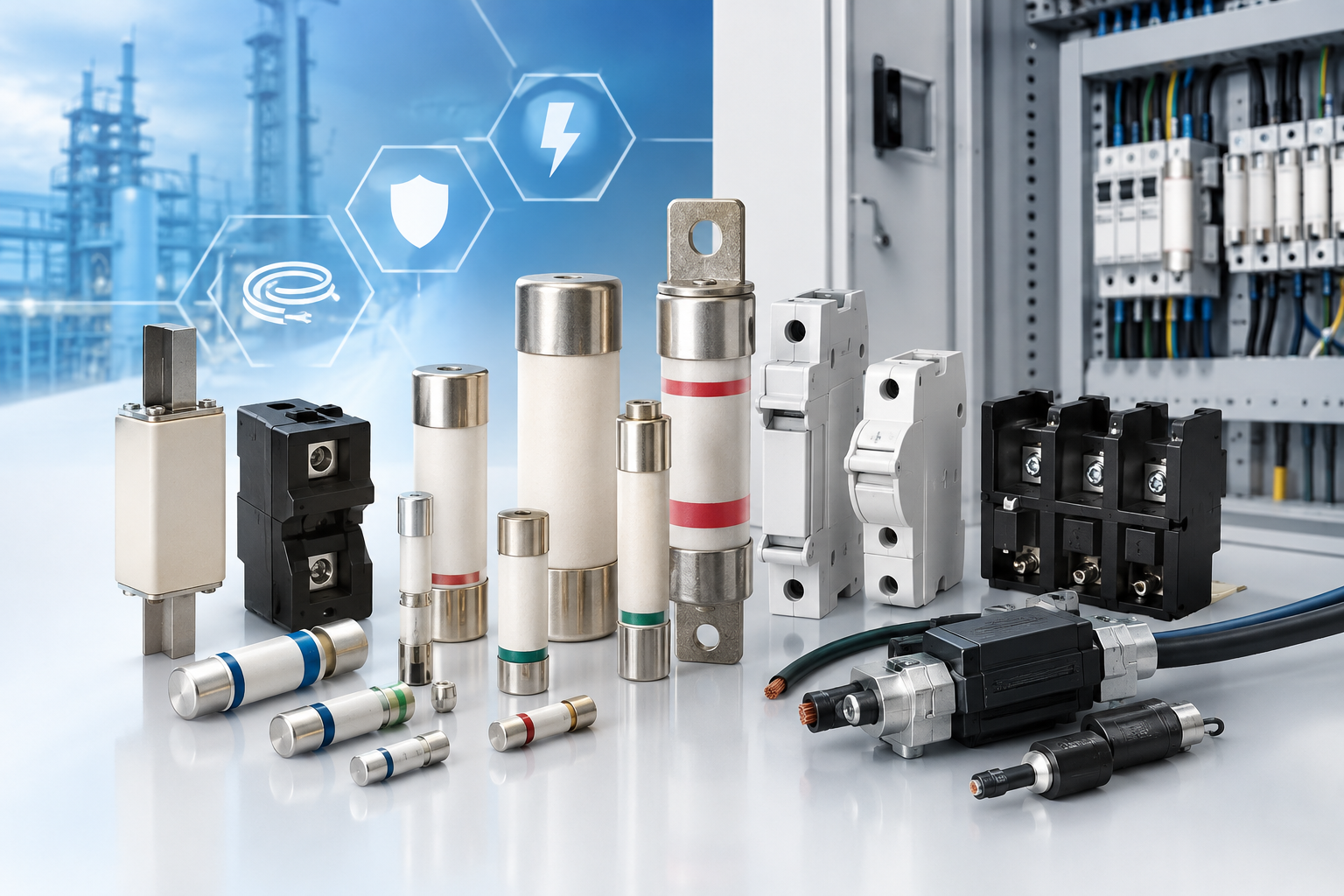
Reliable electrical circuit protection is essential for industrial facilities, commercial buildings, control panels, and power distribution systems. The Eaton Bussmann series Full Line Catalog for low voltage branch circuit fuses and cable limiters provides a detailed technical reference for selecting fuses designed to help protect electrical equipment against overcurrent and short-circuit conditions.
The catalog, identified as Full Line Catalog 1007, Section 1, covers a broad range of low voltage branch circuit fuse technologies, including Class CC, Class CF, Class J, Class L, Class RK, Class T, and additional fuse types. It also provides product ratings, catalog numbers, dimensional information, and guidance for selecting compatible fuse holders and blocks.
For electrical engineers, panel builders, maintenance professionals, and electrical distributors, understanding these product families can simplify component selection and support safer, more reliable electrical system design.
What Are Low Voltage Branch Circuit Fuses?
Low voltage branch circuit fuses are protective devices designed to interrupt excessive current when electrical faults occur. Depending on their design and application, they can help protect conductors, motors, control circuits, distribution equipment, and other electrical components from damaging overcurrent conditions.
When a fuse is selected correctly, it works as part of a coordinated protection system. Its voltage rating, current rating, interrupting capacity, time-current characteristics, and compatibility with the fuse holder all contribute to effective circuit protection.
Eaton Bussmann series fuses offer different characteristics to meet the needs of various electrical applications. Choosing the appropriate fuse class is important because fuses with similar current ratings may differ in physical dimensions, performance, rejection features, and permitted applications.
Key Product Families in the Eaton Bussmann Catalog
1. Class CC Fuses
Class CC fuses are commonly used in industrial control panels, branch circuits, and control circuit applications. The catalog includes products such as LP-CC, FNQ-R, and KTK-R.
The LP-CC Low-Peak time-delay fuse is designed to accommodate certain temporary current surges while providing current-limiting protection during fault conditions. Its rejection feature, when used with a compatible fuse block, helps prevent the insertion of certain incorrectly rated fuse types.
Class CC fuses are particularly relevant for applications where compact components, control circuit protection, and appropriate coordination between protective devices are important.
2. Class CF Fuses and CUBEFuse Solutions
The catalog includes Class CF fuse products such as TCF and FCF, as well as WCF wind CUBEFuse products with specific application restrictions.
CUBEFuse solutions are designed for compact electrical installations where efficient use of panel space is a priority. The catalog highlights the space-saving potential of Low-Peak CUBEFuse solutions when paired with their designated holders.
When evaluating these products, engineers should verify the applicable voltage rating, current rating, fuse-holder compatibility, and certification requirements. WCF products have distinct application limitations and must be used with the specified compatible holder.
3. Class J Fuses
Class J fuses are used in a range of industrial and commercial power distribution applications. The catalog features LPJ and JKS fuse families, with product information covering electrical ratings, dimensions, and associated mounting options.
Class J fuses can be suitable for systems that require current-limiting overcurrent protection. Their physical design and performance characteristics must be matched to the electrical equipment and the available installation space.
The LPJ Low-Peak family is one option for designers considering time-delay characteristics and coordination within compatible fuse systems.
4. Class L Fuses
Class L fuses are designed for high-current applications, including certain large-scale power distribution systems and industrial electrical installations.
The catalog lists product families such as KRP-C, KRP-CL, KLU, and KTU. It provides dimensional information for various current ranges, supporting engineers who need to evaluate the fit of replacement components or plan new installations.
Because Class L fuses serve higher-current applications, selection requires careful review of system fault current, conductor protection requirements, equipment ratings, and the manufacturer's application guidance.
5. Class RK1 and RK5 Fuses
Class RK fuses are widely used in industrial and commercial electrical systems. The catalog includes several product families, including LPN-RK, LPS-RK, KTN-R, KTS-R, FRN-R, and FRS-R.
These products offer different time-delay and current-limiting characteristics, depending on the specific fuse family. The catalog distinguishes between 250 V and 600 V product options and provides dimensional information across multiple current ranges.
When replacing an existing fuse, it is important to confirm the original fuse class, voltage rating, current rating, interrupting rating, and equipment requirements. Physical fit alone does not establish electrical suitability.
6. Class T Fuses
Class T fuses, including JJN and JJS families, are another option for electrical systems requiring compact fuse designs and high-performance overcurrent protection.
The catalog identifies JJN products for applications rated up to 300 V and JJS products for applications rated up to 600 V, subject to the individual product specifications. Current ranges and physical dimensions vary by model.
These characteristics make Class T fuses worth considering when designing or maintaining equipment where available installation space and the required electrical protection performance are important.
7. Plug Fuses and Additional Fuse Accessories
In addition to industrial branch circuit fuse families, the catalog includes plug fuses, fuse reducers, fuse holders, fuse blocks, and related accessories.
These components support practical installation and maintenance requirements. However, accessories must be selected according to their intended use, electrical ratings, and compatibility with the fuse and equipment involved.
The catalog's fuse holder and block selection guide helps users identify mounting options associated with the listed fuse classes and catalog symbols.
Cable Limiters: Supporting Electrical Conductor Protection
Cable limiters are used in certain electrical distribution systems to help protect cables against excessive fault currents. Their application differs from conventional branch circuit fuse protection, so selecting a cable limiter requires an understanding of the system configuration and the protection objective.
The Eaton Bussmann Full Line Catalog directs readers to its cable limiter section for conductor protection information. Engineers should consult the relevant cable limiter specifications to verify available types, ratings, dimensions, and installation requirements.
When specifying cable limiters, consider the cable's characteristics, the prospective short-circuit current, the electrical system configuration, and applicable installation standards. A cable limiter should not be treated as an interchangeable substitute for a branch circuit fuse unless the manufacturer's documentation and the applicable design requirements explicitly permit that use.
How to Select the Correct Eaton Bussmann Fuse
Selecting the correct fuse involves more than matching an ampere rating. The following factors should be reviewed before ordering or installing a replacement.
Voltage Rating
Choose a fuse with a voltage rating suitable for the circuit. The catalog contains products with different AC and, where specified, DC voltage ratings. AC and DC ratings must not be assumed to be interchangeable.
Current Rating
The fuse's ampere rating must be appropriate for the protected circuit, conductor ampacity, equipment requirements, and expected operating conditions. Follow applicable electrical codes and manufacturer guidance when determining the correct rating.
Interrupting Rating
The interrupting rating indicates the fault current a fuse is designed to interrupt under specified conditions. Confirm that the selected fuse's interrupting rating meets or exceeds the available fault current at the installation point.
Fuse Class and Performance Characteristics
Different fuse classes have different construction, dimensions, and performance characteristics. Consider whether the application requires time-delay operation, current-limiting performance, a rejection feature, or specific coordination with upstream and downstream protective devices.
Physical Dimensions and Mounting Compatibility
Verify the fuse's dimensions and the compatibility of the fuse holder or block. The catalog includes dimensional tables and selection guidance to support installation planning and replacement identification.
Certification and Application Requirements
Review the applicable product listings, certifications, environmental requirements, and equipment specifications. A fuse that physically fits an existing holder is not necessarily an approved or suitable replacement.
Benefits of Using the Eaton Bussmann Full Line Catalog
The catalog is a useful technical resource for professionals involved in electrical system design, component procurement, installation, and maintenance.
Key benefits include:
-
Broad product coverage: Information on multiple low voltage branch circuit fuse classes and product families.
-
Technical selection data: Electrical ratings, catalog symbols, and other product-specific specifications.
-
Dimensional references: Measurements to assist with equipment layout and replacement identification.
-
Fuse holder compatibility guidance: Selection information for associated fuse blocks and mounting solutions.
-
Application-focused information: Descriptions of fuse features and typical applications that help narrow down suitable product options.
-
Support for maintenance planning: Product family and catalog number information that can help technicians identify components for further verification.
Using a manufacturer catalog as part of the selection process can reduce uncertainty and help teams make more informed component decisions.
Common Applications for Low Voltage Branch Circuit Fuses
Eaton Bussmann low voltage fuse products may be considered for a variety of applications, depending on the specific model and its ratings.
Examples include:
-
Industrial control panels and automation equipment
-
Motor and control circuits
-
Commercial electrical distribution systems
-
Power distribution equipment
-
Electrical machinery and manufacturing facilities
-
Equipment requiring current-limiting overcurrent protection
-
Applications requiring appropriately coordinated protective devices
Every application must be evaluated against the individual fuse's published specifications and the requirements of the electrical system.
Why Correct Fuse Selection Matters
Incorrect fuse selection can compromise protection, cause unnecessary interruptions, or create equipment compatibility problems. A fuse with an unsuitable current or voltage rating, inadequate interrupting capacity, or incompatible physical configuration may not provide the required protection.
For this reason, electrical professionals should verify the exact catalog number and all relevant ratings before procurement or replacement. Where system conditions are uncertain, consult the equipment manufacturer or a qualified electrical engineer.
The Eaton Bussmann catalog should be used as a technical reference rather than as a substitute for a complete electrical protection study, installation instructions, or applicable electrical codes.
Conclusion
The Eaton Bussmann series Full Line Catalog for low voltage branch circuit fuses and cable limiters provides valuable information for selecting overcurrent protection components across a range of industrial and commercial applications.
By covering multiple fuse classes, product families, electrical ratings, dimensional references, and fuse-holder selection guidance, it helps engineers, maintenance teams, panel builders, and distributors evaluate available options more systematically.
Whether the task involves designing a new control panel, identifying a replacement fuse, or reviewing protection requirements for an existing electrical installation, the most important step is to match the exact product specifications to the application.
Always verify the latest applicable manufacturer documentation, product approvals, and installation requirements before specifying or installing an Eaton Bussmann fuse or cable limiter.
Frequently Asked Questions
What is the Eaton Bussmann Full Line Catalog 1007?
It is a manufacturer catalog containing technical information on Eaton Bussmann fuse products. Section 1 covers low voltage branch circuit fuses, including product families, ratings, dimensions, and fuse holder selection guidance.
Which fuse classes are covered in the catalog?
The section covers several fuse classes and related product types, including Class CC, CF, J, L, RK1, RK5, and T, along with plug fuses and associated accessories.
What is the difference between Class CC and Class J fuses?
Class CC and Class J fuses differ in their physical configurations, application characteristics, and compatible fuse holders. The correct choice depends on the circuit requirements, available equipment, and the specifications of the individual product.
Are Eaton Bussmann fuses suitable for industrial control panels?
Certain Eaton Bussmann fuse families are intended for industrial control panels and related applications. Suitability depends on the specific fuse's ratings, certification, holder compatibility, and the requirements of the equipment being protected.
How do I identify a replacement fuse?
Start with the existing fuse's complete catalog number, class, voltage and current ratings, interrupting rating, and time-delay characteristics. Confirm physical dimensions and holder compatibility, then verify that the replacement is approved for the intended application.
Where can I find cable limiter specifications?
Consult the cable limiter section of the relevant Eaton Bussmann technical catalog and the applicable product documentation. Confirm the limiter's ratings, installation requirements, and suitability for the specific conductor protection application.
- Details
- Category: Electrical Fuses Blog
| bus-ele-cat-1007-flc-2018-intro.pdf | [Bussmann series Full line catalog: Selecting fused circuit protection - Introduction] | 2421 kB |
Eaton Bussmann Series Full Line Catalog: A Guide to Selecting Fused Circuit Protection
Introduction
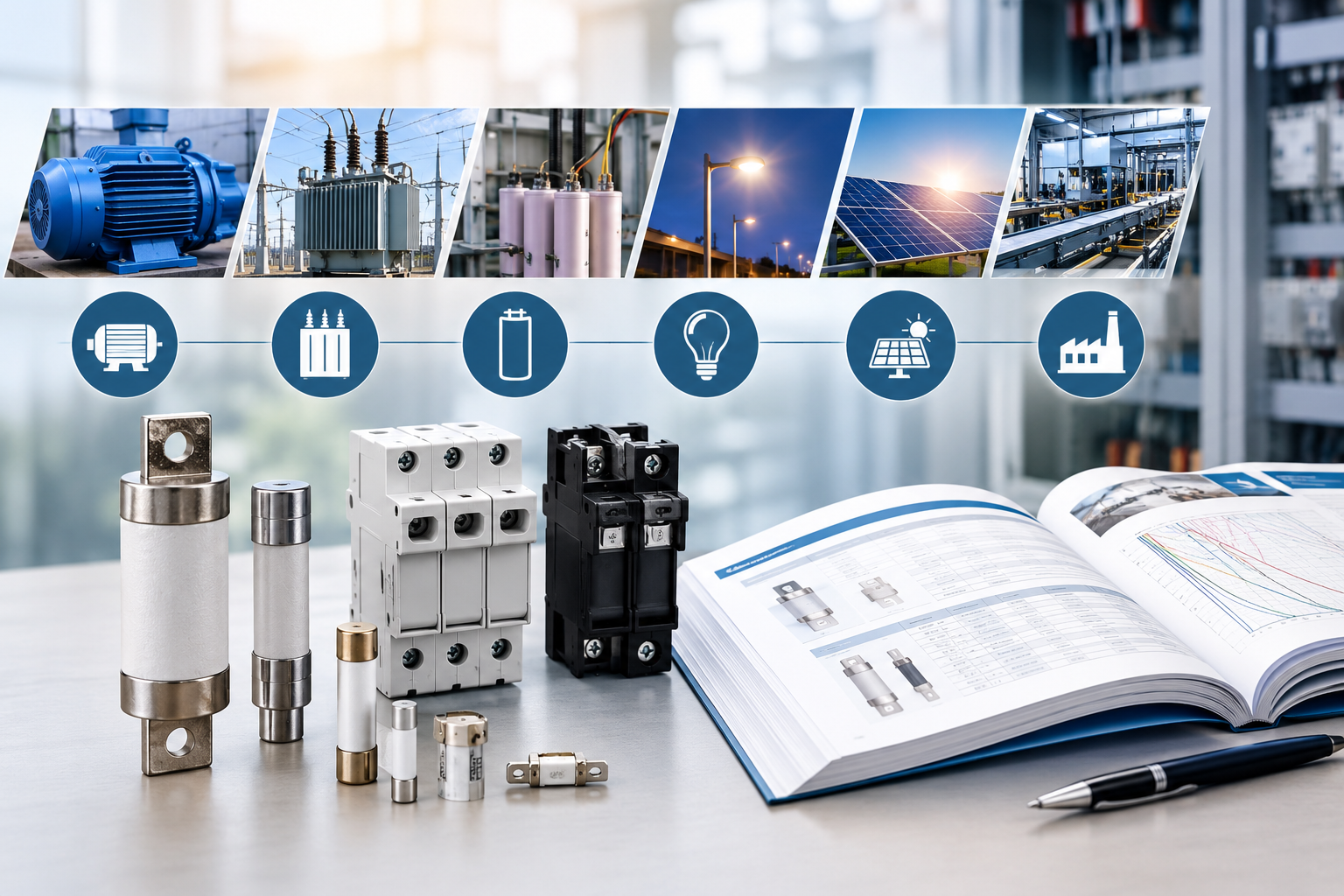
Selecting the right fuse is a critical step in designing a safe, reliable, and efficient electrical system. Whether you are protecting industrial machinery, motor circuits, transformers, lighting systems, electronic equipment, or renewable energy installations, choosing the appropriate fuse helps manage overcurrent conditions and reduce the risk of equipment damage.
The Eaton Bussmann Series Full Line Catalog 1007 provides technical information and application-based recommendations to help electrical engineers, panel builders, maintenance professionals, and system designers select suitable fused circuit protection. Its introduction, Selecting Fused Circuit Protection, outlines fuse recommendations for various electrical applications and provides guidance on fuse sizing, voltage ratings, and compatible fuse holders.
By understanding the fundamentals of fuse selection and using the catalog as a technical reference, professionals can make better-informed decisions about electrical protection, system reliability, and compliance with applicable standards.
What Is Fused Circuit Protection?
Fused circuit protection uses an electrical fuse to interrupt current when an overcurrent condition exceeds the fuse's operating characteristics. A properly selected fuse helps protect conductors, electrical equipment, and other circuit components against the damaging effects of excessive current.
Fuses are available in different current ratings, voltage ratings, classes, time-current characteristics, and physical configurations. Each type is designed for specific applications and operating conditions.
Selecting a fuse involves more than matching its ampere rating to the normal operating current. Engineers must also consider the circuit voltage, prospective short-circuit current, load characteristics, inrush current, conductor ampacity, and applicable electrical codes.
The Eaton Bussmann Series catalog helps simplify this process by organizing fuse recommendations according to common electrical applications.
Understanding the Eaton Bussmann Series Full Line Catalog 1007
The Eaton Bussmann Series Full Line Catalog 1007 is a technical reference covering a broad range of circuit protection products and related electrical components. The October 2018 edition includes an introduction to fuse selection and dedicated sections for different fuse technologies, voltage levels, and installation requirements.
The catalog covers the following product categories:
-
Low-voltage branch circuit fuses
-
Supplemental fuses and cable limiters
-
Electronic, printed circuit board (PCB), and small-dimension fuses
-
High-speed fuses
-
IEC and British Standard fuses
-
Photovoltaic fuses, holders, and fuse blocks
-
Medium-voltage fuses
-
Fuse blocks and holders
-
Power distribution and terminal blocks
-
Disconnect switches and accessories
-
Surge protective devices and telecommunications protection products
The catalog also includes reference material on fuse sizing for 600 V building electrical systems, selective coordination, low-voltage fuse types and classes, electrical formulas, terminology, and product cross-referencing.
This structured approach allows users to identify relevant product families and find technical information for a wide range of electrical protection requirements.
How to Select the Right Fuse for an Electrical Application
Choosing the right fuse requires a systematic evaluation of the electrical circuit and the equipment being protected. The catalog's application tables provide a useful starting point, but the final selection should always be based on the actual system design and applicable regulations.
1. Identify the Application
Start by determining the type of equipment or circuit that requires protection. Common applications include:
-
Electric motors and motor control circuits
-
Transformers and control transformers
-
Capacitor banks
-
Electric heating equipment
-
Lighting ballasts
-
Solenoids and control coils
-
Main, feeder, and branch circuits
-
Photovoltaic systems and electronic equipment
Different applications have different electrical characteristics. A motor, for example, may draw a substantial starting current, while a transformer can experience magnetizing inrush when energized. A fuse must accommodate normal operating conditions while providing the required protection against fault currents.
The Eaton Bussmann Series catalog organizes recommendations by application to help users narrow down the appropriate fuse options.
2. Determine the Required Current Rating
The fuse's current rating is one of the most important selection parameters. It must be suitable for the load, conductors, and protective requirements of the circuit.
When calculating the required fuse rating, consider:
-
The equipment's rated current
-
Continuous and non-continuous loads
-
Motor full-load current
-
Starting and inrush current
-
Conductor ampacity
-
Applicable code requirements
-
The type of overcurrent protection required
The correct sizing method varies by application. Motor circuits, transformer circuits, capacitor installations, and general feeder circuits should not automatically use the same sizing approach.
The catalog provides application-specific sizing recommendations based on the 2017 National Electrical Code (NEC). Because this is a 2018 publication, its guidance should be checked against the current edition of the applicable code and any relevant local requirements before use.
3. Verify the Voltage Rating
A fuse must have a voltage rating appropriate for the circuit in which it is installed. The voltage rating is important because the fuse must be capable of safely interrupting the fault current under the circuit's operating conditions.
When evaluating a fuse, verify:
-
The circuit's nominal voltage
-
The fuse's rated voltage
-
The AC or DC application, as applicable
-
The system's grounding and configuration requirements
-
The fuse's specified interrupting capability
Never assume that a fuse suitable for one voltage level is automatically suitable for another. The manufacturer's technical documentation should be reviewed to confirm suitability for the intended application.
4. Evaluate Time-Delay and Non-Time-Delay Characteristics
Fuse time-current characteristics determine how quickly a fuse responds to an overcurrent condition.
Time-delay fuses are designed to tolerate certain temporary current surges without opening immediately. Depending on the fuse type and application, this can make them suitable for circuits with motor-starting currents, transformer inrush, or other predictable transient loads.
Non-time-delay fuses generally respond more quickly to overcurrent conditions and may be appropriate where rapid interruption is required and the load characteristics permit their use.
The selection should be based on the equipment's operating profile, the type of fault protection required, and the coordination of the overall protection system. A time-delay fuse is not automatically the best choice for every motor circuit, nor is a faster-acting fuse necessarily appropriate for every sensitive load.
5. Check the Fuse Class and Interrupting Rating
Fuse classes help identify products with particular construction, performance, and application characteristics. The required class depends on the circuit, equipment, applicable standards, and installation conditions.
The interrupting rating is also essential. It indicates the maximum fault current a fuse is rated to interrupt safely at its specified voltage under the relevant test conditions.
Before selecting a fuse, verify that its interrupting rating is adequate for the available short-circuit current at the installation point. A fuse with an appropriate current rating may still be unsuitable if its interrupting rating is insufficient.
6. Confirm Compatibility With Fuse Holders and Equipment
Selecting a fuse also involves checking the associated mounting and connection components. Fuse holders, fuse blocks, and disconnecting devices must be compatible with the selected fuse and the circuit's electrical ratings.
Consider the following factors:
-
Fuse dimensions and mounting configuration
-
Fuse holder or fuse block compatibility
-
Rated voltage and current
-
Terminal and conductor requirements
-
Available installation space
-
Environmental and operating conditions
-
Applicable product and installation standards
The Eaton Bussmann Series catalog includes separate sections for fuse blocks, holders, disconnect switches, and related products, helping users consider the protection device and its supporting components together.
Fuse Selection for Common Electrical Applications
The catalog's introduction includes application-based recommendations for several common types of electrical loads. These examples illustrate why fuse selection should be tailored to the circuit rather than based on a single universal rule.
Motor Circuits
Electric motors can draw high starting currents before reaching normal operating speed. Fuse selection must account for motor full-load current, starting characteristics, the role of the motor controller, and the required short-circuit protection.
The catalog discusses time-delay and non-time-delay fuse applications and distinguishes between short-circuit protection and overload protection. These functions may be provided by different components within a motor control system.
The selected fuse must coordinate with the motor starter, overload relay, and other protective devices to support safe and reliable operation.
Transformer Protection
Transformers can experience inrush current when energized, making their protection requirements different from those of many other loads.
Fuse selection depends on factors such as transformer rated current, primary and secondary protection arrangements, impedance, and applicable electrical code requirements.
The catalog provides recommendations for transformers rated at 600 V nominal or less. These tables can support preliminary selection, but the actual transformer configuration and protection scheme must be assessed before a final decision is made.
Capacitor Protection
Capacitor circuits may experience current conditions associated with energization and system operation. The appropriate fuse selection depends on the capacitor's full-load current, fuse characteristics, voltage rating, and the intended protection arrangement.
The catalog provides separate sizing guidance for time-delay and non-time-delay fuses, illustrating the importance of matching the fuse's operating characteristics to the application.
Lighting Ballasts
Lighting systems can require different fuse recommendations depending on the ballast type and installation environment. The catalog distinguishes between indoor and outdoor applications and identifies cases where the fixture manufacturer's specified fuse size and type should be consulted.
This is an important reminder that application-specific manufacturer requirements should be considered alongside general catalog recommendations.
Feeders and Branch Circuits
Main circuits, feeders, and branch circuits supply power to equipment and downstream loads. Their protection requirements depend on load composition, continuous operating current, motor loads, and the available fault current.
The catalog provides sizing guidance for feeder circuits with non-motor loads, combinations of motor and non-motor loads, and motor-only loads. These distinctions help engineers account for the different operating characteristics of each circuit.
For every installation, the final design must satisfy the applicable electrical code, conductor protection requirements, and coordination objectives.
Why Proper Fuse Selection Matters
Correct fuse selection contributes to the safety and performance of electrical installations in several ways.
Equipment protection: A suitable fuse can interrupt excessive current before it causes unacceptable damage to protected components, provided the fuse is correctly applied and the fault conditions fall within its ratings.
System reliability: Matching fuse characteristics to normal load conditions helps reduce unnecessary interruptions caused by predictable starting or inrush currents.
Electrical safety: Appropriate current ratings, voltage ratings, and interrupting capabilities help ensure the protection device is suitable for the circuit's operating and fault conditions.
Selective coordination: Coordinating upstream and downstream protective devices can help isolate a fault to the affected part of an electrical system, where the design and available fault conditions permit.
Simplified maintenance and inventory: Standardizing suitable fuse types across compatible applications can make replacement and maintenance easier. However, substitutions should only be made after verifying that the replacement meets all relevant electrical and application requirements.
Using the Catalog for Efficient Fuse Selection
The Eaton Bussmann Series Full Line Catalog is most useful when treated as a structured engineering reference rather than a simple product list.
A practical selection process includes the following steps:
-
Identify the load and circuit type.
-
Determine the nominal voltage and expected operating current.
-
Establish the applicable fuse-sizing rules.
-
Evaluate starting current, inrush current, and other load characteristics.
-
Confirm the fuse class, time-current characteristics, and interrupting rating.
-
Check compatibility with the fuse holder, block, disconnect switch, and associated equipment.
-
Review the relevant catalog recommendations and product-specific technical data.
-
Verify compliance with current codes, standards, and installation requirements.
-
Have the final selection reviewed by qualified electrical personnel.
The catalog's index and cross-reference material can help users locate product families and relevant technical sections. Where necessary, detailed product datasheets should be consulted to confirm specifications and application limitations.
Important Considerations Before Finalizing a Fuse Selection
Although catalog tables are valuable, they should not replace an engineering assessment of the complete electrical system.
The introduction to the 2018 Eaton Bussmann Series Full Line Catalog states that its recommendations are suggestions and that final fuse selection should be performed by qualified personnel who can fully assess the application's circuit protection requirements.
Users should also be aware that product designs, availability, technical specifications, and regulatory requirements can change. The 2018 edition refers to the 2017 NEC, so it should not be assumed to reflect every current requirement.
Before installation, confirm the latest manufacturer specifications, applicable electrical codes, system fault-current levels, conductor ratings, and coordination requirements. Where the application is complex or the appropriate fuse is uncertain, seek assistance from the manufacturer's application engineering team or another qualified electrical protection specialist.
Conclusion
Selecting the right fuse is essential for effective overcurrent protection, electrical safety, and reliable system performance. The Eaton Bussmann Series Full Line Catalog 1007 provides a broad technical reference for choosing fused circuit protection across applications such as motors, transformers, capacitors, lighting systems, feeders, and branch circuits.
By evaluating current and voltage ratings, fuse characteristics, interrupting capacity, compatibility, and application-specific requirements, electrical professionals can make more informed protection decisions.
The most effective approach combines catalog recommendations with current product datasheets, applicable electrical codes, and a thorough assessment by qualified personnel. This ensures that fuse selection supports the needs of the actual installation rather than relying on a generic recommendation.
Frequently Asked Questions
What is the Eaton Bussmann Series Full Line Catalog?
It is a technical catalog covering Eaton Bussmann Series fuses, fuse holders, circuit protection accessories, and related electrical products. The 2018 edition includes application-based fuse selection guidance and technical reference sections.
How do I choose the correct Bussmann fuse?
Identify the application, determine the required current and voltage ratings, evaluate inrush current and time-current characteristics, verify the interrupting rating, and check compatibility with the equipment and applicable codes. Use the relevant product datasheet and consult qualified personnel before finalizing the selection.
What is the difference between time-delay and non-time-delay fuses?
Time-delay fuses can tolerate certain temporary current surges for a specified period, while non-time-delay fuses generally respond more quickly to overcurrent conditions. The appropriate choice depends on the load, fault protection requirements, and coordination with other protective devices.
Does the 2018 catalog reflect current electrical code requirements?
The catalog's introductory fuse selection tables are based on the 2017 NEC. Users should verify all recommendations against the current applicable code edition, local requirements, and the latest manufacturer documentation.
Why is the fuse interrupting rating important?
The interrupting rating indicates the maximum fault current a fuse is rated to interrupt safely at its specified voltage. The rating must be adequate for the available short-circuit current at the installation point.
Can I replace an existing fuse with one that has the same ampere rating?
Not necessarily. A replacement must also meet the required voltage rating, fuse class, interrupting rating, time-current characteristics, physical compatibility, and application requirements. Always verify the full specification before replacing a fuse.
- Details
- Category: Electrical Fuses Blog
bus-ele-cat-1007-flc-2018.pdf | [Eaton Bussmann series Full line catalog] | 0 kB |
Eaton Bussmann Series Full Line Catalog: A Complete Guide to Electrical Circuit Protection
Introduction to the Eaton Bussmann Series Full Line Catalog
Reliable electrical circuit protection is essential for industrial facilities, commercial buildings, electrical distribution systems, and electronic equipment. Choosing the right fuse and protection components helps safeguard electrical installations against overcurrent conditions, short circuits, and potential equipment damage.
The Eaton Bussmann Series Full Line Catalog 1007 is a comprehensive product reference designed to help electrical engineers, panel builders, maintenance professionals, distributors, and procurement specialists identify suitable circuit protection products for their applications.
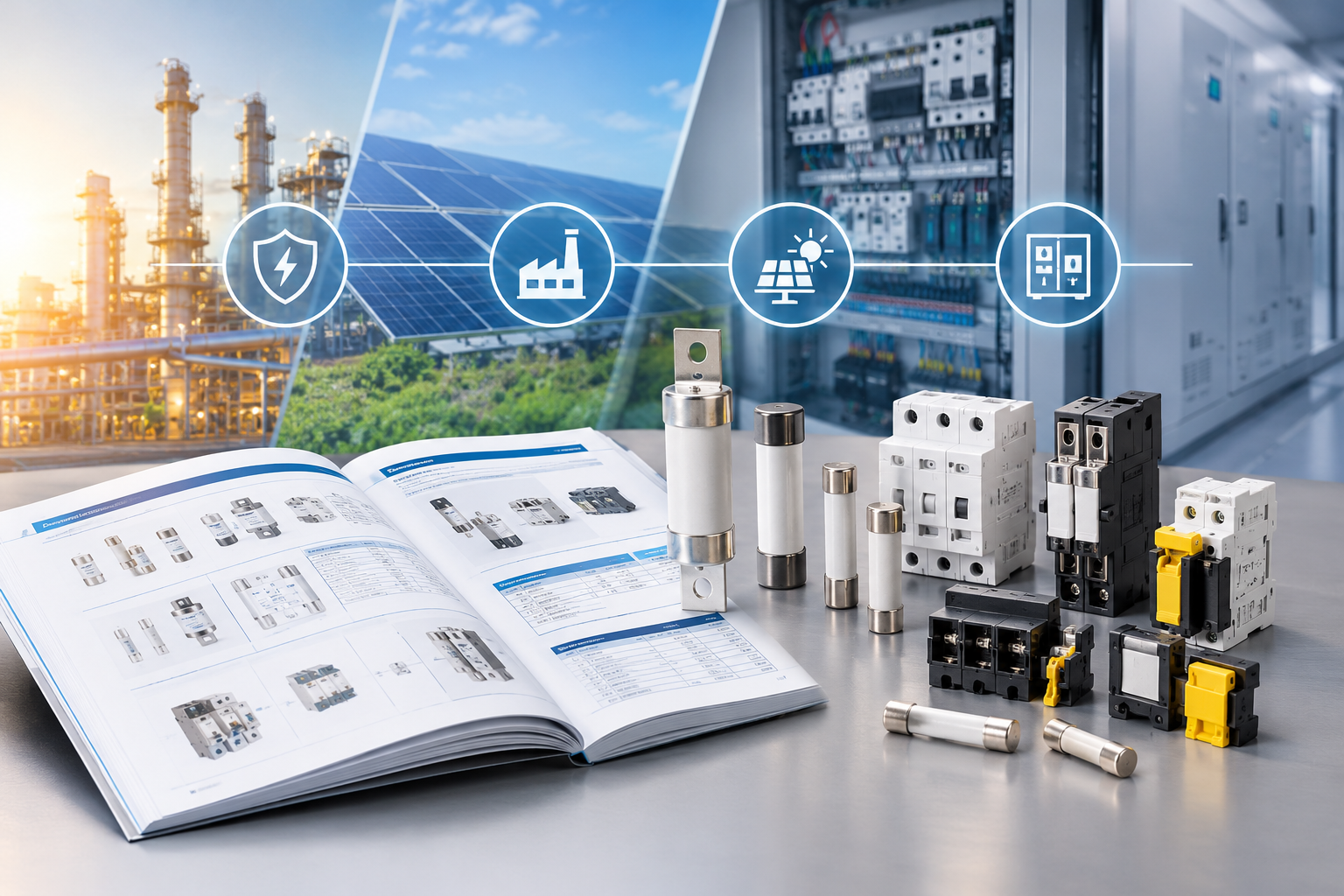
Published in October 2018, the catalog brings together a broad range of Bussmann series fuses, fuse holders, fuse blocks, disconnect switches, surge protective devices, and power distribution components. It provides product descriptions, electrical ratings, catalog numbers, dimensions, and selection information to support product identification and specification.
Whether you are designing an industrial control panel, maintaining an electrical distribution system, or sourcing replacement fuses, the Eaton Bussmann full line catalog provides a valuable starting point for understanding the available product range.
What Is the Eaton Bussmann Series Full Line Catalog?
The Eaton Bussmann Series Full Line Catalog is a technical reference covering a wide selection of electrical circuit protection and power distribution products.
It is intended to simplify the process of finding products that meet specific electrical requirements. Instead of consulting multiple individual product documents at the beginning of a selection process, users can explore product families and compare key specifications within one catalog.
The catalog includes information relevant to:
-
Industrial electrical installations
-
Commercial electrical distribution
-
Control panels and automation systems
-
Electronic and printed circuit board protection
-
Renewable energy applications, including photovoltaic systems
-
Power conversion and semiconductor protection
-
Medium-voltage electrical equipment
-
Fuse holders, disconnect switches, and power distribution assemblies
By bringing these product categories together, the catalog supports more efficient product research, component selection, and electrical system planning.
Key Product Categories in the Bussmann Series Catalog
1. Low-Voltage Branch Circuit Fuses
Low-voltage branch circuit fuses are used to protect electrical circuits and connected equipment from excessive current. The Bussmann series range includes multiple fuse classes and product families designed for different circuit characteristics and installation requirements.
The catalog covers products such as Class CC, Class J, Class L, Class RK1, Class RK5, and other branch circuit fuse types.
Each fuse class has specific characteristics, ratings, and application considerations. Selecting the appropriate product requires evaluating the circuit voltage, operating current, available fault current, required interrupting rating, and applicable electrical standards.
These products are relevant to industrial machinery, distribution panels, motor circuits, and other installations that require dependable overcurrent protection.
2. Low-Voltage Supplemental Fuses and Limiters
The catalog also covers supplemental fuses and current-limiting products for applications requiring additional protection.
These components are commonly considered for control circuits, specialized electrical equipment, and selected power applications. Depending on the product family, available options may differ in voltage rating, current rating, time-delay characteristics, and physical dimensions.
The catalog helps users identify suitable product families and compare their technical specifications before consulting the corresponding product data sheets.
3. Electronic, PCB, and Small-Dimension Fuses
Electronic equipment often requires compact circuit protection components that fit within limited installation spaces.
The Bussmann series catalog includes small-dimension fuses designed for electronic circuits, printed circuit boards, and other compact electrical assemblies. Product families cover different physical sizes and operating characteristics, including fast-acting and time-delay options.
These fuses can be relevant to power supplies, electronic control equipment, instrumentation, and other applications where component dimensions and response characteristics are important.
When selecting an electronic fuse, engineers should consider normal operating current, startup or inrush current, voltage rating, breaking capacity, ambient temperature, and the manufacturer's recommended operating conditions.
4. High-Speed Fuses
High-speed fuses are designed for applications that require rapid protection of sensitive power electronics and semiconductor devices.
The catalog covers Bussmann series high-speed fuse families used in applications such as power converters, rectifiers, DC drives, and other power conversion equipment.
Depending on the product, the available specifications may include AC and DC voltage ratings, current ratings, interrupting capabilities, physical dimensions, and operating characteristics.
Choosing the correct high-speed fuse requires more than matching the nominal current. Engineers should evaluate the semiconductor's withstand characteristics, prospective fault current, system voltage, and the fuse's energy-limiting performance.
5. IEC and British Standard Fuses
Electrical installations designed around IEC and British Standard requirements may require specific fuse dimensions, utilization categories, and electrical ratings.
The Bussmann series catalog includes fuse products intended for these applications, with technical information supporting product comparison and identification.
The range includes industrial cylindrical fuses and other fuse families available in different sizes and current ratings.
For international projects, it is particularly important to verify that the selected fuse meets the applicable installation requirements and is compatible with the relevant fuse holder or fuse base.
6. Photovoltaic Fuses, Holders, and Blocks
Photovoltaic installations require circuit protection components suited to the operating characteristics of solar power systems.
The catalog includes photovoltaic fuse products, holders, and blocks intended for relevant solar electrical applications.
When selecting photovoltaic protection, important considerations include maximum system voltage, operating current, fault-current conditions, fuse utilization requirements, environmental conditions, and compatibility with the installed equipment.
Correct component selection helps support the protection of photovoltaic circuits and associated electrical equipment. The precise suitability of a fuse must always be confirmed against the system design and applicable standards.
7. Medium-Voltage Fuses
Medium-voltage electrical systems require protection solutions selected according to system voltage, equipment characteristics, and fault conditions.
The Bussmann series catalog includes several medium-voltage fuse categories, including E-Rated, R-Rated, and PT fuse products, alongside other specialized fuse types and accessories.
These products serve different protection requirements and are not interchangeable solely because their current ratings appear similar.
Engineers should verify the intended application, voltage rating, fuse characteristics, mounting arrangement, and coordination requirements before specifying a medium-voltage fuse.
8. Fuse Blocks and Holders
Fuse holders and fuse blocks provide the mechanical and electrical interface between a fuse and the circuit in which it is installed.
The catalog describes a variety of mounting arrangements and product configurations, including DIN-rail and panel-mounted options for applicable product families.
Important selection factors include:
-
Compatibility with the selected fuse class and dimensions
-
Rated system voltage and current
-
Available fault-current and short-circuit ratings
-
Number of poles
-
Mounting and wiring requirements
-
Finger-safe construction and other relevant safety features
-
Environmental and installation conditions
Selecting a compatible holder or block is essential for achieving the intended performance of the complete circuit protection assembly.
9. Power Distribution and Terminal Blocks
Power distribution and terminal blocks support the organized distribution and termination of electrical conductors in panels and equipment.
The catalog provides information on product families used in electrical distribution assemblies and control panels.
When specifying these components, users should review conductor compatibility, terminal capacity, rated current and voltage, mounting arrangements, and any applicable short-circuit or installation requirements.
A suitable power distribution layout can also simplify wiring, maintenance, and future modifications.
10. Connector Products and Disconnect Switches
The Bussmann series catalog extends beyond individual fuses to include connector products and disconnect switches.
These product categories support electrical system assembly, circuit isolation, and power distribution. The available configurations and ratings vary by product family.
When evaluating disconnect switches, it is important to distinguish between isolation requirements and switching or load-breaking capabilities. The selected device must be rated for the intended operating conditions and installed according to the manufacturer's instructions.
11. Quik-Spec Electrical Gear
The catalog also covers Quik-Spec electrical gear, a product category intended for specified electrical distribution and circuit protection applications.
These solutions may be relevant to engineers and panel builders looking for coordinated equipment rather than selecting every component independently.
Product suitability depends on the intended installation, system ratings, required protection characteristics, and compatibility with the complete electrical assembly.
12. Surge Protective Devices
Surge protective devices help protect electrical systems and connected equipment against transient overvoltages.
The Bussmann series catalog includes surge protection products within its broader electrical protection portfolio.
Selecting an appropriate surge protective device involves assessing the electrical system configuration, expected surge exposure, required protection level, installation location, and applicable standards.
Surge protection should be considered as part of a coordinated electrical protection strategy rather than as a replacement for overcurrent protection.
How to Use the Eaton Bussmann Full Line Catalog
The catalog is most useful when approached as a structured product selection reference.
Step 1: Identify the Application
Begin by defining the equipment or circuit requiring protection. This might be an industrial control panel, electronic power supply, photovoltaic installation, motor circuit, or medium-voltage assembly.
The application determines which product categories and technical requirements are relevant.
Step 2: Determine the Electrical Requirements
Establish the system voltage, normal operating current, prospective short-circuit current, load characteristics, and any applicable installation standards.
For semiconductor circuits, electronic equipment, and motor applications, additional operating characteristics may influence the selection.
Step 3: Find the Appropriate Product Family
Use the catalog contents and product indexes to identify the relevant section. Compare the available product families and narrow the selection according to the intended application.
Step 4: Compare Ratings and Dimensions
Review the listed current and voltage ratings, interrupting ratings, physical dimensions, utilization categories, and compatibility requirements.
A product should not be selected on the basis of current rating alone. All relevant electrical and mechanical requirements must be satisfied.
Step 5: Verify the Technical Documentation
The full line catalog is dated October 2018. Before purchasing or specifying a product, confirm the current product status, availability, specifications, certifications, and installation requirements using the manufacturer's latest applicable documentation.
This is particularly important for replacement projects, new equipment designs, and installations subject to regulatory requirements.
Step 6: Confirm the Complete Protection Design
The final selection should account for protective-device coordination, conductor protection, equipment withstand ratings, and the installation's operating conditions.
Qualified electrical professionals should verify the complete design before implementation.
Benefits of Using the Bussmann Series Full Line Catalog
Comprehensive Product Reference
The catalog combines multiple product categories in one technical reference, helping users explore options across low-voltage, electronic, high-speed, photovoltaic, and medium-voltage protection.
Easier Product Identification
Catalog numbers, product descriptions, ratings, and dimensional information help users narrow their choices and identify components for further evaluation.
Support for Engineering and Panel Design
Electrical engineers and panel builders can use the catalog during preliminary design, component specification, and electrical bill-of-material preparation.
Assistance with Maintenance and Replacement
Maintenance teams can consult product descriptions and technical ratings when identifying replacement components. However, the original fuse's current rating alone is not sufficient to establish that a replacement is suitable.
Better-Informed Procurement
Procurement professionals can use catalog numbers and specifications to communicate component requirements more precisely and reduce ambiguity during sourcing.
Who Should Use the Eaton Bussmann Series Catalog?
The full line catalog is a useful resource for a broad range of electrical professionals.
-
Electrical engineers: For circuit protection research, product specification, and design evaluation.
-
Panel builders: For identifying fuses, fuse holders, distribution components, and compatible accessories.
-
Maintenance technicians: For investigating existing installations and identifying potential replacement products.
-
Industrial facilities: For supporting electrical maintenance planning and component identification.
-
Electrical distributors: For product identification and technical discussions with customers.
-
Procurement specialists: For matching requested catalog numbers with purchasing requirements.
-
System integrators: For evaluating protection components used in industrial automation and power conversion systems.
The information is most effective when used alongside application-specific engineering calculations and current manufacturer documentation.
Important Considerations When Selecting Bussmann Fuses
Although the catalog provides extensive technical information, choosing the correct fuse requires careful assessment of the complete electrical system.
Voltage rating: The fuse must be suitable for the circuit's operating voltage and AC or DC characteristics.
Current rating: The selected fuse must accommodate normal operation while providing the intended protection under abnormal conditions.
Interrupting rating: The fuse must be capable of safely interrupting the prospective fault current under the applicable conditions.
Operating characteristics: Fast-acting, time-delay, current-limiting, and high-speed fuses have different characteristics and application requirements.
Physical compatibility: Fuse dimensions, mounting arrangements, holders, and terminal configurations must be compatible.
Standards and approvals: The product must satisfy the requirements applicable to the installation and jurisdiction.
Coordination: The selected fuse should be evaluated in relation to other protective devices and the equipment being protected.
Documentation currency: Since the 2018 catalog is a historical edition, verify current specifications and product availability before relying on it for a new design or purchase.
Frequently Asked Questions
What is the Eaton Bussmann Series Full Line Catalog 1007?
It is a comprehensive product catalog published in October 2018 that covers Bussmann series fuses, fuse holders, fuse blocks, power distribution products, disconnect switches, surge protective devices, and related electrical components.
What types of fuses are included in the catalog?
The catalog covers low-voltage branch circuit fuses, supplemental fuses, electronic and PCB fuses, high-speed fuses, IEC and British Standard fuses, photovoltaic fuses, and medium-voltage fuses.
Can the catalog help identify replacement fuses?
Yes. It provides catalog numbers, product descriptions, ratings, and other technical details that can help identify potential replacements. The replacement must still be verified against the original equipment requirements, current product documentation, and applicable standards.
Does the catalog include fuse holders and fuse blocks?
Yes. It includes a dedicated section covering fuse blocks and holders, with product information for applicable mounting configurations and electrical ratings.
Is the 2018 catalog suitable for new electrical designs?
It can serve as a useful preliminary reference for product families and historical specifications. For new designs, users should verify the latest manufacturer documentation, product availability, applicable standards, and current engineering requirements before finalizing a selection.
How do I choose the correct Bussmann fuse?
Start with the application, system voltage, operating current, prospective fault current, and required protection characteristics. Then check the fuse's ratings, operating characteristics, physical compatibility, and applicable approvals. Final selection should be reviewed by a qualified electrical professional.
Conclusion
The Eaton Bussmann Series Full Line Catalog 1007 is a valuable technical reference for professionals working with electrical circuit protection, industrial power distribution, electronic equipment, and related applications.
Its coverage of low-voltage fuses, high-speed fuses, photovoltaic protection, medium-voltage products, fuse holders, disconnect switches, and power distribution components makes it a useful starting point for product research and specification.
By understanding the available product categories and carefully evaluating electrical ratings, physical compatibility, and application requirements, engineers, maintenance teams, and procurement specialists can make better-informed decisions when identifying circuit protection solutions.
Because this edition was published in October 2018, always confirm critical specifications and product availability against current manufacturer documentation before ordering or installing components.
- Details
- Category: Electrical Fuses Blog
Eaton Components for Liquid Cooling in Data Centres: Why Electrical Fuses Are Essential for Reliable Cooling
Introduction
The rapid growth of artificial intelligence (AI), cloud computing, high-performance computing (HPC) and digital services is transforming modern data centres. As computing workloads become more demanding, server racks generate more heat, creating new challenges for thermal management, energy efficiency and operational reliability. Liquid cooling is emerging as an important technology for managing these increasing heat loads while supporting high-density computing environments.
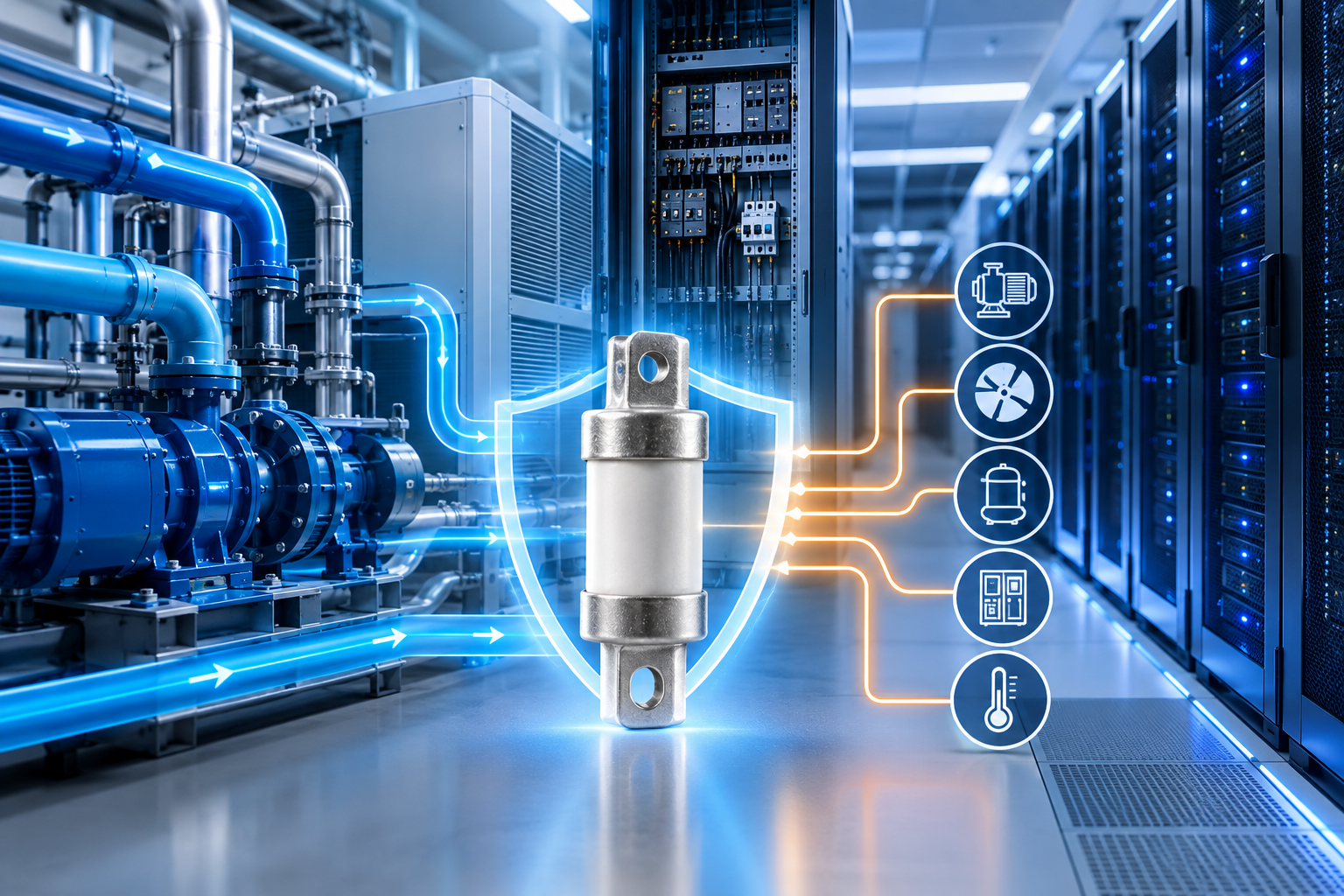
Eaton's Components for Liquid Cooling in Data Centre brochure, reference BR034019EN-US, highlights the importance of electrical components in the design of liquid cooling systems. Alongside pumps, motors, control devices and power distribution equipment, electrical protection plays a critical role in keeping cooling infrastructure safe and dependable.
Electrical fuses are particularly important because they help protect cooling equipment and electrical circuits against damaging overcurrents and short circuits. When correctly selected and coordinated with the wider electrical system, fuses can help limit equipment damage, support maintenance strategies and improve the resilience of data centre cooling infrastructure.
Why Liquid Cooling Is Becoming Essential in Data Centres
Traditional air cooling remains an important part of data centre thermal management. However, as processor performance increases and rack power density rises, removing heat efficiently becomes more challenging.
Liquid cooling transfers heat using a circulating fluid, allowing thermal energy to be captured closer to high-temperature components and transported to a heat exchanger or heat rejection system.
Common liquid cooling technologies include:
-
Direct-to-chip cooling: Cold plates transfer heat directly from processors, including CPUs and GPUs, to a circulating coolant.
-
Coolant distribution units (CDUs): These units circulate and regulate coolant through the cooling loop.
-
Rear-door heat exchangers: These systems remove heat from air leaving server racks.
-
Immersion cooling: Servers or selected electronic components are immersed in a dielectric fluid designed for cooling.
-
Chillers and heat rejection equipment: These systems remove heat from the cooling circuit and transfer it to the surrounding environment.
Each approach has specific electrical requirements. Pumps need reliable motor power, fans require suitable control and protection, and automated cooling equipment depends on electrical panels, sensors, controllers and switching devices.
This is where electrical components become fundamental to the overall performance of liquid cooling systems.
The Role of Electrical Fuses in Data Centre Liquid Cooling
Electrical fuses are essential circuit protection devices that interrupt excessive current when specified operating conditions are exceeded. A fuse contains a calibrated element designed to melt when sufficient current flows through it for a particular duration, disconnecting the affected circuit.
In data centre cooling applications, a correctly specified fuse can help protect electrical equipment from short circuits and other overcurrent conditions. Its effectiveness depends on the fuse's electrical rating, operating characteristics, prospective fault current and coordination with the rest of the installation.
1. Protecting Coolant Distribution Units
Coolant distribution units are central to many liquid cooling architectures. They circulate coolant through server cooling loops and may incorporate pumps, valves, sensors, controls and monitoring systems.
An electrical fault affecting a CDU pump motor or its associated power circuit can interrupt coolant circulation. Depending on the system design, this interruption may cause cooling performance to deteriorate and can eventually trigger server temperature alarms or protective shutdowns.
Fuses installed in appropriately designed CDU electrical circuits can help protect pump motors, power supplies and associated components against short-circuit currents and other specified overcurrent conditions.
By helping isolate electrical faults, properly selected fuses can limit the extent of damage and make it easier to identify and service an affected circuit.
2. Protecting Pumps, Fans and Motors
Liquid cooling infrastructure depends on reliable motor-driven equipment. Pumps circulate coolant, fans move air through heat exchangers and dry coolers, and compressors support chiller operation.
These components can experience electrical faults caused by insulation breakdown, wiring damage, component failure or other abnormal operating conditions.
Electrical fuses help protect the relevant circuits by interrupting excessive current within their specified operating characteristics. For motor-driven equipment, however, fuse selection must account for motor starting current, load characteristics and the protection required by the complete motor circuit.
A fuse should not be assumed to provide every type of motor protection. Overload protection, phase-loss protection and other functions may require additional devices, such as motor overload relays, electronic motor protection or variable frequency drive protection.
Combining correctly rated fuses with appropriate motor control and monitoring devices creates a more comprehensive protection strategy for data centre cooling equipment.
3. Limiting Short-Circuit Damage
Short circuits can produce extremely high fault currents in a very short period. Without suitable protection, these currents may damage conductors, electrical panels, power supplies, motors and other connected equipment.
Fuses are designed to interrupt fault currents within their rated breaking capacity and operating characteristics. Current-limiting fuse designs can also reduce the peak current and let-through energy reaching protected equipment under suitable fault conditions.
This is especially relevant in compact cooling control panels, where several electrical components may be installed close together and available fault currents can be significant.
Selecting fuses with the correct voltage rating, current rating and breaking capacity is therefore an important part of designing safe and reliable liquid cooling equipment.
4. Supporting Cooling System Availability
Data centre operators place a high priority on uptime because cooling failures can affect computing performance, equipment temperature and service continuity.
Electrical fuses contribute to availability by helping isolate electrical faults before they cause more extensive damage. Proper protection coordination can also help prevent a fault in one branch circuit from unnecessarily interrupting other parts of the installation.
For example, a well-engineered electrical design may use appropriately coordinated branch-circuit protection so that a fault affecting one auxiliary pump does not automatically disconnect unrelated cooling equipment.
The actual outcome depends on the protection architecture, redundancy, equipment design and fault conditions. Fuses cannot guarantee uninterrupted cooling, but they form an important part of a broader reliability strategy.
5. Protecting Control Electronics and Auxiliary Circuits
Modern liquid cooling equipment often includes programmable controllers, human-machine interfaces (HMIs), sensors, communications equipment and electronic power supplies.
These devices provide information about operating conditions and help regulate coolant flow, temperatures, pressures and equipment status.
Appropriately selected fuses can protect suitable control and auxiliary power circuits against overcurrent faults. Separate protection for individual branches may also help reduce the risk of one fault disabling multiple control functions.
Where continuity of control is critical, engineers should consider circuit separation, redundant power supplies, alarm functionality and the consequences of losing individual control components.
Choosing the Right Electrical Fuses for Liquid Cooling Equipment
Selecting electrical fuses for a data centre cooling system requires more than matching a fuse's current rating to the normal operating current.
Engineers and cooling equipment manufacturers should consider several important factors.
Rated voltage: The fuse must be suitable for the AC or DC circuit in which it is installed.
Rated current: The selected rating must account for the normal load, conductor protection requirements, ambient conditions and applicable installation standards.
Breaking capacity: The fuse must be capable of safely interrupting the maximum prospective short-circuit current available at its installation point.
Time-current characteristics: The fuse must operate appropriately for the anticipated fault conditions while tolerating permissible transient currents, including motor starting where applicable.
Current-limiting performance: Where relevant, engineers should evaluate peak let-through current and let-through energy to help protect downstream equipment.
Coordination with other protective devices: Fuse characteristics should be assessed alongside circuit breakers, contactors, motor protection devices and upstream protection to support selective fault isolation where practicable.
Environmental conditions: Electrical panels used in cooling plants or data centre equipment may experience elevated ambient temperatures, vibration, restricted airflow or other conditions that influence component selection and installation.
Applicable standards: Fuse selection and equipment design must comply with the relevant electrical installation requirements, product standards and regional regulations.
These considerations help ensure that electrical fuses provide effective protection without unnecessary operation during normal equipment use.
How Fuses Work Alongside Other Electrical Components
Electrical fuses are most effective when integrated into a coordinated electrical protection and control system. In liquid cooling equipment, each component has a distinct function.
| Electrical component | Role in liquid cooling systems |
|---|---|
| Electrical fuses | Interrupt specified overcurrent and short-circuit faults. |
| Circuit breakers | Provide circuit interruption and, depending on type, resettable overcurrent protection. |
| Contactors | Switch motors and other electrical loads during normal operation. |
| Motor protection devices | Help protect motors against overloads and other specified operating faults. |
| Variable frequency drives (VFDs) | Control motor speed to help match pump and fan output to cooling demand. |
| Sensors and controllers | Monitor operating conditions and regulate cooling equipment. |
| Disconnect switches | Provide a means of isolating equipment for maintenance when correctly applied. |
The distinction between these components matters. A contactor is not a substitute for short-circuit protection, and a fuse does not replace every required motor protection or control function.
For example, a variable frequency drive controlling a coolant pump may require upstream fuse protection selected according to the drive manufacturer's instructions, the available fault current and the applicable installation requirements.
Similarly, a control panel containing several power supplies, pumps and auxiliary loads may benefit from a carefully engineered protection arrangement that balances equipment protection, maintainability and fault isolation.
Eaton Components for Liquid Cooling in Data Centres
Eaton provides electrical technologies for cooling equipment manufacturers and industrial applications, including circuit protection, switching, motor control, power distribution and monitoring solutions.
For engineers developing liquid cooling equipment, the value of a component portfolio lies in how individual products work together within the complete machine.
Circuit protection and switching
Fuses, circuit breakers, disconnects and switches help establish the electrical protection and isolation architecture for cooling equipment.
Their selection should reflect the application, available fault current, load characteristics, panel design and relevant safety requirements. In particular, engineers should verify that the chosen fuse is suitable for the specific circuit rather than selecting solely on the basis of nominal current.
Motor control and power management
Pumps, fans and compressors are significant electrical loads in many cooling systems. Motor starters, contactors, soft starters and variable frequency drives can support appropriate starting, switching and speed control.
When coordinated with suitable circuit protection, these technologies help equipment designers build electrical systems that respond to changing cooling demand while protecting critical components.
Monitoring and control
Liquid cooling systems increasingly depend on sensors, controllers, HMIs and communications technologies to monitor operating conditions and support efficient operation.
Electrical protection remains important for these control circuits because faults affecting monitoring or control can compromise the ability to regulate equipment or detect abnormal conditions.
Integrated engineering and panel design
A well-designed cooling machine requires more than a collection of individual components. Engineers must consider wiring, enclosure design, thermal management, protection coordination, accessibility and service requirements.
Integrating these considerations early in the design process can help manufacturers develop repeatable cooling equipment platforms and simplify commissioning and maintenance.
Electrical Fuses and Redundancy in Mission-Critical Data Centres
Redundancy is a key design consideration for data centres that require high availability. Cooling architectures may incorporate multiple pumps, redundant power supplies, backup cooling capacity or separate cooling circuits.
However, redundancy only delivers its intended benefit when the electrical design supports it.
Consider a cooling system with two pumps designed to provide redundancy. If both pumps depend on a common electrical supply or a shared protective device that can disconnect both circuits following a single fault, the intended resilience may be reduced.
A carefully engineered design considers:
-
Independent or appropriately segregated power feeds where required.
-
Correctly selected fuses for individual branches and critical loads.
-
Coordination between upstream and downstream protective devices.
-
Monitoring and alarms for electrical faults and cooling interruptions.
-
Safe maintenance and isolation procedures.
-
Verification of redundancy under realistic fault scenarios.
Fuse selection alone does not establish redundancy. The complete electrical and mechanical architecture must be assessed to understand common failure points and confirm that the required level of availability can be achieved.
Improving Energy Efficiency Without Compromising Electrical Protection
Energy efficiency is an important consideration in data centre design because cooling systems consume power in addition to the electricity required by IT equipment.
Liquid cooling can improve heat transfer in suitable applications, particularly where high-power processors generate concentrated thermal loads. Its overall efficiency, however, depends on the entire system, including pumps, fans, compressors, heat exchangers, controls and facility-side heat rejection.
Variable frequency drives can help reduce unnecessary motor energy consumption when flow or airflow requirements vary. Intelligent controls can adjust operation according to cooling demand, while monitoring systems can help identify abnormal operating conditions.
Electrical fuses contribute differently: their primary purpose is circuit protection, not energy saving. Correctly specified fuses support the safe operation of the electrical architecture that enables efficient cooling equipment to function.
Engineers should therefore evaluate energy efficiency and electrical protection as complementary design requirements rather than assuming that one automatically delivers the other.
Common Mistakes When Selecting Fuses for Data Centre Cooling
Avoiding common selection errors helps improve equipment safety and reliability.
Choosing a fuse based only on nominal current. A suitable selection must also consider voltage, breaking capacity, fault levels, time-current characteristics and the requirements of the protected equipment.
Ignoring motor starting currents. Pumps and compressors can draw transient currents during startup. Fuse characteristics must accommodate permissible starting conditions while maintaining effective fault protection.
Overlooking manufacturer requirements. Drives, power supplies and other electronic equipment may specify particular fuse types or protection arrangements. These requirements should be checked before finalising the design.
Assuming a fuse replaces motor overload protection. A fuse may provide short-circuit protection without providing all the overload protection required for a motor installation.
Failing to assess protection coordination. Poor coordination can result in unnecessary disconnection of upstream circuits and wider disruption following a local fault.
Neglecting inspection and replacement requirements. Fuses should be checked and replaced according to the equipment manufacturer's instructions and applicable maintenance procedures. Replacements must have the correct characteristics and ratings.
Avoiding these mistakes requires collaboration between electrical engineers, cooling equipment manufacturers, panel builders and facility operators.
The Future of Liquid Cooling and Electrical Protection
As AI infrastructure and high-performance computing continue to evolve, cooling systems must accommodate increasing power density, more complex control requirements and changing facility architectures.
Direct-to-chip cooling, advanced coolant distribution units and hybrid thermal management approaches are becoming important options for managing demanding workloads. These developments increase the need for coordinated mechanical, electrical and control engineering.
Electrical fuses will continue to serve an essential role in protecting power circuits within pumps, fans, compressors, control panels and auxiliary equipment. Their value is greatest when they are selected as part of a complete protection strategy that accounts for fault currents, operating conditions, equipment requirements and system availability.
For cooling equipment manufacturers, standardised electrical designs and early component selection can also help simplify production, commissioning and servicing as product portfolios expand.
Eaton's electrical component technologies provide options for OEMs designing and manufacturing cooling equipment, while application-specific engineering remains essential to ensure that individual components are suitable for their intended use.
Conclusion: Electrical Fuses Are a Small Component with a Critical Role
Liquid cooling is helping data centres manage the growing thermal demands of AI, cloud computing and high-performance computing. Coolant distribution units, pumps, compressors, fans and control systems all contribute to maintaining the operating conditions required by modern IT infrastructure.
Yet these mechanical and thermal technologies depend on a reliable electrical foundation.
Electrical fuses are a critical part of that foundation. By interrupting specified overcurrent and short-circuit faults, correctly selected fuses help protect cooling equipment, limit electrical damage and support a coordinated approach to system reliability.
For engineers and OEMs, the priority should be to integrate fuse selection with motor control, circuit protection, monitoring, power distribution and redundancy planning from the earliest stages of equipment design.
Eaton's Components for Liquid Cooling in Data Centre brochure, BR034019EN-US, is a relevant reference for understanding the electrical component considerations involved in liquid cooling equipment design. A holistic approach to component selection can help manufacturers develop cooling systems that are safe, serviceable, efficient and prepared for the evolving requirements of modern data centres.
Frequently Asked Questions
Why are electrical fuses important in data centres?
Electrical fuses help protect circuits and connected equipment against specified overcurrent and short-circuit faults. In data centre cooling systems, they can help protect pumps, fans, compressors, power supplies and other electrical components, supporting the wider reliability strategy.
Where are fuses used in liquid cooling systems?
Depending on the design, fuses may be used in power distribution panels, coolant distribution units, pump and fan circuits, compressor circuits, variable frequency drive installations and auxiliary control power circuits.
Do electrical fuses prevent data centre downtime?
Fuses cannot guarantee uninterrupted operation. However, appropriate fuse selection and coordination can help limit fault damage and support selective isolation. Overall availability also depends on redundancy, equipment reliability, monitoring, maintenance and system design.
What is the difference between a fuse and a circuit breaker?
Both can provide overcurrent protection when correctly specified. A fuse interrupts a fault by melting its internal element and normally requires replacement after operation. A circuit breaker opens its contacts and may be reset after the fault is cleared and the equipment is confirmed safe, depending on its design.
How should engineers select fuses for cooling equipment?
Engineers should consider rated current and voltage, prospective short-circuit current, breaking capacity, time-current characteristics, motor starting conditions, equipment manufacturer requirements, coordination with other protective devices and applicable standards.
What does Eaton's BR034019EN-US brochure cover?
The brochure concerns components for liquid cooling in data centres. It is relevant to engineers and cooling equipment manufacturers evaluating the electrical technologies used in liquid cooling applications, including circuit protection, switching, motor control and related equipment. Specific product selection should be verified against current technical documentation.



