
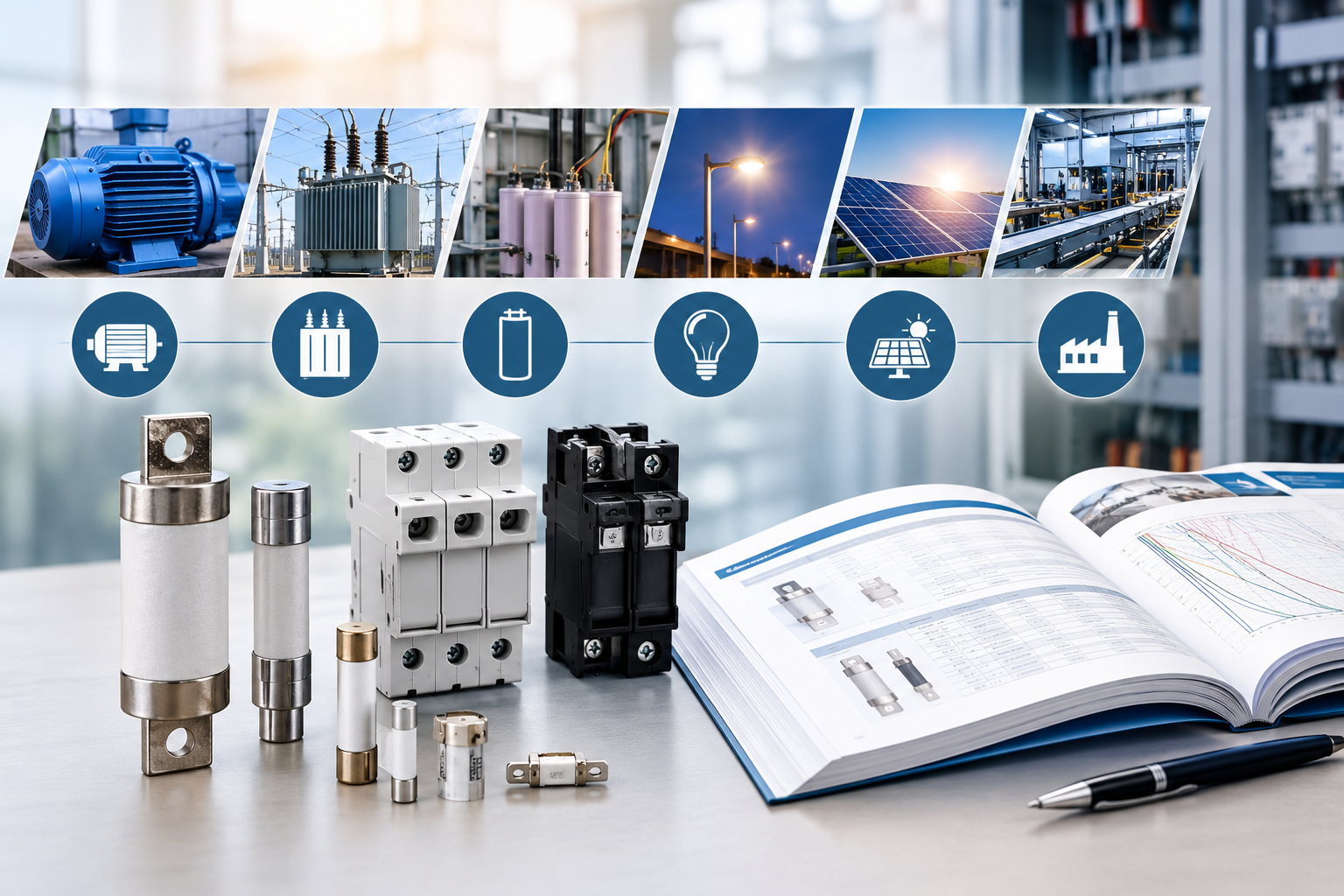
 bus-ele-cat-1007-flc-2018-intro.pdf bus-ele-cat-1007-flc-2018-intro.pdf | [Bussmann series Full line catalog: Selecting fused circuit protection - Introduction] | 2421 kB |
Eaton Bussmann Series Full Line Catalog: A Guide to Selecting Fused Circuit Protection
Introduction
Selecting the right fuse is a critical step in designing a safe, reliable, and efficient electrical system. Whether you are protecting industrial machinery, motor circuits, transformers, lighting systems, electronic equipment, or renewable energy installations, choosing the appropriate fuse helps manage overcurrent conditions and reduce the risk of equipment damage.
The Eaton Bussmann Series Full Line Catalog 1007 provides technical information and application-based recommendations to help electrical engineers, panel builders, maintenance professionals, and system designers select suitable fused circuit protection. Its introduction, Selecting Fused Circuit Protection, outlines fuse recommendations for various electrical applications and provides guidance on fuse sizing, voltage ratings, and compatible fuse holders.
By understanding the fundamentals of fuse selection and using the catalog as a technical reference, professionals can make better-informed decisions about electrical protection, system reliability, and compliance with applicable standards.
What Is Fused Circuit Protection?
Fused circuit protection uses an electrical fuse to interrupt current when an overcurrent condition exceeds the fuse's operating characteristics. A properly selected fuse helps protect conductors, electrical equipment, and other circuit components against the damaging effects of excessive current.
Fuses are available in different current ratings, voltage ratings, classes, time-current characteristics, and physical configurations. Each type is designed for specific applications and operating conditions.
Selecting a fuse involves more than matching its ampere rating to the normal operating current. Engineers must also consider the circuit voltage, prospective short-circuit current, load characteristics, inrush current, conductor ampacity, and applicable electrical codes.
The Eaton Bussmann Series catalog helps simplify this process by organizing fuse recommendations according to common electrical applications.
Understanding the Eaton Bussmann Series Full Line Catalog 1007
The Eaton Bussmann Series Full Line Catalog 1007 is a technical reference covering a broad range of circuit protection products and related electrical components. The October 2018 edition includes an introduction to fuse selection and dedicated sections for different fuse technologies, voltage levels, and installation requirements.
The catalog covers the following product categories:
-
Low-voltage branch circuit fuses
-
Supplemental fuses and cable limiters
-
Electronic, printed circuit board (PCB), and small-dimension fuses
-
High-speed fuses
-
IEC and British Standard fuses
-
Photovoltaic fuses, holders, and fuse blocks
-
Medium-voltage fuses
-
Fuse blocks and holders
-
Power distribution and terminal blocks
-
Disconnect switches and accessories
-
Surge protective devices and telecommunications protection products
The catalog also includes reference material on fuse sizing for 600 V building electrical systems, selective coordination, low-voltage fuse types and classes, electrical formulas, terminology, and product cross-referencing.
This structured approach allows users to identify relevant product families and find technical information for a wide range of electrical protection requirements.
How to Select the Right Fuse for an Electrical Application
Choosing the right fuse requires a systematic evaluation of the electrical circuit and the equipment being protected. The catalog's application tables provide a useful starting point, but the final selection should always be based on the actual system design and applicable regulations.
1. Identify the Application
Start by determining the type of equipment or circuit that requires protection. Common applications include:
-
Electric motors and motor control circuits
-
Transformers and control transformers
-
Capacitor banks
-
Electric heating equipment
-
Lighting ballasts
-
Solenoids and control coils
-
Main, feeder, and branch circuits
-
Photovoltaic systems and electronic equipment
Different applications have different electrical characteristics. A motor, for example, may draw a substantial starting current, while a transformer can experience magnetizing inrush when energized. A fuse must accommodate normal operating conditions while providing the required protection against fault currents.
The Eaton Bussmann Series catalog organizes recommendations by application to help users narrow down the appropriate fuse options.
2. Determine the Required Current Rating
The fuse's current rating is one of the most important selection parameters. It must be suitable for the load, conductors, and protective requirements of the circuit.
When calculating the required fuse rating, consider:
-
The equipment's rated current
-
Continuous and non-continuous loads
-
Motor full-load current
-
Starting and inrush current
-
Conductor ampacity
-
Applicable code requirements
-
The type of overcurrent protection required
The correct sizing method varies by application. Motor circuits, transformer circuits, capacitor installations, and general feeder circuits should not automatically use the same sizing approach.
The catalog provides application-specific sizing recommendations based on the 2017 National Electrical Code (NEC). Because this is a 2018 publication, its guidance should be checked against the current edition of the applicable code and any relevant local requirements before use.
3. Verify the Voltage Rating
A fuse must have a voltage rating appropriate for the circuit in which it is installed. The voltage rating is important because the fuse must be capable of safely interrupting the fault current under the circuit's operating conditions.
When evaluating a fuse, verify:
-
The circuit's nominal voltage
-
The fuse's rated voltage
-
The AC or DC application, as applicable
-
The system's grounding and configuration requirements
-
The fuse's specified interrupting capability
Never assume that a fuse suitable for one voltage level is automatically suitable for another. The manufacturer's technical documentation should be reviewed to confirm suitability for the intended application.
4. Evaluate Time-Delay and Non-Time-Delay Characteristics
Fuse time-current characteristics determine how quickly a fuse responds to an overcurrent condition.
Time-delay fuses are designed to tolerate certain temporary current surges without opening immediately. Depending on the fuse type and application, this can make them suitable for circuits with motor-starting currents, transformer inrush, or other predictable transient loads.
Non-time-delay fuses generally respond more quickly to overcurrent conditions and may be appropriate where rapid interruption is required and the load characteristics permit their use.
The selection should be based on the equipment's operating profile, the type of fault protection required, and the coordination of the overall protection system. A time-delay fuse is not automatically the best choice for every motor circuit, nor is a faster-acting fuse necessarily appropriate for every sensitive load.
5. Check the Fuse Class and Interrupting Rating
Fuse classes help identify products with particular construction, performance, and application characteristics. The required class depends on the circuit, equipment, applicable standards, and installation conditions.
The interrupting rating is also essential. It indicates the maximum fault current a fuse is rated to interrupt safely at its specified voltage under the relevant test conditions.
Before selecting a fuse, verify that its interrupting rating is adequate for the available short-circuit current at the installation point. A fuse with an appropriate current rating may still be unsuitable if its interrupting rating is insufficient.
6. Confirm Compatibility With Fuse Holders and Equipment
Selecting a fuse also involves checking the associated mounting and connection components. Fuse holders, fuse blocks, and disconnecting devices must be compatible with the selected fuse and the circuit's electrical ratings.
Consider the following factors:
-
Fuse dimensions and mounting configuration
-
Fuse holder or fuse block compatibility
-
Rated voltage and current
-
Terminal and conductor requirements
-
Available installation space
-
Environmental and operating conditions
-
Applicable product and installation standards
The Eaton Bussmann Series catalog includes separate sections for fuse blocks, holders, disconnect switches, and related products, helping users consider the protection device and its supporting components together.
Fuse Selection for Common Electrical Applications
The catalog's introduction includes application-based recommendations for several common types of electrical loads. These examples illustrate why fuse selection should be tailored to the circuit rather than based on a single universal rule.
Motor Circuits
Electric motors can draw high starting currents before reaching normal operating speed. Fuse selection must account for motor full-load current, starting characteristics, the role of the motor controller, and the required short-circuit protection.
The catalog discusses time-delay and non-time-delay fuse applications and distinguishes between short-circuit protection and overload protection. These functions may be provided by different components within a motor control system.
The selected fuse must coordinate with the motor starter, overload relay, and other protective devices to support safe and reliable operation.
Transformer Protection
Transformers can experience inrush current when energized, making their protection requirements different from those of many other loads.
Fuse selection depends on factors such as transformer rated current, primary and secondary protection arrangements, impedance, and applicable electrical code requirements.
The catalog provides recommendations for transformers rated at 600 V nominal or less. These tables can support preliminary selection, but the actual transformer configuration and protection scheme must be assessed before a final decision is made.
Capacitor Protection
Capacitor circuits may experience current conditions associated with energization and system operation. The appropriate fuse selection depends on the capacitor's full-load current, fuse characteristics, voltage rating, and the intended protection arrangement.
The catalog provides separate sizing guidance for time-delay and non-time-delay fuses, illustrating the importance of matching the fuse's operating characteristics to the application.
Lighting Ballasts
Lighting systems can require different fuse recommendations depending on the ballast type and installation environment. The catalog distinguishes between indoor and outdoor applications and identifies cases where the fixture manufacturer's specified fuse size and type should be consulted.
This is an important reminder that application-specific manufacturer requirements should be considered alongside general catalog recommendations.
Feeders and Branch Circuits
Main circuits, feeders, and branch circuits supply power to equipment and downstream loads. Their protection requirements depend on load composition, continuous operating current, motor loads, and the available fault current.
The catalog provides sizing guidance for feeder circuits with non-motor loads, combinations of motor and non-motor loads, and motor-only loads. These distinctions help engineers account for the different operating characteristics of each circuit.
For every installation, the final design must satisfy the applicable electrical code, conductor protection requirements, and coordination objectives.
Why Proper Fuse Selection Matters
Correct fuse selection contributes to the safety and performance of electrical installations in several ways.
Equipment protection: A suitable fuse can interrupt excessive current before it causes unacceptable damage to protected components, provided the fuse is correctly applied and the fault conditions fall within its ratings.
System reliability: Matching fuse characteristics to normal load conditions helps reduce unnecessary interruptions caused by predictable starting or inrush currents.
Electrical safety: Appropriate current ratings, voltage ratings, and interrupting capabilities help ensure the protection device is suitable for the circuit's operating and fault conditions.
Selective coordination: Coordinating upstream and downstream protective devices can help isolate a fault to the affected part of an electrical system, where the design and available fault conditions permit.
Simplified maintenance and inventory: Standardizing suitable fuse types across compatible applications can make replacement and maintenance easier. However, substitutions should only be made after verifying that the replacement meets all relevant electrical and application requirements.
Using the Catalog for Efficient Fuse Selection
The Eaton Bussmann Series Full Line Catalog is most useful when treated as a structured engineering reference rather than a simple product list.
A practical selection process includes the following steps:
-
Identify the load and circuit type.
-
Determine the nominal voltage and expected operating current.
-
Establish the applicable fuse-sizing rules.
-
Evaluate starting current, inrush current, and other load characteristics.
-
Confirm the fuse class, time-current characteristics, and interrupting rating.
-
Check compatibility with the fuse holder, block, disconnect switch, and associated equipment.
-
Review the relevant catalog recommendations and product-specific technical data.
-
Verify compliance with current codes, standards, and installation requirements.
-
Have the final selection reviewed by qualified electrical personnel.
The catalog's index and cross-reference material can help users locate product families and relevant technical sections. Where necessary, detailed product datasheets should be consulted to confirm specifications and application limitations.
Important Considerations Before Finalizing a Fuse Selection
Although catalog tables are valuable, they should not replace an engineering assessment of the complete electrical system.
The introduction to the 2018 Eaton Bussmann Series Full Line Catalog states that its recommendations are suggestions and that final fuse selection should be performed by qualified personnel who can fully assess the application's circuit protection requirements.
Users should also be aware that product designs, availability, technical specifications, and regulatory requirements can change. The 2018 edition refers to the 2017 NEC, so it should not be assumed to reflect every current requirement.
Before installation, confirm the latest manufacturer specifications, applicable electrical codes, system fault-current levels, conductor ratings, and coordination requirements. Where the application is complex or the appropriate fuse is uncertain, seek assistance from the manufacturer's application engineering team or another qualified electrical protection specialist.
Conclusion
Selecting the right fuse is essential for effective overcurrent protection, electrical safety, and reliable system performance. The Eaton Bussmann Series Full Line Catalog 1007 provides a broad technical reference for choosing fused circuit protection across applications such as motors, transformers, capacitors, lighting systems, feeders, and branch circuits.
By evaluating current and voltage ratings, fuse characteristics, interrupting capacity, compatibility, and application-specific requirements, electrical professionals can make more informed protection decisions.
The most effective approach combines catalog recommendations with current product datasheets, applicable electrical codes, and a thorough assessment by qualified personnel. This ensures that fuse selection supports the needs of the actual installation rather than relying on a generic recommendation.
Frequently Asked Questions
What is the Eaton Bussmann Series Full Line Catalog?
It is a technical catalog covering Eaton Bussmann Series fuses, fuse holders, circuit protection accessories, and related electrical products. The 2018 edition includes application-based fuse selection guidance and technical reference sections.
How do I choose the correct Bussmann fuse?
Identify the application, determine the required current and voltage ratings, evaluate inrush current and time-current characteristics, verify the interrupting rating, and check compatibility with the equipment and applicable codes. Use the relevant product datasheet and consult qualified personnel before finalizing the selection.
What is the difference between time-delay and non-time-delay fuses?
Time-delay fuses can tolerate certain temporary current surges for a specified period, while non-time-delay fuses generally respond more quickly to overcurrent conditions. The appropriate choice depends on the load, fault protection requirements, and coordination with other protective devices.
Does the 2018 catalog reflect current electrical code requirements?
The catalog's introductory fuse selection tables are based on the 2017 NEC. Users should verify all recommendations against the current applicable code edition, local requirements, and the latest manufacturer documentation.
Why is the fuse interrupting rating important?
The interrupting rating indicates the maximum fault current a fuse is rated to interrupt safely at its specified voltage. The rating must be adequate for the available short-circuit current at the installation point.
Can I replace an existing fuse with one that has the same ampere rating?
Not necessarily. A replacement must also meet the required voltage rating, fuse class, interrupting rating, time-current characteristics, physical compatibility, and application requirements. Always verify the full specification before replacing a fuse.



