
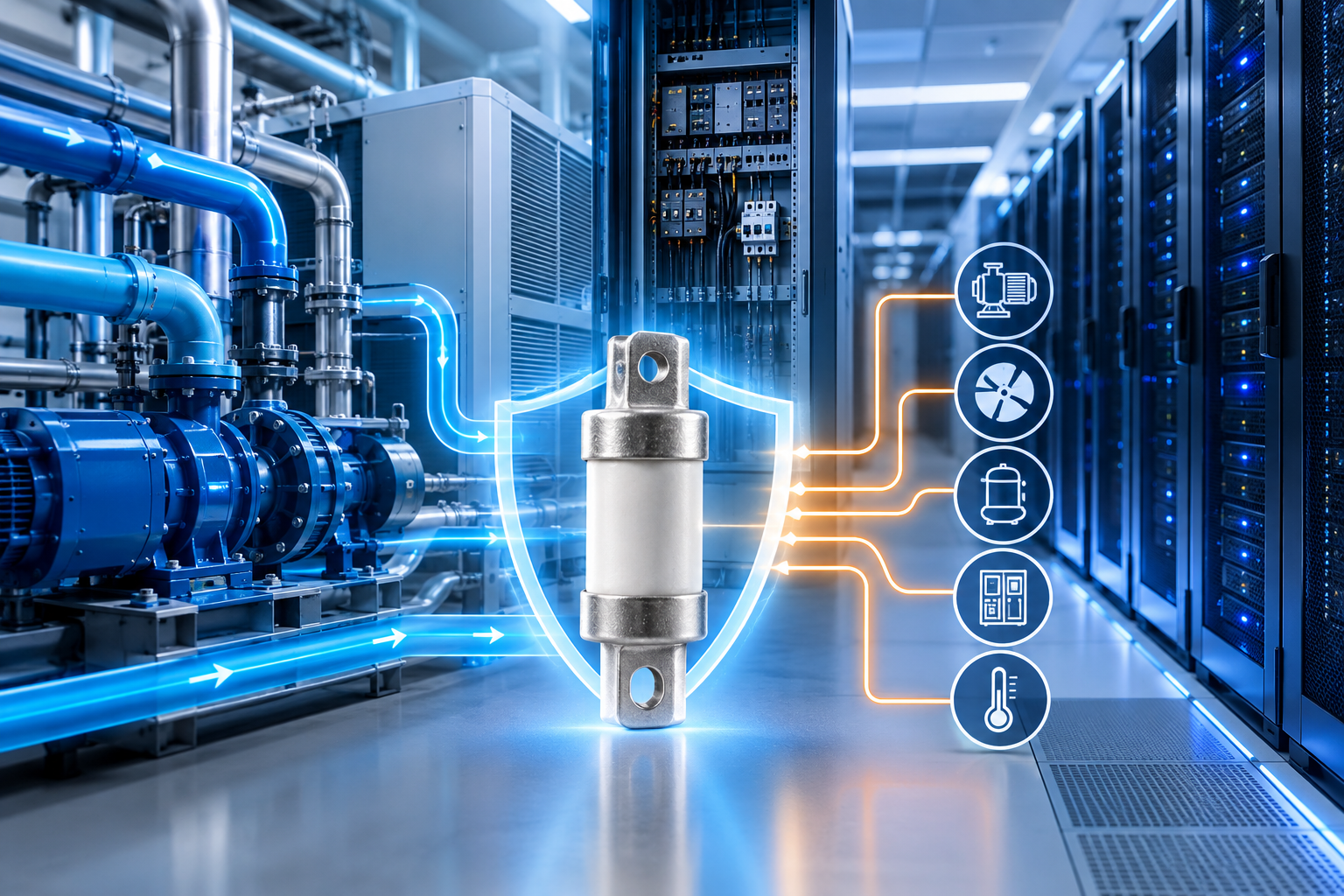
 eaton-components-liquid-cooling-in-data-centre-brochure-br034019en-us.pdf
Eaton Components for Liquid Cooling in Data Centres: Why Electrical Fuses Are Essential for Reliable Cooling
Introduction
The rapid growth of artificial intelligence (AI), cloud computing, high-performance computing (HPC) and digital services is transforming modern data centres. As computing workloads become more demanding, server racks generate more heat, creating new challenges for thermal management, energy efficiency and operational reliability. Liquid cooling is emerging as an important technology for managing these increasing heat loads while supporting high-density computing environments.
Eaton's Components for Liquid Cooling in Data Centre brochure, reference BR034019EN-US, highlights the importance of electrical components in the design of liquid cooling systems. Alongside pumps, motors, control devices and power distribution equipment, electrical protection plays a critical role in keeping cooling infrastructure safe and dependable.
Electrical fuses are particularly important because they help protect cooling equipment and electrical circuits against damaging overcurrents and short circuits. When correctly selected and coordinated with the wider electrical system, fuses can help limit equipment damage, support maintenance strategies and improve the resilience of data centre cooling infrastructure.
Why Liquid Cooling Is Becoming Essential in Data Centres
Traditional air cooling remains an important part of data centre thermal management. However, as processor performance increases and rack power density rises, removing heat efficiently becomes more challenging.
Liquid cooling transfers heat using a circulating fluid, allowing thermal energy to be captured closer to high-temperature components and transported to a heat exchanger or heat rejection system.
Common liquid cooling technologies include:
-
Direct-to-chip cooling: Cold plates transfer heat directly from processors, including CPUs and GPUs, to a circulating coolant.
-
Coolant distribution units (CDUs): These units circulate and regulate coolant through the cooling loop.
-
Rear-door heat exchangers: These systems remove heat from air leaving server racks.
-
Immersion cooling: Servers or selected electronic components are immersed in a dielectric fluid designed for cooling.
-
Chillers and heat rejection equipment: These systems remove heat from the cooling circuit and transfer it to the surrounding environment.
Each approach has specific electrical requirements. Pumps need reliable motor power, fans require suitable control and protection, and automated cooling equipment depends on electrical panels, sensors, controllers and switching devices.
This is where electrical components become fundamental to the overall performance of liquid cooling systems.
The Role of Electrical Fuses in Data Centre Liquid Cooling
Electrical fuses are essential circuit protection devices that interrupt excessive current when specified operating conditions are exceeded. A fuse contains a calibrated element designed to melt when sufficient current flows through it for a particular duration, disconnecting the affected circuit.
In data centre cooling applications, a correctly specified fuse can help protect electrical equipment from short circuits and other overcurrent conditions. Its effectiveness depends on the fuse's electrical rating, operating characteristics, prospective fault current and coordination with the rest of the installation.
1. Protecting Coolant Distribution Units
Coolant distribution units are central to many liquid cooling architectures. They circulate coolant through server cooling loops and may incorporate pumps, valves, sensors, controls and monitoring systems.
An electrical fault affecting a CDU pump motor or its associated power circuit can interrupt coolant circulation. Depending on the system design, this interruption may cause cooling performance to deteriorate and can eventually trigger server temperature alarms or protective shutdowns.
Fuses installed in appropriately designed CDU electrical circuits can help protect pump motors, power supplies and associated components against short-circuit currents and other specified overcurrent conditions.
By helping isolate electrical faults, properly selected fuses can limit the extent of damage and make it easier to identify and service an affected circuit.
2. Protecting Pumps, Fans and Motors
Liquid cooling infrastructure depends on reliable motor-driven equipment. Pumps circulate coolant, fans move air through heat exchangers and dry coolers, and compressors support chiller operation.
These components can experience electrical faults caused by insulation breakdown, wiring damage, component failure or other abnormal operating conditions.
Electrical fuses help protect the relevant circuits by interrupting excessive current within their specified operating characteristics. For motor-driven equipment, however, fuse selection must account for motor starting current, load characteristics and the protection required by the complete motor circuit.
A fuse should not be assumed to provide every type of motor protection. Overload protection, phase-loss protection and other functions may require additional devices, such as motor overload relays, electronic motor protection or variable frequency drive protection.
Combining correctly rated fuses with appropriate motor control and monitoring devices creates a more comprehensive protection strategy for data centre cooling equipment.
3. Limiting Short-Circuit Damage
Short circuits can produce extremely high fault currents in a very short period. Without suitable protection, these currents may damage conductors, electrical panels, power supplies, motors and other connected equipment.
Fuses are designed to interrupt fault currents within their rated breaking capacity and operating characteristics. Current-limiting fuse designs can also reduce the peak current and let-through energy reaching protected equipment under suitable fault conditions.
This is especially relevant in compact cooling control panels, where several electrical components may be installed close together and available fault currents can be significant.
Selecting fuses with the correct voltage rating, current rating and breaking capacity is therefore an important part of designing safe and reliable liquid cooling equipment.
4. Supporting Cooling System Availability
Data centre operators place a high priority on uptime because cooling failures can affect computing performance, equipment temperature and service continuity.
Electrical fuses contribute to availability by helping isolate electrical faults before they cause more extensive damage. Proper protection coordination can also help prevent a fault in one branch circuit from unnecessarily interrupting other parts of the installation.
For example, a well-engineered electrical design may use appropriately coordinated branch-circuit protection so that a fault affecting one auxiliary pump does not automatically disconnect unrelated cooling equipment.
The actual outcome depends on the protection architecture, redundancy, equipment design and fault conditions. Fuses cannot guarantee uninterrupted cooling, but they form an important part of a broader reliability strategy.
5. Protecting Control Electronics and Auxiliary Circuits
Modern liquid cooling equipment often includes programmable controllers, human-machine interfaces (HMIs), sensors, communications equipment and electronic power supplies.
These devices provide information about operating conditions and help regulate coolant flow, temperatures, pressures and equipment status.
Appropriately selected fuses can protect suitable control and auxiliary power circuits against overcurrent faults. Separate protection for individual branches may also help reduce the risk of one fault disabling multiple control functions.
Where continuity of control is critical, engineers should consider circuit separation, redundant power supplies, alarm functionality and the consequences of losing individual control components.
Choosing the Right Electrical Fuses for Liquid Cooling Equipment
Selecting electrical fuses for a data centre cooling system requires more than matching a fuse's current rating to the normal operating current.
Engineers and cooling equipment manufacturers should consider several important factors.
Rated voltage: The fuse must be suitable for the AC or DC circuit in which it is installed.
Rated current: The selected rating must account for the normal load, conductor protection requirements, ambient conditions and applicable installation standards.
Breaking capacity: The fuse must be capable of safely interrupting the maximum prospective short-circuit current available at its installation point.
Time-current characteristics: The fuse must operate appropriately for the anticipated fault conditions while tolerating permissible transient currents, including motor starting where applicable.
Current-limiting performance: Where relevant, engineers should evaluate peak let-through current and let-through energy to help protect downstream equipment.
Coordination with other protective devices: Fuse characteristics should be assessed alongside circuit breakers, contactors, motor protection devices and upstream protection to support selective fault isolation where practicable.
Environmental conditions: Electrical panels used in cooling plants or data centre equipment may experience elevated ambient temperatures, vibration, restricted airflow or other conditions that influence component selection and installation.
Applicable standards: Fuse selection and equipment design must comply with the relevant electrical installation requirements, product standards and regional regulations.
These considerations help ensure that electrical fuses provide effective protection without unnecessary operation during normal equipment use.
How Fuses Work Alongside Other Electrical Components
Electrical fuses are most effective when integrated into a coordinated electrical protection and control system. In liquid cooling equipment, each component has a distinct function.
| Electrical component | Role in liquid cooling systems |
|---|---|
| Electrical fuses | Interrupt specified overcurrent and short-circuit faults. |
| Circuit breakers | Provide circuit interruption and, depending on type, resettable overcurrent protection. |
| Contactors | Switch motors and other electrical loads during normal operation. |
| Motor protection devices | Help protect motors against overloads and other specified operating faults. |
| Variable frequency drives (VFDs) | Control motor speed to help match pump and fan output to cooling demand. |
| Sensors and controllers | Monitor operating conditions and regulate cooling equipment. |
| Disconnect switches | Provide a means of isolating equipment for maintenance when correctly applied. |
The distinction between these components matters. A contactor is not a substitute for short-circuit protection, and a fuse does not replace every required motor protection or control function.
For example, a variable frequency drive controlling a coolant pump may require upstream fuse protection selected according to the drive manufacturer's instructions, the available fault current and the applicable installation requirements.
Similarly, a control panel containing several power supplies, pumps and auxiliary loads may benefit from a carefully engineered protection arrangement that balances equipment protection, maintainability and fault isolation.
Eaton Components for Liquid Cooling in Data Centres
Eaton provides electrical technologies for cooling equipment manufacturers and industrial applications, including circuit protection, switching, motor control, power distribution and monitoring solutions.
For engineers developing liquid cooling equipment, the value of a component portfolio lies in how individual products work together within the complete machine.
Circuit protection and switching
Fuses, circuit breakers, disconnects and switches help establish the electrical protection and isolation architecture for cooling equipment.
Their selection should reflect the application, available fault current, load characteristics, panel design and relevant safety requirements. In particular, engineers should verify that the chosen fuse is suitable for the specific circuit rather than selecting solely on the basis of nominal current.
Motor control and power management
Pumps, fans and compressors are significant electrical loads in many cooling systems. Motor starters, contactors, soft starters and variable frequency drives can support appropriate starting, switching and speed control.
When coordinated with suitable circuit protection, these technologies help equipment designers build electrical systems that respond to changing cooling demand while protecting critical components.
Monitoring and control
Liquid cooling systems increasingly depend on sensors, controllers, HMIs and communications technologies to monitor operating conditions and support efficient operation.
Electrical protection remains important for these control circuits because faults affecting monitoring or control can compromise the ability to regulate equipment or detect abnormal conditions.
Integrated engineering and panel design
A well-designed cooling machine requires more than a collection of individual components. Engineers must consider wiring, enclosure design, thermal management, protection coordination, accessibility and service requirements.
Integrating these considerations early in the design process can help manufacturers develop repeatable cooling equipment platforms and simplify commissioning and maintenance.
Electrical Fuses and Redundancy in Mission-Critical Data Centres
Redundancy is a key design consideration for data centres that require high availability. Cooling architectures may incorporate multiple pumps, redundant power supplies, backup cooling capacity or separate cooling circuits.
However, redundancy only delivers its intended benefit when the electrical design supports it.
Consider a cooling system with two pumps designed to provide redundancy. If both pumps depend on a common electrical supply or a shared protective device that can disconnect both circuits following a single fault, the intended resilience may be reduced.
A carefully engineered design considers:
-
Independent or appropriately segregated power feeds where required.
-
Correctly selected fuses for individual branches and critical loads.
-
Coordination between upstream and downstream protective devices.
-
Monitoring and alarms for electrical faults and cooling interruptions.
-
Safe maintenance and isolation procedures.
-
Verification of redundancy under realistic fault scenarios.
Fuse selection alone does not establish redundancy. The complete electrical and mechanical architecture must be assessed to understand common failure points and confirm that the required level of availability can be achieved.
Improving Energy Efficiency Without Compromising Electrical Protection
Energy efficiency is an important consideration in data centre design because cooling systems consume power in addition to the electricity required by IT equipment.
Liquid cooling can improve heat transfer in suitable applications, particularly where high-power processors generate concentrated thermal loads. Its overall efficiency, however, depends on the entire system, including pumps, fans, compressors, heat exchangers, controls and facility-side heat rejection.
Variable frequency drives can help reduce unnecessary motor energy consumption when flow or airflow requirements vary. Intelligent controls can adjust operation according to cooling demand, while monitoring systems can help identify abnormal operating conditions.
Electrical fuses contribute differently: their primary purpose is circuit protection, not energy saving. Correctly specified fuses support the safe operation of the electrical architecture that enables efficient cooling equipment to function.
Engineers should therefore evaluate energy efficiency and electrical protection as complementary design requirements rather than assuming that one automatically delivers the other.
Common Mistakes When Selecting Fuses for Data Centre Cooling
Avoiding common selection errors helps improve equipment safety and reliability.
Choosing a fuse based only on nominal current. A suitable selection must also consider voltage, breaking capacity, fault levels, time-current characteristics and the requirements of the protected equipment.
Ignoring motor starting currents. Pumps and compressors can draw transient currents during startup. Fuse characteristics must accommodate permissible starting conditions while maintaining effective fault protection.
Overlooking manufacturer requirements. Drives, power supplies and other electronic equipment may specify particular fuse types or protection arrangements. These requirements should be checked before finalising the design.
Assuming a fuse replaces motor overload protection. A fuse may provide short-circuit protection without providing all the overload protection required for a motor installation.
Failing to assess protection coordination. Poor coordination can result in unnecessary disconnection of upstream circuits and wider disruption following a local fault.
Neglecting inspection and replacement requirements. Fuses should be checked and replaced according to the equipment manufacturer's instructions and applicable maintenance procedures. Replacements must have the correct characteristics and ratings.
Avoiding these mistakes requires collaboration between electrical engineers, cooling equipment manufacturers, panel builders and facility operators.
The Future of Liquid Cooling and Electrical Protection
As AI infrastructure and high-performance computing continue to evolve, cooling systems must accommodate increasing power density, more complex control requirements and changing facility architectures.
Direct-to-chip cooling, advanced coolant distribution units and hybrid thermal management approaches are becoming important options for managing demanding workloads. These developments increase the need for coordinated mechanical, electrical and control engineering.
Electrical fuses will continue to serve an essential role in protecting power circuits within pumps, fans, compressors, control panels and auxiliary equipment. Their value is greatest when they are selected as part of a complete protection strategy that accounts for fault currents, operating conditions, equipment requirements and system availability.
For cooling equipment manufacturers, standardised electrical designs and early component selection can also help simplify production, commissioning and servicing as product portfolios expand.
Eaton's electrical component technologies provide options for OEMs designing and manufacturing cooling equipment, while application-specific engineering remains essential to ensure that individual components are suitable for their intended use.
Conclusion: Electrical Fuses Are a Small Component with a Critical Role
Liquid cooling is helping data centres manage the growing thermal demands of AI, cloud computing and high-performance computing. Coolant distribution units, pumps, compressors, fans and control systems all contribute to maintaining the operating conditions required by modern IT infrastructure.
Yet these mechanical and thermal technologies depend on a reliable electrical foundation.
Electrical fuses are a critical part of that foundation. By interrupting specified overcurrent and short-circuit faults, correctly selected fuses help protect cooling equipment, limit electrical damage and support a coordinated approach to system reliability.
For engineers and OEMs, the priority should be to integrate fuse selection with motor control, circuit protection, monitoring, power distribution and redundancy planning from the earliest stages of equipment design.
Eaton's Components for Liquid Cooling in Data Centre brochure, BR034019EN-US, is a relevant reference for understanding the electrical component considerations involved in liquid cooling equipment design. A holistic approach to component selection can help manufacturers develop cooling systems that are safe, serviceable, efficient and prepared for the evolving requirements of modern data centres.
Frequently Asked Questions
Why are electrical fuses important in data centres?
Electrical fuses help protect circuits and connected equipment against specified overcurrent and short-circuit faults. In data centre cooling systems, they can help protect pumps, fans, compressors, power supplies and other electrical components, supporting the wider reliability strategy.
Where are fuses used in liquid cooling systems?
Depending on the design, fuses may be used in power distribution panels, coolant distribution units, pump and fan circuits, compressor circuits, variable frequency drive installations and auxiliary control power circuits.
Do electrical fuses prevent data centre downtime?
Fuses cannot guarantee uninterrupted operation. However, appropriate fuse selection and coordination can help limit fault damage and support selective isolation. Overall availability also depends on redundancy, equipment reliability, monitoring, maintenance and system design.
What is the difference between a fuse and a circuit breaker?
Both can provide overcurrent protection when correctly specified. A fuse interrupts a fault by melting its internal element and normally requires replacement after operation. A circuit breaker opens its contacts and may be reset after the fault is cleared and the equipment is confirmed safe, depending on its design.
How should engineers select fuses for cooling equipment?
Engineers should consider rated current and voltage, prospective short-circuit current, breaking capacity, time-current characteristics, motor starting conditions, equipment manufacturer requirements, coordination with other protective devices and applicable standards.
What does Eaton's BR034019EN-US brochure cover?
The brochure concerns components for liquid cooling in data centres. It is relevant to engineers and cooling equipment manufacturers evaluating the electrical technologies used in liquid cooling applications, including circuit protection, switching, motor control and related equipment. Specific product selection should be verified against current technical documentation.



