
Electrical Fuses Blog
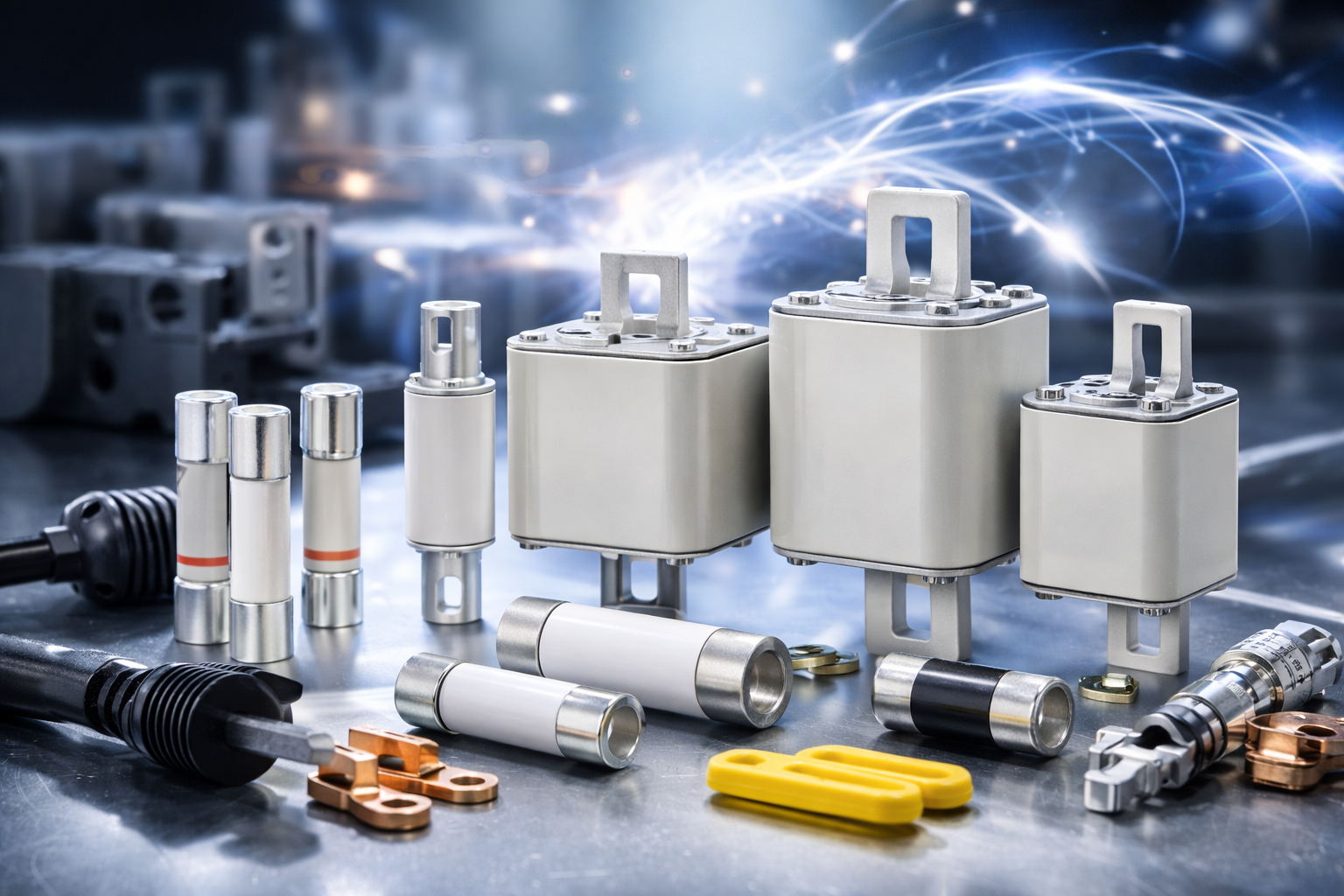
Eaton Bussmann Series Electrical Fuses – Blog & Fachwissen
Im Eaton Bussmann Series Electrical Fuses Blog finden Sie fundiertes Fachwissen rund um elektrische Sicherungen, Überstromschutz und moderne Schutzkonzepte für industrielle und gewerbliche Anwendungen. Diese Kategorie bündelt alle Blogartikel, technischen Beiträge und Praxisguides zu den Sicherungssystemen und Serien von Eaton Bussmann.
Eaton Bussmann zählt weltweit zu den führenden Herstellern von elektrischen Sicherungen, und ihre Serien stehen für Sicherheit, Normkonformität und höchste Zuverlässigkeit in anspruchsvollen elektrischen Systemen.
Was Sie im Eaton Bussmann Sicherungen Blog erwartet
Unsere Blogbeiträge helfen Ingenieuren, Einkäufern, Technikern und Planern dabei, die richtige Sicherungslösung zu finden und technische Zusammenhänge besser zu verstehen.
Themenschwerpunkte dieser Kategorie:
-
🔌 Überblick über Eaton Bussmann Sicherungsserien
-
⚙️ Unterschiede zwischen UL-, IEC- und Spezial-Sicherungen
-
📘 Technische Erklärungen zu Kennlinien, Auslöseverhalten & Bemessungswerten
-
🏭 Anwendungstipps für Industrie, Maschinenbau & Energieverteilung
-
🚗 Beiträge zu EV-, DC- und Hochvolt-Sicherungen
-
🛠 Best Practices für Auswahl, Installation und Wartung
Alle Inhalte sind praxisnah, verständlich aufbereitet und technisch fundiert.
Eaton Bussmann Sicherungsserien im Fokus
Der Blog behandelt regelmäßig verschiedene Eaton Bussmann Series Electrical Fuses, darunter:
-
Industrial Fuses
-
North American (UL) Fuse Series
-
IEC Sicherungsserien
-
High Speed & Semiconductor Fuses
-
EV & DC Sicherungen
-
Supplementary & Specialty Fuses
So erhalten Sie einen umfassenden Überblick über das Eaton Bussmann Portfolio und dessen Einsatzmöglichkeiten.
Fachwissen für sichere elektrische Systeme
Elektrische Sicherungen sind ein zentraler Bestandteil jeder sicheren Stromversorgung. Der Eaton Bussmann Series Electrical Fuses Blog unterstützt Sie dabei, Risiken zu minimieren, Normen einzuhalten und die Lebensdauer Ihrer Anlagen zu verlängern.
Ganz gleich, ob Sie Grundlagenwissen suchen oder tief in spezielle Sicherungsserien eintauchen möchten – hier finden Sie relevante, aktuelle und suchmaschinenoptimierte Inhalte rund um Eaton Bussmann Electrical Fuses.
👉 Jetzt Blogartikel entdecken und Ihr Wissen über Eaton Bussmann Sicherungsserien gezielt erweitern.
- Details
- Category: Electrical Fuses Blog
Fuse Manufacturers in China: How to Identify a Serious Business
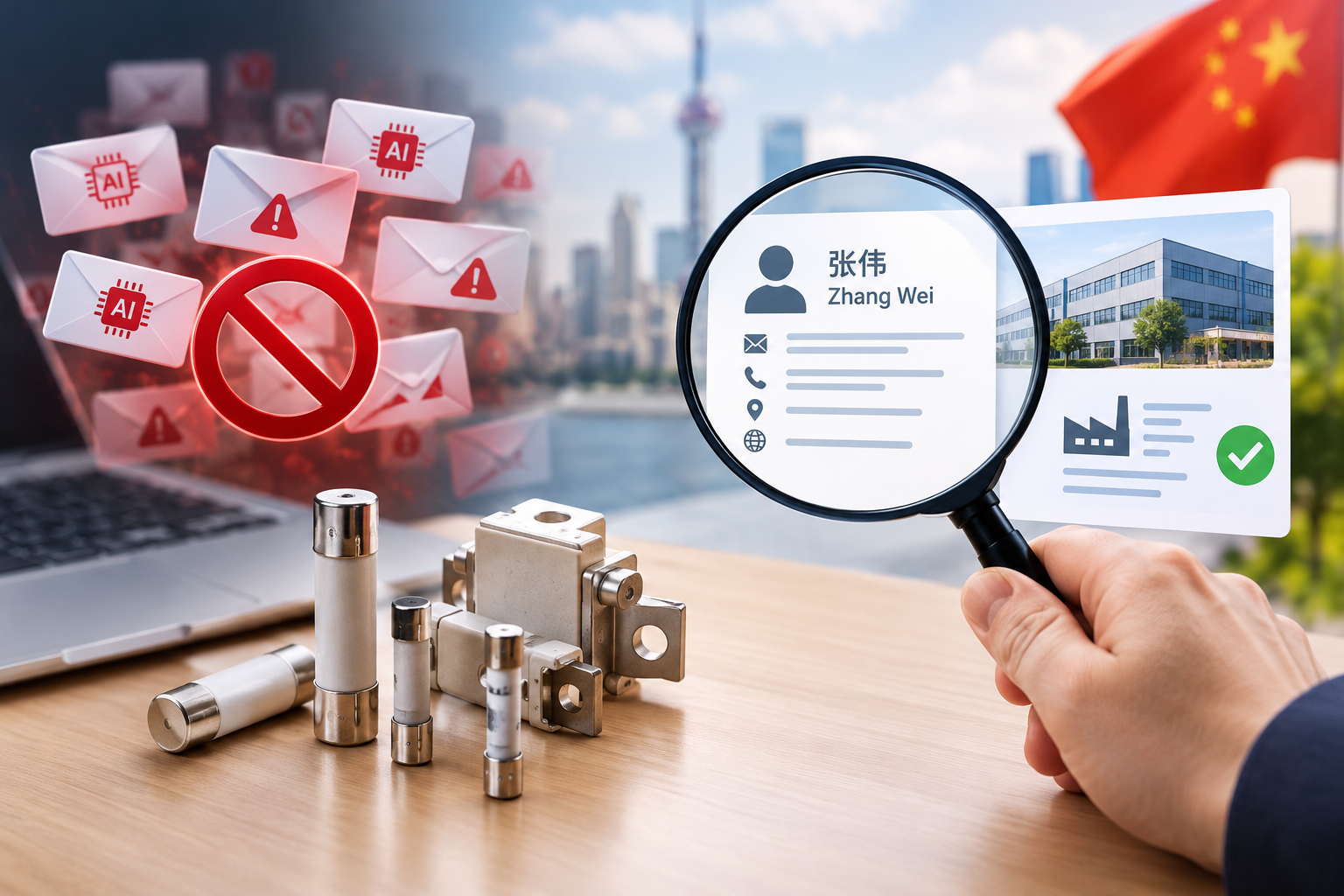
China is one of the world's major manufacturing centres for electrical components, including fuses, circuit protection devices, and industrial safety products. For international buyers, working with Chinese fuse manufacturers can offer access to a wide range of products and competitive manufacturing capabilities.
However, finding a supplier is not the same as finding a reliable business partner.
When searching online for fuse manufacturers in China, buyers are increasingly confronted with unsolicited emails, generic sales pitches, and AI-generated spam messages. These emails may appear professional at first glance, but they do not necessarily demonstrate that the sender is a genuine manufacturer, has a qualified sales team, or has made any serious effort to contact your company.
So, how can you distinguish a serious Chinese fuse manufacturer from an unqualified or potentially misleading supplier?
1. Do Not Trust Every Email from a Chinese Fuse Manufacturer
Many companies receive unsolicited emails from Chinese suppliers promoting fuses, electrical components, and other industrial products. Some of these messages appear to be mass-produced using AI tools and distributed to large numbers of email addresses collected from websites, directories, and other publicly available sources.
The emails may contain polished English, technically correct phrases, and convincing product descriptions. Nevertheless, good English in an email does not prove that the sender actually speaks English or that the company has made a genuine effort to contact your business.
AI tools make it easy to generate professional-looking messages in almost any language. A supplier can send hundreds or thousands of emails without understanding the recipient's business, market, or technical requirements.
For example, a message may claim that a company manufactures high-quality industrial fuses and is interested in establishing a long-term partnership. Yet the email may not mention your company name, your products, or any specific reason why the sender believes your businesses would be a good match.
Such a message is not evidence of a meaningful business relationship.
When evaluating fuse manufacturers in China, look beyond the wording of the email. Pay attention to the sender's identity, company details, and the consistency of the information provided.
2. Check the Sender's Email Domain Against the Company Website
One of the first checks when receiving an unsolicited business email is to examine the sender's actual email address.
The sender's email domain should match the domain of the company's official website.
For example, if a manufacturer operates its official website under example-fuse.com, a business email from an address such as
This is not an absolute guarantee of legitimacy, but it is a useful first screening measure.
Pay attention to the actual sender address shown in the email headers, not just the display name. A sender may use a company name in the display field while sending the message from an unrelated domain.
For more detailed verification, check the following:
-
Does the sender's email domain correspond to the company's official website?
-
Does the company website provide the same email domain in its contact details?
-
Is the domain consistent throughout the correspondence?
-
Does the message contain suspicious inconsistencies between the sender's identity and the company being represented?
Where possible, inspect the technical email headers and authentication results, including SPF, DKIM, and DMARC. These can help determine whether the message was authorised by the sending domain, although they do not independently prove that the business itself is trustworthy.
If the sender uses an unrelated domain and cannot provide a credible explanation, treat the email with caution.
3. A Serious Chinese Business Should Provide Names in Both Chinese and Western Versions
Another useful indicator is the sender's email signature.
A professional Chinese manufacturer communicating with an international business partner should be able to identify the person contacting you clearly.
Ideally, the signature should include:
-
The sender's full name in Chinese characters.
-
The sender's name in a Western-language version, such as Pinyin.
-
The sender's position or department within the company.
-
The company's full legal name.
-
Complete company contact details.
For example, a signature might display a representative's Chinese name alongside its Pinyin version, making it easier to identify the person consistently across Chinese-language and international business records.
This matters because Chinese names may be transliterated into Western characters in different ways. Providing both versions helps reduce ambiguity and makes it easier to verify the sender's identity.
A signature containing only a generic English name, such as “David Sales Manager,” without a verifiable company identity offers little evidence about who is actually contacting you.
Of course, a missing Chinese name does not automatically prove fraud. However, when evaluating unsolicited approaches from Chinese fuse manufacturers, the absence of clear and consistent identification is a legitimate reason to request further verification.
4. Company Details Should Be Provided in Chinese Characters and a Western Version
The same principle applies to the company itself.
A serious Chinese manufacturer should be able to provide its complete company details in Chinese characters as well as in a Western-language version suitable for international customers.
The information should include, where applicable:
-
The full registered Chinese company name.
-
The company's official English name, if one is used.
-
Its registered business address.
-
Its official website.
-
Its business telephone number and relevant contact details.
-
Its business registration information.
The Chinese legal name is particularly important because an English company name may be a translation, a trading name, or a name used specifically for international marketing. It may not be the name under which the company is legally registered in China.
With the Chinese name, buyers can conduct more meaningful checks against official Chinese business registration records and other available sources.
It is also important to distinguish between a manufacturer and a trading company. A trading company may legitimately supply fuses without operating its own factory. The key is to understand exactly which type of business you are dealing with and whether it meets your requirements.
If a company claims to be a fuse manufacturer but cannot provide its full legal identity or explain where its products are manufactured, further investigation is advisable.
5. Generic AI-Generated Emails Are Not Proof of Genuine Business Interest
AI-generated communication is not inherently dishonest. Legitimate manufacturers can use AI tools to translate messages, improve grammar, and communicate more efficiently with international customers.
The problem arises when automated emails are sent indiscriminately to large numbers of businesses and presented as personalised sales enquiries.
A message written in fluent English may create the impression that the sender has carefully researched your company. In reality, it may be a generic template with little or no human involvement.
For buyers searching for fuse manufacturers in China, the important question is not whether an email was written by a human or an AI system. It is whether the sender can demonstrate a genuine business identity and engage meaningfully with your company.
A serious supplier should be able to answer specific questions about its products, manufacturing capabilities, technical specifications, certifications, and commercial conditions.
For example, if you ask about a particular fuse rating, breaking capacity, operating temperature, applicable standard, or production capability, the supplier should provide relevant and verifiable information rather than simply sending another generic sales presentation.
A professional response should demonstrate product knowledge and a clear understanding of your enquiry.
6. How to Evaluate a Chinese Fuse Manufacturer Before Doing Business
Once a supplier has passed the initial email checks, carry out a more thorough assessment before placing an order.
Consider the following steps:
Verify the legal entity. Compare the company's Chinese registered name, address, and available registration information with official or otherwise reliable records.
Confirm its manufacturing capabilities. Ask whether the company manufactures fuses itself or sources them from other factories. If factory ownership matters to your business, request appropriate evidence.
Review technical documentation. Depending on the product, request datasheets, applicable IEC or other relevant standards, test reports, and evidence of certifications. Verify certificates with the issuing organisation where possible.
Assess communication quality. A reliable supplier should respond to specific questions, explain technical details, and communicate clearly about lead times, minimum order quantities, quality control, and delivery conditions.
Request samples when appropriate. Samples can help you evaluate dimensions, markings, performance-related documentation, and compatibility before committing to a larger order. Electrical safety testing should be performed by qualified personnel where required.
Check commercial details. Confirm the contracting entity, payment beneficiary, invoice information, and delivery terms. Unexpected changes to bank details or payments to unrelated entities should trigger additional verification.
No single check guarantees that a supplier is reliable. The objective is to build a consistent picture from several independent sources.
7. When Should You Ignore an Email from a Chinese Fuse Supplier?
For busy purchasing departments, time is a limited resource. It is neither practical nor necessary to respond to every unsolicited sales email.
As a screening policy, it is reasonable to ignore or quarantine unsolicited emails that fail to provide basic, verifiable business information.
In particular, an email should be treated as low priority if:
-
The sender's domain does not match the company's official website and there is no credible explanation.
-
The sender cannot be identified by a verifiable name.
-
The signature omits the sender's Chinese name and Western-language version, with no reasonable explanation.
-
The company details are incomplete or do not provide the Chinese legal name alongside a Western-language version.
-
The company identity cannot be independently verified.
-
The message is generic, irrelevant, or appears to have been sent indiscriminately.
-
The sender avoids specific questions about the company, its products, or its manufacturing capabilities.
If an unsolicited email fails these basic identity checks, ignoring it is a sensible default. There is little reason to invest time in a supplier that has not provided enough information to establish who is contacting you.
However, these criteria should be understood as a practical screening policy rather than definitive proof of fraud. Smaller manufacturers, export agents, and legitimate companies with limited international sales experience may have incomplete signatures or use different email arrangements.
If a supplier appears commercially relevant but fails one of the checks, a brief request for its Chinese legal company name, official website, and verifiable contact details may resolve the issue. If the sender cannot or will not provide this information, there is little justification for proceeding.
Conclusion: Choose Verified Fuse Manufacturers in China, Not Just Convincing Emails
China offers a broad range of manufacturers and suppliers of electrical fuses, but international buyers should not confuse professional-looking sales emails with credible business relationships.
AI-generated spam makes it increasingly easy to produce convincing messages in English and other languages. A polished email does not prove that the sender speaks the language, understands your business, represents a genuine manufacturer, or has made a serious effort to establish contact.
When evaluating fuse manufacturers in China, begin with basic verification:
-
Check whether the sender's actual email domain matches the company's official website.
-
Look for the sender's name in both Chinese characters and a Western-language version.
-
Require complete company details in Chinese characters and a Western-language version.
-
Verify the company's legal identity and manufacturing role.
-
Assess technical competence and commercial reliability before proceeding.
These checks help purchasing managers and technical buyers filter out low-quality unsolicited messages and focus on suppliers that can demonstrate a credible business identity.
Ultimately, the goal is not to reject Chinese suppliers simply because they are Chinese or because they use AI tools. It is to apply consistent standards of transparency, verification, and professional communication to every potential business partner.
A serious fuse manufacturer should be prepared to identify itself clearly, substantiate its capabilities, and answer relevant questions. If an unsolicited email cannot meet even the most basic requirements for business identification, it should not be treated as a serious sales enquiry.

- Details
- Category: Electrical Fuses Blog
Ordering Military Parts and NATO Fuses: Export Clearance, EUSU Forms and Compliance Requirements
Ordering Military Parts: What You Need to Know
Ordering military parts requires more than identifying the correct component and checking availability. Certain military-specification products, NATO parts and dual-use items are subject to export control regulations, meaning that additional documentation and export clearance may be required before an order can be processed.
This is particularly important when purchasing military fuses, NATO fuses and specialised electrical fuses used in defence, aerospace, aviation and other technically demanding applications.
At Casadaa, customers looking to source these components should be aware that orders involving controlled items must undergo the applicable export compliance procedures. Depending on the product, destination, end-user and licensing requirements, supporting documentation may include an End-User and Stockist Undertaking (EUSU) form.
Please note: Orders for controlled military fuses and related parts can only be processed once the required export clearance has been successfully obtained. Orders that do not meet the applicable legal and regulatory requirements will not be processed.
Military Fuses and NATO Parts: Understanding the Product Range
Military and NATO-related electrical components are used in applications where reliable electrical protection and compliance with specific technical requirements are essential.
When ordering military parts, it is important to identify the correct manufacturer, series and part number. Even similar-looking electrical fuses may differ in their current rating, voltage rating, breaking capacity, dimensions and intended application.
The Eaton Bussmann range includes specialised electrical fuses and fuse links associated with military, NATO and aerospace applications.
Examples of part numbers and product designations that customers may be looking for include:
-
UAM series – specialised fuse links, including UAM30, UAM40, UAM50, UAM80, UAM100 and other variants.
-
PAN 6575 – a specification designation associated with UAM fuse-link variants, including PAN 6575-030, PAN 6575-040 and PAN 6575-100.
-
JN1095 – a part number customers may encounter when sourcing military-related electrical components.
-
AST series – specialised fuse variants, including AST1, AST2, AST5 and AST10.
-
AS series – additional electrical fuse variants, including AS2-5, AS5, AS7-5, AS15 and AS20.
The list above is intended as a starting point for product identification, not a complete catalogue or confirmation that every variant is available for purchase. Always verify the precise part number and technical specifications before placing an order.
Explore the Eaton Bussmann military and NATO fuse product range to identify the relevant components.
Why Is Export Clearance Required When Ordering Military Fuses?
Military fuses and other specialised electrical components can fall within export control procedures depending on their classification, intended end-use, destination and the parties involved in the transaction.
Some items may be controlled military goods, while others may be classified as dual-use items. Dual-use items are products, software or technology that can have both civilian and military applications.
For this reason, ordering military parts cannot always be treated as a standard commercial purchase. Export compliance checks may be necessary to establish whether a licence is required and whether the proposed transaction can legally proceed.
The applicable requirements can depend on several factors:
-
The technical classification of the component.
-
The destination country and applicable trade restrictions.
-
The identity of the end-user and any intermediate parties.
-
The declared purpose and intended use of the product.
-
The export licence and supporting documentation required for the transaction.
Providing a part number or submitting a purchase order does not automatically mean that an order can be accepted or dispatched. The required export clearance must first be completed successfully.
The EUSU Form: An Important Step in the Ordering Procedure
When an export licence application requires an End-User and Stockist Undertaking (EUSU), the relevant end-user or stockist must provide the required information.
The EUSU helps establish who will receive the goods, who will use them, and how the items will be handled or transferred throughout the supply chain. The form is an important part of the export licensing process for applicable transactions involving controlled goods.
The UK government's official guidance explains the requirements for completing and submitting the EUSU form.
Read the official guidance: End-User and Stockist Undertaking (EUSU) Form Guidance – GOV.UK
What information may be required?
Depending on the applicable procedure, customers may need to provide:
-
End-user details: The full identity and contact information of the organisation that will ultimately use the items.
-
Stockist or consignee details: Information about the organisation receiving or holding the goods, where applicable.
-
Product information: Accurate descriptions of the military parts or electrical fuses, including relevant part numbers and quantities.
-
End-use information: Details explaining the intended use of the products.
-
Authorised signature: Completion, signature and dating of the undertaking by an appropriately authorised representative.
-
Additional supply-chain information: Details of relevant intermediate users, third parties or ultimate end-users, as required.
All information should be accurate and consistent with the corresponding export licence application. Incomplete, inconsistent or insufficient documentation may result in additional enquiries and delays.
The specific documentation required depends on the transaction and the applicable export control regime. Customers should follow the current official guidance and any instructions provided during the order review.
How to Order Military Parts and NATO Fuses
To help ensure a smooth purchasing process, customers should prepare the necessary product and compliance information before submitting an order.
Step 1: Identify the Correct Part Number
Confirm the exact part number, series and required quantity. For example, customers may be searching for UAM fuse links, PAN 6575 variants, AST fuses or JN1095 components.
Where necessary, provide additional technical information so the product can be identified accurately.
Step 2: Submit Your Enquiry or Purchase Request
Provide the required product details and destination information. This enables the order to be reviewed for availability, technical suitability and any applicable export control requirements.
Step 3: Complete the Required EUSU Documentation
If an EUSU form is required for the applicable export licence, the relevant end-user or stockist must complete the documentation in accordance with the official guidance.
Additional information may be requested to verify the intended end-use, parties involved and export destination.
Step 4: Export Compliance Review
The proposed transaction must be assessed against the applicable export control and licensing requirements. Submission of the required documentation does not itself constitute export clearance or guarantee that a licence will be granted.
Step 5: Export Clearance and Order Processing
Orders for controlled military fuses and related parts can only be processed once the required export clearance has been successfully obtained.
If the transaction cannot satisfy the applicable legal requirements, or the necessary clearance is refused or cannot be obtained, the order will not be processed.
This procedure supports responsible sourcing and helps ensure that controlled products are supplied only where the relevant legal requirements have been met.
Ordering Dual-Use Items: Why Accurate Information Matters
Dual-use items require particular attention because their potential applications can extend beyond conventional civilian use.
An electrical component may be used in an industrial, commercial or aerospace system, but its classification and export requirements must be assessed on the basis of the applicable rules rather than its description alone.
When ordering dual-use items or military-related electrical fuses, customers should provide accurate product information and transparent details about the intended end-user and end-use.
This helps the parties involved determine which documentation, licensing and clearance procedures apply to the transaction.
It is also important to understand that an item being commercially available does not necessarily mean it can be exported to every destination or supplied for every intended use.
Important Notice: Legal Requirements and Order Acceptance
Casadaa treats export compliance as an essential part of the ordering procedure for controlled products.
The following conditions apply to orders subject to export control requirements:
-
Required documentation must be completed accurately and submitted where applicable.
-
The end-user, destination and intended use must satisfy the relevant legal requirements.
-
Any required export licence or clearance must be obtained before the order can proceed.
-
Submission of an order or EUSU form does not guarantee acceptance, licensing approval or shipment.
-
Orders that fail to meet the applicable legal requirements will not be processed.
These requirements apply regardless of the requested quantity or the commercial urgency of an order.
Customers are encouraged to allow sufficient time for documentation checks and export licensing procedures when planning the procurement of military parts, NATO fuses and dual-use electrical components.
Find Military and NATO Fuses at Casadaa
If you are looking for Eaton Bussmann military fuses, NATO fuses or specialised electrical fuse links, identifying the correct part number is the first step.
Review the product range to find relevant variants, verify the technical details and submit an enquiry with the information needed to assess your requirements.
Explore Military Fuses and NATO Fuses at Casadaa
For orders subject to export controls, please be prepared to provide the required end-user information and supporting documentation. Order processing can proceed only after all applicable legal requirements have been satisfied and the required export clearance has been successfully obtained.
Frequently Asked Questions
Do I need an EUSU form to order military fuses?
An EUSU form may be required where the applicable export licensing procedure calls for it. The requirement depends on the goods, transaction and relevant export control rules. Consult the official EUSU guidance for details.
Which military fuse part numbers can I enquire about?
Examples include UAM-series fuse links, PAN 6575 variants, AST-series fuses and JN1095. Check the relevant product listing and confirm the exact part number and specifications before ordering.
Can an order be processed before export clearance is obtained?
No. Where export clearance is required, the order can only be processed after the required clearance has been successfully obtained.
What happens if an order does not meet export control requirements?
Orders that fail to satisfy the applicable legal and regulatory requirements will not be processed. Missing documentation, unresolved compliance concerns or unsuccessful clearance may prevent an order from proceeding.
Are NATO fuses and dual-use items subject to the same rules?
Not necessarily. Export control requirements depend on the item's classification, destination, end-user, intended end-use and the applicable regulations. Each transaction must be assessed according to its circumstances.
Ordering military parts responsibly starts with accurate product identification and export compliance. By preparing the correct part numbers, completing any required EUSU documentation and allowing for export clearance, customers can help ensure that procurement requests are reviewed in accordance with the applicable legal requirements.
- Details
- Category: Electrical Fuses Blog
How to Send an RFQ for Fuses to Casadaa Distribution: Email or Phone?
When sourcing electrical components, submitting a clear and complete request for quotation (RFQ) is essential to receiving an accurate and timely response. If you want to purchase fuses from Casadaa Distribution, you may wonder whether you should send your inquiry by email or contact the company by phone.
For a successful fuse RFQ, Casadaa Distribution recommends sending your inquiry by email. Written requests help reduce errors, ensure that technical details are communicated correctly, and make it easier to identify the exact parts you need.
Casadaa Distribution receives many inquiries. By following the guidelines below, you can help us process your request more efficiently.
Why Should You Send Your Fuse RFQ by Email?
Electrical components often have complex part numbers. Each letter, digit, and character may represent a specific technical feature, such as the fuse size, rated current, voltage, breaking capacity, or product series.
Communicating these details over the phone can be time-consuming and increases the risk of misunderstandings. A single incorrect digit in a fuse part number can result in a quotation for the wrong product.
Email is the preferred method for requesting a quotation from Casadaa Distribution because it provides a clear, written record of your requirements.
An email also allows you to attach datasheets, photographs, technical drawings, and other documents that help identify the requested electrical parts.
What Information Should Your RFQ Include?
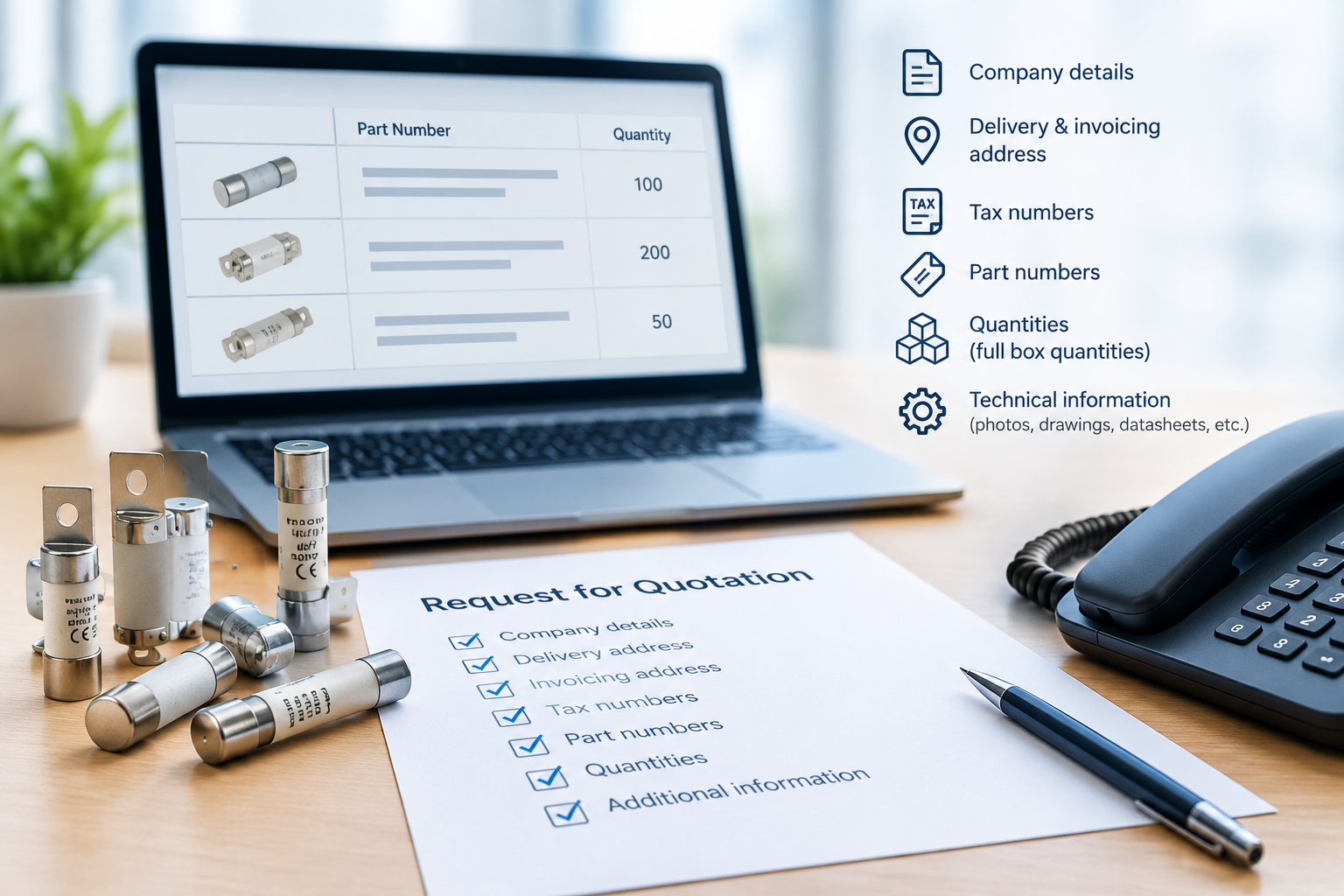
To help Casadaa Distribution evaluate your request, please include the following information in your email.
1. Your Company Information and Imprint
Please include your company's full legal details in your inquiry. This information helps us identify your business and process your request appropriately.
Your email should include:
-
Full company name and legal imprint
-
Registered company address
-
Delivery address
-
Invoicing address, if different
-
VAT identification number and other relevant tax numbers
-
Contact person's name and contact details
Providing complete company information from the beginning can help avoid unnecessary follow-up questions.
2. Exact Fuse Part Numbers
Please list the exact part numbers of the fuses you require. Check the manufacturer, product series, and complete ordering code carefully before sending your RFQ.
In electrical distribution, similar-looking part numbers may refer to different products or specifications. Providing the complete code helps us identify the correct component and determine whether it is available.
If you are requesting several types of fuses, list each part number separately.
3. Required Quantities
Specify the quantity required for each part number.
Please keep in mind that most parts are available only in full-box quantities. The standard packaging quantity may therefore affect the quantity we can offer.
If you require multiple fuse types, a simple list or table containing the part number and requested quantity is an effective way to organize your inquiry.
| Part number | Requested quantity |
|---|---|
| Manufacturer part number A | 100 pcs |
| Manufacturer part number B | 200 pcs |
| Manufacturer part number C | 50 pcs |
The part numbers and quantities above are examples only.
4. Additional Technical Information When the Part Number Is Unknown
Do you need a particular fuse but do not know its exact part number? You can still send an inquiry.
Please provide as much identifying information as possible, including:
-
Manufacturer or brand
-
Rated current and voltage
-
Fuse dimensions
-
Fuse type and application
-
Relevant standards and technical specifications
-
Photographs of the existing fuse and its markings
-
Datasheets, drawings, or other technical documents
Clear photographs and complete technical documentation can significantly improve the chances of identifying the correct component.
The more precise the information, the easier it is to assess your request.
Important: A Fuse Standard Is Not a Part Number
One common source of confusion in fuse procurement is the difference between a technical standard and an actual product number.
For example, BS88 is a fuse standard, not a specific fuse part number. It covers a broad range of fuse types and configurations. Thousands of different products may fall within the relevant BS 88 standards and product categories.
Simply asking for “BS88 fuses” does not provide enough information to identify the exact product you need.
Please specify the required fuse characteristics, manufacturer, dimensions, ratings, and preferably the complete part number. If the part number is unavailable, provide photographs, drawings, or a datasheet so that the product can be identified more accurately.
The same principle applies to other fuse standards: a standard alone does not necessarily identify a unique product.
Will Casadaa Distribution Respond to Every Inquiry?
Casadaa Distribution focuses on electrical components and products within its range.
If your request concerns products that are clearly outside the company's offering, we may not respond to the inquiry. For this reason, please verify that the products you are requesting are relevant to our product portfolio before submitting your RFQ.
Providing accurate product information and a clearly defined request also helps us assess your inquiry more efficiently.
Why Has Your RFQ Email Not Received a Response?
If you have sent a quotation request but have not received a reply, check your email configuration.
Email servers that are incorrectly configured may cause messages to be rejected or classified as spam. Casadaa Distribution's spam protection may block emails that fail relevant checks or appear suspicious.
Before sending your RFQ, make sure that:
-
Your email server is correctly configured.
-
Your domain has the appropriate email authentication settings, where applicable.
-
Your message can be delivered reliably to external recipients.
-
Your attachments are legitimate and do not trigger security filters.
-
You have entered the recipient's email address correctly.
If your email does not reach our inbox, we cannot process your request. Correct email configuration is therefore an important part of successful communication with Casadaa Distribution.
Email or Phone: What Is the Best Way to Request a Fuse Quotation?
For a detailed request for quotation, email is the preferred choice.
| Communication method | Recommendation |
|---|---|
| Preferred for RFQs. Provides written part numbers, quantities, company details, and attachments. | |
| Phone | Less suitable for transmitting long or complex electrical part numbers because of the risk of errors and the time required. |
A phone call may be useful for general communication, but the actual quotation request should be submitted in writing, with all relevant technical and commercial information included.
A Simple Checklist for a Successful RFQ
Before sending your email to Casadaa Distribution, confirm that you have included:
-
Your complete company imprint and legal details
-
Delivery and invoicing addresses
-
VAT identification number and relevant tax numbers
-
Exact fuse part numbers, wherever available
-
Requested quantities for each part
-
An understanding that most parts are supplied in full boxes
-
Photos, drawings, datasheets, or specifications if the part number is unknown
-
Sufficient technical information to distinguish a standard from a specific product
-
A correctly configured email account and server
A complete RFQ helps reduce unnecessary correspondence and increases the likelihood that your requirements can be evaluated correctly.
Conclusion: Send Your Fuse RFQ to Casadaa Distribution by Email
If you want to request a quotation for fuses from Casadaa Distribution, please send your RFQ by email rather than communicating complex part numbers by phone.
Include your company details, delivery and invoicing addresses, tax information, exact part numbers, and required quantities. If you do not know the part number, attach photographs, drawings, or technical documentation. Remember that standards such as BS88 describe a broad category of products rather than identifying one specific fuse.
Finally, ensure that your email server is configured correctly so that spam protection does not prevent your message from reaching us.
A clear, complete, and technically accurate email is the best starting point for a successful quotation request.
Casadaa Distribution — helping you make your electrical component inquiries clear, accurate, and efficient.
- Details
- Category: Electrical Fuses Blog
Export Accompanying Documents (EAD) / Ausfuhrbegleitdokumente (ABD) for Electrical Fuses
When purchasing electrical fuses from an EU-based supplier for delivery to a country outside the European Union, export documentation may be required. One of the key documents in this process is the Export Accompanying Document (EAD), known in German as the Ausfuhrbegleitdokument (ABD).
At Casadaa Distribution, we support our international customers by offering export documentation as an additional service for eligible orders of electrical fuses and related components. Understanding the purpose and cost of an EAD/ABD helps ensure a transparent purchasing process and smooth export handling.
What Is an Export Accompanying Document (EAD/ABD)?
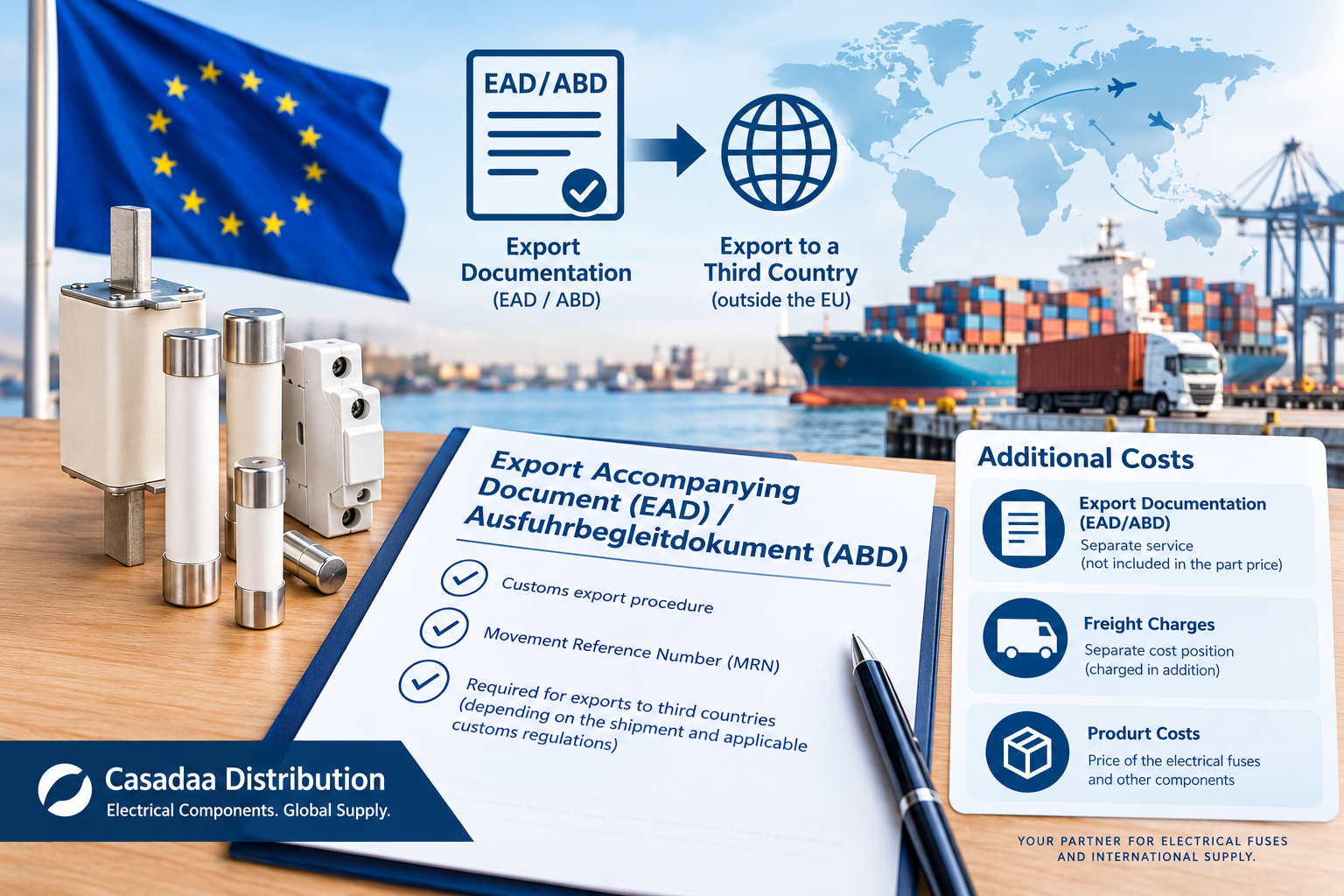
An Export Accompanying Document (EAD), or Ausfuhrbegleitdokument (ABD), is a document generated as part of the electronic customs export procedure in the European Union. It contains information about an export shipment and includes the Master Reference Number (MRN), which is used to identify the export declaration.
The document supports customs processing when goods are exported from the EU to a non-EU destination, also referred to as a third country.
For international buyers purchasing electrical fuses, the EAD/ABD may be required as part of the export customs process, depending on the shipment and applicable customs requirements.
Why Is an EAD/ABD Required When Exporting Electrical Fuses?
Casadaa Distribution is based in the European Union. When electrical fuses are sold and shipped from the EU to a customer in a third country, the goods may need to be declared for export to EU customs authorities.
The EAD/ABD is associated with this export declaration and helps facilitate the customs process. It is particularly relevant for international shipments of industrial electrical components, including:
-
Industrial electrical fuses
-
High-voltage and low-voltage fuses
-
Semiconductor protection fuses
-
NH fuses and other low-voltage fuse types
-
Fuse links and related electrical protection components
The exact export documentation requirements depend on the destination country, the nature and value of the goods, and the applicable customs regulations.
Please note that an EAD/ABD is an EU export customs document. It does not replace any import permits, certificates, or other documentation that may be required by the destination country.
EAD/ABD as an Additional Service at Casadaa Distribution
At Casadaa Distribution, we aim to provide clear and transparent pricing for electrical fuses and other electrical components.
The preparation and handling of Export Accompanying Documents (EAD/ABD) is an additional service and is generally not included in the quoted price of the electrical fuses or other parts.
If export documentation is required for your order, the associated service will be charged separately. This allows customers to distinguish the cost of the products from the additional administrative services required for international export shipments.
We recommend clarifying your export documentation requirements with our team when requesting a quotation or placing an order for delivery outside the European Union.
Freight Charges Are Calculated Separately
In addition to the cost of the electrical fuses and any applicable EAD/ABD service fees, freight charges are a separate cost position and will be charged in addition.
The total order cost may therefore include the following items:
-
Product costs: The price of the electrical fuses and other ordered components.
-
Export documentation fees: The separate charge for preparing or handling the EAD/ABD, where requested or required.
-
Freight charges: The transportation costs for shipping the goods to the agreed destination.
Any other applicable customs-related charges, import duties, taxes, or destination-country fees should also be considered separately where relevant.
This transparent cost structure helps international customers understand the different components of their order and plan their procurement costs accordingly.
Buying Electrical Fuses from an EU Supplier for Export
When sourcing electrical fuses from an EU-based distributor for delivery to a third country, it is important to consider both the product requirements and the administrative aspects of international shipping.
Casadaa Distribution assists customers purchasing electrical fuses by providing product quotations and, where needed, additional export documentation services.
To help us process your request efficiently, please provide the following information when requesting a quotation:
-
The type and quantity of electrical fuses required
-
The delivery address and destination country
-
Whether an Export Accompanying Document (EAD/ABD) is required
-
Any specific export or shipping documentation requirements
Our team can then clarify the applicable product costs, export documentation fees, and freight charges for your order.
Frequently Asked Questions About EAD/ABD for Electrical Fuses
What does EAD stand for?
EAD stands for Export Accompanying Document. It is associated with the EU customs export declaration and contains the relevant shipment reference information.
What does ABD mean in German?
ABD stands for Ausfuhrbegleitdokument. It is the German term commonly used for the Export Accompanying Document in the EU export customs process.
Is an EAD/ABD required when buying electrical fuses from Casadaa Distribution?
When electrical fuses are exported from the EU to a third country, an export customs declaration may be required. The specific documentation requirements depend on the shipment and applicable customs regulations.
Is the EAD/ABD included in the price of electrical fuses?
No. At Casadaa Distribution, export documentation is an additional service and is generally not included in the quoted product prices. Any applicable EAD/ABD service fee will be charged separately.
Are freight charges included in the EAD/ABD fee?
No. Freight charges are a separate cost position and will be charged in addition to the product costs and any applicable export documentation fees.
Does the EAD/ABD cover import customs clearance in the destination country?
No. The EAD/ABD relates to the EU export customs procedure. Import customs clearance, duties, taxes, and other destination-country requirements are separate matters.
Contact Casadaa Distribution for Electrical Fuses and Export Documentation
Are you looking for electrical fuses from an EU-based supplier and need export documentation for delivery to a country outside the European Union?
Casadaa Distribution can help you clarify your product requirements and the additional services needed for your international order.
Contact us for a quotation covering your required electrical fuses, any applicable Export Accompanying Document (EAD/ABD) service fees, and freight charges.
Casadaa Distribution – Your partner for electrical fuses and international supply.
- Details
- Category: Electrical Fuses Blog
 bus-ele-cat-1007-flc-2018-sec-16-cross-ref-index.pdf | [Eaton Bussmann fuses catalog number index] | 2628 kB |
Electrical Fuses: Understanding MOQ, Lead Time, and Availability
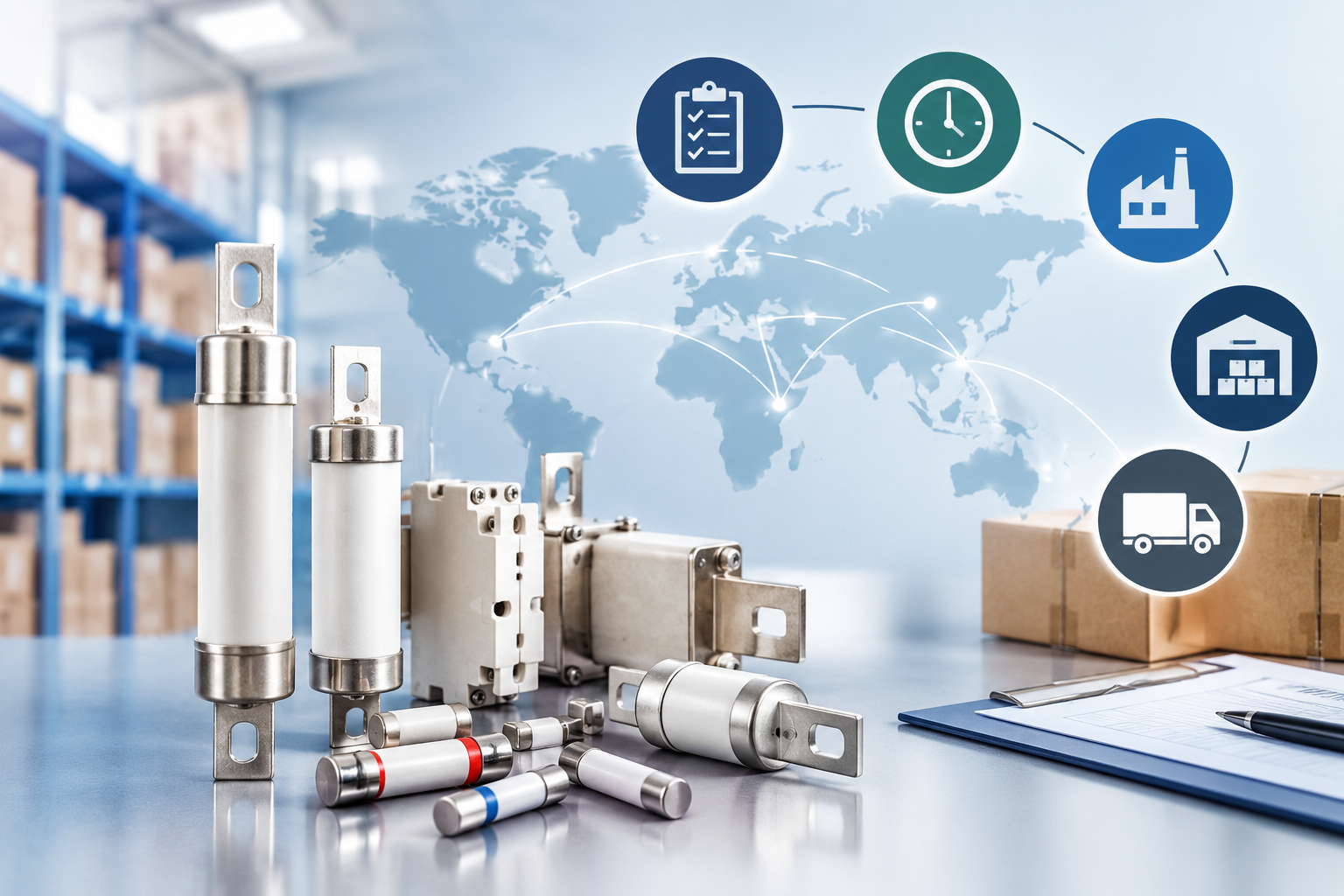
When sourcing electrical fuses, availability, Minimum Order Quantity (MOQ), and lead time are important factors to consider. Finding the right fuse for your application is not always as simple as selecting a standard part number. Even within one fuse series, multiple variations may exist, each designed to meet specific technical requirements, regional standards, mounting configurations, or customer needs.
Eaton Bussmann offers thousands of electrical fuses with different part numbers. As a result, only a selection of these products is available from stock. Understanding the differences between fuse variations and the factors that influence delivery times can help you plan your procurement more efficiently.
Why Are Some Electrical Fuses Available from Stock While Others Have Longer Lead Times?
Eaton Bussmann has an extensive portfolio of electrical fuses designed for a wide range of applications and industries. With thousands of part numbers available, it is not practical for every variation to be held in stock at every location.
Even when two fuses appear to be almost identical, they may have important differences that affect their availability, compatibility, and suitability for a particular application.
For example, one standard fuse type can have ten or more variations. These variations may look similar, but each can have its own specific part number and ordering requirements.
Common reasons for these differences include:
-
Different part numbers: A fuse may have a different manufacturer part number despite sharing similar technical characteristics with another version.
-
Regional variations: Certain fuses are manufactured or configured for specific markets or regions of the world.
-
Different mounting options: A fuse may be available with different mounting arrangements, terminals, dimensions, or installation configurations.
-
Customer-specific part numbers: Some versions are manufactured or identified according to the requirements of a particular customer or original equipment manufacturer (OEM).
-
Different certifications and approvals: Depending on the intended application and market, a fuse may require specific certifications, approvals, or compliance with particular standards.
These differences are important when selecting a replacement fuse or sourcing components for new equipment. A fuse that looks similar to the required product is not necessarily an interchangeable alternative. Electrical ratings, breaking capacity, dimensions, mounting requirements, and applicable certifications must all be considered.
Minimum Order Quantity (MOQ) for Electrical Fuses
The Minimum Order Quantity (MOQ) is the minimum number of units that can be ordered for a particular product or part number. Depending on the specific Eaton Bussmann fuse, the MOQ may vary.
For fuses available from stock, smaller quantities may be possible, depending on the stock level and sales conditions. For products that are not regularly stocked, the manufacturer’s production arrangements, packaging requirements, or purchasing conditions may influence the minimum order quantity.
This is particularly relevant when sourcing less common fuse variations, customer-specific parts, or products intended for a particular regional market.
Before placing an order, it is therefore advisable to confirm the exact part number, current availability, and applicable MOQ. This helps avoid unnecessary delays and allows you to plan your purchasing requirements more accurately.
What Determines the Lead Time for Eaton Bussmann Fuses?
The lead time, also known as delivery time, depends on several factors. Two fuses from the same product family may have significantly different delivery times, even if their technical specifications are similar.
One of the most important factors is which factory manufactures the specific part and in which country stock is held.
The main factors influencing lead time include:
1. Manufacturing Location
Eaton Bussmann electrical fuses are produced at different manufacturing facilities. The lead time for a particular fuse depends partly on which factory is responsible for producing that specific part number.
If the required fuse is not available from existing stock, it may need to be manufactured at the designated production facility. Production schedules and manufacturing capacity can influence the resulting lead time.
2. Stock Availability and Location
The country in which stock is held can also have a significant impact on delivery time.
If the required fuse is available in a nearby warehouse, delivery may be relatively quick. If stock is only available in another country, additional transportation and logistics time may be required.
If no stock is available, the order may depend on the manufacturer's production schedule and subsequent shipment.
3. Exact Part Number and Product Variation
As mentioned above, one standard fuse type can have multiple variations. Stock availability for one part number does not necessarily mean that other versions of the same fuse are also available.
A fuse with a different mounting configuration, regional specification, certification, or customer-specific part number may have a different supply situation and lead time.
For this reason, checking the exact part number is essential when requesting a quotation or planning a delivery.
How to Find the Right Electrical Fuse for Your Requirements
When sourcing Eaton Bussmann electrical fuses, it is important to look beyond the general product series or standard designation. The exact part number determines which product you need and helps establish its availability, MOQ, and expected lead time.
To find the most suitable solution, consider the following steps:
-
Identify the required fuse: Provide the manufacturer part number, product series, or available technical specifications.
-
Confirm the application: Check the electrical ratings, mounting configuration, dimensions, and certification requirements.
-
Check stock availability: Determine whether the exact part number is available from existing stock and where the stock is located.
-
Confirm the MOQ: Establish the minimum order quantity and whether the required quantity can be supplied.
-
Request the lead time: If the product is not available from stock, confirm the expected delivery time based on its manufacturing location and supply situation.
Working with an experienced distributor can simplify this process, particularly when dealing with large product portfolios and less common fuse variations.
Contact Casadaa Distribution for Eaton Bussmann Electrical Fuses
With thousands of Eaton Bussmann fuse part numbers and numerous variations within individual product standards, identifying the right product can require detailed product knowledge and careful sourcing.
At Casadaa Distribution, we help customers identify suitable electrical fuses according to their technical requirements and purchasing needs. Whether you are looking for a standard fuse available from stock or a specific variation with particular mounting, regional, customer-specific, or certification requirements, we can help you explore the available options.
We can assist you in clarifying:
-
The correct Eaton Bussmann fuse part number
-
Current stock availability
-
Minimum Order Quantity (MOQ)
-
Expected lead time and delivery options
-
Potentially suitable alternatives, subject to technical verification
Contact Casadaa Distribution today to discuss your requirements and find the best-fitting Eaton Bussmann fuse for your application.
Let us help you identify the right electrical fuse, clarify availability, and find the most suitable supply solution for your demand.



