
 bus-ele-cat-1007-flc-2018-sec-03-elx.pdf bus-ele-cat-1007-flc-2018-sec-03-elx.pdf | [Eaton Bussmann Electronics Fuses] | 4609 kB |
Better Fuse: Why Eaton Bussmann Fuses Are a Better Choice Than No-Name Fuses
Introduction: Choosing a Better Fuse for Reliable Circuit Protection
When it comes to electrical safety, reliability, and long-term performance, choosing a better fuse is an important decision. Fuses are essential components in electrical and electronic systems, helping protect equipment against overcurrent conditions, short circuits, and potentially damaging electrical faults. However, not all fuses offer the same level of quality, consistency, or documented performance.
Although no-name fuses from various manufacturers in China and other Asian markets may appear attractive because of their low purchase prices, the initial cost does not tell the whole story. Product consistency, verified electrical ratings, compliance with applicable standards, and dependable circuit protection are all important factors when selecting the right fuse.
Eaton Bussmann fuses are a strong choice for applications where quality, engineering, and dependable protection matter. By choosing a reputable fuse manufacturer instead of relying solely on the lowest-priced alternative, businesses can make more informed purchasing decisions and reduce the risks associated with unverified components.
But what makes a better fuse, and why should buyers consider Eaton Bussmann fuses over generic alternatives?
What Makes a Better Fuse?
A better fuse is not simply the cheapest component available. It is a fuse that meets the electrical requirements of the application and provides predictable, documented protection under specified operating conditions.
When evaluating fuse quality, consider these essential factors:
-
Reliable circuit protection: The fuse must respond appropriately to overcurrent conditions within its specified operating characteristics.
-
Verified electrical ratings: Rated current, rated voltage, breaking capacity, and time-current characteristics must be suitable for the intended application.
-
Consistent manufacturing quality: Production consistency helps ensure that components perform according to their specifications.
-
Compliance with relevant standards: Applicable certifications and test documentation help demonstrate that a product meets defined requirements.
-
Traceability and technical documentation: Clear product identification, datasheets, and manufacturer support make component selection and verification easier.
-
Long-term value: A reliable component can help reduce the risks and costs associated with equipment failures, troubleshooting, and unplanned maintenance.
These factors are especially important in industrial equipment, power supplies, automotive electronics, renewable energy systems, and other applications where electrical protection is critical.
Why Eaton Bussmann Fuses Stand Out
Eaton Bussmann is an established name in circuit protection. Its fuse portfolio serves a wide range of electrical and electronic applications, with products designed for different operating conditions, current ratings, voltage levels, and protection requirements.
For engineers, purchasing managers, maintenance professionals, and equipment manufacturers, selecting Eaton Bussmann fuses offers several potential advantages.
1. Established Engineering and Product Development
Fuse performance depends on more than the physical appearance of a component. Internal construction, fuse-element design, materials, manufacturing tolerances, and thermal behavior all influence how a fuse responds to an electrical fault.
Eaton Bussmann products are developed for defined applications and electrical characteristics. This makes it easier for engineers to select a fuse using documented specifications rather than relying on appearance or a supplier's general assurances.
For demanding applications, a properly specified fuse can help provide predictable protection and support the overall reliability of the electrical system.
2. Clearly Defined Electrical Performance
A fuse must be suitable for the circuit it protects. Choosing the wrong rated voltage, current, or breaking capacity can compromise protection, even when the component appears to be well made.
Eaton Bussmann datasheets provide technical information for selecting products according to their intended use. Depending on the product series, relevant parameters may include:
-
Rated current and voltage
-
Breaking capacity
-
Time-current characteristics
-
Voltage drop and power dissipation
-
Temperature-related operating considerations
-
Applicable approvals and standards
This information helps engineers compare products on measurable performance criteria instead of making decisions based on price alone.
3. Quality and Manufacturing Consistency
Consistency matters when a fuse is installed in a product that will be manufactured, distributed, or maintained over many years. Unexpected differences between production batches can create challenges for quality assurance and product reliability.
No-name fuses may offer limited publicly available information about manufacturing controls, batch traceability, or independent testing. However, this is not true of every lesser-known manufacturer, and country of origin alone does not establish product quality.
The important distinction is whether the manufacturer can demonstrate consistent production, suitable quality controls, and performance that matches the published specifications.
When evaluating Eaton Bussmann fuses against generic alternatives, buyers should compare documented quality requirements, technical evidence, and product traceability. This provides a more meaningful basis for selecting a better fuse than simply comparing unit prices.
4. Documentation, Standards, and Approvals
Electrical protection components must be selected according to the requirements of the final equipment and its operating environment.
Depending on the application, a suitable fuse may need to meet particular IEC, UL, or other applicable standards. Buyers should verify the precise approvals, ratings, and conditions stated for the individual product rather than assuming that every fuse from a particular manufacturer carries the same certifications.
Eaton Bussmann product documentation can help engineers identify the specifications and approvals relevant to a given product series.
With generic fuses, the same checks are essential. A printed certification mark or a similar-looking label should not replace verification of the applicable certificate, manufacturer, product model, and rating.
5. Technical Support and Product Selection
Selecting the correct fuse can involve more than matching the amperage printed on an existing component. Engineers may need to consider fault current, inrush current, ambient temperature, voltage, required interrupting capacity, coordination with other protective devices, and the applicable safety standards.
Access to detailed technical information and manufacturer support can help simplify this process.
Eaton Bussmann's broad circuit protection portfolio allows buyers to investigate different fuse types for different applications. This is particularly useful for engineering teams that need to standardize components, review replacement options, or develop new equipment.
6. Total Cost of Ownership, Not Just Purchase Price
A low-cost fuse may reduce the initial bill of materials, but the purchase price is only one part of the total cost of using an electrical component.
If a fuse does not meet its specified performance, potential consequences can include additional testing, production delays, troubleshooting, equipment downtime, warranty claims, or damage to other components.
These outcomes are not inevitable with generic fuses, just as a well-known brand does not eliminate every possibility of failure. The key is to assess the quality evidence and the consequences of failure in the actual application.
For critical equipment, a slightly higher component price may be justified when it delivers demonstrable advantages in verified performance, documentation, traceability, or engineering support.
The better purchasing decision is the one that balances component cost with the cost and risk of the complete system.
Eaton Bussmann Fuses vs. No-Name Fuses from China and Asia
Generic fuses sourced from China and other Asian markets vary considerably in quality. Some manufacturers produce well-engineered, properly tested components, while others may provide insufficient documentation or limited evidence that their products meet the claimed specifications.
For this reason, it is more accurate to distinguish between verified, specification-compliant products and unverified alternatives than to judge a fuse solely by its geographical origin.
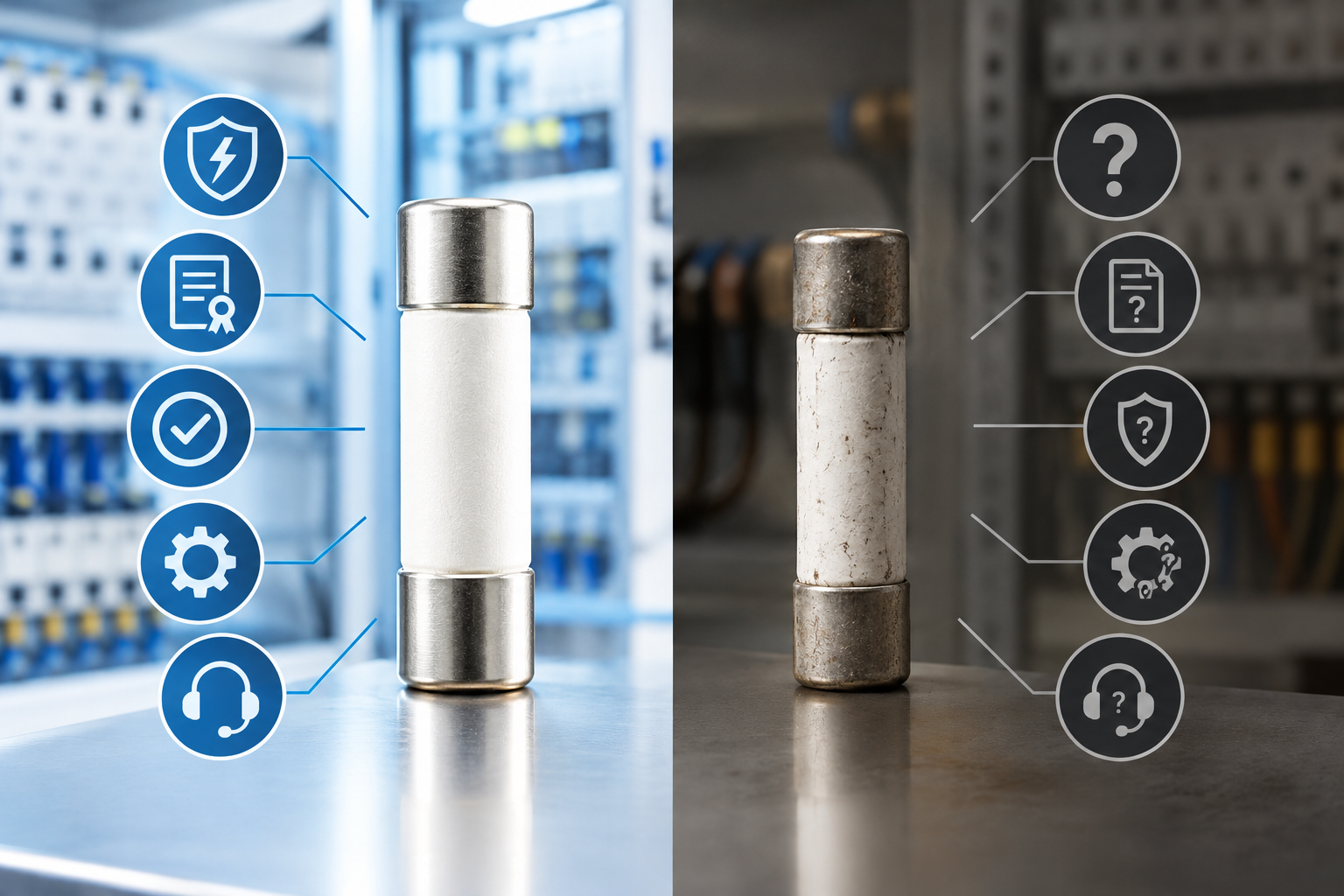
The following comparison highlights the areas buyers should investigate.
| Evaluation criterion | Eaton Bussmann fuses | No-name or generic fuses |
|---|---|---|
| Product specifications | Established product documentation is available for the relevant series | Documentation quality varies by manufacturer and supplier |
| Electrical performance | Defined ratings and characteristics should be checked against the datasheet | Claimed ratings should be independently verified where necessary |
| Manufacturing consistency | Assess through manufacturer quality information and product traceability | Assess individually; evidence may be more limited for some suppliers |
| Certifications and approvals | Verify the approvals applicable to the exact part number | Verify certificates, scope, validity, and product identity |
| Technical support | Manufacturer documentation and support resources are available | Support capabilities vary by supplier |
| Purchase price | May be higher than some low-cost alternatives | Often marketed at a lower initial price |
| Long-term value | Depends on application suitability, performance, and total system cost | Depends on verified quality, reliability, and the actual purchase savings |
The main advantage of choosing an established manufacturer is not that every competing product is inferior. It is that buyers can make a more informed decision when product specifications, technical documentation, and support resources are available and verifiable.
The Risks of Choosing a Fuse Based on Price Alone
A fuse is a safety-related component, so selecting one exclusively on its purchase price can create unnecessary uncertainty.
Incorrect or Unverified Ratings
A fuse's current rating alone does not establish whether it can safely interrupt the prospective fault current in a particular circuit. Rated voltage, breaking capacity, time-current behavior, and the application's specific requirements must also be considered.
Using a component with unsuitable characteristics can result in inadequate protection.
Inconsistent Performance
If a product does not consistently meet its stated specifications, equipment manufacturers may face additional inspection, qualification, and production-control costs.
This is why supplier qualification and, where appropriate, independent testing are important when purchasing from an unfamiliar source.
Inadequate Documentation
Missing or unclear datasheets, certificates, and traceability information can make it harder to establish whether a fuse is appropriate for a regulated or safety-critical application.
Documentation should be treated as part of the product evaluation, not as an administrative detail.
Unexpected Costs
A lower unit price may be offset by extra qualification work, increased inspection requirements, replacement costs, or operational disruption.
Buyers should evaluate the complete cost of sourcing and using a fuse, including the effort needed to verify that it is suitable for the intended application.
How to Choose the Right Eaton Bussmann Fuse
Even the best-known fuse manufacturer cannot offer a single fuse that is ideal for every circuit. Selecting the correct part number is essential.
Follow these steps when choosing an Eaton Bussmann fuse or evaluating an alternative.
Step 1: Identify the electrical requirements.
Determine the circuit's normal operating current, maximum operating voltage, prospective fault current, and expected inrush current.
Step 2: Define the required protection characteristics.
Establish the required time-current behavior, breaking capacity, and any coordination requirements with other protective devices.
Step 3: Consider the operating environment.
Account for ambient temperature, thermal conditions, installation constraints, and any relevant environmental requirements.
Step 4: Verify the applicable standards.
Check which approvals and standards are required for the end product, industry, and market.
Step 5: Review the manufacturer's documentation.
Use the datasheet for the exact fuse model to verify ratings, operating characteristics, dimensions, and approval information.
Step 6: Compare alternatives objectively.
If a generic fuse is being considered as a replacement, confirm that its electrical and mechanical characteristics are genuinely equivalent. Similar dimensions or the same printed current rating do not establish interchangeability.
Step 7: Evaluate total cost and supplier reliability.
Consider purchase price alongside testing requirements, documentation, traceability, support, and the consequences of an unsuitable component.
These steps help ensure that the selected fuse is appropriate for the application, regardless of the manufacturer's location.
Which Applications Benefit from Careful Fuse Selection?
Choosing a suitable fuse is important across a wide range of industries and applications, including:
-
Industrial automation: Protecting control circuits, power supplies, and electrical equipment.
-
Power electronics: Selecting suitable protection for converters, inverters, and electronic power systems.
-
Automotive electronics: Matching protective devices to the electrical requirements of vehicle systems.
-
Renewable energy: Evaluating fuse suitability for solar power systems, energy storage, and associated equipment.
-
Consumer electronics: Supporting product reliability through correctly specified circuit protection.
-
Electrical distribution: Selecting fuses with appropriate voltage ratings and fault-interruption capabilities.
In every case, the correct choice depends on the circuit design, applicable standards, and verified product characteristics. A fuse should never be selected on brand reputation or price alone.
Better Fuse: Make Quality and Reliability Part of Your Purchasing Decision
Searching for a better fuse should mean looking beyond the lowest price. It should mean finding a component with the right electrical characteristics, reliable documentation, suitable approvals, and a clear fit for the intended application.
Eaton Bussmann fuses are worth considering when these factors are important because their established product portfolio and technical documentation support specification-based selection. For buyers comparing them with no-name fuses from China or other Asian markets, the strongest approach is to evaluate actual evidence of performance, manufacturing quality, traceability, and compliance.
Generic alternatives are not automatically poor quality, and premium brands are not automatically suitable for every circuit. What matters is whether the exact product meets the required specifications and can be supported by credible technical evidence.
For engineers, OEMs, distributors, and purchasing professionals, the objective is simple: select a fuse that protects the circuit as intended, meets the relevant requirements, and offers the right balance between purchase price and long-term value.
A better fuse is not just a component with a higher price or a familiar brand name. It is a correctly specified, verifiable, and dependable solution for circuit protection. When reliability, documentation, and engineering confidence matter, Eaton Bussmann fuses deserve a place on your shortlist.
Frequently Asked Questions
What is a better fuse?
A better fuse is one that meets the application's electrical requirements and provides documented, predictable protection. Important considerations include rated current and voltage, breaking capacity, time-current characteristics, product quality, and applicable approvals.
Are Eaton Bussmann fuses better than cheap generic fuses?
Eaton Bussmann fuses are a strong option for buyers who value established product documentation and specification-based selection. Whether one fuse is better than another depends on the exact models being compared and the evidence that each meets the application's requirements.
Are all no-name fuses from China and Asia unreliable?
No. China and other Asian countries have manufacturers with a wide range of capabilities and quality standards. Buyers should evaluate the individual manufacturer, product documentation, test evidence, certifications, and traceability rather than assuming that geographical origin determines quality.
Why should I check a fuse's breaking capacity?
Breaking capacity indicates the maximum prospective fault current that a fuse can safely interrupt under its specified conditions. The selected fuse must be suitable for the fault current that may occur in the application.
Can I replace a generic fuse with an Eaton Bussmann fuse?
Potentially, but the replacement must be checked carefully. The rated current, voltage, breaking capacity, time-current characteristics, dimensions, approvals, and application requirements must be compatible. Consult the relevant datasheets and a qualified electrical engineer when necessary.
Is the cheapest fuse always the most economical option?
No. Purchase price is only one part of total cost. Qualification, testing, documentation, maintenance, downtime, and the consequences of component failure can all affect the final cost of using a fuse.
What should I check before buying a better fuse?
Review the exact part number, manufacturer datasheet, electrical ratings, breaking capacity, relevant approvals, traceability information, and suitability for the intended circuit. Compare products using these measurable criteria rather than price alone.



