
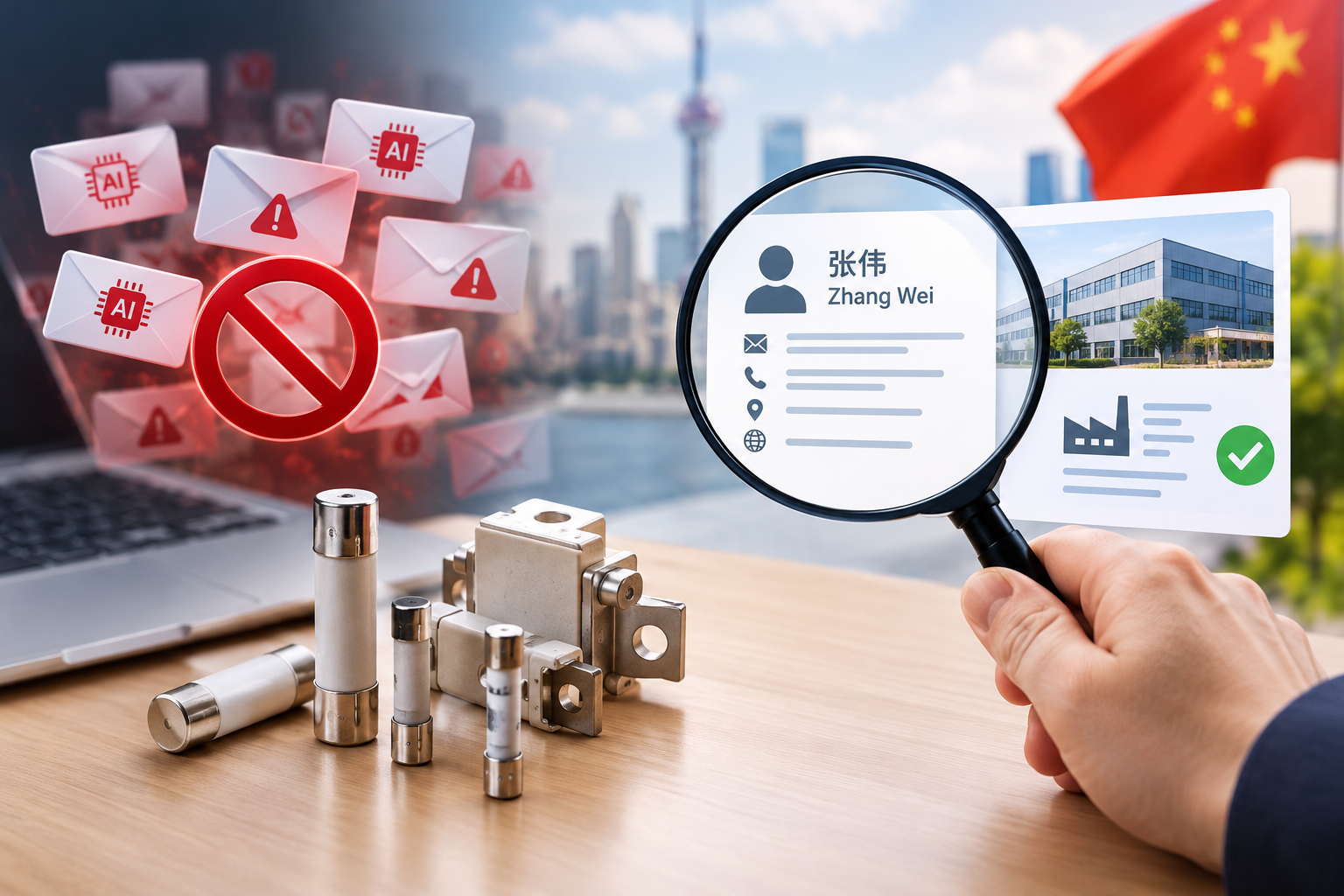
Fuse Manufacturers in China: How to Identify a Serious Business
China is one of the world's major manufacturing centres for electrical components, including fuses, circuit protection devices, and industrial safety products. For international buyers, working with Chinese fuse manufacturers can offer access to a wide range of products and competitive manufacturing capabilities.
However, finding a supplier is not the same as finding a reliable business partner.
When searching online for fuse manufacturers in China, buyers are increasingly confronted with unsolicited emails, generic sales pitches, and AI-generated spam messages. These emails may appear professional at first glance, but they do not necessarily demonstrate that the sender is a genuine manufacturer, has a qualified sales team, or has made any serious effort to contact your company.
So, how can you distinguish a serious Chinese fuse manufacturer from an unqualified or potentially misleading supplier?
1. Do Not Trust Every Email from a Chinese Fuse Manufacturer
Many companies receive unsolicited emails from Chinese suppliers promoting fuses, electrical components, and other industrial products. Some of these messages appear to be mass-produced using AI tools and distributed to large numbers of email addresses collected from websites, directories, and other publicly available sources.
The emails may contain polished English, technically correct phrases, and convincing product descriptions. Nevertheless, good English in an email does not prove that the sender actually speaks English or that the company has made a genuine effort to contact your business.
AI tools make it easy to generate professional-looking messages in almost any language. A supplier can send hundreds or thousands of emails without understanding the recipient's business, market, or technical requirements.
For example, a message may claim that a company manufactures high-quality industrial fuses and is interested in establishing a long-term partnership. Yet the email may not mention your company name, your products, or any specific reason why the sender believes your businesses would be a good match.
Such a message is not evidence of a meaningful business relationship.
When evaluating fuse manufacturers in China, look beyond the wording of the email. Pay attention to the sender's identity, company details, and the consistency of the information provided.
2. Check the Sender's Email Domain Against the Company Website
One of the first checks when receiving an unsolicited business email is to examine the sender's actual email address.
The sender's email domain should match the domain of the company's official website.
For example, if a manufacturer operates its official website under example-fuse.com, a business email from an address such as
This is not an absolute guarantee of legitimacy, but it is a useful first screening measure.
Pay attention to the actual sender address shown in the email headers, not just the display name. A sender may use a company name in the display field while sending the message from an unrelated domain.
For more detailed verification, check the following:
-
Does the sender's email domain correspond to the company's official website?
-
Does the company website provide the same email domain in its contact details?
-
Is the domain consistent throughout the correspondence?
-
Does the message contain suspicious inconsistencies between the sender's identity and the company being represented?
Where possible, inspect the technical email headers and authentication results, including SPF, DKIM, and DMARC. These can help determine whether the message was authorised by the sending domain, although they do not independently prove that the business itself is trustworthy.
If the sender uses an unrelated domain and cannot provide a credible explanation, treat the email with caution.
3. A Serious Chinese Business Should Provide Names in Both Chinese and Western Versions
Another useful indicator is the sender's email signature.
A professional Chinese manufacturer communicating with an international business partner should be able to identify the person contacting you clearly.
Ideally, the signature should include:
-
The sender's full name in Chinese characters.
-
The sender's name in a Western-language version, such as Pinyin.
-
The sender's position or department within the company.
-
The company's full legal name.
-
Complete company contact details.
For example, a signature might display a representative's Chinese name alongside its Pinyin version, making it easier to identify the person consistently across Chinese-language and international business records.
This matters because Chinese names may be transliterated into Western characters in different ways. Providing both versions helps reduce ambiguity and makes it easier to verify the sender's identity.
A signature containing only a generic English name, such as “David Sales Manager,” without a verifiable company identity offers little evidence about who is actually contacting you.
Of course, a missing Chinese name does not automatically prove fraud. However, when evaluating unsolicited approaches from Chinese fuse manufacturers, the absence of clear and consistent identification is a legitimate reason to request further verification.
4. Company Details Should Be Provided in Chinese Characters and a Western Version
The same principle applies to the company itself.
A serious Chinese manufacturer should be able to provide its complete company details in Chinese characters as well as in a Western-language version suitable for international customers.
The information should include, where applicable:
-
The full registered Chinese company name.
-
The company's official English name, if one is used.
-
Its registered business address.
-
Its official website.
-
Its business telephone number and relevant contact details.
-
Its business registration information.
The Chinese legal name is particularly important because an English company name may be a translation, a trading name, or a name used specifically for international marketing. It may not be the name under which the company is legally registered in China.
With the Chinese name, buyers can conduct more meaningful checks against official Chinese business registration records and other available sources.
It is also important to distinguish between a manufacturer and a trading company. A trading company may legitimately supply fuses without operating its own factory. The key is to understand exactly which type of business you are dealing with and whether it meets your requirements.
If a company claims to be a fuse manufacturer but cannot provide its full legal identity or explain where its products are manufactured, further investigation is advisable.
5. Generic AI-Generated Emails Are Not Proof of Genuine Business Interest
AI-generated communication is not inherently dishonest. Legitimate manufacturers can use AI tools to translate messages, improve grammar, and communicate more efficiently with international customers.
The problem arises when automated emails are sent indiscriminately to large numbers of businesses and presented as personalised sales enquiries.
A message written in fluent English may create the impression that the sender has carefully researched your company. In reality, it may be a generic template with little or no human involvement.
For buyers searching for fuse manufacturers in China, the important question is not whether an email was written by a human or an AI system. It is whether the sender can demonstrate a genuine business identity and engage meaningfully with your company.
A serious supplier should be able to answer specific questions about its products, manufacturing capabilities, technical specifications, certifications, and commercial conditions.
For example, if you ask about a particular fuse rating, breaking capacity, operating temperature, applicable standard, or production capability, the supplier should provide relevant and verifiable information rather than simply sending another generic sales presentation.
A professional response should demonstrate product knowledge and a clear understanding of your enquiry.
6. How to Evaluate a Chinese Fuse Manufacturer Before Doing Business
Once a supplier has passed the initial email checks, carry out a more thorough assessment before placing an order.
Consider the following steps:
Verify the legal entity. Compare the company's Chinese registered name, address, and available registration information with official or otherwise reliable records.
Confirm its manufacturing capabilities. Ask whether the company manufactures fuses itself or sources them from other factories. If factory ownership matters to your business, request appropriate evidence.
Review technical documentation. Depending on the product, request datasheets, applicable IEC or other relevant standards, test reports, and evidence of certifications. Verify certificates with the issuing organisation where possible.
Assess communication quality. A reliable supplier should respond to specific questions, explain technical details, and communicate clearly about lead times, minimum order quantities, quality control, and delivery conditions.
Request samples when appropriate. Samples can help you evaluate dimensions, markings, performance-related documentation, and compatibility before committing to a larger order. Electrical safety testing should be performed by qualified personnel where required.
Check commercial details. Confirm the contracting entity, payment beneficiary, invoice information, and delivery terms. Unexpected changes to bank details or payments to unrelated entities should trigger additional verification.
No single check guarantees that a supplier is reliable. The objective is to build a consistent picture from several independent sources.
7. When Should You Ignore an Email from a Chinese Fuse Supplier?
For busy purchasing departments, time is a limited resource. It is neither practical nor necessary to respond to every unsolicited sales email.
As a screening policy, it is reasonable to ignore or quarantine unsolicited emails that fail to provide basic, verifiable business information.
In particular, an email should be treated as low priority if:
-
The sender's domain does not match the company's official website and there is no credible explanation.
-
The sender cannot be identified by a verifiable name.
-
The signature omits the sender's Chinese name and Western-language version, with no reasonable explanation.
-
The company details are incomplete or do not provide the Chinese legal name alongside a Western-language version.
-
The company identity cannot be independently verified.
-
The message is generic, irrelevant, or appears to have been sent indiscriminately.
-
The sender avoids specific questions about the company, its products, or its manufacturing capabilities.
If an unsolicited email fails these basic identity checks, ignoring it is a sensible default. There is little reason to invest time in a supplier that has not provided enough information to establish who is contacting you.
However, these criteria should be understood as a practical screening policy rather than definitive proof of fraud. Smaller manufacturers, export agents, and legitimate companies with limited international sales experience may have incomplete signatures or use different email arrangements.
If a supplier appears commercially relevant but fails one of the checks, a brief request for its Chinese legal company name, official website, and verifiable contact details may resolve the issue. If the sender cannot or will not provide this information, there is little justification for proceeding.
Conclusion: Choose Verified Fuse Manufacturers in China, Not Just Convincing Emails
China offers a broad range of manufacturers and suppliers of electrical fuses, but international buyers should not confuse professional-looking sales emails with credible business relationships.
AI-generated spam makes it increasingly easy to produce convincing messages in English and other languages. A polished email does not prove that the sender speaks the language, understands your business, represents a genuine manufacturer, or has made a serious effort to establish contact.
When evaluating fuse manufacturers in China, begin with basic verification:
-
Check whether the sender's actual email domain matches the company's official website.
-
Look for the sender's name in both Chinese characters and a Western-language version.
-
Require complete company details in Chinese characters and a Western-language version.
-
Verify the company's legal identity and manufacturing role.
-
Assess technical competence and commercial reliability before proceeding.
These checks help purchasing managers and technical buyers filter out low-quality unsolicited messages and focus on suppliers that can demonstrate a credible business identity.
Ultimately, the goal is not to reject Chinese suppliers simply because they are Chinese or because they use AI tools. It is to apply consistent standards of transparency, verification, and professional communication to every potential business partner.
A serious fuse manufacturer should be prepared to identify itself clearly, substantiate its capabilities, and answer relevant questions. If an unsolicited email cannot meet even the most basic requirements for business identification, it should not be treated as a serious sales enquiry.



