
 bus-ele-cat-1007-flc-2018-sec-16-cross-ref-index.pdf bus-ele-cat-1007-flc-2018-sec-16-cross-ref-index.pdf | [Eaton Bussmann series Full line catalog: Cross reference and catalog index] | 2628 kB |
Eaton Bussmann Series Full Line Catalog: Fuse Cross Reference and Catalog Index Guide
Introduction
Selecting the correct electrical fuse is essential for reliable circuit protection, equipment safety, and efficient maintenance. The Eaton Bussmann Series Full Line Catalog 1007 – Fuse Cross Reference and Catalog Index is a useful technical resource for electricians, electrical engineers, maintenance professionals, panel builders, and industrial purchasing teams who need to identify and compare fuse products.
Section 16 of the catalog, published in October 2018, brings together fuse cross-reference information, catalog number listings, fuse selection guidance, selective coordination data, and technical reference material. It helps users navigate the Bussmann series product range and locate relevant information when specifying replacement fuses or planning electrical protection systems.
What Is the Eaton Bussmann Series Full Line Catalog?
The Eaton Bussmann Series Full Line Catalog is a technical reference for electrical circuit protection products. Its cross-reference and index section is designed to simplify product identification and help users navigate catalog information efficiently.
Whether you are maintaining industrial machinery, servicing electrical distribution equipment, or sourcing replacement fuses, the catalog provides a structured starting point for identifying catalog numbers and reviewing important fuse selection considerations.
The document is particularly useful when a technician has an existing fuse part number, needs to locate a product within the catalog, or wants to review information about fuse classes and protective device coordination.
Key Features of the Bussmann Fuse Cross Reference and Catalog Index
1. Fuse Cross-Reference Information
The fuse cross-reference section helps users identify relevant Bussmann series products when comparing existing fuse references or searching for potential replacements.
This is especially valuable during maintenance and repair operations, when the original fuse must be identified before a replacement can be specified.
When using cross-reference information, always verify the replacement fuse's electrical ratings, physical dimensions, fuse class, interrupting rating, time-current characteristics, and applicable approvals. A similar catalog number or ampere rating alone does not establish interchangeability.
2. Catalog Number Index
The catalog number index provides a convenient way to locate product references throughout the catalog. It is useful for procurement teams, distributors, electrical contractors, and engineers who need to find specific Bussmann series products without searching through every catalog section.
An organized catalog index can help streamline purchasing workflows, reduce product identification errors, and make technical documentation easier to navigate.
3. Fuse Sizing Guidance
The document includes guidance on fuse sizing for 600 V building electrical systems. It discusses different circuit applications, including feeder circuits, branch circuits, motor circuits, and transformer protection.
Fuse sizing depends on several factors, including load current, continuous and non-continuous loads, motor starting characteristics, conductor ampacity, and applicable electrical code requirements.
The catalog's sizing information should be treated as technical guidance rather than a substitute for an application-specific engineering assessment. Always confirm the current requirements of the applicable electrical code and the equipment manufacturer's instructions before selecting a fuse.
4. Selective Coordination Reference Tables
Selective coordination is an important consideration in electrical distribution systems where continuity of service matters.
The catalog includes Bussmann series fuse selectivity ratio tables that help engineers assess coordination between upstream and downstream fuses. Proper coordination can help isolate a fault to the affected portion of a system rather than unnecessarily interrupting power to other circuits.
These tables are useful during electrical system design, troubleshooting, and the evaluation of protective device arrangements. The specified fuse types, ratings, and system conditions must be checked before applying any coordination ratio.
5. Fuse Types, Classes, and Electrical Terminology
The catalog also contains reference information on low-voltage branch-circuit fuse types and classes, along with a glossary of common electrical terms and electrical formulas.
This information supports technicians and engineers who need to understand fuse classifications, interpret technical documentation, and compare protective device characteristics.
Understanding fuse classes and operating characteristics is important because different fuses may serve different protection requirements, even when their current ratings appear similar.
How to Use the Bussmann Fuse Cross Reference
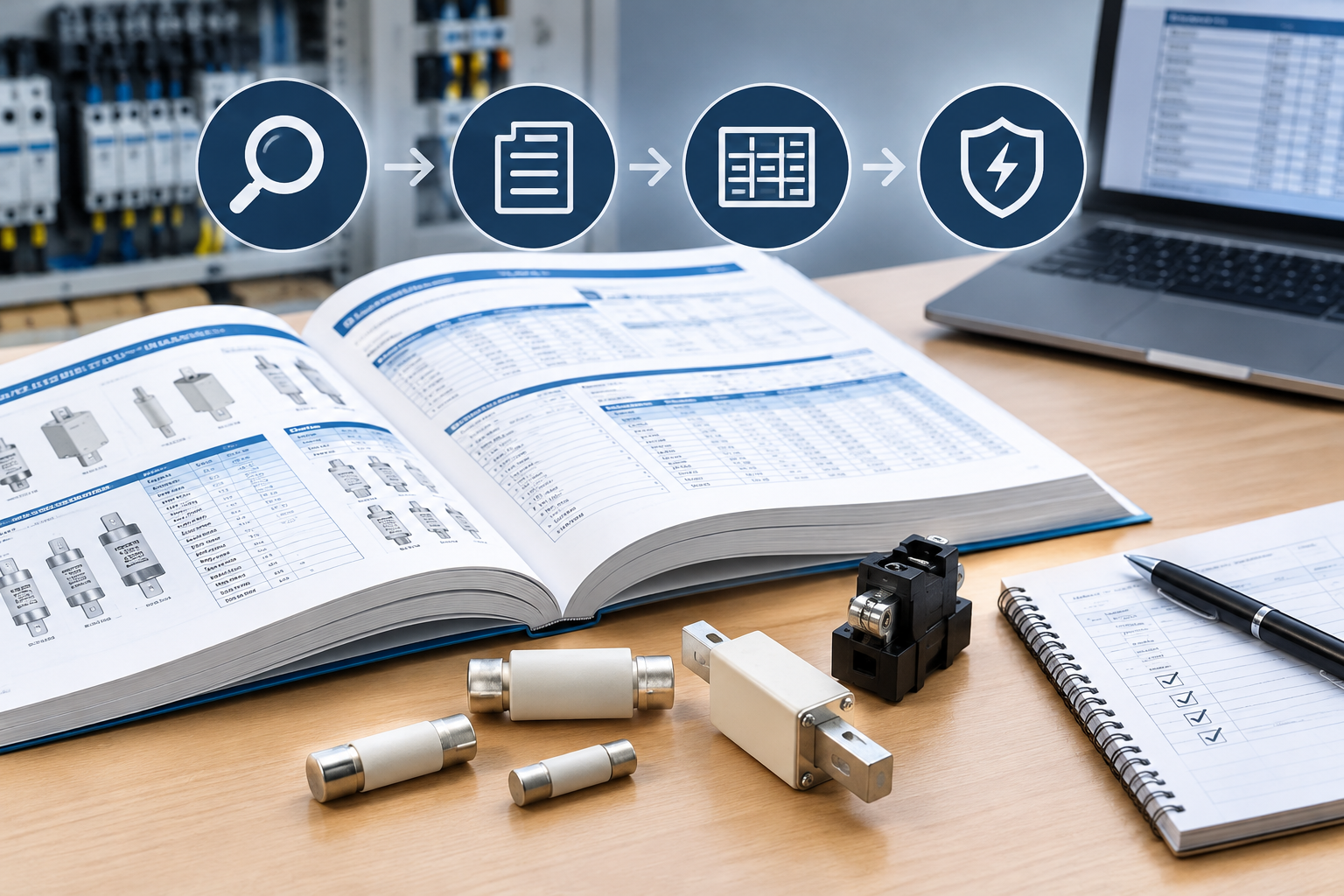
Following a consistent identification process can make fuse replacement and product sourcing more efficient.
Step 1: Identify the existing fuse.
Record the manufacturer, catalog number, current rating, voltage rating, fuse class, and any other markings on the existing component. Check the equipment documentation where available.
Step 2: Locate the catalog reference.
Use the catalog's cross-reference information or catalog number index to find the relevant product information.
Step 3: Verify the electrical specifications.
Compare the required current rating, voltage rating, interrupting capacity, operating characteristics, physical dimensions, and applicable standards.
Step 4: Confirm application suitability.
Consider the equipment being protected, available fault current, load characteristics, conductor requirements, and coordination with upstream and downstream protective devices.
Step 5: Validate before installation.
Confirm the proposed replacement against current manufacturer documentation, equipment requirements, and applicable regulations. Do not assume that a fuse is interchangeable solely because it fits the holder or has the same ampere rating.
This approach can help reduce incorrect orders, avoid unnecessary downtime, and support more reliable electrical maintenance.
Benefits for Electrical Engineers, Maintenance Teams, and Buyers
The Eaton Bussmann fuse catalog cross reference offers several practical benefits for professionals working with electrical protection systems.
-
Faster product identification: Locate catalog numbers and relevant fuse references more efficiently.
-
Simplified replacement research: Establish a starting point for identifying possible replacement fuses.
-
Improved purchasing accuracy: Use detailed product identification to reduce the risk of ordering an incorrect component.
-
Better technical planning: Review fuse classes, sizing considerations, and selective coordination information during system design and maintenance.
-
More efficient troubleshooting: Support maintenance investigations with structured product and technical reference information.
For facilities that maintain a large number of electrical panels, motor control centers, and distribution systems, a consistent catalog lookup process can also improve inventory management and maintenance documentation.
Who Should Use the Eaton Bussmann Full Line Catalog?
This catalog section is relevant to a broad range of electrical professionals:
Electrical engineers: For researching fuse characteristics, protection requirements, and coordination considerations.
Industrial maintenance technicians: For identifying installed fuses and investigating replacement options during maintenance activities.
Panel builders and electrical contractors: For checking product references and supporting component selection during assembly and installation.
Distributors and purchasing teams: For locating catalog numbers and improving the accuracy of parts sourcing.
Facility managers: For supporting electrical maintenance planning and organizing replacement component information.
Important Considerations When Selecting a Replacement Fuse
Although cross-reference tools can simplify product identification, electrical fuse selection requires more than matching a part number.
Before purchasing or installing a replacement, confirm the following:
-
Rated voltage and current.
-
Fuse class and physical configuration.
-
Interrupting rating relative to the available fault current.
-
Time-delay or fast-acting characteristics.
-
Compatibility with the fuse holder and protected equipment.
-
Applicable certification, listing, and electrical code requirements.
-
Coordination with other overcurrent protective devices where required.
A fuse that physically fits an existing holder may still be unsuitable for the application. For this reason, replacement decisions should be based on verified technical specifications and the requirements of the electrical system.
Is the 2018 Bussmann Catalog Still Useful?
The October 2018 edition remains a potentially useful reference for understanding historical catalog numbers, researching older installations, and navigating the fuse cross-reference and index section.
However, it should not automatically be treated as the definitive source for current product availability, revised specifications, discontinued products, or current regulatory requirements. Product lines and technical documentation can change over time.
For new installations and critical replacement decisions, confirm the selected product against the latest applicable Eaton Bussmann technical documentation and the requirements of the equipment manufacturer.
Frequently Asked Questions
What is the Eaton Bussmann Series Full Line Catalog 1007?
It is a technical catalog covering Bussmann series electrical circuit protection products. Section 16 focuses on fuse and fuse block cross references, catalog number indexing, fuse sizing guidance, selective coordination, and supporting technical reference material.
What is a fuse cross-reference catalog used for?
A fuse cross-reference catalog helps users identify relevant product references when researching existing fuses or possible replacements. It supports product identification, purchasing, and maintenance, but any proposed replacement must be checked for electrical and mechanical compatibility.
Where can I find Bussmann fuse catalog numbers?
The catalog's catalog number index is organized to help users locate product references. Section 16 of the 2018 Full Line Catalog 1007 includes the index in pages 10–14 of the section, alongside the cross-reference material.
Does the Bussmann cross-reference guarantee that two fuses are interchangeable?
No. A cross-reference is a research aid, not a guarantee of interchangeability in every application. Voltage rating, current rating, interrupting capacity, fuse class, dimensions, operating characteristics, approvals, and equipment requirements must all be considered.
Can I use the 2018 catalog to select a fuse for a new installation?
The catalog can provide useful background and preliminary selection guidance. However, current manufacturer specifications, applicable codes, and the specific characteristics of the installation must be verified before a fuse is selected.
Conclusion
The Eaton Bussmann Series Full Line Catalog 1007: Fuse Cross Reference and Catalog Index is a valuable reference for professionals who need to identify fuse products, research catalog numbers, and understand key electrical protection considerations.
Its combination of cross-reference information, catalog indexing, fuse sizing guidance, selective coordination tables, and technical terminology makes it useful for maintenance, engineering, purchasing, and electrical system planning.
For the best results, use the catalog as a starting point for product research and verify all final selections against current manufacturer specifications and application requirements. This helps support accurate sourcing, dependable circuit protection, and safer electrical installations.



