
 bus-ele-cat-1007-flc-2018-sec-08-blocks-holders.pdf bus-ele-cat-1007-flc-2018-sec-08-blocks-holders.pdf | [Eaton Bussmann series Full line catalog: Fuse blocks and holders] | 11744 kB |
Eaton Bussmann Series Fuse Blocks and Holders: Product Range, Selection Guide and Applications
Introduction to Eaton Bussmann Series Fuse Blocks and Holders
Reliable electrical circuit protection starts with selecting the right fuse and the correct mounting solution. Eaton Bussmann Series fuse blocks and fuse holders are designed to accommodate a wide range of fuse types and electrical applications, helping engineers, panel builders, maintenance professionals and electrical equipment manufacturers integrate fuses into their systems.
The Eaton Bussmann Series Full Line Catalog 1007, Section 8, covers fuse blocks and holders for industrial control panels, electrical distribution systems and other circuit protection applications. It includes product families for different fuse classes, mounting arrangements, current ratings and installation requirements.
From DIN-rail-mounted fuse holders to panel-mount fuse blocks and in-line fuse holders, this catalog provides a technical reference for identifying suitable components for specific electrical designs.
What Are Fuse Blocks and Fuse Holders?
Fuse blocks and fuse holders provide a secure mounting point for electrical fuses within a circuit. They help establish the required electrical connections while allowing fuses to be installed, inspected and replaced as part of a maintenance or service procedure.
Although the terms are sometimes used interchangeably, their designs and intended applications can differ.
-
Fuse blocks: Provide a mounting base and electrical terminals for compatible fuses, commonly used in control panels and electrical distribution assemblies.
-
Fuse holders: Retain a compatible fuse in a defined mounting arrangement, such as a DIN rail, panel opening or in-line connection.
-
Power distribution fuse blocks: Combine fuse protection and power distribution functions in a single assembly, depending on the product design.
Choosing the appropriate component requires more than matching physical dimensions. Fuse compatibility, voltage and current ratings, terminal requirements, available space and applicable electrical standards must also be considered.
Overview of the Eaton Bussmann Series Full Line Catalog 1007, Section 8
Section 8 of the Eaton Bussmann Series Full Line Catalog 1007 is dedicated to fuse blocks and holders. The October 2018 catalog edition organizes products by fuse type, size, application and mounting configuration.
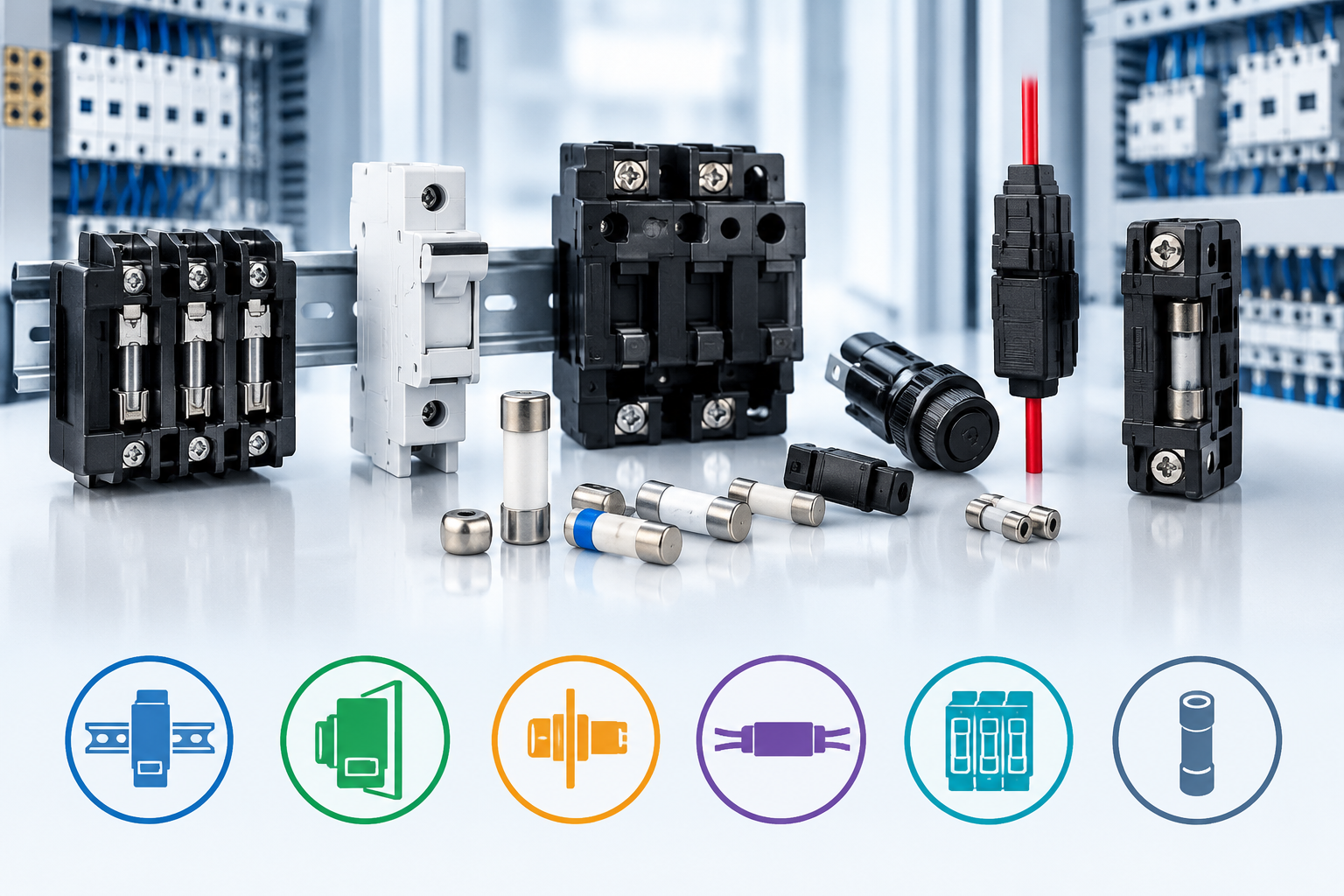
The section includes the following major product categories:
1. Class CC and Midget Fuse Blocks
Class CC and midget fuse blocks are used in compact circuit protection applications, including industrial control panels and control circuits.
The catalog includes modular fuse block families such as BCM and BMM, alongside additional panel-mount and DIN-rail mounting options. These products support the integration of compatible fuse types into control panel designs where space, accessibility and correct fuse selection are important.
2. DIN-Rail Fuse Holders
DIN-rail fuse holders are designed for installations that use standardized mounting rails inside electrical enclosures and control cabinets.
The catalog covers families including CHCC, CHM, NDNF1 and OPM. Depending on the specific model, these holders accommodate different fuse types and sizes.
DIN-rail mounting can simplify panel assembly and maintenance by providing a consistent mounting arrangement and helping organize circuit protection components within an enclosure.
3. Panel-Mount Fuse Blocks
Panel-mount fuse blocks are suitable for applications requiring direct mounting to a panel or equipment structure.
The catalog includes product families such as 3743, 4421, 4515, BG and G. The correct selection depends on the compatible fuse, electrical ratings, terminal configuration and mounting requirements.
These components are relevant to machinery, industrial equipment and control assemblies in which fuses need a defined mounting location.
4. Through-Panel Fuse Holders
Through-panel fuse holders are designed to provide access to a fuse through a panel or enclosure wall. They can be useful when service personnel need to replace a fuse without accessing the internal mounting area directly.
Section 8 includes several holder families for different fuse dimensions, including HTB, HJL, HK, HKP, HLD, HPC, HPD, HPF, HPG, HPM and HPS.
Product suitability varies by series, so the exact fuse dimensions, ratings, mounting cut-out and terminal specifications should be verified before installation.
5. In-Line Fuse Holders
In-line fuse holders are installed within a conductor or wiring assembly and provide a location for a compatible fuse in the electrical path.
The catalog includes holder families for several fuse sizes and classes, including HFA, HFB, HEB, HHB, HR, HM, HRK, HEX and HEY.
Depending on the model, in-line holders may be appropriate for equipment wiring, auxiliary circuits and other applications where the fuse needs to be positioned within a cable or conductor arrangement.
6. Fuse Blocks for Other Fuse Classes
The catalog also covers fuse block and holder options for Class G, Class J, Class T and other fuse formats, as well as NH fuse applications.
These product groups serve different circuit protection requirements. Their current and voltage capabilities, physical dimensions, interruption characteristics and mounting arrangements are not interchangeable by default.
Always select the fuse and its associated holder or block as a compatible combination.
Key Benefits of Selecting the Right Fuse Block or Holder
The correct fuse mounting solution can improve the practicality and maintainability of an electrical installation.
Organized Electrical Panel Design
A suitable fuse block or DIN-rail holder helps keep circuit protection components properly arranged within an enclosure. This supports a more structured panel layout and can make identification and servicing easier.
Compatibility With Specific Fuse Types
Fuse blocks and holders are designed for defined fuse classes, dimensions and configurations. Selecting the appropriate product helps ensure that the fuse fits correctly and that the electrical connections meet the application requirements.
Simplified Maintenance
Accessible fuse mounting arrangements can make inspection and fuse replacement more straightforward. The best configuration depends on the installation environment, enclosure design and maintenance procedures.
Flexible Mounting Options
DIN-rail, panel-mount, through-panel and in-line configurations allow engineers to choose a solution suited to the equipment's physical layout and wiring arrangement.
Space-Conscious Design
Modular products and integrated power distribution solutions can help make effective use of available enclosure space. The actual space savings depend on the selected product, its terminal layout and the overall panel design.
How to Choose the Correct Eaton Bussmann Fuse Block or Holder
Selecting the correct component is essential for electrical compatibility and reliable circuit protection. The following factors should be reviewed during product selection.
1. Identify the Fuse Class and Type
Start by identifying the fuse that the application requires. This may include Class CC, Class G, Class J, Class T, a midget fuse or another supported format.
The holder or block must be specifically suitable for the intended fuse. Similar-looking fuses are not necessarily interchangeable.
2. Verify Voltage and Current Ratings
Check the required system voltage and the fuse's rated current, then confirm that the selected mounting component is suitable for the application.
Do not assume that every product within a particular family has the same ratings. Always consult the individual product specifications and applicable limitations.
3. Select the Appropriate Mounting Style
Consider the available space and how the fuse will be accessed during installation and maintenance.
-
Choose DIN-rail mounting when the panel design uses compatible mounting rails.
-
Consider panel-mount blocks for direct installation on a panel or equipment structure.
-
Evaluate through-panel holders when external access to the fuse is needed.
-
Consider in-line holders for suitable wiring and conductor applications.
4. Check Terminal and Conductor Compatibility
Review terminal type, conductor size, wiring configuration and installation requirements. The terminals must be suitable for the conductors used in the assembly and installed according to the manufacturer's instructions.
5. Review Safety and Compliance Requirements
Check applicable product approvals, environmental requirements, short-circuit current rating where relevant, and any requirements imposed by the electrical system or governing standards.
A fuse holder's rating does not automatically establish the short-circuit performance of the complete assembly. System-level coordination and verification may be necessary.
6. Confirm the Exact Catalog Number
Use the catalog's product tables, dimensional drawings and ordering information to identify the correct catalog number and configuration. Where multiple terminal or mounting options are available, verify the complete ordering code rather than relying on the product family name alone.
Typical Applications for Fuse Blocks and Holders
Eaton Bussmann Series fuse blocks and holders can support a variety of electrical equipment designs when correctly selected for the application.
Industrial control panels: Fuse blocks and DIN-rail holders can be used to integrate suitable fuses into control circuits and other protected electrical branches.
Machinery and automation equipment: Panel-mount and modular fuse solutions can support circuit protection in machinery control assemblies and equipment enclosures.
Electrical distribution assemblies: Compatible fuse blocks can be incorporated into suitable distribution arrangements to protect individual circuits.
Equipment wiring: Appropriate in-line fuse holders can provide a defined fuse location within wiring assemblies.
Maintenance and replacement projects: Catalog-based selection can help technicians identify mounting components compatible with the intended replacement fuse and installation requirements.
The appropriate solution depends on the actual circuit design, environmental conditions, electrical ratings and applicable regulations.
Why Use the Full Line Catalog for Product Selection?
The Eaton Bussmann Series Full Line Catalog 1007, Section 8, brings multiple fuse block and holder families together in one technical reference.
Its selection guide helps users compare available mounting categories and identify product families associated with specific fuse classes and sizes. The individual product pages provide further information needed to assess the suitability of a component.
For engineers, procurement teams and maintenance professionals, this can support a more structured selection process by helping narrow down the available options before checking detailed specifications.
Because the referenced edition is dated October 2018, users should verify current product availability, ratings, approvals and ordering information before specifying or purchasing a component.
Frequently Asked Questions
What products are covered in the Eaton Bussmann Series fuse blocks and holders catalog?
Section 8 covers a broad range of fuse mounting products, including Class CC and midget fuse blocks, DIN-rail holders, panel-mount blocks, through-panel holders, in-line holders and options for other fuse classes.
What is the difference between a DIN-rail fuse holder and a panel-mount fuse block?
A DIN-rail fuse holder is designed to mount on a compatible DIN rail, while a panel-mount fuse block is designed for direct mounting to a panel or equipment structure. The appropriate choice depends on the enclosure design, fuse type and installation requirements.
How do I find the correct catalog number?
Identify the required fuse class and dimensions, then review the relevant product tables and individual product specifications. Confirm the mounting style, terminal configuration, electrical ratings and complete ordering code before placing an order.
Can any Bussmann fuse holder be used with any Bussmann fuse?
No. Fuse holders and blocks are designed for specific fuse dimensions, types and ratings. Compatibility must be confirmed using the manufacturer's documentation.
Is the 2018 catalog suitable for current purchasing decisions?
The 2018 edition remains a useful technical reference for identifying product families and understanding their configurations. However, current availability, specifications, approvals and ordering details should be verified before finalizing a design or purchase.
Conclusion
Eaton Bussmann Series fuse blocks and holders provide a range of mounting solutions for compatible fuses in industrial control panels, electrical equipment and wiring assemblies. The Full Line Catalog 1007, Section 8, helps users navigate options for DIN-rail mounting, panel mounting, through-panel installation, in-line applications and different fuse classes.
By checking fuse compatibility, electrical ratings, terminal specifications, mounting requirements and current product documentation, engineers and purchasing professionals can identify a suitable fuse mounting solution for their application.
For dependable circuit protection, the key is to select the fuse and its associated block or holder as a compatible system, based on verified manufacturer specifications and the requirements of the installation.



