
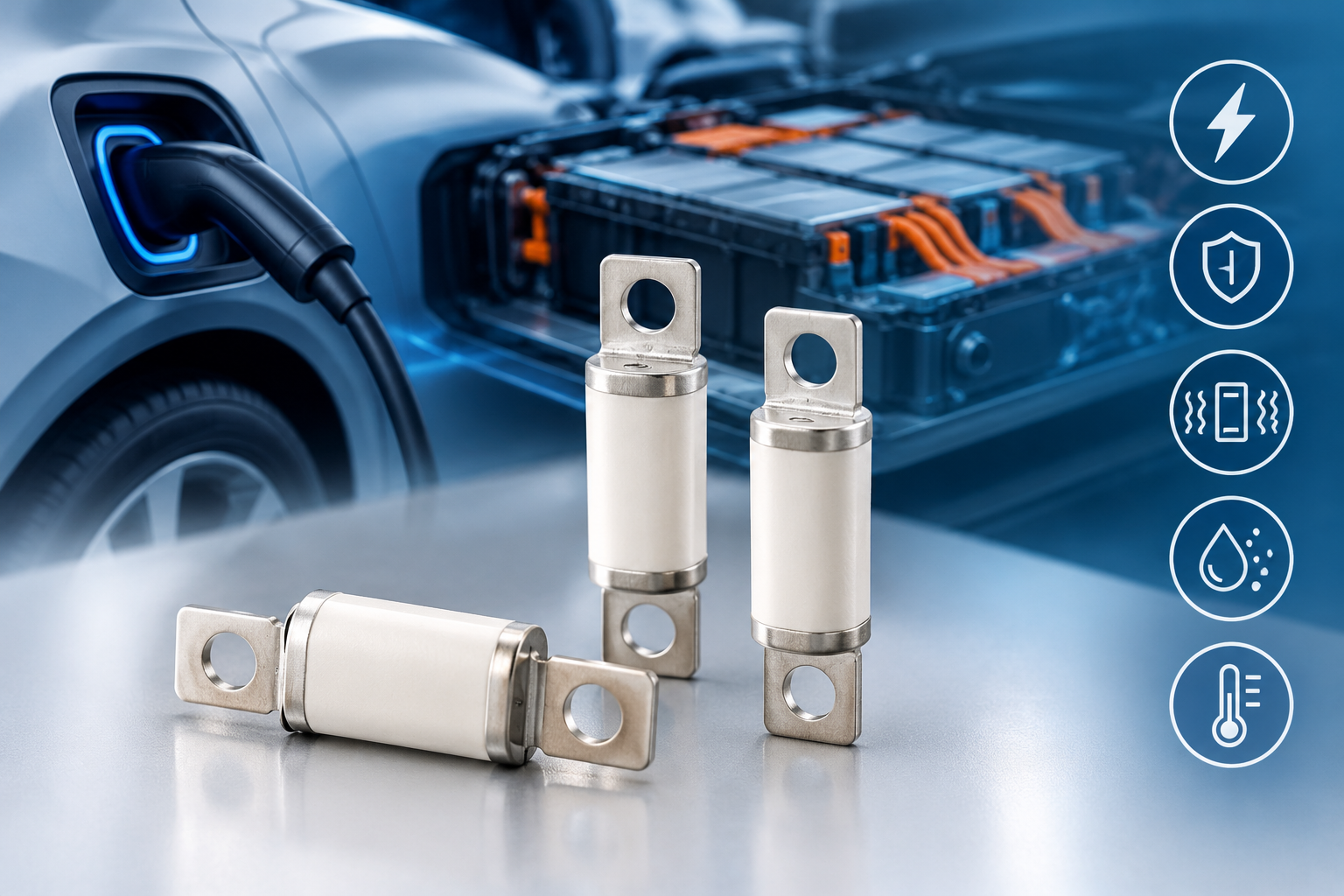
 eaton-ev-fuse-catalogue-emob0062-en-us.pdf  | [Eaton Bussmann EV Fuses] | 0 kB |
Eaton Bussmann EVR 30 mm Fuses: High-Voltage DC Protection for Electric Vehicles
As electric vehicles (EVs) and high-voltage battery systems continue to evolve, reliable circuit protection is essential for electrical safety, system efficiency, and dependable performance. Eaton Bussmann EVR 30 mm fuses are designed for high-current, high-voltage DC applications, helping protect demanding electrical systems used in electric mobility and battery-powered platforms.
With a rated voltage of 500 V DC, current ratings from 200 A to 400 A, and a maximum breaking capacity of 20 kA, the EVR 30 mm fuse range supports the protection requirements of high-capacity battery packs and other suitable high-voltage DC applications.
This guide covers the key technical specifications, product features, available part numbers, installation considerations, and standards associated with Eaton Bussmann EVR 30 mm fuses.
What Are Eaton Bussmann EVR 30 mm Fuses?
Eaton Bussmann EVR 30 mm fuses are high-voltage DC fuses intended for electrical protection in applications that require high current-carrying capability and effective fault-current interruption.
As electric vehicle battery packs operate at increasingly higher voltages and deliver substantial power, appropriately selected fuses play an important role in protecting electrical circuits against excessive current and short-circuit faults.
The EVR 30 mm series offers six rated-current options, ranging from 200 A to 400 A. This range allows engineers and system designers to select a fuse rating appropriate to their specific circuit requirements, operating conditions, and protection strategy.
Key product specifications include:
-
Rated voltage: 500 V DC
-
Rated current range: 200 A–400 A
-
Maximum breaking capacity: 20 kA
-
Minimum breaking capacity: 300% of rated current
-
Time constant: 1–3 ms
-
Screw connection: M8
-
Storage temperature: −40°C to +85°C
Key Features and Benefits of EVR 30 mm Fuses
1. 500 V DC Rated Voltage for High-Voltage Systems
The EVR 30 mm fuse series features a rated voltage of 500 V DC, supporting applications designed around high-voltage battery architectures.
Higher-voltage electrical systems can deliver the required power at lower current levels than lower-voltage systems, potentially allowing smaller and more economical conductors when the complete system is appropriately engineered.
For electric vehicle manufacturers and battery system designers, this can contribute to improved overall system efficiency and reduced conductor requirements. Actual benefits depend on system design, current demand, thermal conditions, and applicable safety requirements.
2. High Current Ratings from 200 A to 400 A
The EVR 30 mm product family includes six current ratings:
-
200 A
-
225 A
-
250 A
-
300 A
-
350 A
-
400 A
This selection provides flexibility for high-current electrical circuits across different system configurations.
Choosing the correct fuse rating requires consideration of normal operating current, load characteristics, ambient temperature, conductor capacity, overload conditions, and the required coordination with other protective devices.
A fuse with a higher current rating is not automatically the best choice. Proper selection must ensure that the fuse provides effective protection under the anticipated fault conditions.
3. Maximum Breaking Capacity of 20 kA
One of the key characteristics of Eaton Bussmann EVR 30 mm fuses is their specified maximum breaking capacity of 20 kA.
Breaking capacity describes the maximum prospective fault current that a fuse is designed to interrupt safely under its specified test conditions. This is particularly important in high-capacity battery systems, where available short-circuit currents can be substantial.
Effective fault-current interruption helps reduce the risk of continued fault current and associated damage to electrical components.
Engineers should verify that the fuse's breaking capacity is suitable for the prospective short-circuit current at the installation point and for the actual circuit voltage and DC time constant.
4. Minimum Breaking Current of 300% of Rated Current
The specified minimum breaking current is 300% of the fuse's rated current.
This parameter is important when evaluating the fuse's operating characteristics and its suitability for a particular circuit. It should be considered alongside the fuse time-current characteristics and the system's expected overload and fault-current profile.
For reliable protection, engineers should confirm that anticipated fault currents fall within the fuse's specified operating range and that the fuse coordinates correctly with other protection devices.
5. Time Constant of 1–3 ms
The EVR 30 mm series specifies a time constant of 1–3 milliseconds.
In DC circuit protection, the circuit time constant is relevant to fault interruption because DC current does not naturally pass through zero in the same way as alternating current. The inductance and resistance of the circuit can therefore influence the difficulty of interrupting a fault.
The actual application should be assessed against the manufacturer's specified test conditions and interruption characteristics to ensure the fuse is suitable for the intended DC circuit.
6. M8 Screw Connection for Secure Installation
All listed EVR 30 mm fuse variants use an M8 screw connection.
The specified torque limit is 12 ± 1 Nm, corresponding to an installation torque range of 11–13 Nm. Following the manufacturer's installation instructions is important to help achieve a reliable electrical connection and avoid connection problems associated with incorrect tightening.
The listed product weight is 0.16 kg per fuse, and the packaging quantity is 100 units per box.
Eaton Bussmann EVR 30 mm Fuses: Technical Specifications
The following table summarises the main technical data for the EVR 30 mm fuse range.
| Parameter | Specification |
|---|---|
| Product series | Eaton Bussmann EVR 30 mm |
| Rated voltage | 500 V DC |
| Rated current | 200 A–400 A |
| Maximum breaking capacity | 20 kA |
| Minimum breaking current | 300% of rated current |
| Time constant | 1–3 ms |
| Screw type | M8 |
| Weight | 0.16 kg |
| Storage temperature | −40°C to +85°C |
| Torque limit | 12 ± 1 Nm |
| Packaging quantity | 100 per box |
These specifications are based on the supplied product data. Always consult the applicable manufacturer datasheet for detailed electrical characteristics, dimensional information, and installation requirements before specifying or installing a fuse.
Available Eaton Bussmann EVR 30 mm Fuse Part Numbers
The EVR 30 mm range comprises six part numbers, allowing selection according to the required nominal current rating.
| Part number | Rated current | Packaging | Screw type | Weight | Storage temperature | Torque limit |
|---|---|---|---|---|---|---|
| EVR30-200 | 200 A | 100/box | M8 | 0.16 kg | −40°C to +85°C | 12 ± 1 Nm |
| EVR30-225 | 225 A | 100/box | M8 | 0.16 kg | −40°C to +85°C | 12 ± 1 Nm |
| EVR30-250 | 250 A | 100/box | M8 | 0.16 kg | −40°C to +85°C | 12 ± 1 Nm |
| EVR30-300 | 300 A | 100/box | M8 | 0.16 kg | −40°C to +85°C | 12 ± 1 Nm |
| EVR30-350 | 350 A | 100/box | M8 | 0.16 kg | −40°C to +85°C | 12 ± 1 Nm |
| EVR30-400 | 400 A | 100/box | M8 | 0.16 kg | −40°C to +85°C | 12 ± 1 Nm |
How to Choose the Right EVR 30 mm Fuse
Selecting the correct part number starts with understanding the circuit's normal operating conditions and protection requirements.
EVR30-200 — 200 A: For applications requiring a nominal fuse current rating of 200 A, subject to the full circuit design and manufacturer's specifications.
EVR30-225 — 225 A: For circuits designed around a 225 A fuse rating.
EVR30-250 — 250 A: For applications requiring a nominal 250 A fuse rating.
EVR30-300 — 300 A: For circuits designed around a 300 A fuse rating.
EVR30-350 — 350 A: For applications requiring a nominal 350 A fuse rating.
EVR30-400 — 400 A: For circuits designed around a 400 A fuse rating.
These descriptions identify the nominal ratings rather than prescribing a particular application for each SKU. Final selection must account for the fuse's time-current performance, temperature derating, fault current, conductor protection, and coordination with the rest of the electrical system.
Standards and Regulatory Compliance
The supplied product information identifies the following standards as design references for the Eaton Bussmann EVR 30 mm fuse series:
-
ISO 8820-8:2012
-
GB/T 31465.1-2015
-
GB/T 31465.6-2017
-
GB/T 13539.1-2015
-
GB/T 13539.4-2016
The product information also states that the series is compliant with RoHS, ELV, and REACH requirements.
These regulatory frameworks address different aspects of environmental and chemical compliance:
-
RoHS: Restricts the use of specified hazardous substances in covered electrical and electronic equipment.
-
ELV: Addresses end-of-life vehicle requirements, including restrictions on certain hazardous substances in vehicles and their components.
-
REACH: Governs the registration, evaluation, authorisation, and restriction of chemicals in the European Union.
The listed standards should be understood as design references unless the applicable certification or conformity documentation confirms the precise scope of compliance. Buyers should request current manufacturer documentation when formal certification or regulatory verification is required.
Typical Applications of EVR 30 mm Fuses
The EVR 30 mm fuse series is intended for high-voltage DC circuit protection. Potential applications should be assessed against the manufacturer's approved application scope and the system's electrical requirements.
Relevant application areas may include:
-
Electric vehicle battery systems: High-voltage DC circuits associated with traction battery architectures.
-
Battery-powered vehicle platforms: Electrical systems requiring high-current protection.
-
High-capacity battery packs: Circuits where available fault current and interruption capability are important design considerations.
-
High-voltage DC distribution: Suitable circuits that meet the fuse's voltage, current, time-constant, and breaking-capacity specifications.
In electric vehicles, battery packs must deliver high power for acceleration and driving range while maintaining appropriate electrical protection. Correctly specified fuses form one part of a wider safety strategy that can also include contactors, battery management systems, insulation monitoring, and other protective measures.
The EVR 30 mm fuse should not be assumed suitable for every EV, energy storage, or industrial application simply because the nominal voltage and current ratings appear compatible. Full manufacturer specifications and system-level validation remain essential.
Installation and Storage Considerations
Correct handling, installation, and storage help maintain the expected performance of electrical protection components.
Installation torque
The supplied torque specification is 12 ± 1 Nm for the M8 screw connection. Use the manufacturer's approved installation procedure and suitable tools, ensuring that mating surfaces, terminals, and mounting arrangements meet the specified requirements.
Storage temperature
The listed storage temperature range is −40°C to +85°C. This is a storage specification, not necessarily the permitted operating-temperature range. Confirm the operating limits and any derating requirements in the manufacturer's datasheet.
Electrical system compatibility
Before installation, verify:
-
The circuit's maximum continuous DC voltage.
-
The expected normal operating current and load profile.
-
The prospective short-circuit current at the installation point.
-
Compatibility with the specified DC time constant.
-
The fuse's time-current characteristics and breaking capacity.
-
Coordination with cables, busbars, contactors, and other protective devices.
-
The manufacturer's mounting, clearance, and environmental requirements.
A qualified engineer should confirm the fuse selection and the overall protection strategy before the equipment is placed into service.
Why Consider Eaton Bussmann EVR 30 mm Fuses?
For designers and procurement teams working with high-voltage DC electrical systems, the EVR 30 mm series offers a defined range of current ratings and a 500 V DC voltage specification.
Its principal selection considerations include:
-
A rated voltage of 500 V DC.
-
Six current-rating options from 200 A to 400 A.
-
A specified maximum breaking capacity of 20 kA.
-
An M8 screw connection.
-
A specified storage temperature range of −40°C to +85°C.
-
Published design references and environmental compliance information.
These characteristics make the series worth evaluating for suitable high-current DC protection requirements. Final suitability depends on the manufacturer's complete technical documentation and the conditions of the intended installation.
Frequently Asked Questions About Eaton Bussmann EVR 30 mm Fuses
What is the rated voltage of an Eaton Bussmann EVR 30 mm fuse?
The specified rated voltage is 500 V DC.
What current ratings are available?
The series includes 200 A, 225 A, 250 A, 300 A, 350 A, and 400 A variants.
What is the maximum breaking capacity?
The maximum breaking capacity is specified as 20 kA. The prospective fault current, circuit voltage, and DC time constant must be checked against the manufacturer's ratings and test conditions.
What is the minimum breaking current?
The supplied technical data specifies a minimum breaking current of 300% of the fuse's rated current.
What is the recommended installation torque?
The listed torque limit is 12 ± 1 Nm for the M8 screw connection. Follow the current manufacturer's installation instructions for the specific product.
What is the storage temperature range?
The specified storage temperature range is −40°C to +85°C. The permissible operating-temperature range may differ.
How many fuses are supplied in each box?
The listed packaging quantity is 100 fuses per box for all six part numbers.
Which standards are referenced for the EVR 30 mm series?
The supplied product information references ISO 8820-8:2012, GB/T 31465.1-2015, GB/T 31465.6-2017, GB/T 13539.1-2015, and GB/T 13539.4-2016. Confirm the applicable documentation for the exact part number and intended market.
Conclusion
Eaton Bussmann EVR 30 mm fuses provide a range of high-voltage DC fuse options with a rated voltage of 500 V DC, current ratings from 200 A to 400 A, and a specified maximum breaking capacity of 20 kA.
With six available part numbers, M8 screw connections, and published technical and regulatory information, the series offers engineers and procurement professionals a useful starting point when evaluating fuse protection for suitable electric vehicle and high-current DC applications.
For the best results, match the fuse rating to the circuit's operating conditions, confirm fault-interruption requirements, and consult the manufacturer's datasheet before making a final selection.
Looking for an Eaton Bussmann EVR 30 mm fuse? Compare the EVR30-200, EVR30-225, EVR30-250, EVR30-300, EVR30-350, and EVR30-400 part numbers to identify the rating that best matches your technical requirements.



