
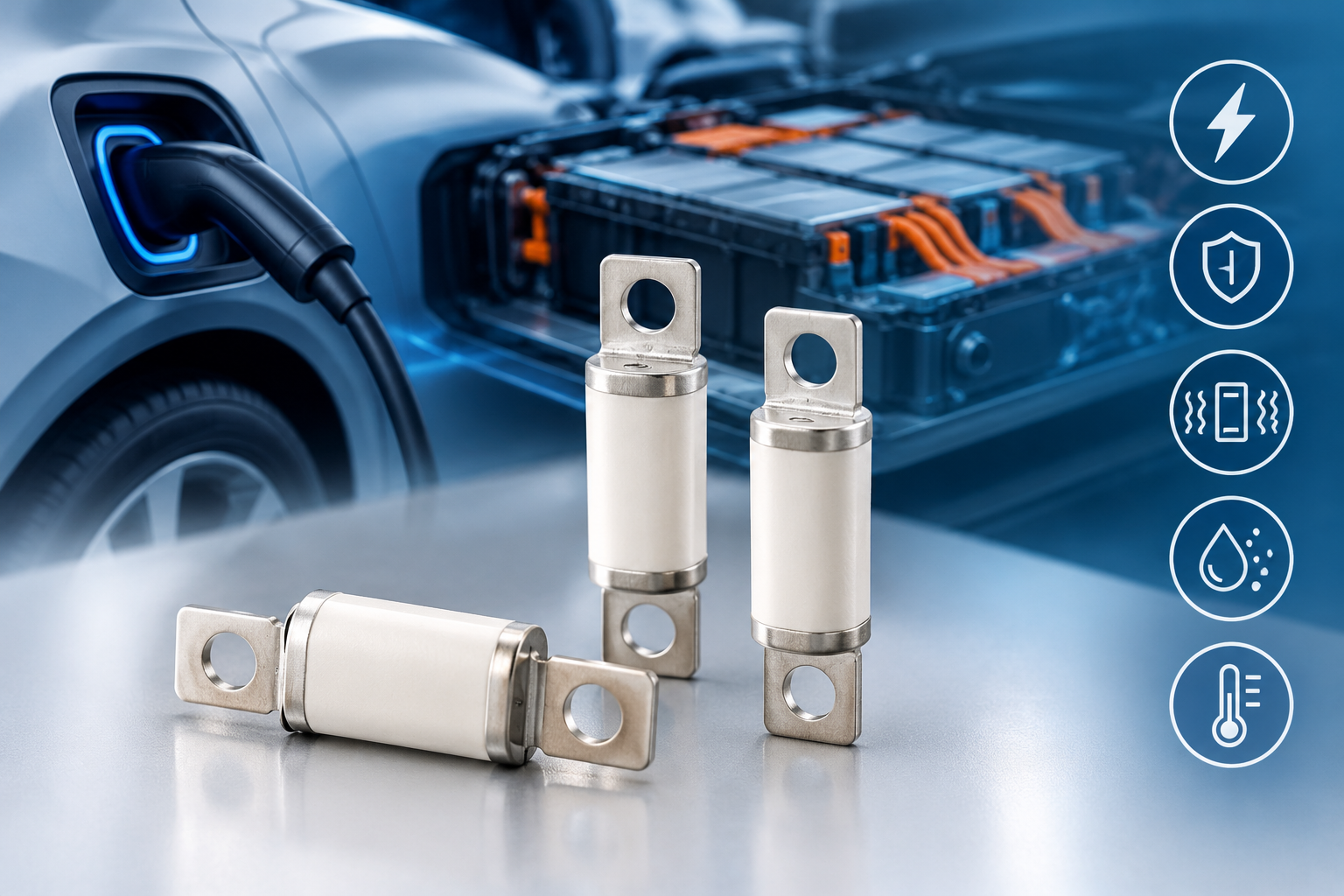
 eaton-ev-fuse-catalogue-emob0062-en-us.pdf  | [Eaton Bussmann EV Fuses] | 0 kB |
Eaton Bussmann EVR 40 mm Fuses: High-Voltage DC Protection for Electric Vehicles
As electric vehicles (EVs) and high-voltage battery systems continue to evolve, reliable electrical protection is essential for improving safety, performance and system efficiency. The Eaton Bussmann EVR 40 mm fuses are designed to meet the demanding requirements of high-capacity electric vehicle battery packs, providing high-voltage DC protection for applications that require substantial current-handling capability and high interrupting performance.
With a rated voltage of 500 V DC, current ratings from 350 A to 600 A, and a maximum breaking capacity of 50 kA, the EVR 40 mm fuse series offers a range of options for engineers and manufacturers developing modern electric vehicle electrical systems.
In this guide, we explore the key features, technical specifications, available part numbers and application considerations for Eaton Bussmann EVR 40 mm fuses.
What Are Eaton Bussmann EVR 40 mm Fuses?
Eaton Bussmann EVR 40 mm fuses are high-current DC protection components designed for demanding electric vehicle applications. They are intended to protect electrical circuits against excessive current and help interrupt fault currents when operating conditions exceed the fuse's designed characteristics.
As EV battery systems increase in voltage and energy capacity, circuit protection components must be capable of handling high operating currents and interrupting potentially substantial fault currents. The EVR 40 mm series addresses these requirements with a 500 V DC voltage rating and current options ranging from 350 A to 600 A.
The series is particularly relevant to engineers, system integrators and manufacturers looking for high-current fuse solutions for electric vehicle battery and power distribution systems.
Key Features and Benefits of EVR 40 mm Fuses
1. 500 V DC Rated Voltage
The EVR 40 mm fuse series has a rated voltage of 500 V DC, supporting the requirements of high-voltage electric vehicle battery systems within its specified operating limits.
Higher-voltage architectures can help improve overall system efficiency by allowing lower current for a given power level. Depending on the system design, this can support the use of smaller, more economical conductors while meeting the requirements of higher-voltage battery packs.
Selecting a fuse with the appropriate DC voltage rating is essential because DC fault interruption presents different challenges from AC circuit protection.
2. High Current Ratings from 350 A to 600 A
The EVR 40 mm range offers six rated-current options:
-
350 A – EVR40-350
-
400 A – EVR40-400
-
450 A – EVR40-450
-
500 A – EVR40-500
-
550 A – EVR40-550
-
600 A – EVR40-600
This selection allows engineers to evaluate different fuse ratings according to the application's continuous operating current, expected overload conditions, available fault current and protection coordination requirements.
The correct rating should be selected based on the complete electrical design rather than nominal current alone.
3. High Breaking Capacity of up to 50 kA
One of the key specifications of the EVR 40 mm series is its maximum breaking capacity of 50 kA.
High-capacity EV battery packs can deliver substantial fault currents under certain failure conditions. A fuse with an appropriate breaking capacity is therefore an important part of the system's protective design.
The 50 kA maximum breaking capacity provides a specified fault-interruption capability, subject to the manufacturer's applicable test conditions and ratings.
The minimum breaking capacity is specified as 200% of the rated current. Engineers should consider this characteristic when assessing the fuse's operating behaviour and suitability for the intended circuit.
4. Designed for Fast DC Fault Conditions
The EVR 40 mm fuses have a specified time constant of 1–3 ms. Time constant is an important parameter in DC fuse testing because it describes the rate at which fault current rises in an inductive circuit.
This specification is relevant when evaluating fuse performance in high-voltage DC systems, where circuit inductance and fault-current characteristics influence interruption behaviour.
For a complete design assessment, the fuse's time-current characteristics and applicable DC test conditions should be reviewed alongside the system's prospective fault current.
5. Compact, High-Current Design
The EVR 40 mm series is available in a range of high-current ratings while maintaining a listed weight of 0.23 kg per fuse.
Each model uses an M8 screw connection and is supplied in packaging quantities of 60 units per box. These common specifications can help simplify product comparison, component selection and inventory planning across the range.
Correct installation, including the specified terminal torque, remains essential for reliable electrical connections.
Eaton Bussmann EVR 40 mm Fuse Technical Specifications
The following table summarises the main technical data supplied for the EVR 40 mm fuse series.
| Parameter | Specification |
|---|---|
| Product series | Eaton Bussmann EVR 40 mm |
| Rated voltage | 500 V DC |
| Rated current range | 350 A–600 A |
| Maximum breaking capacity | 50 kA |
| Minimum breaking capacity | 200% of rated current |
| Time constant | 1–3 ms |
| Screw type | M8 |
| Weight | 0.23 kg |
| Packaging quantity | 60 per box |
| Storage temperature | –40°C to +85°C |
| Terminal torque | 12 ± 1 Nm |
| Environmental compliance | RoHS, ELV and REACH compliant |
Important: Storage temperature is not the same as operating temperature. Confirm the permitted operating conditions, mounting requirements and detailed electrical characteristics against the manufacturer's current datasheet before selecting or installing a fuse.
Eaton Bussmann EVR 40 mm Fuse Part Numbers
The EVR 40 mm series includes six models, with each part number corresponding to a specific rated current.
| Part number | Rated current | Packaging | Screw type | Weight | Storage temperature | Torque |
|---|---|---|---|---|---|---|
| EVR40-350 | 350 A | 60/box | M8 | 0.23 kg | –40°C to +85°C | 12 ± 1 Nm |
| EVR40-400 | 400 A | 60/box | M8 | 0.23 kg | –40°C to +85°C | 12 ± 1 Nm |
| EVR40-450 | 450 A | 60/box | M8 | 0.23 kg | –40°C to +85°C | 12 ± 1 Nm |
| EVR40-500 | 500 A | 60/box | M8 | 0.23 kg | –40°C to +85°C | 12 ± 1 Nm |
| EVR40-550 | 550 A | 60/box | M8 | 0.23 kg | –40°C to +85°C | 12 ± 1 Nm |
| EVR40-600 | 600 A | 60/box | M8 | 0.23 kg | –40°C to +85°C | 12 ± 1 Nm |
All six models share the same listed mechanical and storage specifications, making rated current the primary distinguishing characteristic in the supplied catalogue data.
When ordering, always verify the complete part number to ensure the selected fuse matches the intended electrical design.
Applications of EVR 40 mm Fuses
The combination of a 500 V DC rating, high current capacity and substantial breaking capacity makes the EVR 40 mm series relevant to several types of electric vehicle electrical systems.
Electric Vehicle Battery Packs
Battery protection is a critical consideration in EV design. The EVR 40 mm series can be evaluated for battery circuits where the voltage, current and prospective fault conditions fall within the fuse's specified limits.
High-Voltage Power Distribution
High-voltage distribution systems supply power to multiple electrical subsystems. Appropriate fuse selection helps provide protection against overcurrent and fault conditions within the distribution architecture.
Electric Drive Systems
Electric vehicle acceleration can demand substantial electrical power. High-current fuse options may be relevant to drive-related circuits, provided that the selected model is compatible with the circuit's operating and fault characteristics.
EV Power Electronics
Power conversion and control equipment must be protected against electrical faults. The EVR 40 mm series may be considered for suitable DC circuits associated with power electronics, subject to the equipment manufacturer's protection requirements.
Application note: These are potential application areas, not a guarantee of suitability for every EV architecture. Confirm the manufacturer's approved applications and the complete electrical ratings before use.
Standards and Environmental Compliance
The Eaton Bussmann EVR 40 mm fuse series is listed as compliant with the following environmental requirements:
-
RoHS – Restriction of Hazardous Substances
-
ELV – End-of-Life Vehicles
-
REACH – Registration, Evaluation, Authorisation and Restriction of Chemicals
The supplied reference standards include:
-
ISO 8820-8:2012
-
GB/T 31465.1-2015
-
GB/T 31465.6-2017
-
GB/T 13539.1-2015
-
GB/T 13539.4-2016
GB/T 13539.1-2015 appears twice in the supplied technical information and is listed here once.
These standards provide important reference points for evaluating automotive and electrical fuse requirements. However, the inclusion of a standard in product documentation should not automatically be interpreted as independent certification to every requirement. Consult the manufacturer's documentation for the exact standard editions, applicable clauses and conformity status.
How to Select the Right EVR 40 mm Fuse
Choosing the correct fuse requires more than matching the rated current to the nominal operating current.
Step 1: Confirm the System Voltage
Check that the maximum voltage the fuse may be required to interrupt does not exceed its applicable DC voltage rating. The EVR 40 mm series is specified at 500 V DC.
Step 2: Determine the Required Current Rating
Evaluate continuous current, expected overloads, ambient conditions, conductor characteristics and the fuse manufacturer's derating guidance.
The series offers ratings from 350 A through 600 A, allowing engineers to compare several options.
Step 3: Calculate the Prospective Fault Current
Determine the maximum fault current that could occur at the fuse installation point. The selected fuse must have an appropriate breaking capacity for the system's fault conditions.
The EVR 40 mm series has a listed maximum breaking capacity of 50 kA, but the applicable voltage and test conditions must also be considered.
Step 4: Check Protection Coordination
Ensure the fuse operates appropriately in relation to other protective devices and the withstand capabilities of the protected conductors and equipment.
Review time-current curves, pre-arcing and total clearing characteristics, and any other manufacturer-specified parameters required for the design.
Step 5: Verify Mechanical Installation
Confirm the M8 connection, mounting arrangement, clearances and terminal requirements. The supplied terminal torque specification is 12 ± 1 Nm.
Follow the manufacturer's installation instructions and use the specified torque to help achieve a reliable electrical connection.
Step 6: Review Environmental Conditions
The listed storage temperature range is –40°C to +85°C. Verify the permitted operating temperature separately, particularly where the fuse will be installed close to battery modules, power electronics or other heat-generating components.
Why Choose Eaton Bussmann EVR 40 mm Fuses?
For engineers and manufacturers developing high-voltage electric vehicle systems, the EVR 40 mm series offers several practical selection advantages.
A broad current range: Six ratings from 350 A to 600 A support evaluation across different high-current circuit requirements.
High-voltage DC capability: The 500 V DC rating is intended for applications that require protection in higher-voltage electrical architectures within the specified limits.
Substantial breaking capacity: The listed 50 kA maximum breaking capacity addresses the need to evaluate protection under potentially high fault-current conditions.
Consistent mechanical specifications: The M8 screw connection, 0.23 kg listed weight and common terminal torque simplify comparison between the six catalogue variants.
Environmental compliance: Listed RoHS, ELV and REACH compliance supports consideration of relevant environmental requirements during component selection.
These characteristics make the series worth evaluating for demanding EV protection applications where correct electrical coordination and installation are essential.
Frequently Asked Questions About EVR 40 mm Fuses
What voltage are Eaton Bussmann EVR 40 mm fuses rated for?
The EVR 40 mm series has a rated voltage of 500 V DC.
What current ratings are available?
Six ratings are listed: 350 A, 400 A, 450 A, 500 A, 550 A and 600 A.
What is the maximum breaking capacity?
The listed maximum breaking capacity is 50 kA. Confirm the applicable voltage and test conditions when assessing suitability for a specific circuit.
What does the EVR40-500 part number mean?
EVR40-500 identifies the EVR 40 mm fuse variant with a rated current of 500 A.
What type of screw connection does the series use?
All listed variants use an M8 screw connection.
What is the recommended terminal torque?
The supplied specification is 12 ± 1 Nm. Always follow the manufacturer's installation instructions for the specific product and connection arrangement.
Are EVR 40 mm fuses suitable for all electric vehicles?
No. Suitability depends on system voltage, operating current, prospective fault current, DC interruption requirements, environmental conditions and protection coordination. The complete application must be evaluated against the manufacturer's specifications.
Conclusion: High-Current DC Protection for EV Systems
The Eaton Bussmann EVR 40 mm fuse series provides a range of high-current fuse options for engineers working on electric vehicle electrical systems. With a 500 V DC rating, current ratings from 350 A to 600 A and a listed maximum breaking capacity of 50 kA, the series addresses key electrical protection considerations for high-capacity battery and power distribution applications.
Its consistent M8 connection, common mechanical specifications and range of catalogue part numbers also support straightforward comparison during component selection.
Whether you are evaluating the EVR40-350, EVR40-400, EVR40-450, EVR40-500, EVR40-550 or EVR40-600, always verify the electrical ratings, interruption characteristics and installation requirements against the manufacturer's current documentation.
Looking for Eaton Bussmann EVR 40 mm fuses? Compare the available current ratings and technical specifications to identify the appropriate model for your electric vehicle or high-voltage DC protection requirements.



