
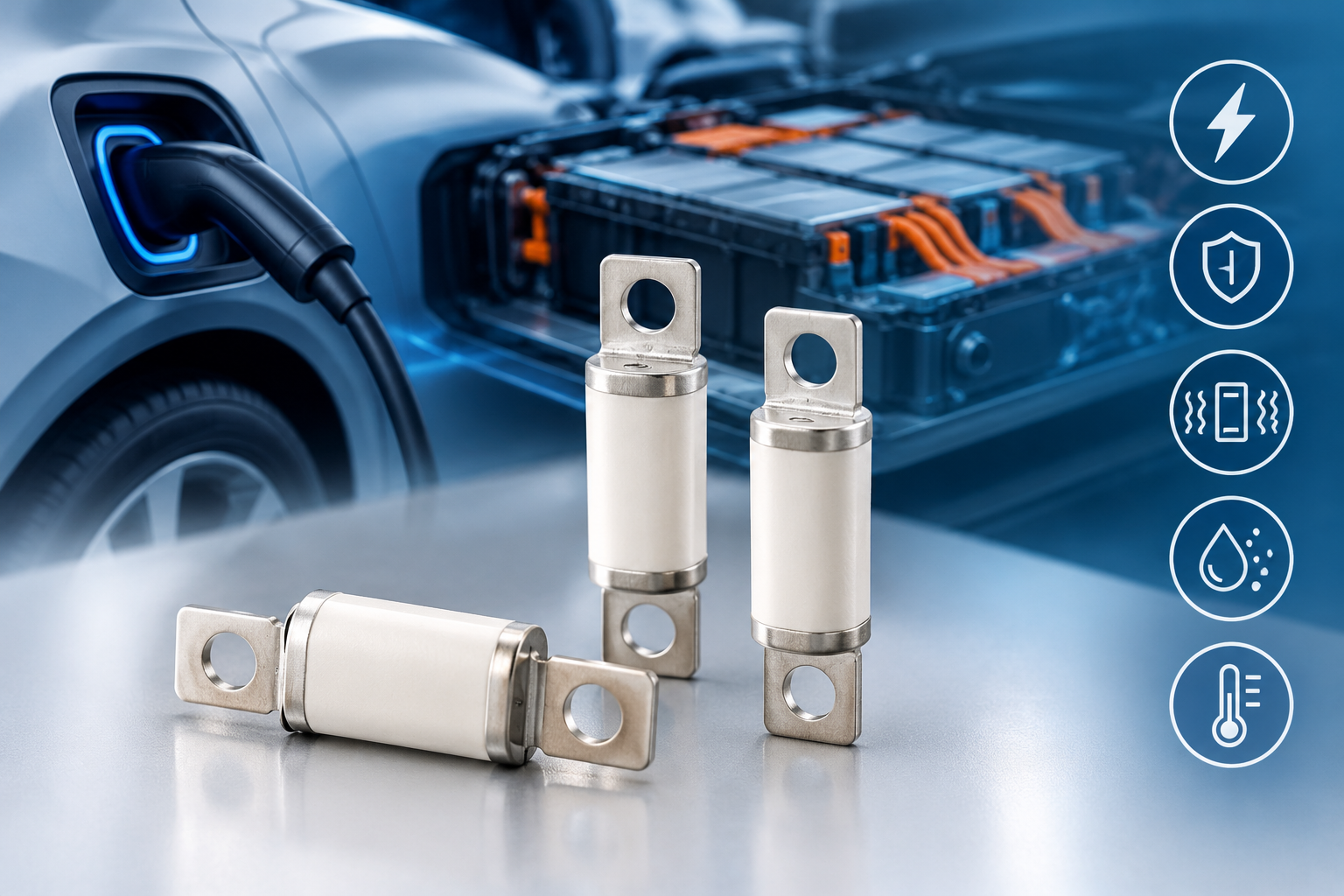
 eaton-ev-fuse-catalogue-emob0062-en-us.pdf  | [Eaton Bussmann EV Fuses] | 0 kB |
Eaton Bussmann EVR 25 mm Fuses: High-Voltage DC Protection for Electric Vehicles
As electric vehicles (EVs), hybrid electric vehicles (HEVs) and high-voltage battery systems continue to evolve, reliable electrical protection is essential for safety, performance and system efficiency. The Eaton Bussmann EVR 25 mm fuse series is designed to protect high-voltage DC applications, offering rated voltages up to 500 VDC, current ratings from 150 A to 250 A, and a maximum breaking capacity of 20 kA.
Designed for demanding automotive and battery applications, these fuses combine high-current protection with a compact 25 mm format. Their high interrupting capacity makes them a suitable option for engineers and manufacturers developing advanced electric vehicle power systems.
In this guide, we explore the key features, technical specifications, available part numbers and potential applications of Eaton Bussmann EVR 25 mm fuses.
What Are Eaton Bussmann EVR 25 mm Fuses?
Eaton Bussmann EVR 25 mm fuses are high-current DC protection components designed for use in high-voltage electrical systems. They are intended to help interrupt excessive current under specified fault conditions, protecting electrical circuits and supporting the safe operation of high-capacity battery packs.
The EVR25 product family covers five current ratings: 150 A, 175 A, 200 A, 225 A and 250 A. Each variant features M8 screw terminals, a nominal weight of 0.125 kg and a specified storage temperature range of –40°C to +85°C.
With a rated voltage of 500 VDC and a maximum breaking capacity of 20 kA, the series is designed to address the protection requirements of modern electric vehicle and battery-powered systems.
Key Features and Benefits of EVR 25 mm Fuses
1. 500 VDC Rated Voltage
The Eaton Bussmann EVR 25 mm fuse series has a rated voltage of 500 VDC, making it suitable for consideration in high-voltage DC circuit protection designs.
Higher-voltage battery architectures can support improved system efficiency and may allow the use of smaller, more economical conductors for a given power requirement, subject to current, thermal, insulation and installation constraints.
Selecting an appropriately rated fuse helps engineers develop electrical protection systems that meet the voltage and current requirements of the application.
2. Current Ratings from 150 A to 250 A
The EVR25 series is available in five current ratings, providing flexibility when designing battery protection and high-current DC circuits.
Available ratings include:
-
EVR25-150: 150 A
-
EVR25-175: 175 A
-
EVR25-200: 200 A
-
EVR25-225: 225 A
-
EVR25-250: 250 A
This range allows designers to evaluate different fuse ratings according to the circuit's continuous operating current, expected overload conditions, conductor capacity and fault-current characteristics.
The correct fuse rating should always be selected using the manufacturer's application guidance and the electrical requirements of the complete system.
3. High Interrupting Capacity of 20 kA
One of the key specifications of Eaton Bussmann EVR 25 mm fuses is their maximum breaking capacity of 20 kA.
High-capacity battery systems can deliver substantial fault currents during short-circuit events. A fuse must be capable of safely interrupting the prospective fault current available in its intended circuit.
The EVR25 series' specified interrupting capacity makes it an important candidate for evaluating protection in high-energy battery applications. Engineers should verify that the prospective DC fault current, operating voltage and circuit time constant fall within the fuse's applicable ratings.
The stated minimum breaking current is 300% of the fuse's rated current. This specification is important when assessing whether a fuse can interrupt a particular fault condition. Protection at lower fault-current levels must be evaluated against the manufacturer's time-current characteristics and application requirements.
4. Compact 25 mm Format with M8 Screw Terminals
The EVR25 series uses an M8 screw-terminal connection, providing a defined mounting interface for high-current electrical connections.
The nominal weight of each listed fuse is 0.125 kg, supporting straightforward consideration during component selection and system layout.
When installing these fuses, engineers should follow the specified terminal torque of 12 ± 1 Nm. Correct tightening helps establish a suitable electrical connection while reducing the risk of connection problems associated with improper installation.
Always confirm the required mounting arrangement, terminal hardware and installation instructions for the specific application.
5. Wide Storage Temperature Range
Eaton Bussmann EVR 25 mm fuses have a specified storage temperature range of –40°C to +85°C.
This range supports storage planning across a variety of manufacturing, distribution and industrial environments. It is important to distinguish storage temperature from operating temperature: the stated storage range should not be interpreted as an operating-temperature rating.
For applications exposed to elevated temperatures, vibration or demanding environmental conditions, engineers should consult the applicable product documentation to verify operating limits and qualification requirements.
Eaton Bussmann EVR 25 mm Fuse Technical Specifications
The following table summarises the principal electrical and mechanical specifications supplied for the EVR25 series.
| Parameter | Specification |
|---|---|
| Product series | Eaton Bussmann EVR 25 mm |
| Rated voltage | 500 VDC |
| Rated current range | 150 A–250 A |
| Maximum breaking capacity | 20 kA |
| Minimum breaking capacity | 300% of rated current |
| Time constant | 1–3 ms |
| Screw terminal type | M8 |
| Weight per fuse | 0.125 kg |
| Storage temperature | –40°C to +85°C |
| Terminal torque | 12 ± 1 Nm |
| Packaging quantity | 100 per box |
| Compliance information | RoHS, ELV and REACH compliant |
Note: Specifications are based on the supplied product information. Confirm the current manufacturer's datasheet and application requirements before selecting or installing a fuse.
Eaton Bussmann EVR25 Series: Part Numbers and Current Ratings
The Eaton Bussmann EVR 25 mm fuse range includes five catalogue part numbers. All listed variants share the same packaging quantity, terminal type, weight, storage temperature range and torque specification.
| Part number | Rated current | Packaging | Screw type | Weight | Storage temperature | Torque |
|---|---|---|---|---|---|---|
| EVR25-150 | 150 A | 100/box | M8 | 0.125 kg | –40°C to +85°C | 12 ± 1 Nm |
| EVR25-175 | 175 A | 100/box | M8 | 0.125 kg | –40°C to +85°C | 12 ± 1 Nm |
| EVR25-200 | 200 A | 100/box | M8 | 0.125 kg | –40°C to +85°C | 12 ± 1 Nm |
| EVR25-225 | 225 A | 100/box | M8 | 0.125 kg | –40°C to +85°C | 12 ± 1 Nm |
| EVR25-250 | 250 A | 100/box | M8 | 0.125 kg | –40°C to +85°C | 12 ± 1 Nm |
Which EVR25 Fuse Rating Should You Choose?
Choosing the correct Eaton Bussmann EVR25 fuse depends on the operating characteristics and protection requirements of the circuit.
EVR25-150 — 150 A: Consider this variant when the calculated circuit requirements call for a 150 A fuse rating.
EVR25-175 — 175 A: Suitable for evaluation in designs requiring a nominal 175 A fuse rating.
EVR25-200 — 200 A: An option for high-current circuits designed around a 200 A fuse rating.
EVR25-225 — 225 A: Provides a higher nominal current rating for applications whose protection design calls for 225 A.
EVR25-250 — 250 A: The highest-current variant in the listed EVR25 range, intended for designs requiring a nominal 250 A fuse rating.
These ratings are not interchangeable without engineering assessment. The final selection should account for continuous current, ambient temperature, overload profiles, conductor sizing, prospective short-circuit current and the manufacturer's time-current curves.
Potential Applications of Eaton Bussmann EVR 25 mm Fuses
The EVR25 series is designed around the requirements of high-voltage, high-current DC protection. Depending on the product's qualification and the system design, potential applications for evaluation include the following.
Electric Vehicles and Hybrid Electric Vehicles
Electric and hybrid vehicles use high-voltage electrical architectures to deliver power between batteries, power electronics and electric drive systems.
Appropriately rated fuses can help protect these circuits against excessive current during electrical faults. The EVR25 series' 500 VDC rating and current range make it relevant for consideration in compatible automotive DC protection designs.
High-Voltage Battery Packs
High-capacity battery packs require carefully coordinated protection components to address potentially high fault currents.
The EVR25 series' specified maximum breaking capacity of 20 kA provides an important parameter for engineers evaluating fuse suitability in battery-related applications. Actual compatibility depends on the battery voltage, available fault current, circuit time constant and required protection performance.
Battery Power Distribution Systems
High-current DC distribution systems connect energy storage to downstream electrical equipment. Selecting suitable fuses helps support circuit protection and the isolation of faults within the intended protection scheme.
The EVR25 range offers multiple current ratings and an M8 screw-terminal interface for consideration in compatible installations.
Automotive Power Electronics
Power conversion equipment and associated DC circuits may require overcurrent protection selected to match their electrical characteristics.
When considering EVR25 fuses for these systems, designers should assess coordination with other protective devices, permissible fault energy and the electrical withstand limits of connected components.
Application suitability must be confirmed against the manufacturer's product qualifications and the requirements of the complete electrical system.
Standards and Regulatory Compliance
The supplied product information identifies the Eaton Bussmann EVR 25 mm fuse series as compliant with RoHS, ELV and REACH requirements.
These regulatory frameworks address different aspects of materials and chemical management:
-
RoHS: Restricts the use of specified hazardous substances in applicable electrical and electronic equipment.
-
ELV: Addresses restricted substances and end-of-life requirements for vehicles within the scope of the relevant legislation.
-
REACH: Regulates chemicals and related obligations within the European Union.
The product information also references the following standards:
-
ISO 8820-8:2012
-
GB/T 31465.1-2015
-
GB/T 31465.6-2017
-
GB/T 13539.1-2015
-
GB/T 13539.4-2016
These references provide useful starting points for technical review and product qualification. The supplied information does not establish the exact scope of certification or conformity against each individual standard. Buyers and engineers should request the relevant manufacturer declarations and supporting documentation when formal compliance evidence is required.
Installation and Handling Considerations
Correct installation is essential to the performance of any high-current fuse. When working with Eaton Bussmann EVR25 fuses, consider the following points.
Observe the specified terminal torque. The supplied torque limit is 12 ± 1 Nm. Use appropriate tools and follow the manufacturer's mounting instructions.
Verify voltage compatibility. Confirm that the system's maximum DC voltage is within the fuse's applicable rating.
Check prospective fault current. Ensure that the available fault current does not exceed the fuse's applicable breaking capacity under the actual circuit conditions.
Coordinate overcurrent protection. Select the fuse using the manufacturer's time-current characteristics and verify coordination with the battery, conductors and connected equipment.
Follow storage requirements. Keep the fuse within the specified storage temperature range of –40°C to +85°C.
Consult the current datasheet. Verify installation, environmental and electrical limits before commissioning the product.
High-voltage battery systems can present serious electrical hazards. Installation, inspection and replacement should be performed by appropriately qualified personnel using the required isolation and safety procedures.
Why Consider Eaton Bussmann EVR 25 mm Fuses?
The EVR25 series brings together several specifications relevant to high-voltage DC protection:
-
A rated voltage of 500 VDC.
-
Five available current ratings from 150 A to 250 A.
-
A maximum breaking capacity of 20 kA.
-
A compact 25 mm product format.
-
M8 screw terminals.
-
A defined terminal torque of 12 ± 1 Nm.
-
Supplied information indicating RoHS, ELV and REACH compliance.
These characteristics make the series worth evaluating for compatible electric vehicle, battery and high-current DC applications.
However, no fuse should be selected on current rating alone. Engineers must consider voltage, fault-current behaviour, circuit time constant, thermal conditions and the protection requirements of the complete system.
Frequently Asked Questions About Eaton Bussmann EVR 25 mm Fuses
What is the voltage rating of Eaton Bussmann EVR25 fuses?
The supplied specifications list a rated voltage of 500 VDC.
What current ratings are available in the EVR25 series?
The five listed ratings are 150 A, 175 A, 200 A, 225 A and 250 A.
What is the maximum breaking capacity of an EVR25 fuse?
The specified maximum breaking capacity is 20 kA. Confirm suitability against the prospective DC fault current and applicable circuit conditions.
What is the minimum breaking current?
The supplied technical information specifies a minimum breaking capacity of 300% of rated current. Consult the manufacturer's documentation to understand its precise application and interpretation.
What terminal type do EVR25 fuses use?
The listed variants use M8 screw terminals.
What is the recommended tightening torque?
The specified terminal torque is 12 ± 1 Nm. Always follow the applicable manufacturer installation instructions.
How many EVR25 fuses are supplied per box?
The catalogue information specifies 100 fuses per box for all five listed part numbers.
What is the storage temperature range?
The specified storage temperature range is –40°C to +85°C. This is a storage specification, not a confirmed operating-temperature range.
Which standards are referenced for the EVR25 series?
The supplied documentation references ISO 8820-8:2012, GB/T 31465.1-2015, GB/T 31465.6-2017, GB/T 13539.1-2015 and GB/T 13539.4-2016. Request the relevant conformity documentation to verify the applicable requirements.
Conclusion: Find the Right Eaton Bussmann EVR 25 mm Fuse
The Eaton Bussmann EVR 25 mm fuse series offers a selection of high-current DC fuse ratings for engineers evaluating protection in compatible high-voltage battery and automotive electrical systems.
With a 500 VDC rated voltage, current ratings from 150 A to 250 A, a maximum breaking capacity of 20 kA and M8 screw terminals, the series provides several important specifications for component selection.
Whether you are comparing the EVR25-150, EVR25-175, EVR25-200, EVR25-225 or EVR25-250, the right choice depends on your system's operating current, voltage, fault-current characteristics and protection requirements.
Review the relevant manufacturer datasheet and technical documentation before specifying a fuse. Selecting the correct protection component helps support electrical system reliability, appropriate fault interruption and safe operation.
Looking for Eaton Bussmann EVR 25 mm fuses? Compare the available part numbers and technical specifications to identify the variant that best matches your application.



