
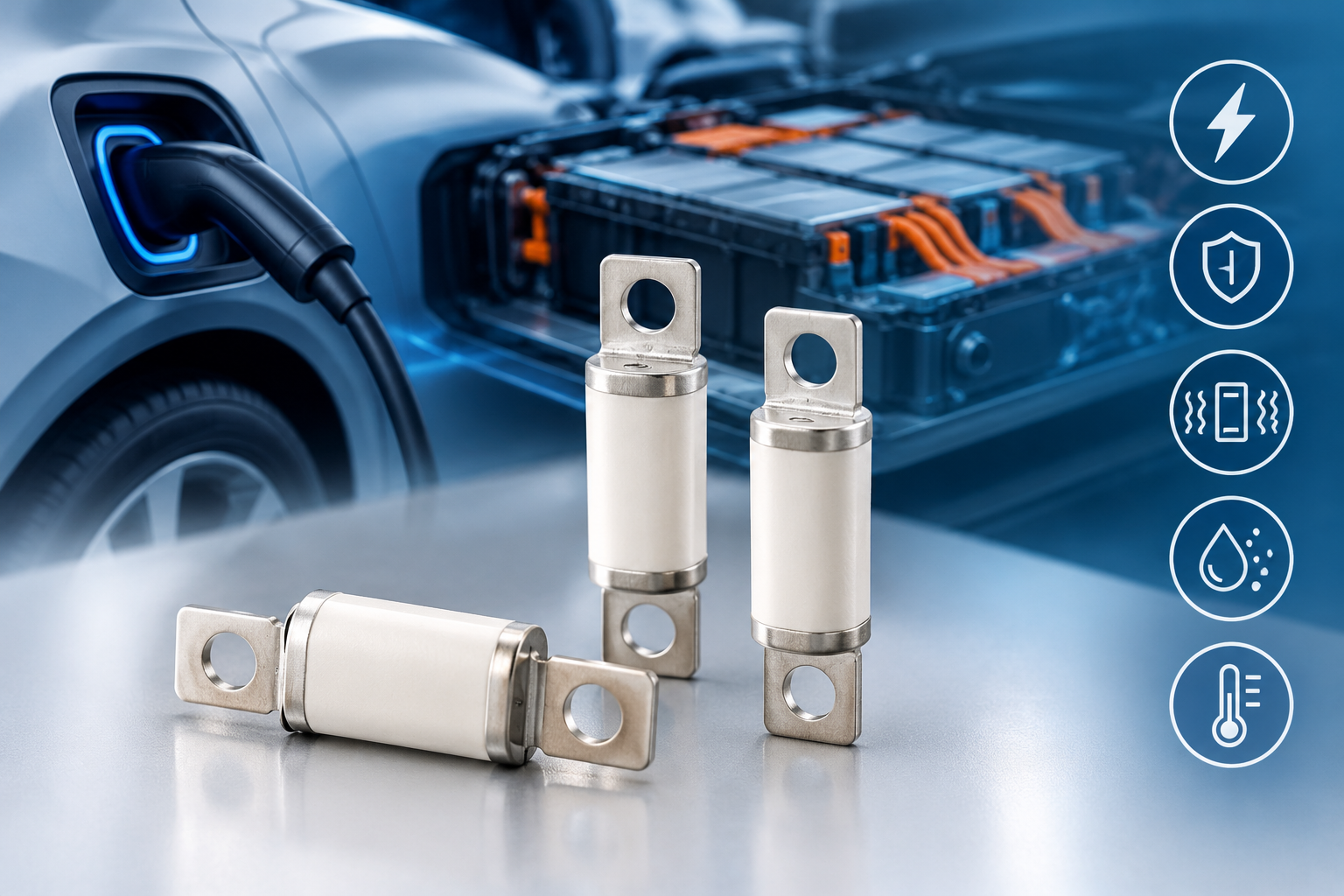
 eaton-ev-fuse-catalogue-emob0062-en-us.pdf  | [Eaton Bussmann EV Fuses] | 0 kB |
Eaton Bussmann EVR 20 mm Fuses: Features, Specifications and Applications
As electric vehicles (EVs) continue to evolve, reliable electrical circuit protection has become increasingly important. High-voltage battery systems, power distribution units and other critical electrical components require dependable protection against overloads and short circuits. The Eaton Bussmann EVR 20 mm fuse is designed to meet these demands in electric vehicle applications operating at up to 500 V DC.
Part of Eaton's Bussmann series of electric vehicle fuses, the EVR20 combines a compact cylindrical design with high interrupting capacity and current ratings suitable for demanding automotive electrical systems. Available in several amperage options, it provides engineers and manufacturers with flexibility when designing circuit protection for electric mobility applications.
In this guide, we explore the key features, technical specifications, applications and selection considerations for Eaton Bussmann EVR 20 mm fuses.
What Is an Eaton Bussmann EVR 20 mm Fuse?
The Eaton Bussmann EVR20 is a high-voltage DC fuse developed for electric vehicle circuit protection. Its 20 mm diameter format provides a compact solution for protecting suitable high-current circuits in EV electrical architectures.
Unlike conventional low-voltage automotive blade fuses, EV-rated fuses are designed to interrupt fault currents under the electrical conditions associated with high-voltage battery systems. This is particularly important because DC fault currents can be challenging to interrupt safely.
The EVR20 series is rated for 500 V DC, with current ratings ranging from 50 A to 150 A and a maximum breaking capacity of 20 kA, according to Eaton's product catalogue.
These characteristics make the EVR20 a potential solution for appropriately engineered EV power circuits where the operating voltage, continuous current, fault level and installation requirements match the fuse's specifications.
Key Features of Eaton Bussmann EVR20 Fuses
1. 500 V DC Voltage Rating
The EVR20 series is designed for electrical systems with a rated voltage of up to 500 V DC. This makes it relevant to selected electric vehicle platforms and other compatible DC power applications.
Choosing a fuse with the correct DC voltage rating is essential. The fuse must be suitable for the system's maximum operating voltage and its expected fault conditions.
2. High Interrupting Capacity
Eaton specifies a maximum breaking capacity of 20 kA for the EVR20 range.
Breaking capacity describes the maximum prospective fault current a fuse can safely interrupt under its specified test conditions. This is a critical consideration in EV battery circuits, where batteries can deliver substantial fault currents.
The actual suitability of a fuse depends on the available fault current, system voltage and installation conditions.
3. Multiple Current Ratings
The EVR20 range includes several current ratings, allowing engineers to select a fuse that matches the requirements of the protected circuit.
Available options include 50 A, 60 A, 70 A, 80 A, 100 A, 125 A and 150 A.
Selecting the correct rating requires more than matching the fuse to a circuit's normal current draw. Engineers must also consider inrush current, overload characteristics, ambient temperature, conductor ratings and the manufacturer's time-current data.
4. Compact Cylindrical Construction
The 20 mm fuse body is intended for applications where space-efficient circuit protection is important.
Compact fuse designs can help electrical engineers integrate protection into suitably designed vehicle power distribution assemblies and battery-related electrical systems without unnecessarily increasing component size.
The EVR20 uses an M8 screw connection, which must be compatible with the designated fuse holder or mounting arrangement.
5. Designed for Electric Vehicle Applications
The EVR20 belongs to Eaton's Bussmann series of EV fuses. This product family addresses the circuit protection requirements of electric mobility systems, where high voltage, significant current and demanding fault conditions must be considered together.
Depending on the vehicle architecture and engineering design, EV fuses can support protection strategies for battery power distribution and other high-current DC circuits.
Eaton Bussmann EVR20 Fuse Specifications
The following table summarises the principal specifications published for the EVR20 series.
| Specification | EVR20 range |
|---|---|
| Manufacturer | Eaton Bussmann |
| Product series | EVR20 |
| Fuse body diameter | 20 mm |
| Rated voltage | 500 V DC |
| Available current ratings | 50 A–150 A |
| Maximum breaking capacity | 20 kA |
| Minimum breaking capacity | 400% of rated current |
| Connection type | M8 screw connection |
| Packaging quantity | 200 per box |
| Storage temperature | -40°C to +85°C |
| Published tightening torque | 12 ± 1 Nm |
| Application category | Electric vehicle circuit protection |
Important: These are series-level catalogue specifications. Always consult the latest official Eaton datasheet for the exact part number, operating conditions, installation requirements and applicable standards before specifying or installing a fuse.
Available Eaton Bussmann EVR20 Fuse Models
The EVR20 series offers several current ratings to accommodate different circuit requirements.
| Part number | Rated current |
|---|---|
| EVR20-50 | 50 A |
| EVR20-60 | 60 A |
| EVR20-70 | 70 A |
| EVR20-80 | 80 A |
| EVR20-100 | 100 A |
| EVR20-125 | 125 A |
| EVR20-150 | 150 A |
All listed models share the series' nominal 500 V DC voltage rating and 20 kA maximum breaking capacity.
However, the correct model should be determined through electrical protection calculations rather than by selecting the highest available amperage or simply matching the normal operating current.
Typical Applications of EVR20 Fuses
Eaton Bussmann EVR20 fuses are intended for electric vehicle applications requiring suitable high-voltage DC circuit protection.
Potential application areas include:
Electric Vehicle Battery Systems
Battery circuits require protection against abnormal currents that could damage conductors, connections and connected equipment. A correctly selected EV fuse can form part of a coordinated battery protection system.
Power Distribution Units
Electric vehicle power distribution units route electrical energy to different vehicle subsystems. Appropriate fuses can help isolate faults in protected branches and reduce the risk of damage spreading through the electrical system.
High-Current DC Circuits
The EVR20's 50 A–150 A current range may suit selected high-current DC circuits when its voltage rating, breaking capacity and time-current characteristics meet the design requirements.
Electric Mobility Engineering and Development
Vehicle manufacturers, engineering teams and specialist EV integrators may evaluate EVR20 fuses when developing or maintaining compatible electrical architectures.
Note: The suitability of an EVR20 fuse for any particular circuit must be verified against the system design and Eaton's technical documentation. It should not be assumed that every battery, charging circuit or electric vehicle is compatible with this fuse series.
How to Choose the Right EVR20 Fuse
Selecting the correct Eaton Bussmann EVR20 fuse involves several important considerations.
1. Confirm the System Voltage
Verify the maximum DC operating voltage of the protected circuit. The EVR20's 500 V DC rating must not be exceeded.
2. Calculate the Required Current Rating
Determine the expected continuous current and account for load variations, inrush current, thermal conditions and the characteristics of the protected components.
A fuse rated too low may operate unnecessarily, while an oversized fuse may not provide adequate protection.
3. Check the Available Fault Current
The circuit's prospective short-circuit current must be compatible with the fuse's breaking capacity. The EVR20's published maximum breaking capacity is 20 kA under its specified conditions.
4. Review Time-Current Characteristics
A fuse's time-current curve helps establish how quickly it operates at different overload levels. This information is essential when coordinating protection with battery systems, contactors, conductors and other protective devices.
5. Verify Mounting and Torque Requirements
Confirm that the M8 connection is compatible with the installation. Eaton's catalogue lists a tightening torque of 12 ± 1 Nm; verify the requirement against the exact part number and installation documentation.
Correct installation is important for maintaining reliable electrical contact and controlling connection heating.
6. Confirm the Required Standards
Check the standards applicable to the intended vehicle, market and circuit. Eaton's EVR20 catalogue references ISO 8820-8:2012 and other relevant standards. Confirm the exact compliance and certification requirements for the specific model before use.
Eaton Bussmann EVR20 vs Conventional Automotive Fuses
Standard automotive blade fuses are generally designed for lower-voltage vehicle circuits, whereas the EVR20 is intended for compatible high-voltage DC applications.
The main differences include:
-
Voltage rating: EVR20 is rated at 500 V DC.
-
Current capacity: The range covers 50 A to 150 A.
-
Fault interruption: Its maximum breaking capacity is specified as 20 kA.
-
Connection design: It uses an M8 screw connection rather than a typical blade-fuse interface.
-
Application requirements: Selection must account for high-voltage DC fault conditions and the relevant vehicle electrical architecture.
These differences mean the EVR20 should not be treated as a direct replacement for a conventional automotive fuse. Equally, a conventional blade fuse should not replace an EV-rated fuse unless the complete circuit protection design explicitly supports that choice.
Why Choose Eaton Bussmann EVR20 Fuses?
Eaton's Bussmann EV fuse portfolio is designed to address the electrical protection requirements of electric mobility applications.
The EVR20 series offers several practical advantages:
-
Multiple current ratings for design flexibility.
-
A compact 20 mm diameter fuse body.
-
A 500 V DC voltage rating.
-
A maximum breaking capacity of 20 kA.
-
A defined M8 mounting connection.
-
Product documentation to support engineering selection and integration.
For engineers and procurement teams, using the exact part number and consulting the manufacturer's latest documentation are important steps in ensuring that the selected component meets the project's electrical and mechanical requirements.
Frequently Asked Questions About Eaton Bussmann EVR20 Fuses
What voltage is the Eaton Bussmann EVR20 rated for?
The EVR20 series has a rated voltage of 500 V DC.
What amperage ratings are available?
The listed ratings are 50 A, 60 A, 70 A, 80 A, 100 A, 125 A and 150 A.
What is the breaking capacity of an EVR20 fuse?
Eaton specifies a maximum breaking capacity of 20 kA for the EVR20 series. The permissible application must also satisfy the manufacturer's stated voltage and fault-current conditions.
What does EVR20-100 mean?
EVR20-100 is a specific model in the Eaton Bussmann EVR20 series with a nominal current rating of 100 A.
What connection does the EVR20 use?
The catalogue lists an M8 screw connection. Confirm holder compatibility and the prescribed installation torque before fitting the fuse.
Can an EVR20 fuse be used in any electric vehicle?
No. Compatibility depends on the vehicle's electrical architecture, maximum DC voltage, continuous current, prospective fault current, mounting arrangement and required protection characteristics.
Where can I find the official EVR20 datasheet?
Start with Eaton's official Bussmann series EV fuses product page or its EV fuse catalogue.
Conclusion
The Eaton Bussmann EVR20 is a 20 mm electric vehicle fuse series designed for compatible high-voltage DC circuits. With a 500 V DC rating, current options from 50 A to 150 A and a maximum breaking capacity of 20 kA, it offers a range of choices for EV circuit protection designs.
Whether you are an electrical engineer, vehicle manufacturer, EV system integrator or component purchaser, choosing the correct EVR20 model requires careful consideration of system voltage, current demand, fault levels, mounting requirements and applicable standards.
For reliable component selection, always verify the exact part number against Eaton's latest technical documentation and ensure that the fuse is suitable for the intended application.



