
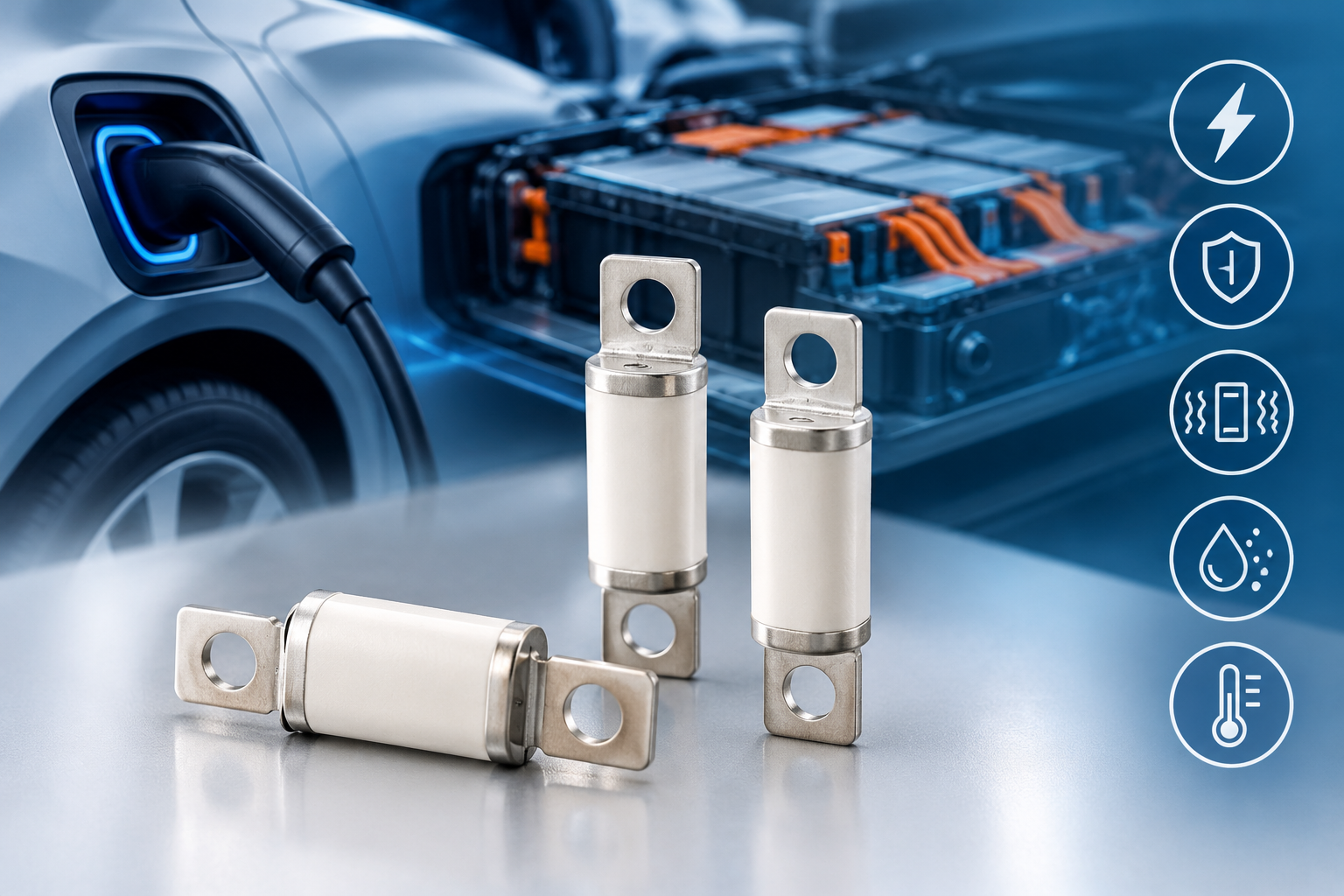
 eaton-ev-fuse-catalogue-emob0062-en-us.pdf | [Eaton Bussmann EV Fuses] | 15391 kB |
Eaton Bussmann EVR 10 mm Fuses: Features, Specifications and Applications
Introduction to Eaton Bussmann EVR 10 mm Fuses
As electric vehicles (EVs), hybrid vehicles and high-voltage battery systems continue to evolve, reliable circuit protection is essential for ensuring electrical safety, system performance and operational efficiency. Eaton Bussmann EVR 10 mm fuses are designed to meet the demanding protection requirements of automotive and electric vehicle applications, offering a 500 V DC voltage rating, high interrupting capacity and resistance to harsh operating environments.
Available in 30 A, 40 A and 50 A ratings, the EVR 10 mm fuse series supports high-capacity battery packs and electrical systems where dependable overcurrent protection is critical. With a maximum breaking capacity of 20 kA, compliance with relevant environmental requirements and protection against shock, vibration and environmental exposure, these fuses are suitable for demanding automotive applications.
In this guide, we explore the key features, technical specifications, available part numbers and selection considerations for Eaton Bussmann EVR 10 mm fuses.
What Are Eaton Bussmann EVR 10 mm Fuses?
Eaton Bussmann EVR 10 mm fuses are automotive circuit protection components developed for high-voltage DC electrical systems. They help protect electrical circuits against excessive current by interrupting the circuit when specified fault conditions occur.
The EVR series addresses the requirements of modern electric vehicle battery systems, where higher operating voltages and increased battery capacity can place greater demands on circuit protection devices.
These fuses combine a 500 V DC rated voltage, 20 kA maximum breaking capacity and current ratings of 30 A, 40 A and 50 A. Their design also accounts for automotive shock and vibration requirements, alongside demanding environmental protection conditions.
Depending on the required configuration, the series includes different packaging options and variants with M5 screw connections.
Key Features and Benefits of EVR 10 mm Fuses
1. 500 V DC Rated Voltage
One of the main advantages of the Eaton Bussmann EVR 10 mm fuse series is its 500 V DC voltage rating.
Higher-voltage battery architectures can help improve overall system efficiency by reducing current for a given power level. This can allow smaller, more economical conductors to be used where the complete system design permits.
The EVR series is designed to support the protection needs of these higher-voltage battery packs, making it relevant to electric vehicle and other suitable high-voltage DC applications.
2. High Interrupting Capacity of 20 kA
Modern electric vehicle battery packs can deliver substantial fault currents. Effective circuit protection must therefore be capable of interrupting potentially high currents safely under specified operating conditions.
The EVR 10 mm fuse series offers a maximum breaking capacity of 20 kA, helping protect high-capacity battery systems against severe overcurrent faults when the fuse is correctly selected and applied within its ratings.
Its high interrupting capacity supports the protection requirements of battery packs designed to deliver the power needed for vehicle acceleration and driving range.
3. Three Rated Current Options
The EVR 10 mm series is available in three rated current options:
-
30 A: For applications requiring a 30-ampere fuse rating.
-
40 A: For circuits designed around a 40-ampere fuse rating.
-
50 A: For applications requiring a 50-ampere fuse rating.
Having multiple current ratings allows engineers and procurement teams to select a suitable option for the intended circuit.
The final fuse rating should be determined by considering normal operating current, expected overloads, conductor ampacity, ambient temperature, fault current and the requirements of the complete electrical system.
4. Automotive Shock and Vibration Resistance
Vehicles expose electrical components to continuous vibration, mechanical shock and changing operating conditions.
The Eaton Bussmann EVR 10 mm fuse series specifies shock and vibration performance for the ISO 16750-3 commercial vehicle (CV) use case.
This makes mechanical environmental requirements an important part of evaluating the series for automotive applications. Engineers should confirm the applicable test conditions and system-level qualification requirements before approving a fuse for a particular vehicle platform.
5. IP69 and IP6K9K Environmental Protection
Environmental exposure can be a major consideration in automotive electrical installations, particularly where components are exposed to moisture, dirt and demanding cleaning conditions.
The EVR 10 mm series specifies environmental protection ratings of IP69 and IP6K9K.
These ratings are associated with protection against dust ingress and high-pressure water exposure under the relevant test conditions. However, the protection achieved in an actual installation also depends on the mounting arrangement, enclosure design, terminals and sealing interfaces.
For this reason, the environmental rating should be evaluated in the context of the complete assembly rather than the fuse alone.
6. Compliance with Environmental Requirements
The EVR 10 mm fuse series is listed as compliant with the following environmental requirements:
-
RoHS
-
ELV
-
REACH
These requirements are relevant to manufacturers and suppliers working with automotive electrical components and managing material restrictions, end-of-life vehicle requirements and chemical compliance obligations.
Compliance documentation should be checked against the specific part number and the requirements of the intended market.
Eaton Bussmann EVR 10 mm Fuse: Technical Specifications
The following table summarises the principal technical information for the EVR 10 mm fuse series.
| Parameter | Specification |
|---|---|
| Product series | Eaton Bussmann EVR 10 mm |
| Rated voltage | 500 V DC |
| Rated current options | 30 A, 40 A, 50 A |
| Maximum breaking capacity | 20 kA |
| Minimum breaking capacity | 200% of rated current |
| Time constant | 1.5–2.5 ms |
| Shock and vibration | ISO 16750-3, CV use case |
| Environmental protection | IP69 and IP6K9K |
| Environmental compliance | RoHS, ELV, REACH |
| Referenced standards | GB/T 31465.6, ISO 8820, JASO D622 |
| Listed storage temperature | −40°C to +85°C |
| Weight per fuse | 0.012 kg (12 g) |
| M5 terminal torque, where specified | 4.5 ± 1 Nm |
Important: The listed storage temperature is not necessarily the permitted operating temperature. Consult the manufacturer's datasheet for operating-temperature limits, time-current characteristics, voltage and interrupting-capacity conditions, and other application-specific parameters.
Understanding the Breaking Capacity
Breaking capacity is an important specification when choosing a fuse for a high-voltage DC system.
The EVR 10 mm series has a maximum breaking capacity of 20 kA. This indicates the specified maximum fault current the fuse is designed to interrupt under the applicable test conditions.
The series also lists a minimum breaking capacity of 200% of rated current. This parameter should not be confused with the rated current or with the current at which a fuse will always operate. Fuse operation depends on the magnitude and duration of the current, as well as the fuse's time-current characteristics.
When designing battery protection circuits, engineers should verify that the prospective fault current falls within the fuse's specified interrupting range and that the fuse's DC voltage rating is suitable for the application.
Eaton Bussmann EVR 10 mm Fuse Part Numbers
The EVR 10 mm fuse series includes multiple part numbers for each current rating. The following table reproduces the available catalogue information to help buyers identify the correct variant.
| Part number | Rated current | Packaging quantity | Screw type | Weight | Storage temperature | Torque limits |
|---|---|---|---|---|---|---|
| EVR10-30 | 30 A | 10/box | NA | 0.012 kg | −40°C to +85°C | NA |
| EVR10-30-T | 30 A | 270/box | M5 | 0.012 kg | −40°C to +85°C | 4.5 ± 1 Nm |
| EVR10-30-B | 30 A | 270/box | M5 | 0.012 kg | −40°C to +85°C | 4.5 ± 1 Nm |
| EVR10-30-1P | 30 A | 180/box | NA | 0.012 kg | −40°C to +85°C | NA |
| EVR10-40 | 40 A | 10/box | NA | 0.012 kg | −40°C to +85°C | NA |
| EVR10-40-T | 40 A | 270/box | M5 | 0.012 kg | −40°C to +85°C | 4.5 ± 1 Nm |
| EVR10-40-B | 40 A | 270/box | M5 | 0.012 kg | −40°C to +85°C | 4.5 ± 1 Nm |
| EVR10-40-1P | 40 A | 180/box | NA | 0.012 kg | −40°C to +85°C | NA |
| EVR10-50 | 50 A | 10/box | NA | 0.012 kg | −40°C to +85°C | NA |
| EVR10-50-T | 50 A | 270/box | M5 | 0.012 kg | −40°C to +85°C | 4.5 ± 1 Nm |
| EVR10-50-B | 50 A | 270/box | M5 | 0.012 kg | −40°C to +85°C | 4.5 ± 1 Nm |
| EVR10-50-1P | 50 A | 180/box | NA | 0.012 kg | −40°C to +85°C | NA |
Note: NA indicates that the corresponding value is not specified in the supplied catalogue data. Confirm the exact terminal design, mounting method, packaging configuration and ordering details with the manufacturer or authorised distributor.
How to Choose the Right EVR 10 mm Fuse
Selecting the correct fuse involves more than matching the rated current to the expected load.
Step 1: Confirm the DC Voltage
Ensure that the circuit's maximum operating voltage does not exceed the fuse's 500 V DC rating. Consider voltage transients and the maximum battery voltage under the intended operating conditions.
Step 2: Select the Appropriate Current Rating
Choose between 30 A, 40 A and 50 A based on the circuit's continuous current, expected load profile and applicable design requirements.
The fuse must coordinate with the wiring, connectors and protected equipment. A higher current rating should not be selected simply to prevent nuisance operation.
Step 3: Check the Prospective Fault Current
Confirm that the expected fault current is within the fuse's specified breaking-capacity limits. The maximum breaking capacity of 20 kA should be evaluated alongside the actual battery system's fault-current characteristics.
Step 4: Confirm the Mounting Configuration
Determine whether the application requires an M5 screw connection or another mounting arrangement. Where the specified variant has an M5 connection, follow the listed torque limit of 4.5 ± 1 Nm.
Do not assume that variants with different suffixes are mechanically interchangeable without checking their manufacturer documentation.
Step 5: Evaluate Environmental Conditions
Consider temperature, vibration, moisture and cleaning exposure. Confirm that the fuse and its installation meet the requirements of the intended automotive environment.
Step 6: Review Standards and Documentation
Check the latest manufacturer's datasheet, relevant qualification information and applicable standards before finalising a design or placing a production order.
Typical Applications of Eaton Bussmann EVR 10 mm Fuses
The EVR 10 mm series is intended to address the requirements of demanding automotive and high-voltage DC circuit protection applications.
Potential applications, subject to verification of the electrical and environmental requirements, include:
-
Electric vehicle battery systems
-
Hybrid vehicle electrical systems
-
High-voltage DC power distribution
-
Automotive auxiliary power circuits
-
Battery-powered commercial vehicles
-
Other suitable DC electrical systems requiring the specified voltage, current and interrupting ratings
The fuse's suitability for any particular application must be verified against the circuit's operating conditions, mounting requirements and relevant safety standards.
Why Consider Eaton Bussmann EVR 10 mm Fuses?
For engineers, vehicle manufacturers and component procurement teams, the EVR 10 mm series offers several useful characteristics in one product family.
High-voltage capability: The 500 V DC rating supports appropriately designed higher-voltage electrical architectures.
High breaking capacity: A maximum breaking capacity of 20 kA addresses applications where substantial battery fault currents may occur.
Flexible current ratings: The availability of 30 A, 40 A and 50 A options provides flexibility for different circuit requirements.
Automotive environmental considerations: Specified shock, vibration and environmental protection characteristics support evaluation for demanding vehicle installations.
Multiple catalogue configurations: Different packaging quantities and terminal configurations provide options for purchasing and integration.
Together, these features make the series worth evaluating for automotive circuit protection designs where the published electrical and environmental specifications match the application.
Frequently Asked Questions About EVR 10 mm Fuses
What is the voltage rating of Eaton Bussmann EVR 10 mm fuses?
The EVR 10 mm fuse series has a rated voltage of 500 V DC.
What current ratings are available?
The series is available in 30 A, 40 A and 50 A versions, with several catalogue part numbers for each rating.
What is the maximum breaking capacity?
The specified maximum breaking capacity is 20 kA. The applicable fault-current and test conditions should be verified in the manufacturer's datasheet.
What is the minimum breaking capacity?
The supplied technical data specifies a minimum breaking capacity of 200% of rated current. This specification should be interpreted alongside the manufacturer's fuse operating characteristics and test conditions.
Are EVR 10 mm fuses suitable for automotive applications?
The series specifies shock and vibration performance for the ISO 16750-3 commercial vehicle use case and environmental protection ratings of IP69 and IP6K9K. Suitability for a specific vehicle or installation must be confirmed through the applicable qualification and system design requirements.
What is the recommended torque for M5 variants?
The supplied catalogue data specifies a torque limit of 4.5 ± 1 Nm for variants identified with an M5 screw type. Follow the manufacturer's installation instructions for the exact part number.
Which standards are referenced for the EVR 10 mm series?
The supplied product information references GB/T 31465.6, ISO 8820 and JASO D622. Check the current manufacturer documentation to confirm the applicable editions and the exact scope of conformity or design reference.
What storage temperature is specified?
The catalogue lists a storage temperature range of −40°C to +85°C. This should not be interpreted as the operating-temperature range without further confirmation.
Conclusion
The Eaton Bussmann EVR 10 mm fuse series offers a combination of 500 V DC voltage capability, 30 A to 50 A current ratings and a maximum breaking capacity of 20 kA for demanding circuit protection applications.
Its specified shock and vibration performance, environmental protection ratings and range of catalogue configurations make it a useful option to evaluate for electric vehicle and other suitable automotive electrical systems.
Before selecting a fuse, confirm the required current rating, maximum system voltage, prospective fault current, mounting configuration, environmental conditions and applicable standards. Always consult the latest manufacturer documentation to ensure the selected part meets the requirements of the complete electrical system.
If you are sourcing EVR10-30, EVR10-40 or EVR10-50 fuses, compare the available part-number suffixes, packaging quantities and mounting specifications to identify the correct configuration for your project.



