
 eaton-ev-fuse-catalogue-emob0062-en-us.pdf  | [Eaton EV Fuses] | 0 kB |
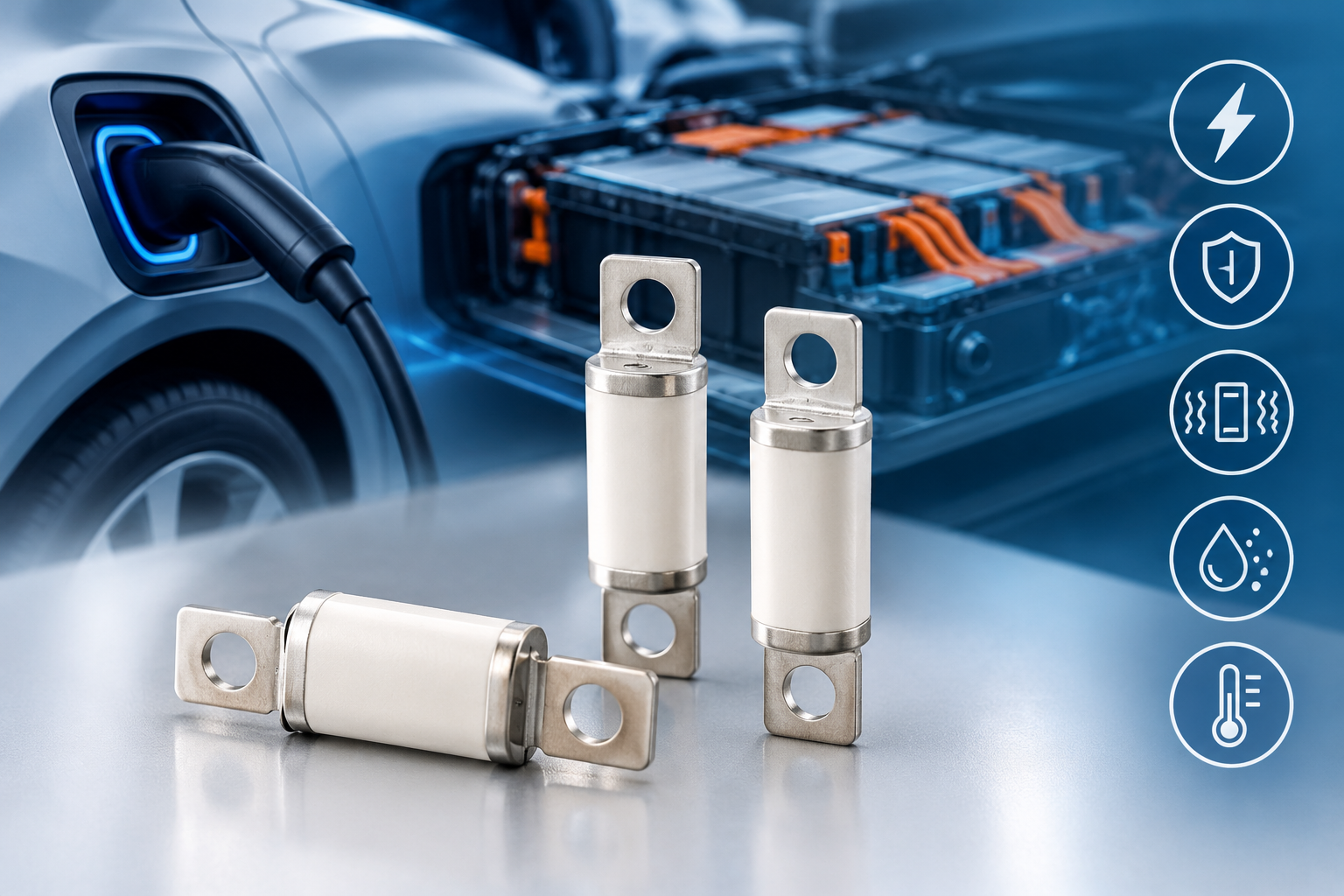
Eaton Bussmann EVPR 10 mm Fuses: High-Voltage DC Protection for Electric Vehicles
As electric vehicles (EVs) continue to evolve, reliable electrical protection is essential for ensuring the safety, performance and efficiency of high-voltage battery systems. The Eaton Bussmann EVPR 10 mm fuse series is designed to address the demanding protection requirements of electric vehicle applications, combining a high DC voltage rating, high interrupting capacity and multiple current ratings in a compact fuse design.
With a rated voltage of 850 VDC, available current ratings of 30 A, 40 A and 50 A, and a breaking capacity of 20 kA, EVPR 10 mm fuses are suitable for consideration in high-voltage EV electrical architectures where dependable DC overcurrent protection is required.
Available in several packaging configurations, the series offers flexibility for vehicle manufacturers, electrical engineers, system integrators and component distributors.
What Are Eaton Bussmann EVPR 10 mm Fuses?
Eaton Bussmann EVPR 10 mm fuses are electrical protection components designed for electric vehicle applications. They are intended to interrupt excessive current under specified fault conditions, helping protect connected electrical components and high-voltage battery systems.
The EVPR series is particularly relevant to EV architectures that require protection capable of handling high DC voltages and the substantial fault currents associated with high-capacity battery packs.
Unlike conventional low-voltage automotive fuses, high-voltage DC fuses must be selected with careful consideration of the system voltage, prospective fault current, circuit characteristics and the energy that must be interrupted during a fault.
The EVPR 10 mm series combines the following key specifications:
-
Rated voltage: 850 VDC
-
Rated current options: 30 A, 40 A and 50 A
-
Breaking capacity: 20 kA
-
Time constant: 2 ± 0.5 ms
-
Screw connection: M5
-
Storage temperature: −40°C to +85°C
-
Operating class: EV
These specifications make the series a candidate for appropriately engineered high-voltage EV protection systems. Final suitability depends on the electrical characteristics and requirements of the intended application.
Key Features and Benefits of the EVPR 10 mm Fuse Series
1. High 850 VDC Voltage Rating
One of the defining characteristics of Eaton Bussmann EVPR 10 mm fuses is their 850 VDC rated voltage.
As electric vehicle manufacturers develop higher-voltage battery architectures, protection components must be capable of operating at the relevant DC voltage levels. Selecting a fuse with an appropriate voltage rating is essential for safe fault interruption and overall system design.
A higher-voltage electrical architecture can also support improved power delivery and reduced current for a given power level. This can help engineers evaluate opportunities to optimise conductor sizing, electrical losses and system packaging.
However, conductor selection must account for current, temperature, installation conditions and applicable standards. The fuse voltage rating alone does not determine the appropriate conductor size.
2. High 20 kA Breaking Capacity
The EVPR 10 mm fuse series features a 20 kA breaking capacity, making fault-interruption capability an important consideration when designing high-voltage battery protection systems.
Electric vehicle battery packs can deliver substantial fault currents under short-circuit conditions. A suitably selected fuse must be able to interrupt the prospective fault current safely within its specified operating conditions.
The 20 kA breaking capacity provides an important selection parameter for engineers assessing whether a fuse is suitable for a particular battery circuit.
Before installation, verify that the prospective fault current at the installation point does not exceed the fuse's specified breaking capacity and that the fuse is suitable for the system's DC voltage and circuit characteristics.
3. Three Rated Current Options
The Eaton Bussmann EVPR 10 mm range is available in three rated current options:
-
30 A: For circuits designed around a 30 A fuse rating.
-
40 A: For circuits designed around a 40 A fuse rating.
-
50 A: For circuits designed around a 50 A fuse rating.
This range gives engineers flexibility when evaluating protection requirements across different EV electrical circuits.
The correct rating must be determined from the circuit's normal operating current, permissible overload conditions, conductor ampacity, fault characteristics and the fuse's time-current performance. A fuse should not be selected based solely on the nominal current rating of the connected equipment.
4. M5 Screw Connection
All listed EVPR 10 mm variants use an M5 screw connection.
The specified tightening torque is 4.5 ± 1 Nm, corresponding to an acceptable range of 3.5–5.5 Nm, subject to the manufacturer's installation instructions.
Correct tightening is important for achieving a reliable electrical connection and avoiding problems associated with loose or improperly tightened terminals.
Always follow the applicable manufacturer documentation, terminal hardware requirements and assembly procedures when installing the fuse.
5. Multiple Packaging Options
The EVPR 10 mm series offers packaging quantities of 10, 70, 180 and 270 units per box, depending on the SKU.
This range supports different purchasing and inventory requirements, from smaller quantities for evaluation or limited production needs to larger quantities for manufacturing and distribution.
Selecting the appropriate packaging variant can help simplify stock management and procurement planning.
Eaton Bussmann EVPR 10 mm Fuse Technical Specifications
The following table summarises the principal technical characteristics of the EVPR 10 mm fuse series.
| Parameter | Specification |
|---|---|
| Product series | Eaton Bussmann EVPR 10 mm |
| Rated voltage | 850 VDC |
| Rated current | 30 A, 40 A, 50 A |
| Breaking capacity | 20 kA |
| Time constant | 2 ± 0.5 ms |
| Screw type | M5 |
| Tightening torque | 4.5 ± 1 Nm |
| Storage temperature | −40°C to +85°C |
| Operation class | EV |
| Standards referenced | GB/T 31465, ISO 8820 |
| Environmental compliance | RoHS, ELV and REACH compliant |
Note: Refer to the manufacturer's current datasheet for complete electrical characteristics, installation instructions, dimensional drawings and application-specific limitations.
Eaton Bussmann EVPR 10 mm Fuse Part Numbers and Packaging
The series includes 12 catalog SKUs covering three current ratings and four packaging configurations.
The suffixes identify different catalog and packaging variants. Confirm the exact ordering code with the supplier before purchasing.
| Part number | Current rating | Packaging quantity | Screw type | Weight (kg) |
|---|---|---|---|---|
| EVPR10-30 | 30 A | 10/box | M5 | Not specified |
| EVPR10-30-T | 30 A | 270/box | M5 | 0.0120 ± 0.0010 |
| EVPR10-30-B | 30 A | 70/box | M5 | 0.0115 ± 0.0010 |
| EVPR10-30-1P | 30 A | 180/box | M5 | 0.0100 ± 0.0010 |
| EVPR10-40 | 40 A | 10/box | M5 | Not specified |
| EVPR10-40-T | 40 A | 270/box | M5 | 0.0120 ± 0.0010 |
| EVPR10-40-B | 40 A | 70/box | M5 | 0.0115 ± 0.0010 |
| EVPR10-40-1P | 40 A | 180/box | M5 | 0.0100 ± 0.0010 |
| EVPR10-50 | 50 A | 10/box | M5 | Not specified |
| EVPR10-50-T | 50 A | 270/box | M5 | 0.0120 ± 0.0010 |
| EVPR10-50-B | 50 A | 70/box | M5 | 0.0115 ± 0.0010 |
| EVPR10-50-1P | 50 A | 180/box | M5 | 0.0100 ± 0.0010 |
The weights above are reproduced from the supplied catalog information. Because the listed values are not identified explicitly as individual-unit or packaged weights, confirm the applicable weight basis with the manufacturer or distributor before using them for shipping calculations or mechanical design.
How to Choose the Right EVPR 10 mm SKU
Choosing the correct part number involves more than matching the required current rating.
Consider these factors:
-
Current rating: Determine whether the application requires the 30 A, 40 A or 50 A variant.
-
Packaging quantity: Choose the 10-, 70-, 180- or 270-unit configuration according to procurement and inventory needs.
-
Connection compatibility: Confirm that the M5 screw connection is compatible with the intended mounting arrangement.
-
Electrical performance: Verify the 850 VDC rating, 20 kA breaking capacity and suitability for the circuit's prospective fault current.
-
Installation requirements: Follow the specified tightening torque and manufacturer installation instructions.
-
Environmental conditions: Ensure the component can be stored and handled within the specified temperature range and installed under conditions permitted by the full datasheet.
Potential Applications of EVPR 10 mm Fuses
The EVPR series is intended for electric vehicle protection applications. Depending on the system design and manufacturer approval, relevant applications may include the following.
High-Voltage Battery Systems
High-voltage battery packs require suitable protection against overcurrent and short-circuit faults. A correctly selected fuse can help isolate a fault and limit damage to connected equipment.
The EVPR series' 850 VDC rating and 20 kA breaking capacity are key parameters to evaluate when considering protection for high-voltage battery circuits.
Electric Vehicle Power Distribution
EV power distribution systems route electrical energy between the battery and various subsystems. Protection components must be matched to the electrical demands and fault characteristics of each circuit.
The available 30 A, 40 A and 50 A ratings provide options for circuits with different protection requirements, subject to engineering validation.
High-Voltage Auxiliary Circuits
Certain auxiliary systems in electric vehicles may operate from high-voltage DC supplies. Where the electrical design and manufacturer's specifications permit, an appropriately rated fuse can form part of the circuit protection strategy.
The required current rating and fuse characteristics should always be established through circuit-level analysis rather than selected solely from the nominal voltage.
EV Manufacturing and Component Supply
The different packaging options can be useful for automotive manufacturers, assembly operations and component distributors managing multiple production volumes.
Standardising approved part numbers across production and service inventory may also simplify purchasing and stock control.
These examples describe potential areas for engineering evaluation, not a guarantee of suitability for every circuit or vehicle platform.
Standards and Environmental Compliance
The Eaton Bussmann EVPR 10 mm fuse series references the following standards and compliance requirements in the supplied product information.
GB/T 31465: A Chinese national standard series addressing automotive fuses.
ISO 8820: An international standard series covering road-vehicle fuse-links and associated test requirements.
RoHS, ELV and REACH: Environmental and chemical compliance frameworks relevant to restricted substances, end-of-life vehicles and the registration, evaluation and control of chemicals.
The product information identifies the EVPR series as designed with reference to GB/T 31465 and ISO 8820 and as RoHS, ELV and REACH compliant.
For automotive qualification, procurement approval or regulatory documentation, obtain the relevant manufacturer's declarations and confirm the specific editions, parts and requirements applicable to the intended product and market.
Installation and Handling Considerations
Correct selection, installation and handling are essential for reliable fuse performance.
Observe the Specified Tightening Torque
The listed tightening torque for EVPR 10 mm fuses is 4.5 ± 1 Nm. Use appropriate tooling and follow the manufacturer's installation instructions.
Check DC Voltage and Fault Current
Verify that the circuit's maximum DC voltage and prospective fault current fall within the fuse's specified capabilities. DC fault interruption requires particular attention because DC circuits do not have the natural current zero-crossings found in AC systems.
Confirm Coordination With Other Components
Assess fuse coordination with conductors, contactors, battery management systems and other protection devices. Time-current behaviour, energy let-through and the system's fault characteristics should be considered where applicable.
Follow Storage Requirements
The specified storage temperature range is −40°C to +85°C. Keep the fuse within the manufacturer's storage and handling requirements and check the complete datasheet for any additional environmental limitations.
Replace With an Approved Equivalent
If a fuse operates because of a fault, investigate the cause before replacement. Use an approved replacement with the correct current rating, voltage rating, breaking capacity and physical configuration. Never bypass the fuse or substitute a component solely because its current rating appears similar.
Why Consider Eaton Bussmann EVPR 10 mm Fuses?
For engineers and procurement teams evaluating high-voltage EV protection components, the EVPR series offers several relevant characteristics:
-
High DC voltage capability: An 850 VDC rated voltage for compatible high-voltage architectures.
-
High breaking capacity: A specified 20 kA interrupting capability.
-
Flexible current selection: Three rated current options of 30 A, 40 A and 50 A.
-
Consistent mounting interface: M5 screw connections across the listed SKUs.
-
Multiple order quantities: Packaging options for different purchasing requirements.
-
Referenced automotive fuse standards: GB/T 31465 and ISO 8820.
-
Environmental compliance information: RoHS, ELV and REACH compliance stated in the supplied product information.
Together, these characteristics provide a useful starting point for evaluating the series in an appropriately designed EV protection system.
Frequently Asked Questions About Eaton Bussmann EVPR 10 mm Fuses
What is the rated voltage of Eaton Bussmann EVPR 10 mm fuses?
The EVPR 10 mm series has a rated voltage of 850 VDC.
Which current ratings are available?
The series is available in 30 A, 40 A and 50 A versions, with multiple catalog SKUs for each rating.
What is the breaking capacity of the EVPR 10 mm fuse?
The specified breaking capacity is 20 kA. Confirm that this value is adequate for the prospective fault current and operating conditions of the intended circuit.
What screw connection do these fuses use?
All listed variants use an M5 screw connection.
What is the recommended tightening torque?
The catalog specification is 4.5 ± 1 Nm. Always follow the manufacturer's complete installation instructions.
What is the storage temperature range?
The stated storage temperature range is −40°C to +85°C.
What packaging options are available?
The catalog lists four packaging quantities: 10, 70, 180 and 270 fuses per box. Availability depends on the selected SKU.
Which standards are referenced for the EVPR series?
The supplied information references GB/T 31465 and ISO 8820 and identifies RoHS, ELV and REACH compliance. Consult the manufacturer for the applicable declarations and supporting documentation.
How do I select the correct EVPR fuse?
Start by determining the circuit's rated current, maximum DC voltage and prospective fault current. Then assess time-current characteristics, conductor protection, installation compatibility and environmental conditions. Finally, select the appropriate current rating and packaging SKU using the manufacturer's current datasheet.
Conclusion
The Eaton Bussmann EVPR 10 mm fuse series is designed for electric vehicle applications requiring high-voltage DC protection. With an 850 VDC rated voltage, 20 kA breaking capacity and current ratings of 30 A, 40 A and 50 A, the series provides several options for engineers assessing protection requirements in high-voltage EV electrical systems.
Its M5 screw connection, specified tightening torque, referenced automotive fuse standards and range of packaging configurations also support evaluation for engineering, manufacturing and procurement purposes.
When selecting an EVPR fuse, verify the exact part number, electrical performance, mounting requirements and applicable compliance documentation to ensure it is appropriate for the intended circuit.
Looking for Eaton Bussmann EVPR 10 mm fuses? Compare the available 30 A, 40 A and 50 A variants, confirm your required packaging quantity and consult the latest manufacturer's datasheet before placing an order.



