
 eaton-ev-fuse-catalogue-emob0062-en-us.pdf  | [Eaton EV Fuses] | 0 kB |
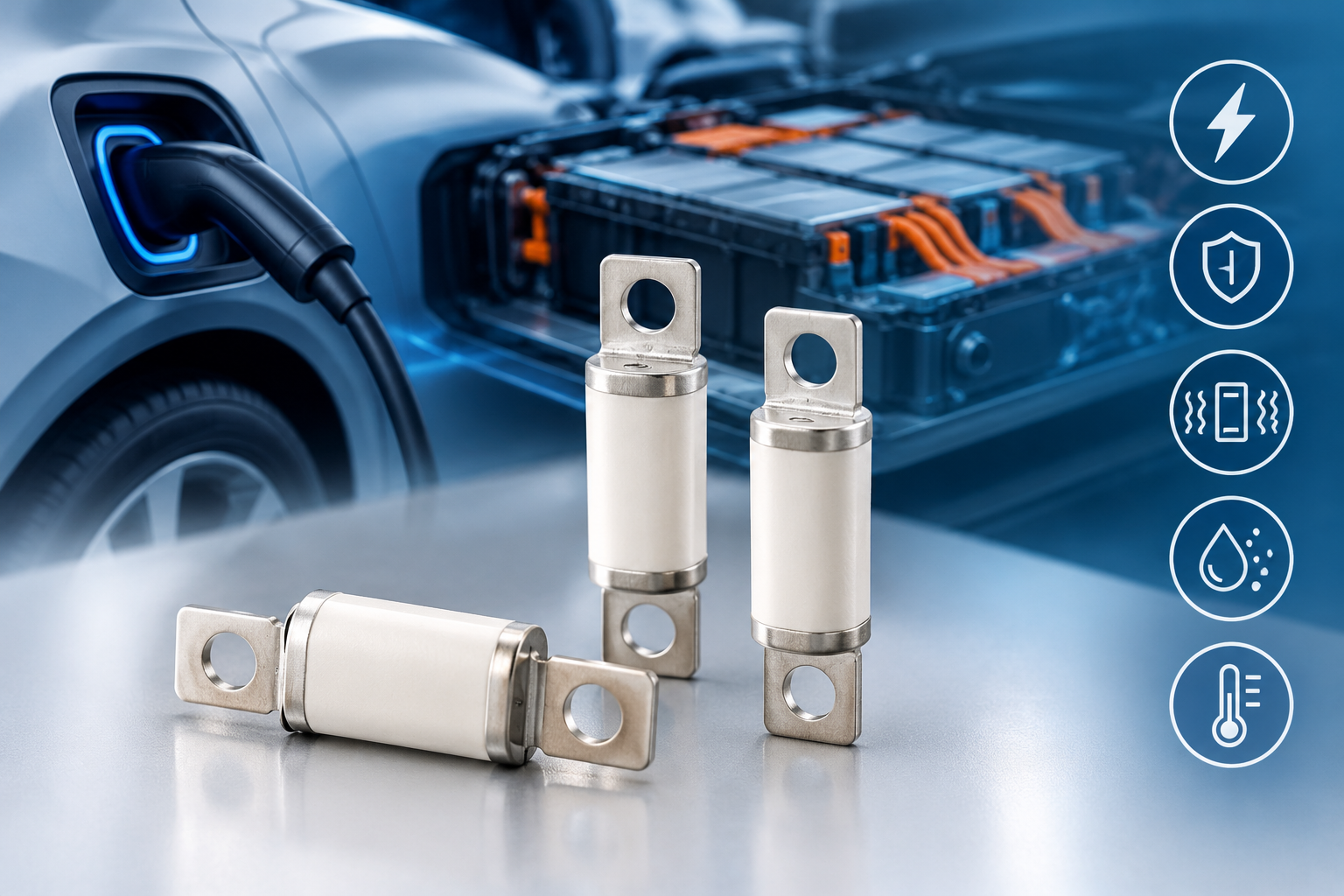
Eaton Bussmann EVKR 25 mm Fuses: High-Voltage Protection for Electric Vehicles
As electric vehicle (EV) technology advances, reliable electrical protection is essential for maintaining vehicle safety, performance and system efficiency. The Eaton Bussmann EVKR 25 mm fuses are designed to meet the demanding requirements of high-voltage electric vehicle battery systems, offering a rated voltage of 1000 V DC and current ratings from 70 A to 100 A.
Designed for applications requiring high interrupting capacity and dependable circuit protection, the EVKR fuse range supports the needs of modern electric vehicle architectures, including high-capacity battery packs engineered to deliver improved acceleration and driving range.
In this guide, we explore the key features, technical specifications, available part numbers and practical considerations when selecting an Eaton Bussmann EVKR 25 mm fuse.
What Are Eaton Bussmann EVKR 25 mm Fuses?
The Eaton Bussmann EVKR 25 mm fuse series is a high-voltage DC fuse range intended for electric vehicle applications. With a 1000 V DC voltage rating and four available current ratings, these fuses provide options for different circuit protection requirements.
Their high interrupting rating makes them suitable for applications where electrical faults can produce substantial fault currents, such as high-capacity EV battery systems.
Key product characteristics include:
-
1000 V DC rated voltage for high-voltage electrical architectures.
-
70 A, 80 A, 90 A and 100 A current ratings to accommodate different circuit requirements.
-
50 kA maximum breaking capacity for interrupting high fault currents under specified conditions.
-
M8 screw connections for secure electrical and mechanical installation.
-
Compact 25 mm fuse format for applications where installation space matters.
-
RoHS, ELV and REACH compliance to support environmental and regulatory requirements.
These characteristics make the EVKR range a product to consider when designing or maintaining high-voltage EV electrical systems.
Technical Specifications of Eaton Bussmann EVKR Fuses
The following table summarises the principal technical data for the EVKR 25 mm fuse series.
| Specification | Details |
|---|---|
| Product series | Eaton Bussmann EVKR |
| Fuse format | 25 mm |
| Rated voltage | 1000 V DC |
| Available rated currents | 70 A, 80 A, 90 A, 100 A |
| Maximum breaking capacity | 50 kA |
| Minimum breaking capacity | 300% of rated current (In) |
| Screw type | M8 |
| Individual fuse weight | 0.098 kg |
| Packaging quantity | 80 pieces per box |
| Storage temperature | –40°C to +85°C |
| Torque limit | 12 ± 1 Nm |
| Environmental compliance | RoHS, ELV and REACH |
| Reference design standards | ISO 8820-8 and GB/T 31465.6 |
Important: The minimum breaking capacity of 300% In refers to three times the fuse's rated current. It is distinct from the maximum breaking capacity of 50 kA. The complete fuse time-current characteristics and application conditions should be checked before selecting a fuse for a particular circuit.
Key Features and Benefits
1. 1000 V DC Rated Voltage
The EVKR series has a rated voltage of 1000 V DC, supporting the requirements of high-voltage electric vehicle battery systems.
Higher-voltage architectures can help improve overall system efficiency and may enable the use of smaller, more economical conductors for a given power requirement. The appropriate conductor size still depends on current, cable length, installation conditions, temperature and applicable electrical design standards.
For EV designers, choosing a fuse with a suitable voltage rating is essential to ensure that the protective device is appropriate for the circuit's operating voltage and fault conditions.
2. High Interrupting Capacity for Battery Protection
Electric vehicle battery packs can deliver very high fault currents under short-circuit conditions. Effective circuit protection is therefore essential to limit electrical damage and support system safety.
The Eaton Bussmann EVKR 25 mm fuses feature a maximum breaking capacity of 50 kA. This rating indicates their specified ability to interrupt fault currents up to that level under the manufacturer's applicable test conditions.
A high breaking capacity is particularly important when selecting protective devices for high-energy battery systems. The prospective fault current, system voltage and required protection characteristics must all be considered during fuse selection.
3. Four Current Ratings for Flexible Selection
The EVKR series is available in four current ratings: 70 A, 80 A, 90 A and 100 A.
This range provides flexibility when matching a fuse to the electrical requirements of a particular application.
The correct rating should be selected by evaluating factors such as:
-
Normal operating current and expected load variations.
-
Continuous current requirements.
-
Ambient and installation temperatures.
-
Cable and terminal current-carrying capacity.
-
Short-circuit current and required disconnection performance.
-
Fuse time-current characteristics and coordination with other protective devices.
Selecting a fuse based solely on its nominal current rating is not sufficient. The complete electrical system must be evaluated to ensure suitable protection.
4. M8 Screw Connection
All four EVKR 25 mm fuse variants use an M8 screw connection.
The specified torque limit is 12 ± 1 Nm, equivalent to an acceptable tightening range of 11–13 Nm, subject to the manufacturer's installation instructions and the requirements of the mating connection.
Correct tightening is important for maintaining a reliable electrical connection and avoiding problems associated with excessive contact resistance, overheating or mechanical damage.
Always confirm that the mating terminals, fasteners and installation arrangement are compatible with the fuse specification.
5. Environmental and Regulatory Compliance
The EVKR series is listed as compliant with:
-
RoHS: Restriction of Hazardous Substances requirements.
-
ELV: End-of-Life Vehicles requirements.
-
REACH: European chemical registration, evaluation and restriction requirements.
The product information also specifies resistance testing under the following conditions:
-
H₂O at 12.5 ppm for 96 hours, in accordance with IEC 68-2-43 Kd.
-
SO₂ at 25 ppm for 504 hours, in accordance with IEC 68-2-42 Kd.
These environmental test references are relevant when evaluating components intended for demanding operating environments. The specific test conditions and the manufacturer's supporting documentation should be reviewed when assessing suitability for a particular application.
The product is also designed with reference to ISO 8820-8 and GB/T 31465.6. These references should not be interpreted as independent certification claims unless confirmed by the applicable manufacturer documentation.
Eaton Bussmann EVKR 25 mm Fuse Part Numbers
The EVKR series includes four variants, differentiated by their rated current.
| Part number | Rated current | Packaging quantity | Screw type | Weight | Storage temperature | Torque limit |
|---|---|---|---|---|---|---|
| EVKR25-70 | 70 A | 80 per box | M8 | 0.098 kg | –40°C to +85°C | 12 ± 1 Nm |
| EVKR25-80 | 80 A | 80 per box | M8 | 0.098 kg | –40°C to +85°C | 12 ± 1 Nm |
| EVKR25-90 | 90 A | 80 per box | M8 | 0.098 kg | –40°C to +85°C | 12 ± 1 Nm |
| EVKR25-100 | 100 A | 80 per box | M8 | 0.098 kg | –40°C to +85°C | 12 ± 1 Nm |
The weight is listed per fuse. Packaging quantities and specifications should be confirmed against the current product documentation when placing an order.
Which EVKR Fuse Should You Choose?
The correct part number depends primarily on the circuit's electrical requirements.
-
EVKR25-70: For applications requiring a nominal fuse rating of 70 A.
-
EVKR25-80: For applications requiring a nominal fuse rating of 80 A.
-
EVKR25-90: For applications requiring a nominal fuse rating of 90 A.
-
EVKR25-100: For applications requiring a nominal fuse rating of 100 A.
These descriptions identify the available current ratings; they do not establish suitability for any particular vehicle or battery system. Always verify the manufacturer's time-current curves, voltage rating, breaking capacity and application-specific requirements before finalising your selection.
Applications of EVKR 25 mm Fuses
The Eaton Bussmann EVKR range is intended for high-voltage electric vehicle protection applications. Depending on the system design and the manufacturer's approved application guidance, relevant design considerations may include:
Electric Vehicle Battery Systems
High-voltage battery systems require protective devices that can interrupt fault currents at the system's operating voltage. A 1000 V DC rated fuse can be considered where its ratings and characteristics align with the battery architecture.
High-Capacity Battery Packs
Battery packs designed to provide high power for acceleration and extended driving range can present demanding short-circuit protection requirements. The EVKR series' specified 50 kA maximum breaking capacity is a key parameter to evaluate in these applications.
High-Voltage Power Distribution
EV power distribution systems require appropriate protection for conductors and connected electrical equipment. Fuse selection should account for the load profile, prospective fault current and coordination requirements throughout the circuit.
The suitability of an EVKR fuse for a specific subsystem must be confirmed using the manufacturer's technical documentation rather than inferred from the voltage and current ratings alone.
Installation and Handling Considerations
Correct installation is essential for reliable fuse performance.
Before installing an Eaton Bussmann EVKR 25 mm fuse, consider the following:
-
Verify the electrical ratings. Confirm that the 1000 V DC rating, rated current and breaking capacity are suitable for the application.
-
Check the prospective fault current. Ensure the fuse's breaking capacity is adequate for the maximum anticipated fault current under the applicable conditions.
-
Use the specified connection hardware. The EVKR series uses M8 screw connections.
-
Apply the correct tightening torque. The listed torque is 12 ± 1 Nm. Follow the manufacturer's instructions for the actual assembly.
-
Observe storage requirements. The specified storage temperature range is –40°C to +85°C.
-
Review coordination and derating requirements. Check time-current curves, operating temperatures and interactions with other protective devices.
High-voltage EV systems can retain dangerous electrical energy even after the vehicle has been switched off. Installation and replacement should only be performed by appropriately qualified personnel following the vehicle or system manufacturer's isolation, verification and safety procedures.
Why Consider Eaton Bussmann EVKR 25 mm Fuses?
When comparing high-voltage fuse options for electric vehicles, engineers and procurement teams need to evaluate more than nominal current ratings.
The EVKR range offers several relevant specification points:
-
A 1000 V DC rated voltage.
-
Four current options between 70 A and 100 A.
-
A specified maximum breaking capacity of 50 kA.
-
M8 screw connections and a defined tightening torque.
-
Environmental compliance declarations covering RoHS, ELV and REACH.
-
Reference design standards including ISO 8820-8 and GB/T 31465.6.
Together, these features provide a useful starting point for evaluating the series against the requirements of a high-voltage electrical protection design.
Final selection should always be based on the full product datasheet, application requirements and any applicable vehicle-level validation or approval process.
Frequently Asked Questions
What is the voltage rating of Eaton Bussmann EVKR 25 mm fuses?
The EVKR 25 mm fuse series has a rated voltage of 1000 V DC.
What current ratings are available?
The range includes four variants: 70 A, 80 A, 90 A and 100 A.
What is the breaking capacity of an EVKR fuse?
The specified maximum breaking capacity is 50 kA. The minimum breaking capacity is specified as 300% of the fuse's rated current. Both values must be considered alongside the applicable voltage and test conditions.
What are the part numbers for the EVKR 25 mm series?
The available part numbers are EVKR25-70, EVKR25-80, EVKR25-90 and EVKR25-100.
What tightening torque is required?
The specified torque is 12 ± 1 Nm for the M8 screw connection, subject to the manufacturer's installation instructions.
What is the operating temperature range?
The supplied technical data specifies a storage temperature range of –40°C to +85°C. This is a storage specification, not a confirmed operating temperature range. Refer to the full datasheet for operating limits.
Which standards are referenced for the EVKR series?
The product information references ISO 8820-8 and GB/T 31465.6. The specific requirements applicable to the intended vehicle or system should be verified before selection.
Conclusion
The Eaton Bussmann EVKR 25 mm fuse series provides a choice of 70 A, 80 A, 90 A and 100 A ratings for high-voltage DC protection applications. With a 1000 V DC rated voltage, a specified maximum breaking capacity of 50 kA and M8 screw connections, the range offers key characteristics to assess when designing electrical protection for electric vehicle systems.
For engineers, system integrators and procurement specialists, selecting the correct EVKR fuse means matching its complete electrical characteristics to the battery system, prospective fault current, installation conditions and protection coordination requirements.
Looking for Eaton Bussmann EVKR 25 mm fuses? Compare the EVKR25-70, EVKR25-80, EVKR25-90 and EVKR25-100 variants to identify the appropriate rated current for your application, and consult the latest manufacturer documentation before ordering or installation.



