
 eaton-bussmann-series-photovoltaic-fuses-catalogue-ca135004en.pdf  | [Eaton Bussmann PV Fuses] | 0 kB |
What Is a Solar PV Fuse and Why Is It Required?
Solar energy systems are becoming increasingly popular as businesses and homeowners look for reliable, cost-effective, and environmentally friendly sources of electricity. However, like any electrical installation, a solar photovoltaic (PV) system requires proper electrical protection to ensure safe and efficient operation.
One of the most important protection components in a solar power system is the solar PV fuse. It plays a critical role in protecting photovoltaic modules, cables, connectors, combiner boxes, and other electrical equipment against overcurrent and short-circuit conditions.
But what exactly is a solar PV fuse, how does it work, and why is it necessary for solar installations?
In this article, we will explore everything you need to know about solar PV fuses, including their working principles, applications, benefits, selection criteria, and importance in maintaining solar system safety.
What Is a Solar PV Fuse?
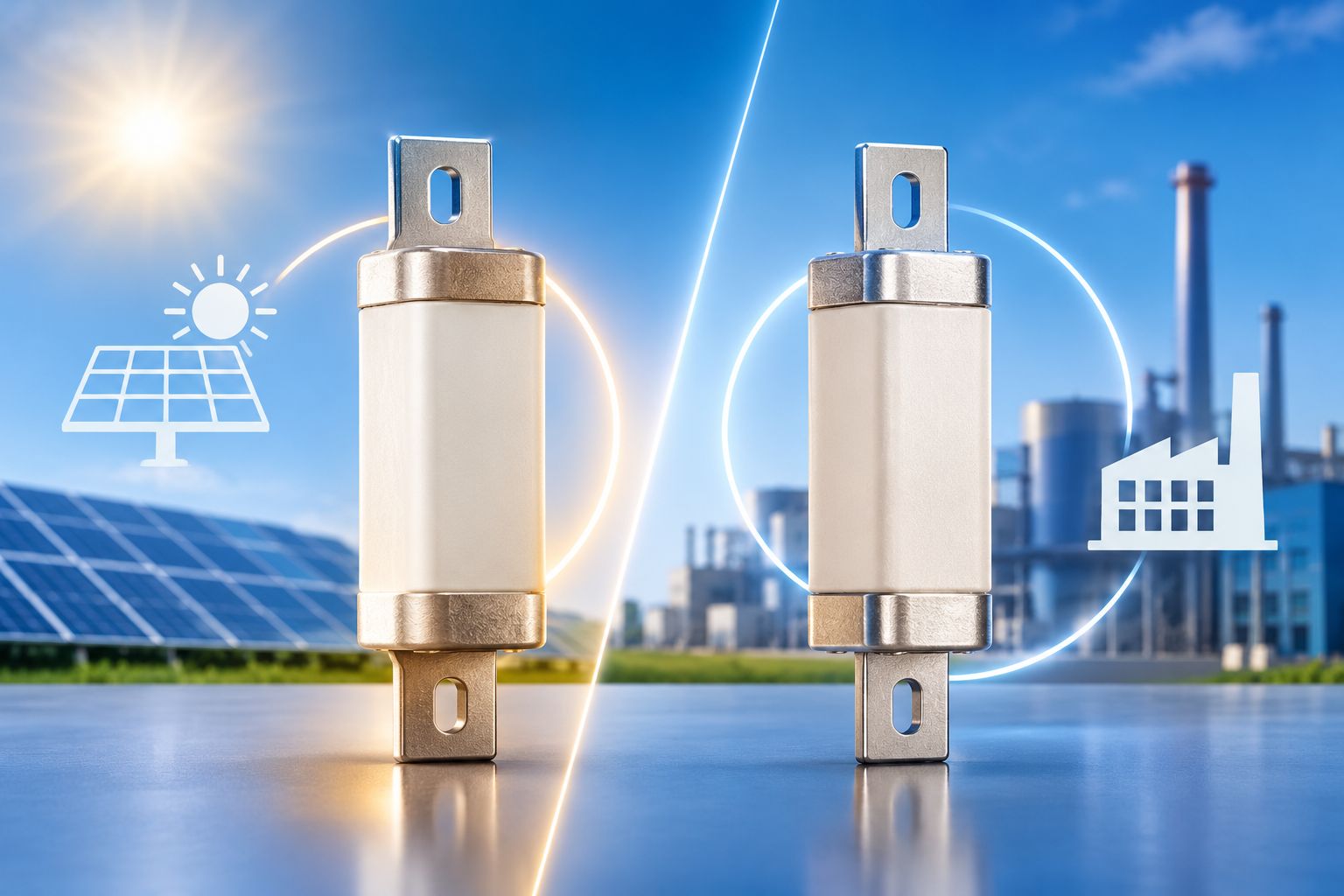
A solar PV fuse is a specialised electrical protection device designed to protect photovoltaic systems against excessive current and electrical faults.
Unlike conventional fuses used in standard electrical circuits, solar PV fuses are specifically designed for direct current (DC) applications. Solar panels generate DC electricity, which creates different protection requirements compared with alternating current (AC) electrical systems.
A solar PV fuse works by interrupting the electrical circuit when the current exceeds a predetermined safe level. When excessive current flows through the fuse, its internal metal element heats up and eventually melts, disconnecting the faulty circuit.
This process helps prevent:
-
Overheating of electrical cables.
-
Damage to solar panels and photovoltaic modules.
-
Short-circuit-related equipment failures.
-
Electrical fires caused by excessive current.
-
Damage to inverters and other system components.
Solar PV fuses are commonly installed in solar string circuits and photovoltaic combiner boxes, particularly in systems where multiple solar strings are connected in parallel.
How Does a Solar PV Fuse Work?
The working principle of a solar PV fuse is relatively simple. It uses a specially designed fuse element that melts when excessive current flows through it.
However, its construction is engineered to handle the specific electrical conditions associated with solar power systems.
The operation of a solar PV fuse involves the following stages:
1. Normal Electrical Operation
Under normal operating conditions, electrical current flows through the fuse element without causing it to melt. The fuse allows the solar system to generate and distribute electricity efficiently.
2. Detection of Excessive Current
When an electrical fault occurs, such as a short circuit or abnormal reverse current, the current flowing through the fuse may exceed its permitted operating characteristics.
3. Fuse Element Melting
Excessive current generates heat within the fuse element. When the element reaches its designed operating condition, it melts and breaks the electrical connection.
4. Circuit Interruption
Once the fuse element melts, the circuit opens and stops the abnormal current from continuing to flow through the affected section.
5. Electrical Arc Suppression
During circuit interruption, an electrical arc may form between the separated ends of the fuse element. Solar PV fuses are designed with suitable internal construction to extinguish this arc safely under their specified operating conditions.
This final stage is particularly important because DC current does not naturally pass through zero as AC current does.
Why Is a Solar PV Fuse Required?
Solar PV fuses are essential for protecting photovoltaic systems from electrical faults that could damage equipment or compromise installation safety.
Here are the main reasons why solar PV fuse protection is required.
1. Protection Against Overcurrent
Overcurrent occurs when electrical current exceeds the safe operating capacity of a circuit.
In a photovoltaic installation, excessive current can damage cables, connectors, junction boxes, and other electrical components.
A properly selected solar PV fuse interrupts the affected circuit when the current reaches its specified operating characteristics.
This helps minimise overheating and reduces the risk of electrical damage.
2. Protection Against Reverse Current
Reverse current is one of the major concerns in solar PV systems containing multiple parallel-connected strings.
When one string develops a fault, other healthy strings may feed current back into the faulty string. This additional current can exceed the safe current-carrying capacity of the affected circuit.
Solar PV fuses help protect individual strings by interrupting excessive reverse current when the relevant fault conditions occur.
This is particularly important in large solar installations with multiple parallel-connected photovoltaic strings.
3. Prevention of Electrical Fires
Excessive current can cause electrical cables and connections to overheat.
If the fault remains undetected, the increased temperature may damage insulation and surrounding materials, potentially creating a fire hazard.
By interrupting abnormal current, solar PV fuses help reduce the risk of overheating and electrical fires.
4. Protection of Solar Panels and Electrical Components
Solar installations contain several interconnected electrical components, including:
-
Solar photovoltaic modules.
-
DC cables and connectors.
-
Junction boxes.
-
Combiner boxes.
-
Inverters.
-
DC distribution equipment.
An electrical fault in one section can affect other connected components.
Solar PV fuse protection helps isolate the faulty circuit and reduce the possibility of damage spreading throughout the installation.
5. Improved System Reliability
Solar power systems are designed to operate for many years. Reliable electrical protection is therefore essential for maintaining long-term performance.
A correctly selected PV fuse helps reduce unexpected equipment failures, maintenance requirements, and system downtime.
It also supports safer operation across residential, commercial, industrial, and utility-scale solar installations.
What Makes a Solar PV Fuse Different from a Conventional Fuse?
A solar PV fuse is specifically designed to operate under the electrical and environmental conditions of photovoltaic systems.
There are several important differences between PV fuses and conventional electrical fuses.
DC Voltage Rating: Solar PV systems operate using DC electricity, often at relatively high voltages. Therefore, PV fuses must have an appropriate DC voltage rating for the installation.
Arc Interruption Capability: DC circuits do not have the natural current-zero crossing found in AC circuits. PV fuses require suitable arc-extinguishing capabilities to interrupt DC fault current safely.
Continuous Operation: Solar installations can generate electricity for extended periods during daylight hours. PV fuses must withstand continuous operating current without excessive temperature rise.
Temperature Resistance: Solar installations are frequently exposed to changing environmental temperatures. PV fuses must maintain suitable performance under their specified operating temperature conditions.
Power Dissipation: Fuse power losses can contribute to heat generation within electrical enclosures. Low power dissipation is an important consideration, particularly in large solar installations.
These characteristics make dedicated photovoltaic fuse protection important for modern solar power systems.
What Is a gPV Fuse?
A gPV fuse is a specialised fuse designed for photovoltaic system protection.
The designation gPV identifies a fuse category intended for protecting solar PV strings and arrays.
The letter "g" represents full-range protection within the applicable fuse classification, while "PV" identifies its photovoltaic application.
These fuses are designed to address the specific protection requirements of solar installations, including DC overcurrent conditions and reverse-current faults.
The IEC 60269-6 standard provides supplementary requirements for fuse-links used in photovoltaic string and array protection.
Difference Between gPV and gG Fuses
Although both gPV and gG fuses provide overcurrent protection, they are designed for different applications.
| Feature | gPV Fuse | gG Fuse |
|---|---|---|
| Primary application | Solar photovoltaic systems | General electrical circuits |
| Application focus | PV string and array protection | General-purpose circuit protection |
| DC suitability | Designed for specified PV DC applications | Requires specific application verification |
| Operating conditions | Designed around PV requirements | Designed around general electrical requirements |
| Selection factors | PV voltage, current, reverse current, and fault conditions | Circuit voltage, current, and protection requirements |
A conventional fuse should not automatically be considered a suitable replacement for a dedicated PV fuse. The electrical ratings, interruption capability, and application requirements must always be verified.
Where Are Solar PV Fuses Used?
Solar PV fuses are installed at different points within a photovoltaic system, depending on the system architecture and protection requirements.
1. PV String Protection
A solar string consists of multiple photovoltaic modules connected in series.
When several strings are connected in parallel, current from healthy strings may flow towards a faulty string.
String fuses help protect individual circuits against excessive current and reverse-current conditions.
2. Solar Combiner Boxes
A photovoltaic combiner box collects electrical power from multiple solar strings before transferring it to downstream equipment.
String fuses are commonly installed inside combiner boxes to provide individual string protection.
They help isolate faulty branches without unnecessarily affecting the entire solar array.
3. Inverter DC Input Protection
Solar inverters convert DC electricity generated by photovoltaic modules into AC electricity for household, commercial, or grid-connected applications.
Appropriate DC-side protection helps manage electrical faults between the solar array and inverter.
The exact fuse arrangement depends on the inverter design, system configuration, and applicable electrical requirements.
4. Residential Solar Installations
Residential rooftop solar systems require appropriate protection to safeguard their modules, cables, and electrical equipment.
Solar PV fuses may be used where the system configuration requires string-level overcurrent protection.
5. Commercial and Utility-Scale Solar Systems
Large solar installations often contain numerous parallel-connected strings and extensive DC distribution networks.
As system size increases, the importance of correct fuse selection and protection coordination also increases.
PV fuses help protect individual circuits and support reliable operation across larger installations.
How to Select the Right Solar PV Fuse?
Selecting the correct solar PV fuse is essential for ensuring effective electrical protection.
Choosing a fuse based only on its current rating is not sufficient. Several technical factors must be evaluated.
1. Rated DC Voltage
The fuse must have a DC voltage rating suitable for the maximum possible voltage of the photovoltaic circuit.
The maximum system voltage should be calculated by considering the number of modules connected in series, module open-circuit voltage, and relevant temperature conditions.
2. Rated Current
The current rating must be appropriate for the operating conditions of the PV circuit.
Selection should consider module short-circuit current, expected operating current, system configuration, cable capacity, and applicable design requirements.
3. Maximum Series Fuse Rating
Solar module manufacturers specify a maximum series fuse rating for their products.
The selected fuse must not exceed the permitted protection rating specified in the module documentation.
4. Breaking Capacity
Breaking capacity refers to the maximum fault current that a fuse can safely interrupt at its specified voltage.
The selected fuse must have sufficient breaking capacity to handle the prospective short-circuit current at the installation point.
5. Ambient Temperature
Solar installations may experience high temperatures, particularly in rooftop environments and enclosed combiner boxes.
Temperature can affect fuse performance and allowable continuous current.
Therefore, the installation environment and relevant derating requirements must be considered.
6. Power Dissipation
Power dissipation refers to the electrical energy converted into heat while current flows through a fuse.
Lower power dissipation can help reduce heat generation inside electrical enclosures and improve overall system efficiency.
This consideration becomes increasingly important in large solar power plants containing many fuse connections.
7. Physical Compatibility
The fuse must be compatible with its fuse holder and installation arrangement.
Important considerations include:
-
Fuse dimensions.
-
Terminal configuration.
-
Mounting requirements.
-
Holder compatibility.
-
Electrical connections.
-
Enclosure space.
8. Applicable Standards
Always verify that the selected PV fuse complies with the relevant industry standards and local electrical regulations.
IEC 60269-6 is an important standard covering supplementary requirements for photovoltaic fuse-links.
Professional electrical design and installation practices are essential to ensure the complete protection system operates correctly.
Solar PV Fuse vs DC Circuit Breaker: What Is the Difference?
Solar PV fuses and DC circuit breakers are both used for electrical protection, but they operate differently.
| Feature | Solar PV Fuse | DC Circuit Breaker |
|---|---|---|
| Operating principle | Melting fuse element | Mechanical switching and tripping mechanism |
| Fault protection | Interrupts excessive current | Trips during specified fault conditions |
| After operation | Usually requires replacement | Can generally be reset if suitable |
| Maintenance | Replacement of operated fuse | Reset and inspection, as applicable |
| Installation | Often compact | Depends on breaker design |
| Application | PV string and array protection | DC circuit protection and switching |
Both devices have important roles in photovoltaic protection systems.
The correct choice depends on the electrical design, system voltage, fault current, protection coordination, installation requirements, and maintenance strategy.
They should not be treated as automatically interchangeable.
Common Mistakes to Avoid When Selecting Solar PV Fuses
Incorrect fuse selection can reduce protection effectiveness and potentially expose the solar installation to electrical hazards.
Some common mistakes include:
1. Choosing a Fuse Based Only on Current Rating
A suitable fuse must have the correct voltage rating, breaking capacity, and operating characteristics, not just the required ampere rating.
2. Using a Conventional Fuse in a PV Application
Not every DC-rated fuse is suitable for photovoltaic protection. Always verify the fuse's intended application and technical specifications.
3. Ignoring Reverse Current
Parallel-connected PV strings can contribute current to a faulty circuit. Reverse-current exposure must be considered during system design.
4. Overlooking Temperature Conditions
High ambient temperatures and insufficient ventilation can affect fuse performance and allowable current.
5. Ignoring Breaking Capacity
A fuse must be capable of safely interrupting the prospective fault current at the operating voltage.
6. Neglecting Fuse Holder Compatibility
The fuse link and its holder must be electrically, mechanically, and thermally compatible.
Avoiding these mistakes helps improve the safety, reliability, and long-term performance of photovoltaic installations.
Benefits of Using Proper Solar PV Fuse Protection
Correctly designed solar PV fuse protection offers several important benefits:
-
Electrical safety: Helps interrupt abnormal current and reduce electrical hazards.
-
Equipment protection: Protects photovoltaic modules, cables, connectors, and other system components.
-
Fire risk reduction: Helps prevent excessive current from causing dangerous overheating.
-
System reliability: Reduces the risk of extensive equipment damage during electrical faults.
-
Improved maintenance: Allows faulty circuits to be isolated more effectively.
-
Long-term performance: Supports reliable operation throughout the solar installation's service life.
These benefits make solar PV fuses an important component of a properly engineered photovoltaic protection system.
Frequently Asked Questions (FAQs)
1. What is the main purpose of a solar PV fuse?
The main purpose of a solar PV fuse is to protect photovoltaic circuits against excessive current and electrical faults. It interrupts the circuit when current reaches its specified operating characteristics, helping prevent equipment damage and overheating.
2. Are solar PV fuses necessary?
Solar PV fuses are required where the system design and applicable electrical standards call for overcurrent protection. They are particularly important in parallel-connected PV systems where current from healthy strings can flow into a faulty string.
3. What is a gPV fuse?
A gPV fuse is a specialised fuse designed for photovoltaic applications. It provides protection for PV strings and arrays and is designed to meet the specific electrical requirements of solar DC systems.
4. Can I use a normal fuse in a solar panel system?
A conventional fuse should not be used as a replacement for a PV fuse without verifying its suitability. The device must have appropriate DC voltage, current, breaking capacity, and operating characteristics for the specific photovoltaic application.
5. Where should a solar PV fuse be installed?
Solar PV fuses are commonly installed in string circuits and photovoltaic combiner boxes. Their exact location depends on the system configuration, equipment requirements, and applicable electrical regulations.
6. What happens if a solar PV fuse blows?
When a PV fuse operates, it interrupts the affected electrical circuit. The corresponding string or circuit may stop supplying power. The cause of the fault should be identified before a correctly rated replacement fuse is installed.
7. What standard applies to solar PV fuses?
IEC 60269-6 provides supplementary requirements for fuse-links designed to protect photovoltaic strings and arrays. Other applicable national standards and installation regulations should also be considered.
8. What is the difference between a PV fuse and a DC fuse?
A PV fuse is specifically designed and evaluated for photovoltaic applications. A general DC fuse may be suitable for certain DC circuits, but it is not automatically appropriate for solar PV installations. Its ratings and interruption characteristics must be verified.
Conclusion
A solar PV fuse is an essential electrical protection component in photovoltaic systems. It helps protect solar strings, cables, connectors, combiner boxes, and other electrical equipment against overcurrent and short-circuit conditions.
Because solar installations operate using DC electricity and may involve multiple parallel-connected strings, they require protection devices designed for their specific electrical conditions.
Selecting the right solar PV fuse involves evaluating several factors, including DC voltage rating, current rating, reverse-current exposure, breaking capacity, temperature, power dissipation, and applicable standards.
Ultimately, proper PV fuse selection and installation help improve electrical safety, protect valuable equipment, reduce maintenance risks, and support the long-term reliability of solar power systems.



