
 eaton-ev-fuse-catalogue-emob0062-en-us.pdf  | [Eaton Bussmann EV Fuses] | 0 kB |
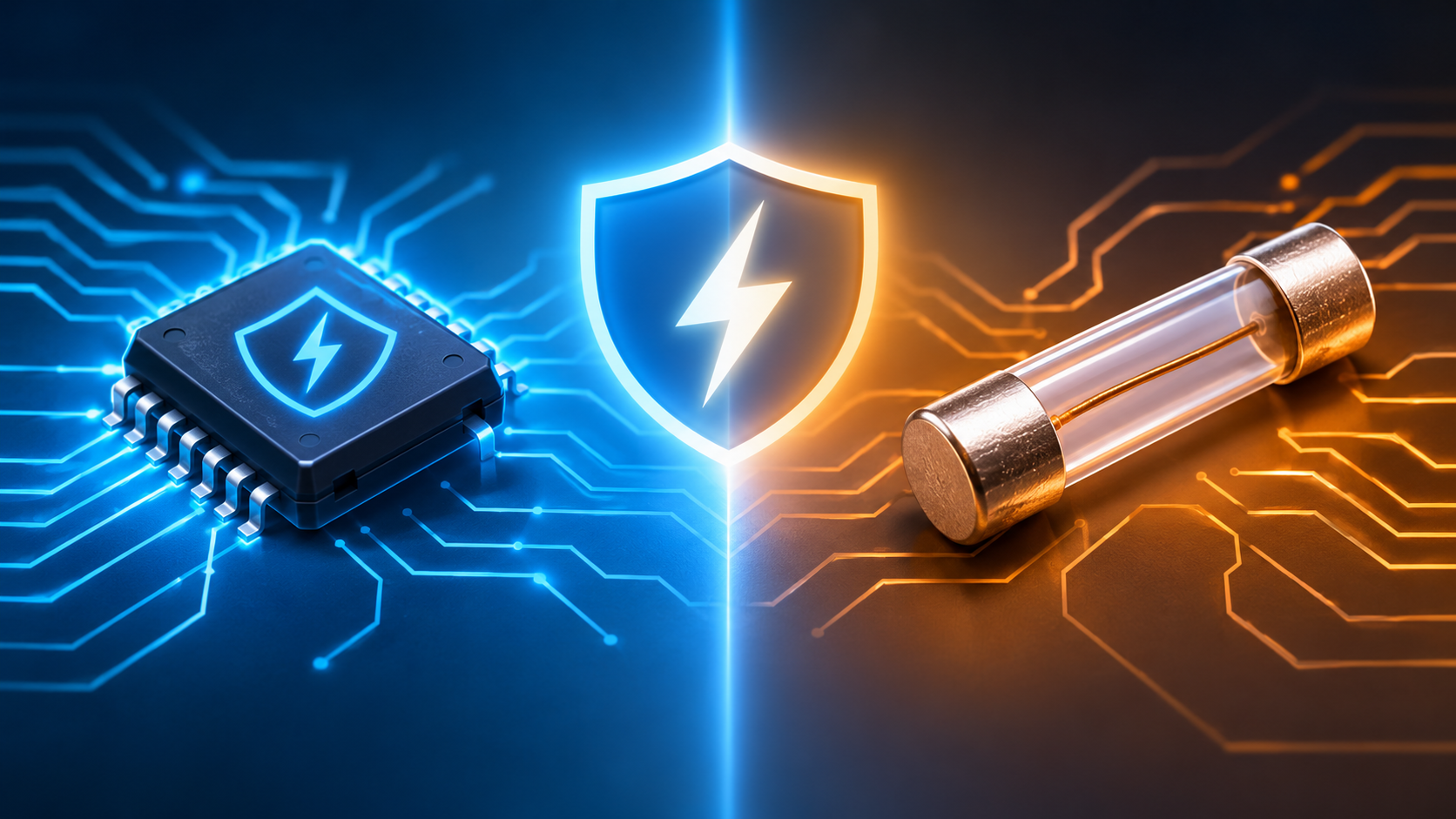
Solid-State vs Traditional Fuse: Key Differences, Advantages, and Which Is Better?
Introduction
Electrical circuit protection is essential for maintaining the safety, reliability, and performance of modern electrical systems. As technology advances, traditional fuse designs are increasingly being compared with newer semiconductor-based protection solutions. One of the most important developments is the solid-state fuse, also known as an electronic fuse or eFuse.
Both solid-state and traditional fuses are designed to protect electrical circuits from excessive current and potentially damaging faults. However, they use different operating principles, offer different performance characteristics, and serve different application requirements.
The debate surrounding solid-state vs traditional fuse technology has become particularly important in electric vehicles (EVs), battery energy storage systems, renewable energy installations, and advanced power electronics.
So, which technology offers better protection? Is a solid-state fuse a suitable replacement for a traditional fuse, or do conventional fuses still provide important advantages?
This guide explores their working principles, advantages, disadvantages, and practical applications to help engineers and system designers make informed decisions.
1. What Is a Solid-State Fuse?
A solid-state fuse is an electronic circuit protection device that uses semiconductor components to control and interrupt electrical current when abnormal operating conditions are detected.
Unlike traditional fuses, which rely on a metal element melting under excessive current, solid-state fuses typically use semiconductor switches, such as MOSFETs, combined with electronic sensing and control circuits.
When the device detects an overcurrent condition, its electronic control system activates the semiconductor switch to interrupt current flow.
Key Features of Solid-State Fuses
1. Extremely Fast Response Time
Solid-state fuses can respond to electrical faults within microseconds. This rapid interruption helps limit fault energy and reduces the potential for damage to sensitive electronic components.
2. Resettable Operation
Many solid-state fuses can be reset automatically or through an external control signal after a fault has been cleared. This eliminates the need for physical replacement after every protection event.
3. Intelligent Monitoring
Electronic protection systems can monitor current, voltage, and temperature in real time. Depending on the design, they can also provide diagnostic information to a battery management system or other control equipment.
4. Adjustable Protection Parameters
Some solid-state fuses allow engineers to configure current limits, thermal shutdown thresholds, inrush current control, and other protection functions.
5. No Mechanical Contacts
Because solid-state fuses use semiconductor switching rather than mechanical contacts, they avoid problems such as contact bounce, mechanical wear, and contact welding.
Advantages of Solid-State Fuses
Solid-state fuse technology offers several benefits for modern electrical applications:
-
Fast fault interruption: Microsecond-level switching can help protect sensitive electronic equipment.
-
Reduced maintenance: Resettable operation can reduce replacement requirements and system downtime.
-
Advanced diagnostics: Electronic monitoring provides valuable information about system conditions.
-
Flexible configuration: Adjustable protection settings support different load requirements.
-
Long switching life: Semiconductor-based devices can support a high number of switching cycles when operated within their specified limits.
Disadvantages of Solid-State Fuses
Despite their advantages, solid-state fuses also have limitations.
-
Higher initial cost: Semiconductor components and control electronics make these devices more expensive than conventional fuses.
-
Thermal management requirements: Semiconductor switches generate heat during normal operation because of their on-state resistance. High-current applications may require additional cooling.
-
Limited breaking capacity: Their short-circuit interruption capability may be lower than that of appropriately rated high-performance fuses.
-
Greater system complexity: Control circuits, sensors, software, and power management functions introduce additional design considerations.
-
Qualification challenges: Applications such as electric vehicles require extensive reliability and safety validation before new protection technologies can be adopted.
2. What Is a Traditional Fuse?
A traditional fuse is a passive electrical protection device designed to interrupt current when it exceeds a predetermined level.
It contains a specially designed fusible element that heats up when electrical current flows through it. If excessive current persists, the element melts and opens the circuit, preventing further current flow.
Traditional fuses have been used in electrical systems for more than a century. Their straightforward operating principle, predictable characteristics, and proven reliability make them an important part of modern electrical protection.
Key Features of Traditional Fuses
1. Thermal Operating Principle
Traditional fuses operate through the heating and melting of a fusible metal element. The operating time depends on the magnitude and duration of the overcurrent.
2. Single-Use Protection
Once a fuse operates, its fusible element is destroyed. The fuse must be replaced before the circuit can return to normal operation.
3. Passive Operation
Traditional fuses do not require external power supplies, software, sensors, or electronic control systems to perform their basic protection function.
4. High Breaking Capacity
Properly designed high-performance fuses can interrupt very high short-circuit currents. This makes them particularly suitable for high-energy electrical systems.
5. Proven Reliability
Traditional fuse technology has extensive operating experience across industrial equipment, automotive systems, renewable energy installations, and electrical distribution networks.
Advantages of Traditional Fuses
Traditional fuses continue to offer several important benefits:
-
Cost-effectiveness: They generally have a lower purchase price than semiconductor-based protection devices.
-
High short-circuit protection: Many fuse designs provide excellent breaking capacity for demanding electrical applications.
-
Simple construction: Their passive operating principle reduces system complexity.
-
No external power required: They operate independently of electronic control systems.
-
Established performance: Their characteristics and application requirements are well understood.
-
Fail-safe protection: A correctly selected fuse provides independent overcurrent interruption without relying on software or communication signals.
Disadvantages of Traditional Fuses
Although traditional fuses are highly reliable, they also have some limitations:
-
Single-use operation: A blown fuse must be physically replaced.
-
No electronic diagnostics: Standard fuses cannot independently communicate real-time operating information.
-
Limited protection functions: Their primary function is overcurrent protection rather than comprehensive electronic monitoring.
-
Thermal aging: Repeated thermal cycling and prolonged operating conditions can influence fuse performance.
-
Replacement downtime: In remote or difficult-to-access installations, replacing a fuse can increase maintenance time and costs.
3. Solid-State vs Traditional Fuse: Key Differences
Understanding the differences between these two technologies is essential when selecting an appropriate electrical protection solution.
Although both protect circuits against excessive current, their operating mechanisms and performance characteristics are significantly different.
Comparison Table
| Comparison Factor | Solid-State Fuse | Traditional Fuse |
|---|---|---|
| Operating principle | Electronic semiconductor switching | Thermal melting of a fusible element |
| Response time | Microseconds | Milliseconds to seconds, depending on fault current |
| Reset capability | Usually resettable, depending on design | Single-use |
| Short-circuit capacity | Design-dependent and often more limited | Generally very high in suitable fuse designs |
| Initial cost | Relatively high | Relatively low |
| System complexity | Requires electronic control | Simple passive construction |
| Monitoring | Supports electronic diagnostics | No built-in electronic monitoring |
| Protection settings | Often configurable | Determined by fuse characteristics |
| Mechanical wear | No mechanical contacts | No mechanical switching contacts |
| Thermal management | Requires semiconductor heat management | Requires appropriate fuse and holder thermal design |
| Maintenance | Potentially lower replacement requirements | Requires replacement after operation |
| Typical applications | Sensitive electronic circuits and controlled power systems | High-current and high-voltage circuit protection |
The comparison demonstrates that neither technology is universally superior. The right solution depends on the electrical characteristics, safety requirements, operating environment, and overall system design.
4. Response Time: Why Does It Matter?
Response time is one of the most significant differences between solid-state and traditional fuse technology.
When an electrical fault occurs, excessive current can generate heat, damage insulation, destroy electronic components, and create dangerous operating conditions.
A protection device must interrupt the fault quickly enough to prevent unacceptable damage.
Solid-State Fuse Response Time
Solid-state fuses can detect and interrupt certain electrical faults within microseconds.
Their electronic sensing and semiconductor switching mechanisms allow them to respond extremely quickly to abnormal current conditions.
This capability is particularly useful in applications involving sensitive electronic equipment, where even a short-duration fault can cause significant damage.
Traditional Fuse Response Time
Traditional fuses operate according to their time-current characteristics.
A small overload may take considerably longer to interrupt than a severe short circuit. Under high fault-current conditions, a properly selected fuse can operate very rapidly.
The actual operating time depends on several factors, including:
-
Rated current.
-
Fault current magnitude.
-
Fuse construction.
-
Ambient temperature.
-
Pre-existing thermal conditions.
Which Is Better?
Solid-state fuses generally offer faster and more precisely controlled electronic interruption. However, response speed alone does not determine overall protection performance.
The fuse must also have an adequate voltage rating, current rating, and breaking capacity for the application.
5. Breaking Capacity and Electrical Safety
Breaking capacity is another critical factor when comparing solid-state and traditional fuses.
It refers to the maximum prospective fault current that a protection device can safely interrupt under specified conditions.
In electric vehicles and battery energy storage systems, short-circuit currents can reach extremely high levels because of the substantial energy stored in batteries.
Solid-State Fuse Breaking Capacity
Solid-state devices use semiconductor switches to interrupt current. Their ability to withstand and interrupt high fault currents depends on semiconductor ratings, circuit design, thermal conditions, and protection coordination.
Although semiconductor technology continues to improve, achieving the high short-circuit breaking capacity required in demanding battery applications remains challenging.
Traditional Fuse Breaking Capacity
Traditional high-performance fuses are specifically engineered to interrupt high fault currents safely.
Their internal construction helps extinguish the electrical arc generated when the fusible element melts.
Depending on the design and rating, these devices can provide very high DC breaking capacity, making them suitable for demanding battery and power distribution applications.
Why Does This Matter?
For high-voltage battery systems, selecting a protection device based only on response time can be dangerous.
Engineers must consider the maximum prospective short-circuit current, rated voltage, interruption characteristics, and coordination with other protection components.
6. Applications of Solid-State and Traditional Fuses
Both technologies have important roles in modern electrical systems. Their suitability depends on the required protection level and operating conditions.
Applications of Solid-State Fuses
Solid-state fuses are particularly attractive in applications where fast response, electronic monitoring, and resettable operation are important.
Common application areas include:
-
Sensitive electronic equipment.
-
Low-to-medium-current power distribution.
-
Advanced battery management systems.
-
Electronic control units.
-
Intelligent power distribution systems.
-
Circuits with frequent switching requirements.
-
Systems requiring remote diagnostics and monitoring.
In these applications, the ability to detect faults quickly and provide electronic feedback can improve system control and maintenance.
Applications of Traditional Fuses
Traditional fuses remain widely used in applications requiring high short-circuit interruption capability, simple operation, and proven reliability.
Typical applications include:
-
Electric vehicle battery protection.
-
Battery energy storage systems.
-
Solar photovoltaic installations.
-
Industrial electrical distribution.
-
High-voltage DC circuits.
-
Power conversion equipment.
-
Charging infrastructure.
-
High-current battery connections.
Their passive construction and established protection characteristics make them particularly valuable in high-energy electrical systems.
7. Solid-State Fuse vs Traditional Fuse in Electric Vehicles
Electric vehicles represent one of the most demanding environments for electrical circuit protection.
Modern EV architectures increasingly operate at 400V, 800V, and higher voltage levels. Their battery packs can deliver substantial fault currents, making reliable protection essential.
Why Solid-State Fuses Are Attractive for EVs
Solid-state protection technology offers several potential advantages for electric vehicles:
-
Faster electronic fault detection.
-
Improved protection coordination.
-
Intelligent battery monitoring.
-
Resettable protection functions.
-
Reduced dependence on mechanical switching components.
These features may be especially useful in secondary circuits and sensitive electronic systems.
Why Traditional Fuses Remain Important in EVs
Despite the development of electronic protection technology, traditional fuses continue to play a major role in EV battery protection.
Their high breaking capacity, passive operation, established safety performance, and relatively low cost make them suitable for high-current battery circuits.
For applications involving severe short-circuit conditions, a properly rated traditional fuse remains an important independent safety barrier.
Can Solid-State Fuses Replace Traditional EV Fuses?
Not in every application.
Solid-state fuses offer significant technological advantages, but their current limitations in cost, thermal management, and high-current interruption prevent them from being a universal replacement for traditional fuses.
A more practical approach is to combine both technologies where appropriate.
Traditional fuses can provide primary protection for high-energy circuits, while solid-state devices can provide faster, intelligent protection for selected secondary circuits.
8. How to Choose Between a Solid-State and Traditional Fuse
Selecting the right fuse technology requires a detailed understanding of the electrical system.
The following factors can help engineers identify the most suitable protection solution.
1. Voltage Rating
Determine the maximum operating voltage of the circuit.
For DC applications, ensure that the selected protection device is specifically rated for the required DC voltage and can safely interrupt the available fault current.
2. Current Rating
Evaluate the continuous operating current and expected overload conditions.
The protection device must support normal operating conditions while providing reliable interruption during abnormal current events.
3. Short-Circuit Breaking Capacity
Calculate or determine the maximum prospective short-circuit current.
The selected device must have a breaking capacity equal to or greater than the available fault current under the specified operating conditions.
4. Required Response Time
Consider how quickly the circuit must be disconnected to prevent damage.
Sensitive electronic systems may benefit from the microsecond-level response of solid-state protection. High-energy circuits may prioritize proven short-circuit interruption performance.
5. Cost and Maintenance
Compare initial purchase costs with long-term operating expenses.
Solid-state devices may reduce replacement requirements, while traditional fuses offer lower component costs and straightforward maintenance.
6. Operating Environment
Consider temperature, vibration, humidity, installation space, and accessibility.
Solid-state devices require appropriate thermal management, while traditional fuses must be installed and operated within their specified environmental and thermal limits.
7. Safety and Reliability
Evaluate the required safety standards, protection coordination, qualification requirements, and expected service life.
For critical applications, independent protection and well-established interruption performance should be important considerations.
9. Will Solid-State Fuses Replace Traditional Fuses in the Future?
Solid-state fuse technology is developing rapidly, particularly as electric vehicles, renewable energy systems, and intelligent power distribution become more advanced.
Semiconductor improvements are creating opportunities for faster fault interruption, more sophisticated monitoring, and increasingly compact electronic protection systems.
However, traditional fuses continue to offer important advantages that are difficult to overlook.
Their high breaking capacity, simple operating principle, low cost, and extensive field experience make them highly effective for many demanding electrical applications.
The future of circuit protection is therefore more likely to involve cooperation between the two technologies rather than the complete replacement of one by the other.
Solid-state fuses may become increasingly common in applications requiring intelligent and resettable protection, while traditional fuses will continue to serve as essential protection components in high-current and high-voltage systems.
Conclusion
The comparison of solid-state vs traditional fuse technology highlights two different approaches to electrical circuit protection.
Solid-state fuses offer fast electronic response, resettable operation, intelligent monitoring, and flexible protection settings. These characteristics make them attractive for sensitive electronic circuits and advanced power management systems.
Traditional fuses provide proven reliability, high short-circuit breaking capacity, passive operation, and cost-effective protection. These advantages make them particularly suitable for electric vehicle batteries, energy storage systems, photovoltaic installations, and industrial power distribution.
Ultimately, choosing between a solid-state and traditional fuse requires more than comparing response times or initial costs. Engineers must evaluate voltage ratings, current requirements, breaking capacity, operating conditions, safety standards, and total system reliability.
Rather than viewing these technologies as direct competitors, it is important to recognize their complementary strengths. Combining appropriate electronic protection with correctly selected traditional fuses can provide a balanced and effective approach to protecting modern electrical systems.
Frequently Asked Questions (FAQs)
1. What is the main difference between a solid-state fuse and a traditional fuse?
The main difference is their operating principle. A solid-state fuse uses semiconductor switches and electronic circuits to interrupt current, while a traditional fuse uses a metal element that melts when excessive current flows through it.
2. Is a solid-state fuse faster than a traditional fuse?
Yes, solid-state fuses can typically interrupt faults within microseconds. Traditional fuse operating times range from milliseconds to seconds, depending on the magnitude and duration of the overcurrent.
3. Are solid-state fuses reusable?
Most solid-state fuses offer resettable operation, either automatically or through an external control signal. Traditional fuses are single-use devices and must be replaced after operation.
4. Why are traditional fuses still used in electric vehicles?
Traditional fuses offer high short-circuit breaking capacity, proven reliability, simple construction, and cost-effective protection. These characteristics make them particularly suitable for high-voltage EV battery systems.
5. Are solid-state fuses more expensive?
Generally, yes. Solid-state fuses require semiconductor components, sensing circuits, and electronic control systems, resulting in higher initial costs than conventional fuses.
6. Can solid-state fuses replace traditional fuses completely?
No. Solid-state fuses offer advantages in response time and electronic monitoring, but traditional fuses remain important for high-current applications requiring very high short-circuit breaking capacity. Both technologies are expected to coexist in many electrical systems.
7. Which fuse is better for battery energy storage systems?
The choice depends on the system's voltage, current, available short-circuit current, and protection requirements. Traditional high-performance fuses are widely used for main battery protection because of their high breaking capacity. Solid-state devices may provide additional protection in selected electronic and secondary circuits.
8. What factors should be considered when selecting a fuse?
Important factors include rated voltage, rated current, breaking capacity, time-current characteristics, ambient temperature, installation conditions, applicable safety standards, and coordination with other circuit protection devices.



