
 eaton-bussmann-nh-ebh000-horizontal-switch-disconnectors-datasheet-10292-en-uk.pdf | [NH Horizontal fuse switch disconnectors - EBH000] | 186 kB |
| eaton-bussmann-series-ebh-horizontal-00-1-2-fuse-switch-disconnector-datasheet-10293-en-us.pdf | [NH Horizontal fuse switch disconnectors - EBH range] | 5391 kB |
Understanding Fuse Switch Disconnectors: A Critical Component for Electrical Safety
Electrical safety is a fundamental requirement in industrial, commercial, and renewable energy applications. As electrical systems become increasingly complex, reliable protection and isolation devices are essential for preventing equipment damage, reducing operational risks, and ensuring workplace safety. One important component that fulfils these requirements is the fuse switch disconnector.
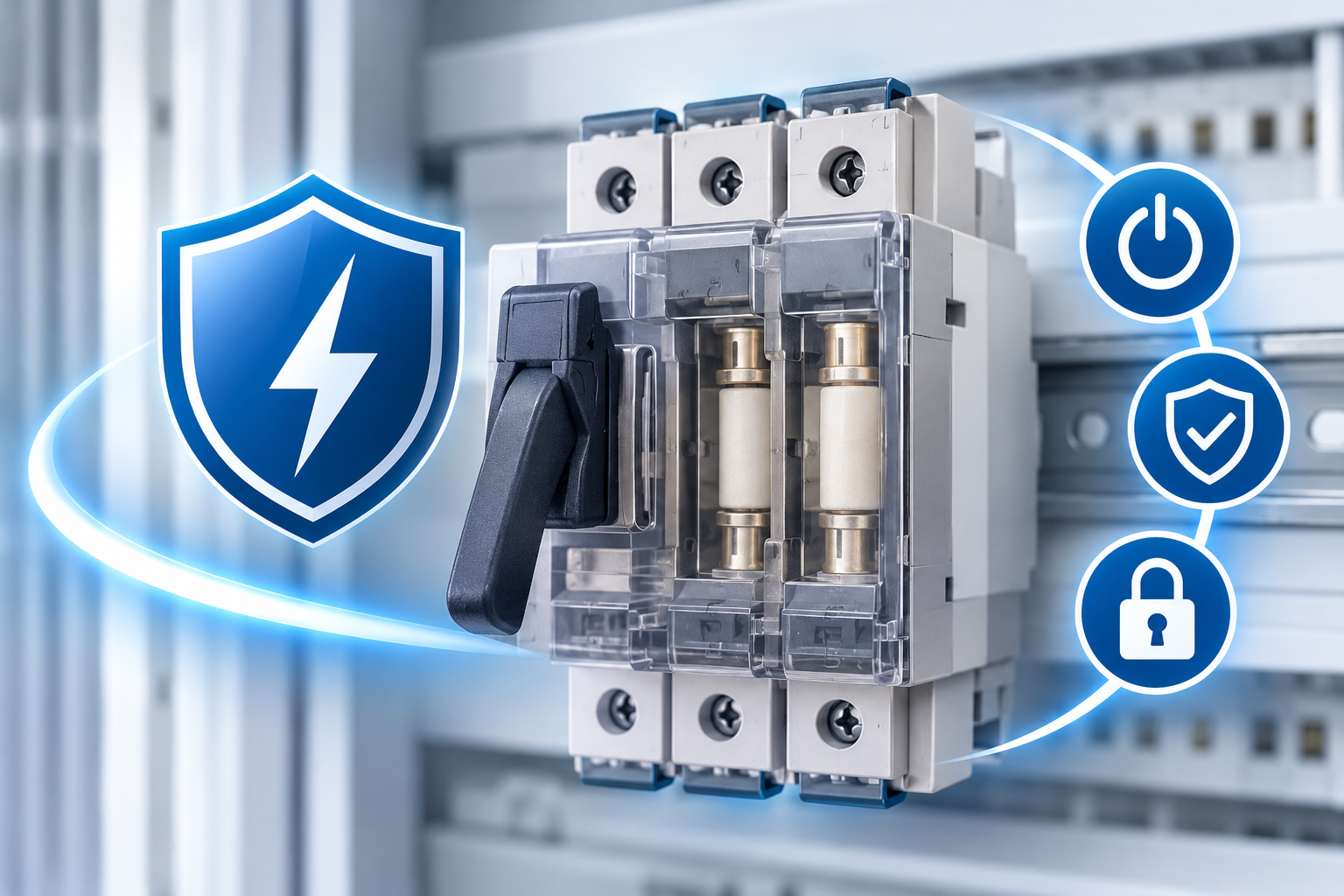
A fuse switch disconnector combines three essential electrical functions: circuit switching, overcurrent protection, and electrical isolation. By integrating these functions into a single device, it provides a practical and reliable solution for managing electrical distribution systems.
Understanding how fuse switch disconnectors work, their advantages, applications, and selection criteria can help electrical engineers, technicians, and facility managers make informed decisions about electrical safety.
What Is a Fuse Switch Disconnector?
A fuse switch disconnector is an electrical protection and switching device designed to control, protect, and isolate electrical circuits. It combines a manually operated switching mechanism with integrated fuse protection and an isolation function.
Unlike conventional switches, which primarily control the flow of electricity, fuse switch disconnectors also protect electrical installations against excessive current caused by overloads and short circuits.
The device performs three primary functions:
-
Circuit switching: Allows operators to manually connect or disconnect an electrical circuit under specified operating conditions.
-
Overcurrent protection: Uses integrated fuses to interrupt excessive current and protect connected equipment from electrical faults.
-
Circuit isolation: Provides a means of safely separating electrical equipment from its power supply during maintenance or inspection.
These combined capabilities make fuse switch disconnectors valuable components in low-voltage electrical distribution systems.
How Does a Fuse Switch Disconnector Work?
A fuse switch disconnector operates through the coordinated action of its switching mechanism, fuse elements, and isolation contacts. Each component performs a specific function to maintain electrical safety and operational reliability.
Understanding these operating principles helps explain why the device is widely used in electrical distribution applications.
1. Switching Function
The switching mechanism allows operators to manually control the electrical connection between the power supply and the connected load.
When the switch is in the ON position, electrical current flows through the device to the connected equipment. When moved to the OFF position, the switching contacts open and interrupt the normal current flow.
This function is particularly useful when electrical equipment needs to be disconnected for routine maintenance, inspection, or operational adjustments.
2. Fuse Protection Function
Overcurrent protection is one of the most important features of a fuse switch disconnector.
When an electrical circuit experiences an overload or short circuit, the current may exceed the fuse's rated operating limits. Under these conditions, the fuse element heats up and eventually melts, interrupting the electrical circuit.
This rapid interruption helps prevent excessive heat generation, cable damage, equipment failure, and potential fire hazards.
Once a fuse operates, the damaged fuse link must be replaced with a compatible replacement that meets the required electrical ratings.
3. Electrical Isolation Function
The isolation function allows electrical equipment to be separated from its power source.
When the device is switched to the OFF position, its contacts create an isolating gap, helping ensure that the downstream circuit is disconnected from the supply.
This function is essential when technicians need to carry out maintenance, troubleshooting, or equipment replacement.
However, safe isolation procedures must always be followed. Operators should verify the absence of voltage using an appropriate testing instrument and apply the required lockout/tagout procedures before starting electrical work.
Key Benefits of Fuse Switch Disconnectors
Fuse switch disconnectors offer several advantages that make them suitable for modern electrical distribution systems.
1. Reliable Overcurrent Protection
One of the main advantages of fuse switch disconnectors is their ability to provide dependable protection against overloads and short circuits.
Fuse elements respond to excessive current by melting and interrupting the circuit. Depending on the fuse type and its characteristics, this can provide effective protection for cables, transformers, motors, and other electrical equipment.
2. High Breaking Capacity
Electrical faults can generate extremely high short-circuit currents. A properly selected fuse switch disconnector with compatible fuse links can safely interrupt high fault currents within its specified breaking capacity.
This capability helps reduce the risk of severe equipment damage and improves the overall safety of electrical installations.
3. Improved Electrical Safety
The combination of switching, protection, and isolation functions helps simplify electrical circuit management.
By providing a dedicated means of disconnecting and protecting circuits, fuse switch disconnectors support safer maintenance procedures and reduce exposure to electrical hazards.
4. Cost-Effective Solution
Fuse switch disconnectors can provide an economical alternative to certain circuit protection arrangements.
Their relatively simple construction and replaceable fuse elements can help reduce initial equipment costs and simplify maintenance requirements.
However, the overall cost-effectiveness depends on the application, fault levels, maintenance practices, and replacement fuse availability.
5. Easy Maintenance and Replacement
When a fuse operates, it can generally be replaced without replacing the entire switching device.
This makes maintenance more straightforward and can help reduce equipment downtime.
Replacement fuses must always match the manufacturer's specifications, including voltage rating, current rating, breaking capacity, and operating characteristics.
6. Compact and Space-Efficient Design
Combining several electrical functions into one device can reduce the number of separate components required within an electrical distribution panel.
This makes fuse switch disconnectors useful in installations where available panel space is limited.
Common Applications of Fuse Switch Disconnectors
Fuse switch disconnectors are used across various industries because of their ability to provide circuit protection and isolation in a single device.
Some of their most common applications include:
1. Industrial Power Distribution
Industrial facilities depend on reliable electrical distribution systems to operate machinery, production lines, motors, and other essential equipment.
Fuse switch disconnectors help protect individual circuits and connected loads against overcurrent conditions.
They can be installed in distribution panels, motor control centres, and industrial switchgear assemblies, provided the selected equipment is suitable for the application.
2. Commercial Buildings
Commercial buildings contain extensive electrical networks that supply lighting, heating, ventilation, air conditioning, lifts, and other electrical equipment.
Fuse switch disconnectors can be used in main and sub-distribution systems to provide circuit protection and local isolation.
Their combined functionality helps simplify electrical distribution arrangements and supports maintenance activities.
3. Solar Photovoltaic Systems
Solar photovoltaic installations require reliable electrical protection because they operate under specific DC electrical conditions.
Fuse switch disconnectors designed for photovoltaic applications can provide switching, isolation, and fuse protection for suitable solar circuits.
They are particularly relevant in applications where solar arrays, combiner boxes, and other DC distribution equipment require dedicated circuit protection.
It is important to select devices specifically rated for the system's DC voltage, current, and fault conditions. AC-rated switching equipment must not be assumed suitable for DC applications.
4. Energy Storage Systems
Battery energy storage systems involve high-current electrical connections and require appropriate protection against overloads and short circuits.
Fuse switch disconnectors can be incorporated into suitable energy storage distribution arrangements to help protect battery circuits and connected equipment.
Correct device selection is essential because DC fault interruption and battery fault characteristics can differ significantly from conventional AC applications.
5. HVAC Systems
Heating, ventilation, and air conditioning systems contain motors, compressors, fans, and other electrical components that require reliable circuit protection.
Fuse switch disconnectors can provide local switching and protection for suitable HVAC circuits.
They also support equipment isolation during servicing and routine maintenance.
Fuse Switch Disconnector vs. Circuit Breaker: What Is the Difference?
Fuse switch disconnectors and circuit breakers both provide electrical circuit protection, but they operate differently.
Understanding their differences is important when selecting the appropriate protection device.
| Feature | Fuse Switch Disconnector | Circuit Breaker |
|---|---|---|
| Protection mechanism | Replaceable fuse element | Thermal, magnetic, electronic, or other tripping mechanism |
| Switching operation | Usually manual | Manual and automatic, depending on design |
| Overcurrent protection | Through integrated fuses | Through internal protective mechanisms |
| Fault response | Depends on fuse characteristics | Depends on the breaker's trip characteristics |
| Reset capability | Requires fuse replacement after operation | Generally resettable after the fault is cleared |
| Maintenance | Requires inspection and fuse replacement | Requires inspection and functional maintenance |
| Typical advantage | High fault-current interruption with a relatively simple design | Reusable protection and, in some models, adjustable protection settings |
Neither solution is universally better.
Fuse switch disconnectors can be advantageous where high breaking capacity, straightforward construction, and economical protection are important. Circuit breakers may be more suitable where resettable protection or adjustable tripping characteristics are required.
The final choice should depend on the electrical system design, fault levels, load characteristics, and applicable safety standards.
Important Factors to Consider When Selecting a Fuse Switch Disconnector
Choosing the correct fuse switch disconnector is essential for ensuring electrical safety and long-term operational reliability.
Several technical factors should be evaluated before installation.
1. Rated Operating Voltage
The device must be suitable for the system's operating voltage.
Both AC and DC applications require appropriate voltage ratings. DC circuits often present additional interruption challenges because direct current does not naturally pass through zero as alternating current does.
Always verify that the device is specifically rated for the intended AC or DC application.
2. Rated Current
The rated current indicates the continuous current that the device is designed to carry under specified conditions.
The selected rating must be compatible with the connected load, conductor capacity, and overall protection coordination.
An incorrectly selected current rating may result in unnecessary fuse operation or inadequate circuit protection.
3. Breaking Capacity
Breaking capacity is a critical safety parameter.
It defines the maximum prospective fault current that the protective arrangement can safely interrupt under specified conditions.
The selected fuse and switching assembly must have adequate fault-interruption capability for the installation.
4. Number of Poles
Fuse switch disconnectors are available in different pole configurations, including single-pole, double-pole, three-pole, and other arrangements.
The appropriate configuration depends on the electrical system, earthing arrangement, and isolation requirements.
5. Environmental Conditions
Operating conditions can significantly affect electrical equipment performance.
Factors such as ambient temperature, humidity, dust, vibration, and enclosure conditions should be considered during device selection.
The device must be suitable for the environment in which it will be installed.
6. Compliance with Electrical Standards
Electrical protection equipment should comply with the relevant national and international standards.
Depending on the application and device type, applicable requirements may include IEC 60947-3 for switches, disconnectors, switch-disconnectors, and fuse-combination units.
Compliance helps ensure that equipment meets established requirements for electrical performance, construction, and safety.
Installation and Maintenance Best Practices
Proper installation and regular maintenance are essential for ensuring the safe and reliable operation of fuse switch disconnectors.
The following practices should be considered:
-
Use qualified personnel: Installation, inspection, and maintenance should be performed by appropriately trained electrical professionals.
-
Follow manufacturer instructions: Always observe the specified mounting, wiring, torque, and operating requirements.
-
Select compatible fuse links: Replacement fuses must have the correct voltage, current, breaking capacity, and operating characteristics.
-
Inspect electrical connections: Loose or deteriorated connections can cause overheating and increase the risk of electrical failure.
-
Check for physical damage: Inspect the enclosure, contacts, insulation, and fuse carriers for signs of wear, cracking, or overheating.
-
Maintain proper isolation procedures: Before performing maintenance, disconnect the supply, secure the isolation point, and verify that the circuit is de-energised.
-
Follow scheduled inspections: Establish a maintenance programme based on operating conditions, manufacturer recommendations, and applicable regulations.
Regular inspections can help identify developing problems before they lead to unexpected equipment failure.
Common Mistakes to Avoid When Using Fuse Switch Disconnectors
Even a correctly selected electrical protection device can become ineffective if it is improperly installed or maintained.
Some common mistakes include:
Using an incorrectly rated fuse: Installing a fuse with an unsuitable current or voltage rating can compromise circuit protection.
Ignoring DC interruption requirements: Using equipment designed only for AC applications in a DC circuit can create serious safety risks.
Overlooking short-circuit levels: The breaking capacity must be sufficient for the prospective fault current at the installation point.
Replacing fuses without investigating the fault: A blown fuse may indicate an underlying electrical problem. The cause should be identified and corrected before restoring the circuit.
Treating isolation as proof of a safe working condition: Switching a device OFF does not eliminate the need for voltage verification and appropriate safety procedures.
Avoiding these mistakes helps maintain the effectiveness of electrical protection systems and reduces unnecessary operational risks.
Why Fuse Switch Disconnectors Are Important for Modern Electrical Systems
Modern electrical installations require reliable solutions that combine protection, operational control, and safe maintenance capabilities.
Fuse switch disconnectors address these requirements by integrating multiple functions into a single electrical device.
Their role is particularly important in industrial distribution networks, commercial buildings, solar photovoltaic installations, and energy storage systems.
As renewable energy technologies and electrical infrastructure continue to expand, the demand for appropriately rated switching and protection equipment is also increasing.
Fuse switch disconnectors therefore remain an important part of electrical system design, particularly where dependable fuse-based protection and circuit isolation are required.
Conclusion
Fuse switch disconnectors are essential components in many modern electrical distribution systems. By combining circuit switching, fuse-based overcurrent protection, and electrical isolation, they provide a practical solution for protecting equipment and supporting safer maintenance operations.
Their advantages include reliable fault-current interruption, straightforward maintenance, compact construction, and cost-effective protection.
However, achieving these benefits depends on selecting the correct device for the application, considering voltage and current ratings, breaking capacity, pole configuration, environmental conditions, and applicable electrical standards.
Whether used in industrial facilities, commercial buildings, solar photovoltaic systems, or energy storage installations, a properly selected and maintained fuse switch disconnector plays an important role in improving electrical safety and system reliability.
Understanding its operating principles and application requirements is an important step towards designing safer, more efficient, and more dependable electrical installations.



