
 eaton-bussmann-series-high-speed-fuses-application-guide-br132015en-en-us.pdf  | [Eaton Bussmann Fuses Technical Guide] | 0 kB |
AC Fuse in DC Circuits: Can You Safely Use an AC Fuse in a DC Application?
Fuses play an essential role in electrical safety by protecting circuits and equipment against overcurrent and short-circuit conditions. However, selecting the correct fuse for an electrical application is just as important as installing one. One common question among electricians, electrical engineers, and technicians is whether an AC fuse can be used in DC circuits.
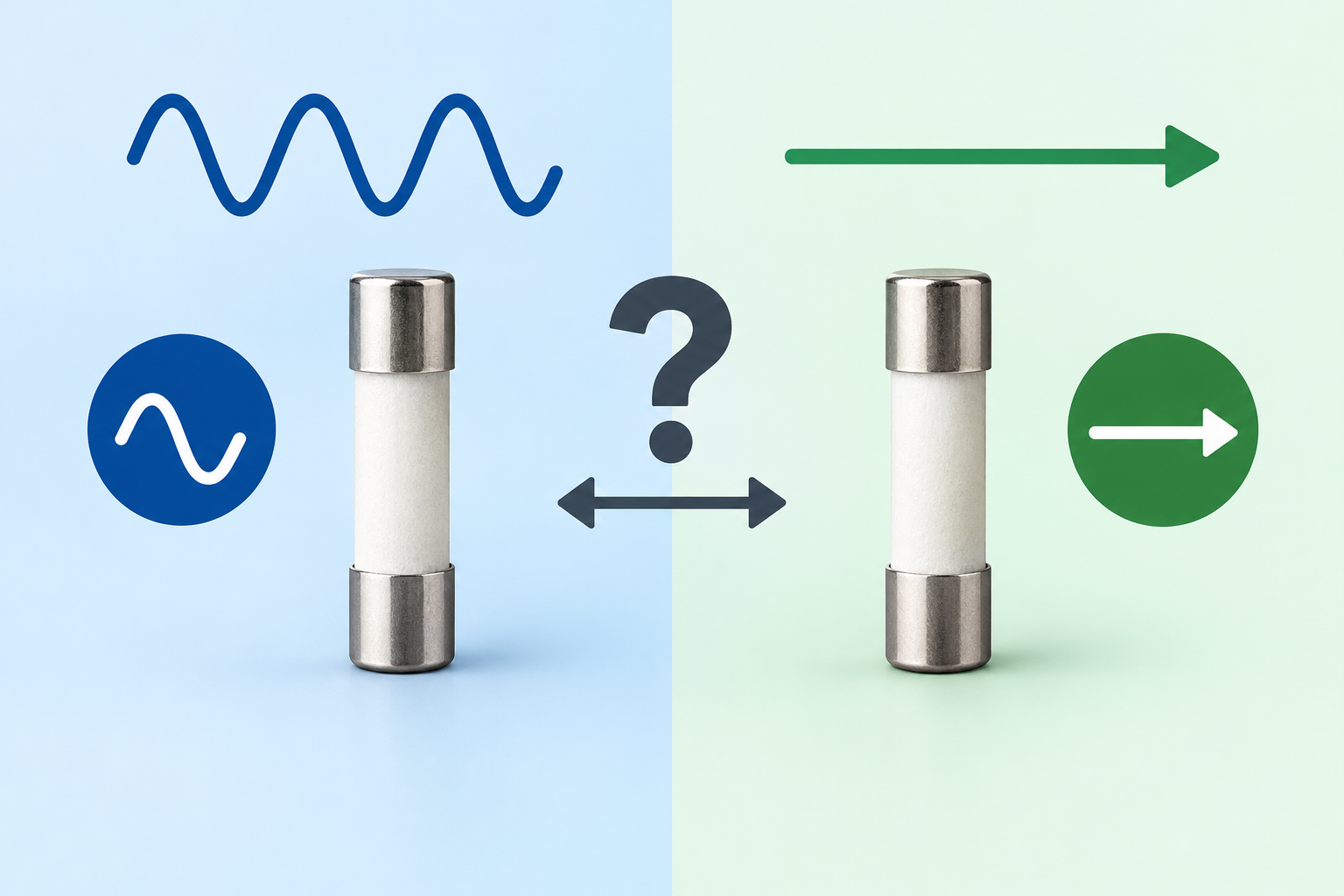
Although AC and DC fuses may look similar and perform the same basic protective function, their electrical characteristics and arc-extinguishing capabilities can differ significantly. Using an AC-rated fuse in a DC circuit without verifying its suitability can lead to serious safety risks, including sustained electrical arcing, equipment damage, and fire hazards.
In this article, we will explain how AC and DC fuses work, the differences between them, why AC fuses may not be suitable for DC applications, and how to select the correct fuse for your electrical system.
1. What Is an Electrical Fuse?
An electrical fuse is a protective device designed to interrupt the flow of current when an electrical circuit experiences an overload or short circuit.
A typical fuse contains a metal element that allows electrical current to pass through under normal operating conditions. When the current exceeds a predetermined level, the fuse element generates excessive heat and eventually melts, opening the circuit and stopping the current flow.
The primary functions of an electrical fuse include:
-
Protecting electrical equipment against excessive current.
-
Preventing damage caused by short circuits.
-
Reducing the risk of electrical fires.
-
Protecting cables, conductors, and sensitive components.
-
Disconnecting faulty electrical circuits from their power sources.
Fuses are commonly used in residential electrical systems, industrial equipment, automotive applications, solar photovoltaic installations, battery systems, and power distribution networks.
However, not all fuses are suitable for every electrical application. Voltage rating, current rating, breaking capacity, and the type of current must all be considered.
2. Understanding the Difference Between AC and DC Current
Before discussing the use of AC fuses in DC circuits, it is important to understand the fundamental difference between alternating current and direct current.
What Is AC (Alternating Current)?
Alternating current is an electrical current that periodically changes direction and magnitude.
In most electrical power systems, AC operates at a frequency of either 50 Hz or 60 Hz. This means the current completes 50 or 60 cycles per second, respectively.
One important characteristic of AC current is that it naturally passes through zero during every cycle.
This zero-crossing characteristic plays a significant role in electrical arc interruption and makes it easier for appropriately designed AC fuses to extinguish an arc when the fuse element melts.
What Is DC (Direct Current)?
Direct current flows continuously in one direction. Unlike alternating current, DC does not periodically reverse its direction or naturally pass through zero during normal operation.
Common DC applications include:
-
Solar photovoltaic systems.
-
Battery energy storage systems.
-
Electric vehicles.
-
Telecommunications equipment.
-
Industrial DC power supplies.
-
Electronic control systems.
Because DC current does not have natural zero crossings, interrupting a DC circuit can be more challenging than interrupting an AC circuit.
This difference is one of the main reasons why fuse selection is particularly important in DC applications.
3. Can You Use an AC Fuse in a DC Circuit?
An AC fuse should not automatically be considered suitable for a DC circuit.
Whether an AC-rated fuse can be used in a DC application depends on its specific DC voltage rating, interrupting capacity, construction, and manufacturer's specifications.
Some fuses are rated for both AC and DC applications, while others are designed and tested for AC operation only.
The most important consideration is the fuse's ability to safely interrupt the available fault current and extinguish the electrical arc.
An AC fuse may have a DC voltage rating lower than its AC voltage rating. Therefore, checking the manufacturer's datasheet is essential before using a fuse in a DC system.
For example, a fuse rated at 600 VAC may have a separate DC rating of 300 VDC. This is only an illustrative example; actual ratings vary by fuse design and manufacturer.
Never assume that an AC voltage rating automatically applies to DC circuits.
4. Why Is Using an AC Fuse in a DC Circuit Dangerous?
The main challenge when using an AC fuse in a DC circuit is electrical arc extinction.
To understand this problem, we first need to examine what happens when a fuse operates.
How Does a Fuse Interrupt an Electrical Circuit?
Under normal operating conditions, current flows through the fuse element without causing it to melt.
When an overload or short circuit occurs:
-
Excessive current flows through the fuse element.
-
The temperature of the metal element increases.
-
The fuse element reaches its melting point.
-
The metal element melts and creates a gap.
-
An electrical arc may form across the gap.
-
The fuse must extinguish the arc to interrupt the current safely.
The ability to extinguish this arc is critical to the safe operation of an electrical fuse.
Why Is Arc Extinction Easier in AC Circuits?
In an AC circuit, the current naturally reaches zero twice during each complete electrical cycle.
At 50 Hz, this happens 100 times per second. At 60 Hz, it happens 120 times per second.
When the fuse element melts, the electrical arc may be interrupted more easily around these natural current zero points.
The fuse is designed to withstand the electrical conditions and prevent the arc from being re-established.
Why Is Arc Extinction More Difficult in DC Circuits?
DC current does not naturally pass through zero during normal operation.
When a fuse element melts in a DC circuit, the electrical arc may continue because current continues flowing through the ionised gap between the separated fuse elements.
If the arc is not extinguished properly, it can cause:
-
Excessive heat generation.
-
Damage to the fuse housing.
-
Electrical equipment failure.
-
Sustained arcing.
-
Fire hazards.
-
Potential damage to surrounding components.
DC-rated fuses are specifically engineered to interrupt direct current safely. Their internal construction, arc-quenching materials, and dimensions are designed according to their intended voltage and interrupting requirements.
This is why an AC-only fuse should never be substituted for a DC-rated fuse without confirming its suitability.
5. AC Fuse vs DC Fuse: Key Differences
Although AC and DC fuses share the same fundamental purpose, there are important differences in their design and operating characteristics.
| Comparison | AC Fuse | DC Fuse |
|---|---|---|
| Current type | Alternating current | Direct current |
| Current direction | Periodically changes direction | Flows in one direction |
| Zero crossing | Naturally occurs every half-cycle | No natural zero crossing |
| Arc extinction | Generally easier | Generally more challenging |
| Arc suppression | Designed for AC interruption | Designed for DC arc interruption |
| Voltage rating | Specified AC voltage rating | Specified DC voltage rating |
| Applications | AC distribution and equipment | Batteries, solar systems, and DC equipment |
One important point is that the physical appearance of a fuse does not determine whether it is suitable for AC or DC operation.
Always verify the electrical ratings and application specifications.
6. Different Types of AC and DC Fuses
Fuses are available in several designs to accommodate different electrical systems, operating conditions, and protection requirements.
Common Types of AC Fuses
AC fuses are widely used in residential, commercial, and industrial electrical installations.
Common types include:
1. Cartridge Fuses
Cartridge fuses contain a fusible element enclosed in an insulating body. They are commonly used in electrical distribution systems, control panels, and industrial equipment.
2. HRC Fuses
High Rupturing Capacity (HRC) fuses are designed to interrupt high fault currents safely. They are frequently used in industrial power distribution and electrical protection systems.
3. Rewirable Fuses
Rewirable fuses use a replaceable fuse wire that melts when excessive current flows through the circuit.
4. Drop-Out Fuses
Drop-out fuses are commonly used in overhead electrical distribution systems. They provide protection against overcurrent conditions and can also provide a visible indication of fuse operation.
Common Types of DC Fuses
DC fuses are specifically selected for direct-current applications where reliable interruption and arc suppression are essential.
Common types include:
1. DC Cartridge Fuses
These fuses are designed to interrupt DC fault currents safely. They are used in battery systems, industrial DC equipment, and power distribution applications.
2. Automotive Fuses
Automotive fuses protect vehicle electrical circuits against overloads and short circuits. They are available in different current ratings and physical configurations.
3. Solar PV Fuses
Solar photovoltaic fuses protect PV modules, strings, and associated DC circuits against excessive fault currents.
They are designed to withstand the specific electrical conditions found in photovoltaic systems.
4. Battery Protection Fuses
Battery fuses protect energy storage systems against excessive current and short-circuit faults. Their DC voltage rating and interrupting capacity must match the battery system requirements.
5. Semiconductor Fuses
Semiconductor fuses are designed to provide fast protection for sensitive power electronic components, such as inverters, rectifiers, and converters.
7. How to Select the Right Fuse for a DC Circuit
Choosing the correct fuse is essential for maintaining electrical safety and protecting equipment.
When selecting a DC fuse, consider the following factors.
1. DC Voltage Rating
The fuse must have a DC voltage rating equal to or greater than the maximum operating voltage of the circuit.
Using a fuse with an insufficient voltage rating can prevent it from safely interrupting the circuit during a fault.
2. Current Rating
The current rating determines how much current a fuse can carry under specified operating conditions without opening.
Select a fuse based on the circuit's normal operating current, conductor capacity, applicable electrical standards, and load characteristics.
Avoid selecting a fuse based solely on the equipment's nominal current.
3. Breaking Capacity
Breaking capacity, also known as interrupting rating, refers to the maximum fault current a fuse can safely interrupt at its specified voltage.
This is particularly important in DC applications involving batteries and energy storage systems, where available short-circuit currents can be extremely high.
The fuse's breaking capacity must be sufficient for the prospective fault current at the installation point.
4. Time-Current Characteristics
Different applications require different fuse response times.
For example, some electrical equipment experiences temporary inrush currents during startup. A fast-acting fuse may open unnecessarily under these conditions.
Time-delay fuses may be appropriate for certain applications, while semiconductor protection often requires very fast-acting fuses.
Always consider the load characteristics when selecting a fuse.
5. Operating Temperature
Ambient temperature affects fuse performance and current-carrying capability.
High operating temperatures may reduce the current a fuse can safely carry, while other environmental conditions can affect its service life.
Always consider the manufacturer's temperature derating specifications.
6. Applicable Standards and Certifications
Choose fuses that comply with the relevant electrical standards and certification requirements for the intended application.
This helps ensure that the fuse has been evaluated for its specified operating conditions and protection characteristics.
8. Where Are DC Fuses Commonly Used?
DC fuses are essential components in many modern electrical and energy systems.
Their applications include:
Solar Photovoltaic Systems
Solar PV installations use DC fuses to protect photovoltaic strings and other DC-side components against excessive fault currents.
Battery Energy Storage Systems
Battery storage installations require appropriately rated DC fuses to protect battery modules, connections, and associated electrical equipment.
Electric Vehicles
Electric vehicles use DC-rated protection devices to protect high-voltage battery circuits and electrical power distribution systems.
Telecommunication Systems
Telecommunications infrastructure frequently uses DC power supplies and battery backup systems that require reliable overcurrent protection.
Industrial Equipment
Industrial applications may use DC motors, power converters, control systems, and other equipment that require dedicated DC circuit protection.
In all these applications, selecting a fuse with the correct DC voltage rating and interrupting capacity is essential.
9. Frequently Asked Questions About AC Fuses in DC Circuits
Q1. Can an AC fuse work on DC current?
An AC-rated fuse can only be used in a DC circuit if the manufacturer specifies a suitable DC voltage rating and interrupting capacity for the application. An AC-only rating does not guarantee safe DC operation.
Q2. Why are DC fuses different from AC fuses?
The main difference relates to arc interruption. AC current naturally reaches zero twice per cycle, helping extinguish electrical arcs. DC current does not have natural zero crossings, making arc interruption more difficult.
DC-rated fuses are designed to manage these conditions safely.
Q3. What happens if you use an AC fuse in a DC circuit?
If an AC-only fuse is used in a DC circuit beyond its specified DC capabilities, it may fail to interrupt the current safely.
A sustained electrical arc can cause excessive heating, equipment damage, and potentially a fire.
Q4. Does a fuse have positive and negative terminals?
Most conventional fuses are non-polarised and can be installed in either orientation.
However, some specialised protective devices may have specific installation requirements. Always follow the manufacturer's instructions.
Q5. Can a DC fuse be used in an AC circuit?
A DC-rated fuse may be suitable for certain AC applications if its specifications explicitly permit the intended AC voltage, current, and interrupting conditions.
However, suitability should never be assumed based on its DC rating alone.
Q6. Does the voltage rating of a fuse matter?
Yes. The voltage rating is critical because it determines the conditions under which the fuse can safely interrupt an electrical circuit.
The fuse voltage rating must meet or exceed the applicable circuit voltage for the relevant current type.
Q7. Why do DC circuits require special arc protection?
DC current does not naturally reach zero during normal operation. Therefore, when a fuse opens, the resulting electrical arc can continue for longer unless the fuse has suitable arc-extinguishing capabilities.
Specially designed DC fuses help interrupt this current safely.
10. Conclusion
Using an AC fuse in a DC circuit requires careful consideration of its electrical ratings and interruption capabilities. Although both AC and DC fuses protect electrical systems against overloads and short circuits, their ability to interrupt fault currents can differ significantly.
The absence of natural current zero crossings in DC circuits makes arc extinction more challenging. Therefore, selecting a fuse with an appropriate DC voltage rating, current rating, and breaking capacity is essential.
Whether protecting solar photovoltaic installations, battery energy storage systems, electric vehicles, or industrial DC equipment, always verify the manufacturer's specifications before installing a fuse.
The most important rule is simple: Never assume that an AC-rated fuse is suitable for DC applications. Always select a fuse that is specifically rated and tested for the intended electrical system.



