
 eaton-bussmann-series-photovoltaic-fuses-catalogue-ca135004en.pdf  | [Eaton Bussmann PV Fuses] | 0 kB |
3 Scenarios Demanding Solar Fuse Protection: A Complete Guide to PV System Safety
Introduction
Solar energy systems are becoming increasingly popular for residential, commercial, and utility-scale power generation. As solar installations grow in capacity and complexity, ensuring their electrical safety and reliability becomes more important than ever. One essential component of a well-protected photovoltaic (PV) system is solar fuse protection.
Although solar panels are designed to operate reliably under varying environmental conditions, PV systems are not immune to electrical faults. Short circuits, reverse currents, insulation failures, and equipment malfunctions can cause excessive current flow. Without appropriate protection, these problems may damage expensive electrical components, reduce system efficiency, or even create serious fire hazards.
Unlike conventional AC systems, solar PV installations operate with direct current (DC), which presents unique protection challenges. DC arcs can be difficult to extinguish, making the selection of suitable overcurrent protection devices particularly important.
So, where is solar fuse protection most necessary?
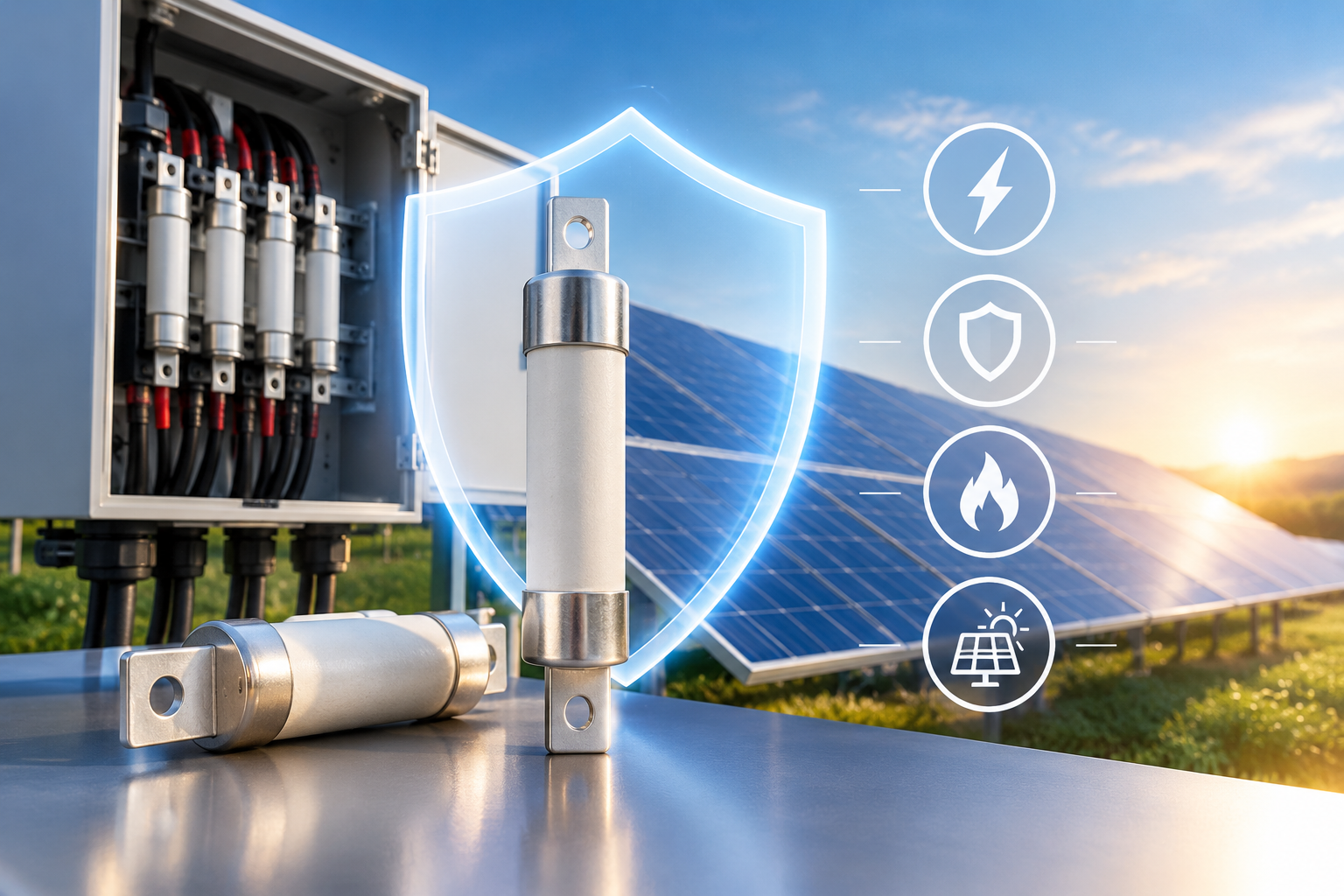
There are three critical scenarios in which photovoltaic fuses play an essential role: PV string circuits, combiner boxes, and inverter DC inputs. Understanding these applications helps system designers and installers build safer, more reliable solar power systems.
1. PV String Protection: Preventing Reverse Current Damage
What Is a PV String?
A photovoltaic string consists of multiple solar panels connected in series to increase the system's operating voltage. In larger solar installations, several strings are connected in parallel through a combiner box to increase the total current output.
While this configuration improves power generation capacity, it also introduces a potential electrical risk.
When one PV string experiences a short circuit, ground fault, or internal module failure, the other parallel-connected strings may supply reverse current into the faulty string.
This reverse current can exceed the maximum series fuse rating of the affected solar modules, potentially causing overheating, damaged junction boxes, melted connectors, and electrical fires.
Why Is Solar String Fuse Protection Necessary?
Solar string fuses are designed to interrupt excessive reverse current and isolate faulty strings from the rest of the photovoltaic array.
Their main benefits include:
-
Preventing module damage: Limiting excessive reverse current helps protect solar panels and their internal electrical connections.
-
Reducing fire risks: Disconnecting a faulty string helps prevent overheating and potential ignition.
-
Protecting electrical wiring: Proper fuse protection reduces the risk of damage to cables and connectors.
-
Improving system reliability: Isolating a fault allows unaffected PV strings to continue operating.
Where Are Solar String Fuses Installed?
String fuses are generally installed inside PV combiner boxes, with individual protection provided for each string input. Smaller or standalone photovoltaic systems may also use suitable in-line fuse arrangements.
How to Select the Right PV String Fuse
Choosing an appropriate solar string fuse requires evaluating several electrical parameters:
1. Rated Voltage
The fuse voltage rating must be equal to or higher than the maximum system DC voltage. Common PV system voltage levels include 1,000V DC and 1,500V DC, while some advanced installations use higher voltage levels.
2. Rated Current
The fuse's rated current must accommodate normal operating conditions while providing effective protection against excessive fault current. Selection should account for module specifications, operating current, environmental conditions, and applicable electrical standards.
3. Fuse Size
Common cylindrical photovoltaic fuse sizes include:
-
10 × 38 mm
-
14 × 51 mm
-
22 × 58 mm
The appropriate size depends on the required current rating and installation arrangement.
4. Breaking Capacity
The fuse must have sufficient DC breaking capacity to safely interrupt the maximum prospective fault current at its installation location.
5. Protection Standard
Photovoltaic applications generally require gPV-class fuses designed according to IEC 60269-6.
Selecting a properly rated PV string fuse helps protect individual solar modules and maintain the overall safety of the photovoltaic array.
2. PV Combiner Box Protection: Safeguarding the Combined DC Circuit
What Is a Solar PV Combiner Box?
A photovoltaic combiner box is an electrical enclosure that brings together the outputs of multiple solar panel strings.
Instead of running separate DC cables from every string directly to the inverter, the combiner box combines their electrical output into a common DC circuit.
This arrangement simplifies wiring, improves system organization, and makes electrical protection and maintenance more manageable.
However, combining multiple PV strings also increases the current flowing through the main output circuit.
Why Does a Combiner Box Need Fuse Protection?
Each string input typically has its own fuse to protect against reverse current. However, individual string protection alone may not provide sufficient protection for the combined output circuit.
Consider a situation in which a short circuit occurs in the DC cable connecting the combiner box to the inverter.
Because multiple PV strings are connected in parallel, their combined current may contribute to the fault. This can place considerable electrical stress on the main DC cables and connected equipment.
A suitably selected main fuse or other appropriately rated overcurrent protection device helps interrupt excessive current and protect the downstream circuit.
Where Is the Main Combiner Box Fuse Installed?
The main fuse is generally installed at the combiner box output, before the DC cable connection leading to the inverter.
In large photovoltaic installations, multiple combiner boxes may feed a secondary combining unit. Additional protection may therefore be required at different levels of the DC distribution network.
Important Factors When Selecting a Combiner Box Fuse
Several factors should be considered when selecting a main PV combiner fuse.
1. System Voltage
The fuse must be rated for the maximum DC voltage of the photovoltaic system.
2. Total Output Current
The rated current should be determined using the maximum expected circuit current, applicable electrical code requirements, and appropriate safety factors.
3. Fuse Type and Size
High-current combiner box applications commonly use NH-type blade fuses because they are suitable for larger current ratings and robust DC protection arrangements.
4. Mounting Configuration
The fuse and holder must be compatible with the combiner box design. Common mounting arrangements include screw-mounted and busbar-mounted configurations.
5. Fault Indication
Some fuse holders offer striker mechanisms and microswitches that can provide remote fault indication. These features are particularly useful in large solar installations where continuous monitoring is important.
Practical Example of Combiner Box Fuse Sizing
Suppose a solar combiner box contains six parallel strings, with each string having a maximum circuit current of 15A.
The combined current is:
6 × 15A = 90A
If the applicable design rules require a 125% current factor, the calculation becomes:
90A × 1.25 = 112.5A
A suitable standard fuse rating must then be selected based on the applicable code, conductor ampacity, equipment ratings, and installation conditions.
This example illustrates why accurate current calculations are essential when designing PV combiner box protection.
3. Solar Inverter DC Input Protection: Protecting the System's Most Critical Equipment
Why Is the Inverter Important?
A solar inverter is one of the most important components in a photovoltaic power generation system.
Its primary function is to convert the DC electricity generated by solar panels into AC electricity that can be used by electrical equipment or supplied to the power grid.
Because the inverter is directly connected to the photovoltaic array, its DC input circuit is exposed to the electrical characteristics and potential fault currents of the connected solar strings.
An internal inverter fault, such as a semiconductor failure or capacitor malfunction, may create an abnormal current condition.
Without suitable protection, excessive current can damage internal components, cause costly equipment failures, and increase fire risks.
Why Is DC Input Fuse Protection Necessary?
Solar inverter DC input fuses provide an important layer of overcurrent protection.
Their main functions include:
-
Protecting inverter components: Interrupting excessive fault current helps limit damage to sensitive internal electrical components.
-
Reducing equipment failure risks: Proper protection can prevent certain electrical faults from developing into more serious failures.
-
Improving operational safety: Suitable DC fuse protection helps reduce the risks associated with electrical faults.
-
Supporting coordinated protection: Properly selected fuses help ensure that faults are isolated at the appropriate protection level.
Where Are Inverter DC Input Fuses Installed?
Inverter input fuses are generally installed in dedicated fuse holders or fuse switch-disconnectors near the inverter's DC input terminals.
Depending on the inverter design, the protection devices may also be integrated into the inverter enclosure.
Key Considerations for Selecting Inverter DC Input Fuses
1. Maximum DC Voltage
The fuse voltage rating must be compatible with the maximum DC voltage of the connected PV array.
2. Total Input Current
The rated current must be selected according to the total expected current supplied by all connected strings or combiner boxes.
3. Operating Characteristics
The fuse's time-current characteristics must be appropriate for the inverter's electrical requirements and the fault conditions it needs to interrupt.
4. Protection Coordination
The inverter input fuse must coordinate with upstream and downstream protective devices.
Ideally, a fault should be isolated by the protective device closest to its location, minimizing unnecessary shutdowns of the entire solar power system.
For example, a fault within an individual string should generally be cleared by its string protection device before it affects the combiner box or inverter protection.
5. Installation and Derating Conditions
Ambient temperature, enclosure conditions, conductor specifications, and the fuse holder's ratings must all be considered during selection.
Correct inverter DC input fuse selection helps protect expensive power conversion equipment and supports long-term system reliability.
Comparing the Three Main Solar Fuse Protection Scenarios
Although all three applications involve overcurrent protection, their installation locations and protection objectives are different.
| Protection Application | Installation Location | Main Protection Purpose |
|---|---|---|
| PV String Protection | Individual string inputs in the combiner box | Prevent reverse current damage to solar modules |
| Combiner Box Protection | Main DC output of the combiner box | Protect combined DC cables and downstream circuits |
| Inverter DC Input Protection | Inverter DC input terminals or enclosure | Protect inverter equipment against excessive fault current |
Despite their different functions, all three applications share several important requirements:
-
DC voltage rating: The fuse must be suitable for the maximum system DC voltage.
-
Photovoltaic suitability: Use appropriate PV-rated protection devices rather than assuming a conventional AC fuse is suitable.
-
Breaking capacity: The fuse must safely interrupt the available prospective DC fault current.
-
Standards compliance: Select suitable gPV-class fuses designed for photovoltaic applications and verify applicable certification requirements.
-
Proper coordination: Ensure that protective devices work together to isolate faults effectively.
5 Important Factors to Consider When Choosing Solar Fuse Protection
Selecting the right photovoltaic fuse involves more than matching its current rating to the operating current of a solar circuit.
For reliable and effective protection, consider the following factors.
1. System Maximum DC Voltage
The maximum system voltage determines the minimum required voltage rating of the fuse.
Common photovoltaic installations operate at 1,000V DC or 1,500V DC, while some newer systems use higher voltage levels.
Always verify the maximum possible circuit voltage under the relevant design conditions.
2. Rated Current and Temperature Derating
The fuse must carry normal operating current without unnecessary interruption while responding appropriately to abnormal current conditions.
Ambient temperature, enclosure temperature, installation method, and continuous operating conditions may affect the effective current-carrying capability of a fuse.
Therefore, current selection should include appropriate derating considerations.
3. DC Breaking Capacity
DC fault interruption is particularly challenging because DC current does not naturally pass through zero as AC current does.
A photovoltaic fuse must have a DC breaking capacity sufficient to interrupt the prospective fault current safely at the rated system voltage.
An inadequate breaking capacity can compromise the protection of the entire electrical installation.
4. Fuse Operating Characteristics
Different parts of a solar PV system have different protection requirements.
The fuse's time-current characteristics should be evaluated to ensure that it can withstand normal operating conditions while clearing relevant fault currents within the required time.
5. Compliance with Photovoltaic Standards
Photovoltaic fuses should be specifically designed for PV applications.
The gPV fuse class under IEC 60269-6 is an important reference for selecting suitable overcurrent protection devices for solar installations.
Installers and system designers should also verify local electrical regulations and applicable certification requirements.
Conclusion
Solar fuse protection is an essential part of designing a safe, reliable, and efficient photovoltaic power generation system.
The three most important protection scenarios are PV string circuits, combiner box outputs, and inverter DC inputs.
At the string level, fuses help prevent reverse current from damaging solar modules and wiring. At the combiner box level, main fuses protect the combined DC circuit against excessive fault current. At the inverter level, DC input fuses provide an additional layer of protection for valuable power conversion equipment.
However, installing a fuse is not enough. Choosing the correct voltage rating, current rating, breaking capacity, operating characteristics, and protection coordination is equally important.
By understanding these three critical applications and following appropriate electrical design standards, solar installers and system designers can significantly improve photovoltaic system safety, protect valuable equipment, and support long-term operational reliability.
Ultimately, effective solar fuse protection is not simply an electrical design requirement. It is a fundamental investment in the safety, performance, and durability of every solar PV installation.



