
 eaton-bussmann-series-photovoltaic-fuses-catalogue-ca135004en.pdf  | [Eaton Bussmann PV Fuses] | 0 kB |
Solar Fuse Protection for Utility PV Plants: Ensuring Safety, Reliability, and Long-Term Performance
Utility-scale solar power plants play an increasingly important role in the global transition towards renewable energy. As photovoltaic (PV) installations continue to expand in capacity and complexity, ensuring electrical safety and system reliability has become a major priority. One essential component in achieving these goals is solar fuse protection.
Solar fuses protect photovoltaic systems against overcurrent conditions, short circuits, and other electrical faults that can damage valuable equipment or interrupt power generation. In large-scale solar installations, where hundreds or thousands of PV modules operate together, properly selected fuse protection is critical for maintaining operational efficiency and minimising downtime.
This article explores the importance of solar fuse protection for utility PV plants, common electrical protection challenges, key fuse selection criteria, and best practices for installation and maintenance.
1. Why Solar Fuse Protection Is Essential for Utility PV Plants
Utility-scale photovoltaic plants typically consist of multiple PV arrays, string connections, combiner boxes, DC distribution systems, and central or string inverters. These components work together to convert solar energy into usable electrical power.
However, electrical faults can occur due to damaged cables, module failures, insulation problems, environmental exposure, or abnormal operating conditions.
Without appropriate protection, these faults may result in:
-
Overcurrent and short-circuit damage.
-
Excessive heating of electrical components.
-
DC arc faults and potential fire hazards.
-
Damage to PV modules and inverter equipment.
-
Unexpected system shutdowns.
-
Increased maintenance costs and reduced energy production.
Solar photovoltaic fuses provide an important layer of protection by interrupting excessive fault currents before they cause further damage.
In utility-scale installations, PV string fuses are particularly important because they help isolate faulty strings and prevent reverse current from healthy parallel strings from flowing into the affected circuit.
Effective fuse protection therefore contributes to improved system availability, equipment protection, and long-term investment performance.
2. Common Electrical Protection Challenges in Utility-Scale Solar Plants
Large photovoltaic installations face several challenges that make electrical protection more demanding than in smaller solar systems.
2.1 High DC Voltage and Arc Fault Risks
Modern utility PV plants increasingly operate at DC system voltages of up to 1500V. Higher system voltages can improve installation efficiency by reducing current levels and cable requirements.
However, high-voltage DC circuits present specific safety challenges.
Unlike AC circuits, DC circuits do not naturally pass through zero current during each cycle. Consequently, interrupting DC fault currents and extinguishing electrical arcs can be more challenging.
A poorly selected fuse may fail to interrupt a fault safely, potentially resulting in equipment damage, overheating, or fire hazards.
For this reason, utility-scale solar installations require photovoltaic fuses specifically designed and rated for their DC operating voltage and expected fault conditions.
2.2 Extreme Environmental Conditions
Utility PV plants are often located in deserts, coastal regions, remote agricultural areas, and locations with significant temperature fluctuations.
Solar protection components may be exposed to:
-
High ambient temperatures.
-
Low temperatures and thermal cycling.
-
High humidity and moisture.
-
Dust and airborne contaminants.
-
Ultraviolet radiation.
-
Vibration and mechanical stress.
-
Corrosive environmental conditions.
These factors can affect fuse materials, electrical contacts, insulation, and overall operating performance.
Selecting solar fuses with suitable thermal stability, mechanical strength, and environmental resistance helps improve long-term reliability.
2.3 High-Density PV Combiner Box Configurations
Utility PV plants often use high-density DC combiner boxes to collect the output of multiple photovoltaic strings.
These configurations require compact protection devices that can accommodate limited installation space without compromising electrical safety.
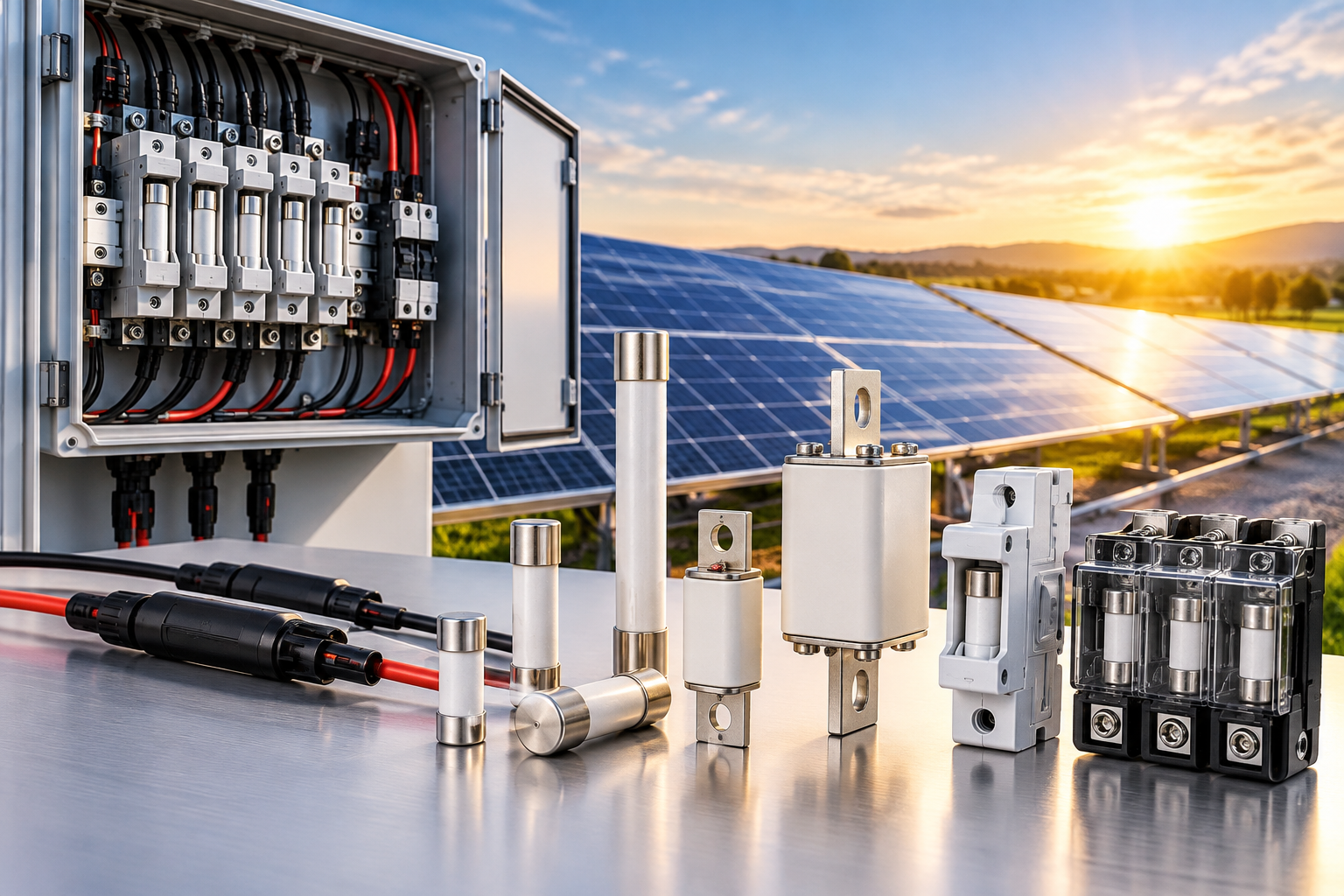
Common photovoltaic fuse dimensions include:
-
10 × 38 mm.
-
10 × 85 mm.
-
14 × 85 mm.
-
22 × 58 mm.
The correct fuse dimensions and mounting arrangements must be compatible with the combiner box design, fuse holders, and electrical connections.
Selecting appropriately sized components simplifies installation and helps maintain effective protection across the PV system.
3. Important Criteria for Selecting Solar Fuses for Utility PV Plants
Choosing the right solar fuse involves more than matching the current rating. Engineers must consider system voltage, operating current, short-circuit conditions, environmental requirements, and applicable safety standards.
3.1 Compliance with Photovoltaic Fuse Standards
Compliance with relevant electrical standards is essential when selecting protection devices for utility-scale solar installations.
IEC 60269-6 is an important international standard covering supplementary requirements for fuse-links used to protect solar photovoltaic energy systems.
Engineers should verify that the selected fuse has appropriate test documentation and certification for its intended application.
Relevant considerations include:
-
Rated DC voltage.
-
Rated current.
-
Breaking capacity.
-
Operating characteristics.
-
Temperature performance.
-
Electrical and mechanical safety.
Using appropriately tested photovoltaic fuses helps ensure reliable protection under the operating conditions expected in large solar installations.
3.2 Correct Voltage and Current Ratings
Fuse voltage and current ratings must be carefully matched to the electrical characteristics of the PV system.
Voltage rating:
The fuse must have a DC voltage rating equal to or greater than the maximum possible system voltage under the specified operating conditions.
For example, a 1500V DC photovoltaic system requires fuses specifically rated for the applicable 1500V DC operating conditions.
Current rating:
The fuse current rating must be selected according to the PV module specifications, string design, maximum expected current, conductor capacity, and applicable installation standards.
Engineers should consider:
-
PV module short-circuit current.
-
Maximum string operating current.
-
Number of parallel strings.
-
Ambient temperature.
-
Fuse-holder temperature limitations.
-
Cable ampacity.
-
Protection coordination requirements.
Incorrect fuse sizing can lead to nuisance operation or inadequate protection. Therefore, calculations should follow the applicable standards and equipment manufacturers' recommendations.
3.3 High Breaking Capacity and Arc Extinguishing Performance
Breaking capacity is one of the most important characteristics of a photovoltaic fuse.
It indicates the maximum fault current that a fuse can safely interrupt under its specified operating conditions.
In large PV plants, multiple parallel strings can contribute substantial reverse fault current to a damaged string.
A suitable PV fuse must therefore have sufficient DC breaking capacity to interrupt the prospective fault current safely.
High-quality photovoltaic fuses commonly use specialised arc-extinguishing materials, such as high-purity quartz sand, to absorb heat and help extinguish the electrical arc generated during fuse operation.
Carefully engineered fuse elements also contribute to consistent operating characteristics and reliable fault interruption.
3.4 Mechanical Strength and Environmental Protection
The physical construction of solar fuses is another important selection factor.
Utility-scale PV installations require components capable of operating reliably under demanding environmental conditions.
Important design characteristics include:
-
Flame-retardant insulating materials.
-
Corrosion-resistant electrical contacts.
-
High-quality fuse-element materials.
-
Effective insulation.
-
Resistance to thermal stress.
-
Suitable environmental sealing.
-
Mechanical durability.
These characteristics help reduce premature component deterioration and support long-term system reliability.
4. Solar Fuses vs. Other Electrical Protection Devices
Several protection technologies are used in photovoltaic installations. Each has specific advantages and limitations depending on the system design.
4.1 Solar Fuses
Photovoltaic fuses are specifically designed to protect solar DC circuits against excessive current and short circuits.
Their main advantages include:
-
Fast fault-current interruption.
-
Compact dimensions.
-
High DC breaking capacity.
-
No moving mechanical components.
-
Low maintenance requirements.
-
Cost-effective protection.
-
Reliable isolation of faulty PV strings.
However, a fuse is a single-use protection device. Once it operates, the fuse-link must be replaced before the circuit can return to service.
4.2 DC Circuit Breakers
DC circuit breakers provide reusable overcurrent protection and can be manually or automatically reset after a fault has been investigated.
Depending on the design, they may also provide switching and isolation functions.
Their advantages include operational convenience and the possibility of remote control in suitable installations.
However, circuit breakers can involve greater installation costs, additional space requirements, and mechanical maintenance considerations.
They must also be specifically designed and rated for the DC voltage and prospective fault current of the application.
4.3 Thermal Relays
Thermal relays are commonly used for overload protection in electrical and motor-control applications.
They operate based on the heating effect of electrical current and are generally not designed to provide the high-speed, high-breaking-capacity short-circuit protection required in PV string circuits.
Consequently, thermal relays should not be considered a direct replacement for appropriately rated photovoltaic fuses.
4.4 Why Photovoltaic Fuses Remain Important
For utility-scale solar installations, photovoltaic fuses offer a practical and reliable method of protecting individual strings and DC circuits.
Their compact design, high breaking capacity, and specialised DC arc-extinguishing characteristics make them particularly suitable for PV combiner boxes and other DC protection applications.
The final protection arrangement should always be based on a coordinated electrical protection design.
5. Where Are Solar Fuses Installed in Utility PV Systems?
Understanding the location of fuse protection is essential for designing an effective photovoltaic electrical system.
5.1 PV String Protection
PV string fuses are commonly installed in series with individual photovoltaic strings.
Their primary purpose is to interrupt reverse current that may flow from parallel strings into a faulty string.
Without suitable string protection, reverse current can exceed the permissible current rating of PV modules, connectors, and cables.
5.2 DC Combiner Boxes
DC combiner boxes collect the electrical output from multiple PV strings before transferring power towards the inverter.
String fuses installed within these enclosures help isolate individual faulty circuits while allowing unaffected strings to continue operating.
This arrangement can simplify troubleshooting and reduce the impact of individual string faults on overall plant performance.
5.3 DC Distribution and Protection Assemblies
Additional fuse protection may be required in DC distribution assemblies, depending on the system architecture and electrical design.
Engineers must evaluate the prospective fault current, conductor protection requirements, and coordination between upstream and downstream protective devices.
Correctly positioned fuses help create a comprehensive protection strategy throughout the photovoltaic installation.
6. Best Practices for Solar Fuse Installation and Maintenance
Even correctly selected photovoltaic fuses may not provide reliable protection if they are installed or maintained improperly.
Utility PV plant operators should follow established installation procedures and maintenance schedules.
6.1 Use Compatible Fuse Holders
Always ensure that the fuse-link is compatible with its holder or mounting assembly.
Check the rated voltage, current capacity, dimensions, contact arrangement, and temperature limitations.
Incompatible components may cause excessive contact resistance, overheating, or unreliable electrical connections.
6.2 Follow Manufacturer Torque Specifications
Electrical connections must be tightened according to the equipment manufacturer's recommended torque values.
Loose connections can increase contact resistance and generate excessive heat.
Over-tightening may damage terminals, contacts, or mechanical components.
Using calibrated torque tools helps achieve consistent and reliable electrical connections.
6.3 Perform Regular Visual Inspections
Periodic inspections help identify potential problems before they develop into serious electrical failures.
Maintenance teams should look for:
-
Discoloured fuse holders.
-
Signs of overheating.
-
Cracked or damaged housings.
-
Corrosion on electrical contacts.
-
Loose connections.
-
Evidence of moisture or contamination.
-
Abnormal temperature increases.
Thermal imaging can also help identify developing hotspots in electrical connections and distribution equipment.
6.4 Replace Operated Fuses Correctly
After a fuse operates, maintenance personnel should investigate the underlying fault before replacing the fuse-link.
Simply installing a new fuse without identifying the cause may result in repeated failures.
Replacement fuses must have the correct electrical ratings, breaking capacity, dimensions, and operating characteristics.
Never replace an operated photovoltaic fuse with a higher-rated fuse simply to prevent repeated operation.
6.5 Maintain an Appropriate Spare Parts Inventory
Utility-scale solar plants often operate in remote locations where obtaining replacement components can take time.
Maintaining an inventory of critical photovoltaic fuse ratings and compatible accessories can help reduce maintenance delays.
Spare parts should be stored under suitable environmental conditions and managed according to the manufacturer's recommendations.
7. Benefits of Proper Solar Fuse Protection for Utility PV Plants
Investing in a properly engineered solar fuse protection system offers several operational and financial benefits.
Improved electrical safety: Correctly selected fuses help interrupt dangerous overcurrent and short-circuit conditions, reducing the risk of equipment damage and electrical fires.
Reduced equipment damage: Fast fault isolation helps protect photovoltaic modules, cables, combiner boxes, and other electrical components.
Higher system availability: Isolating individual faulty strings can minimise the impact of localised electrical problems on overall plant operation.
Lower maintenance costs: Reliable protection components and appropriate installation practices can reduce unexpected maintenance activities and replacement costs.
Long-term operational reliability: Components designed for high-voltage DC applications and demanding environmental conditions support consistent system performance.
Better investment protection: Reducing equipment failures and unplanned downtime helps protect the long-term financial performance of utility-scale solar projects.
8. Future Trends in Photovoltaic Fuse Protection
As solar technology continues to evolve, electrical protection requirements are also changing.
Larger PV installations, higher DC voltages, advanced inverter technologies, and increasingly compact electrical enclosures are creating new demands for photovoltaic protection components.
Several trends are particularly important.
Higher DC System Voltages
The adoption of higher-voltage PV architectures requires protection devices with suitable voltage ratings, insulation performance, and DC breaking capacity.
More Compact Protection Equipment
Modern combiner box designs prioritise space efficiency. This increases demand for compact photovoltaic fuses and compatible mounting systems.
Improved Materials and Manufacturing
Advances in fuse-element design, insulating materials, and arc-extinguishing technology can contribute to more consistent performance and improved durability.
Greater Focus on System Reliability
Solar plant operators increasingly prioritise preventive maintenance, equipment monitoring, and lifecycle cost management.
Reliable fuse protection remains an important part of this broader approach to photovoltaic system safety.
9. Conclusion: Choosing Reliable Solar Fuse Protection for Utility PV Plants
Solar fuse protection is a fundamental element of electrical safety and operational reliability in utility-scale photovoltaic installations.
As PV plants become larger and operate at higher DC voltages, selecting the correct fuse protection becomes increasingly important.
Engineers and project developers should prioritise appropriately rated photovoltaic fuses with sufficient DC breaking capacity, reliable arc-extinguishing performance, environmental durability, and compliance with relevant electrical standards.
Correct installation, regular inspection, and proper replacement procedures are equally important for maintaining effective protection throughout the system's operating life.
Ultimately, a well-designed solar fuse protection strategy helps safeguard valuable PV equipment, minimise unexpected downtime, improve plant availability, and support the long-term performance of utility-scale solar power generation.
Reliable electrical protection is not simply an installation requirement. It is a critical investment in the safety, efficiency, and sustainability of modern solar energy infrastructure.



