
 eaton-bussmann-series-battery-storage-fuses-application-guide-ca135002en.pdf  | [Eaton Bussmann BSS Fuses] | 0 kB |
| eaton-bussmann-series-dc-fuses-catalog-ca135009en-us.pdf | [Eaton Bussmann DC Fuses] | 0 kB |
| eaton-ev-fuse-catalogue-emob0062-en-us.pdf | [Eaton Bussmann EV Fuses] | 0 kB |
EV Fuse for Energy Storage & EV Charging: How to Choose the Right DC Fuse
Introduction
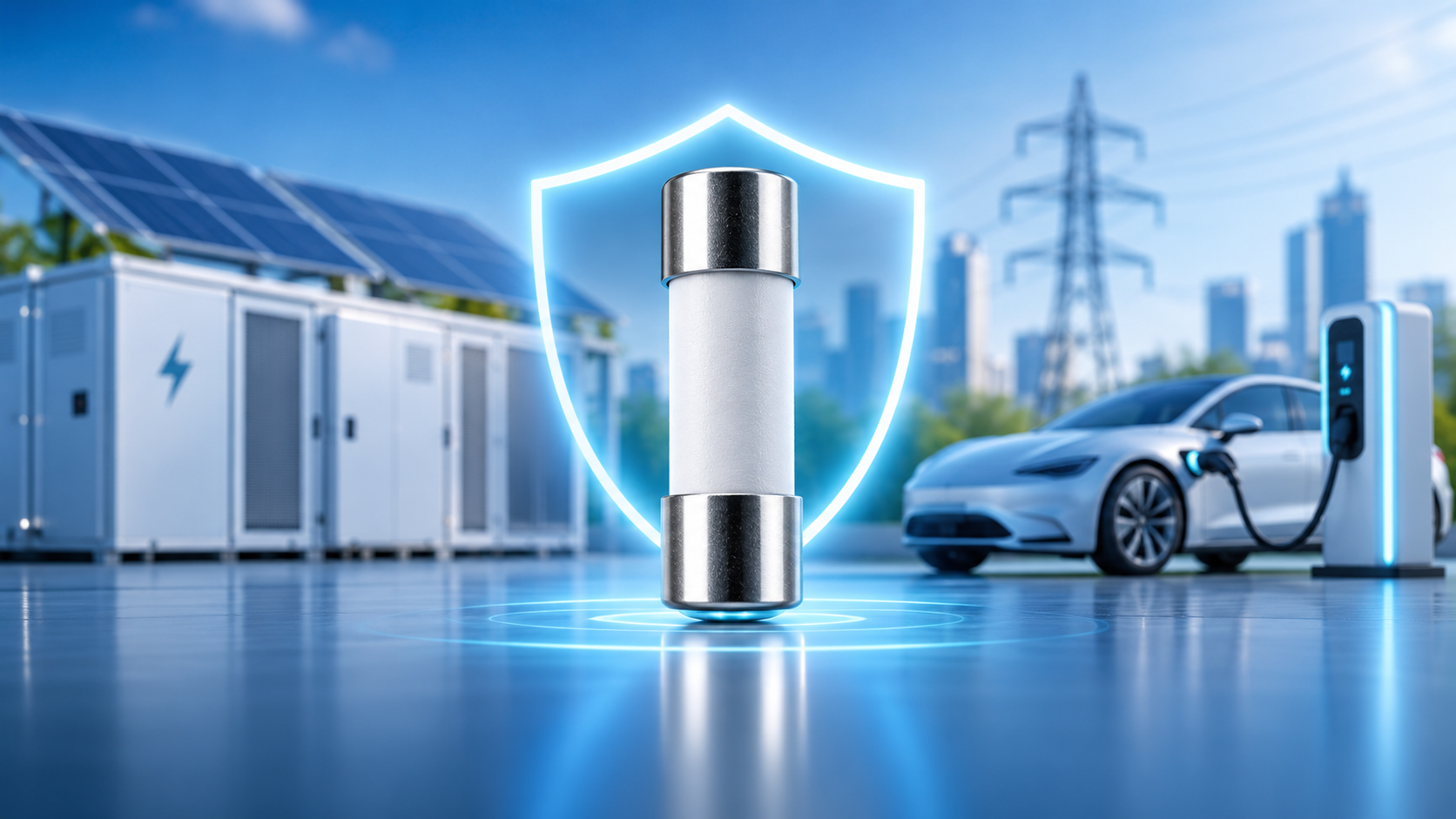
The rapid growth of electric vehicles (EVs), high-power charging infrastructure, and battery energy storage systems (BESS) has increased the demand for reliable DC electrical protection. As modern power systems operate at increasingly higher voltages and currents, selecting the right DC fuse has become essential for ensuring electrical safety, equipment protection, and long-term system reliability.
An EV fuse is a critical protective component in electric vehicle charging stations, battery energy storage systems, and high-voltage DC distribution networks. It protects sensitive electrical components against overcurrent and short-circuit faults by interrupting dangerous current flows before they cause extensive damage.
However, not all fuses are suitable for high-voltage DC applications. Choosing an inappropriate fuse can result in inadequate fault protection, excessive heat generation, equipment failure, and serious safety risks.
This guide explains what an EV fuse is, why DC-rated protection matters, and how to select the right DC fuse for energy storage and EV charging applications.
1. What Is an EV Fuse?
An EV fuse is an electrical protection device specifically designed for high-voltage applications in electric vehicles, charging infrastructure, and battery energy storage systems.
Its primary function is to interrupt excessive electrical current when an overload or short circuit occurs. By disconnecting the faulty circuit, the fuse helps prevent damage to batteries, power conversion equipment, cables, and other electrical components.
Unlike conventional low-voltage protection devices, EV fuses must withstand demanding operating conditions, including:
-
High DC operating voltages.
-
Significant short-circuit currents.
-
Rapid changes in electrical load.
-
High temperatures and thermal stress.
-
Strict space and installation requirements.
EV fuses are commonly used in 400V, 800V, and higher-voltage DC electrical architectures.
Their ability to interrupt high DC fault currents makes them an important safety component in modern electrification systems.
2. Why DC Fuses Are Essential for Energy Storage and EV Charging
DC electrical systems present different protection challenges compared with AC systems.
In AC circuits, the current naturally passes through zero during every cycle, which helps extinguish the electrical arc when a fuse operates.
DC circuits do not have this natural current zero-crossing. Consequently, interrupting a DC fault can be more challenging, particularly in high-voltage systems with substantial available fault current.
A properly selected DC fuse helps address these challenges.
Protection Against Short Circuits
Battery systems can deliver extremely high fault currents during short-circuit conditions. Without appropriate protection, excessive current can damage battery modules, busbars, cables, and power electronics.
A suitable DC fuse interrupts dangerous fault currents and limits the energy released into the protected circuit.
Protection of Sensitive Power Electronics
Modern EV charging stations and energy storage systems contain sensitive semiconductor components, including:
-
Insulated-gate bipolar transistors (IGBTs).
-
Metal-oxide-semiconductor field-effect transistors (MOSFETs).
-
Power conversion modules.
-
DC-DC converters.
-
Battery management system components.
These devices can be vulnerable to high-energy electrical faults. A properly coordinated fuse helps reduce the risk of catastrophic component damage.
Improved Electrical Safety
Electrical faults can generate excessive heat, electrical arcs, and potentially dangerous equipment failures.
Correctly rated DC fuses provide an essential layer of protection by disconnecting faulted circuits and helping reduce the risk of secondary damage.
Increased System Reliability
Reliable overcurrent protection helps minimise equipment downtime, maintenance costs, and unexpected system failures.
For commercial charging stations and large-scale energy storage installations, this contributes to more dependable operation.
3. Key Applications of EV DC Fuses
EV DC fuses are used across several industries and electrical applications.
Electric Vehicle Charging Stations
High-power EV charging stations require dependable DC protection because they operate with substantial electrical currents and high DC voltages.
DC fuses protect critical components such as:
-
Charging power modules.
-
DC output circuits.
-
Power distribution units.
-
DC busbars.
-
Internal electrical connections.
In fast-charging and ultra-fast-charging infrastructure, selecting a fuse with appropriate voltage, current, and breaking capacity is particularly important.
Battery Energy Storage Systems (BESS)
Battery energy storage systems store and distribute electrical energy through interconnected battery modules and DC power circuits.
These systems require reliable protection against overloads and short circuits.
DC fuses can be installed in battery strings, battery racks, module connections, and DC distribution circuits, depending on the system architecture.
They help protect battery components, electrical connections, and power conversion equipment.
Industrial DC Power Distribution
Industrial facilities increasingly use DC distribution systems for energy management, automation, and power conversion.
DC fuses provide overcurrent protection for electrical equipment, distribution networks, and high-power DC circuits.
Renewable Energy Storage Systems
Solar energy storage installations combine photovoltaic generation, battery storage, and power conversion equipment.
Suitable DC fuse protection helps safeguard battery connections and other DC circuits against electrical faults.
4. Five Important Factors When Choosing the Right DC Fuse
Selecting the correct EV fuse requires more than matching its rated current to the electrical load.
Engineers should evaluate several technical parameters to ensure that the fuse provides reliable protection under normal and fault conditions.
4.1 Voltage Rating
The voltage rating is one of the most important considerations when selecting a DC fuse.
The fuse must have a DC voltage rating equal to or higher than the maximum voltage it may experience in the application.
Common voltage categories include:
-
500V DC.
-
750V DC.
-
1000V DC.
-
1500V DC.
For example, an energy storage system operating on a 1000V DC architecture requires a fuse specifically rated for the relevant maximum DC voltage.
It is important to consider the maximum possible system voltage rather than relying exclusively on the nominal operating voltage.
Using a fuse with an insufficient voltage rating can compromise its ability to safely interrupt fault currents.
4.2 Current Rating
The current rating determines how much continuous current a fuse can carry under specified operating conditions without opening.
Choosing the correct rated current requires considering:
-
Normal operating current.
-
Maximum continuous load.
-
Ambient temperature.
-
Installation conditions.
-
Heat generated by nearby components.
-
Manufacturer derating requirements.
A preliminary sizing approach sometimes uses a fuse rating of at least 125% of the expected continuous operating current.
However, this is not a universal selection rule. Actual fuse sizing must account for applicable electrical standards, manufacturer specifications, conductor ampacity, operating conditions, and system protection requirements.
For example, if a DC circuit normally operates at 200A, an initial calculation using a 125% factor gives:
200A × 1.25 = 250A.
This provides a preliminary reference point, not an automatic final fuse selection.
The selected fuse must also provide appropriate protection during overloads and short circuits.
4.3 Breaking Capacity
Breaking capacity, also called interrupting rating, refers to the maximum prospective fault current that a fuse can safely interrupt at its specified voltage and under defined test conditions.
This parameter is particularly important in battery energy storage systems because battery banks can deliver very high short-circuit currents.
Typical high-power DC applications may require breaking capacities of 20kA, 30kA, or higher, depending on the system design.
When selecting an EV fuse, engineers should:
-
Calculate the maximum prospective short-circuit current.
-
Consider battery configuration and available fault energy.
-
Check the fuse's DC interrupting rating.
-
Verify that the breaking capacity exceeds the expected fault current.
An inadequate breaking capacity can lead to dangerous fuse failure during a short circuit.
4.4 I²t Value and Energy Let-Through
The I²t value represents the thermal energy associated with current passing through a fuse during its operating and interruption process.
It is an important parameter when protecting sensitive electrical components.
A lower let-through I²t can help reduce the thermal and mechanical stress experienced by protected equipment during a fault.
This is particularly relevant for:
-
IGBT power modules.
-
MOSFET semiconductor devices.
-
Battery modules.
-
DC power conversion equipment.
-
High-current electrical connections.
Engineers should compare the fuse's pre-arcing and total-clearing I²t values with the withstand characteristics of the protected components.
Proper coordination helps ensure that the fuse operates quickly enough to limit damaging fault energy.
4.5 Thermal Performance
Thermal performance directly affects fuse reliability and service life.
High-current DC applications generate heat during normal operation. Poor thermal management can cause excessive temperature increases, premature fuse operation, and deterioration of electrical connections.
Important thermal considerations include:
-
Ambient operating temperature.
-
Continuous current loading.
-
Contact resistance.
-
Fuse holder compatibility.
-
Ventilation and enclosure design.
-
Installation orientation.
-
Heat generated by adjacent components.
A fuse should always be selected and installed according to its specified operating conditions.
Thermal derating is particularly important in compact EV charging equipment and high-density battery storage installations.
5. EV Fuse vs. Conventional AC Fuse: What Is the Difference?
One of the common mistakes in electrical protection design is assuming that a conventional AC fuse can automatically replace a DC-rated fuse.
Although both devices provide overcurrent protection, their interruption capabilities must be evaluated for the intended application.
The main challenge is electrical arc interruption.
When a fuse element melts, an electrical arc forms between the separated conductive elements. In a DC circuit, the arc does not benefit from the natural current zero-crossing found in AC systems.
Therefore, the fuse must have an appropriate DC voltage rating and interrupting capability for the application.
Key differences to evaluate include:
| Parameter | AC Fuse | DC-Rated Fuse |
|---|---|---|
| Intended application | AC electrical circuits | DC electrical circuits |
| Voltage rating | Specified AC voltage | Specified DC voltage |
| Arc interruption | Designed for AC interruption conditions | Designed for applicable DC interruption conditions |
| Current rating | Depends on fuse specifications | Depends on fuse specifications |
| Breaking capacity | Must match AC fault conditions | Must match DC fault conditions |
| Application | AC distribution and equipment | EV charging, batteries, and DC distribution |
An AC fuse should never be assumed suitable for DC operation based solely on its current rating.
The manufacturer's specified DC voltage and breaking capacity must always be verified.
6. Common Mistakes to Avoid When Selecting an EV Fuse
Even a high-quality fuse may fail to provide adequate protection if it is incorrectly selected or installed.
The following mistakes should be avoided.
Using an Inappropriate Voltage Rating
Selecting a fuse based only on nominal system voltage can result in insufficient protection.
Always consider the maximum operating voltage and ensure the fuse has the appropriate DC rating.
Ignoring Breaking Capacity
A fuse with insufficient interrupting capacity may not safely clear a high-energy short circuit.
Always calculate the prospective fault current before selecting the fuse.
Choosing an Incorrect Current Rating
An undersized fuse may experience unnecessary interruptions during normal operation.
An oversized fuse may fail to protect cables and connected equipment adequately.
Current selection must consider both continuous operation and fault protection requirements.
Overlooking I²t Coordination
Ignoring energy let-through can expose sensitive semiconductor components and battery equipment to excessive thermal stress.
Check the fuse's total-clearing I²t against the withstand limits of the protected components.
Neglecting Thermal Derating
Ambient temperature, enclosure design, and installation conditions can significantly affect fuse performance.
Always account for thermal derating when determining the appropriate rated current.
Failing to Verify Technical Certifications and Testing
Fuse performance should be supported by relevant testing, technical documentation, and applicable product standards.
Engineers should review datasheets, certification information, and manufacturer test reports before approving a fuse for a critical application.
7. How to Select the Right EV Fuse: A Practical Checklist
Before finalising a DC fuse selection for an EV charging station or energy storage system, engineers should evaluate the following requirements:
Step 1: Identify the system voltage
Determine the nominal and maximum DC operating voltage.
Step 2: Calculate the operating current
Establish the maximum continuous current under normal operating conditions.
Step 3: Determine the prospective short-circuit current
Calculate the maximum fault current that the fuse may need to interrupt.
Step 4: Verify breaking capacity
Ensure the fuse's interrupting rating is sufficient for the available fault current at the application voltage.
Step 5: Check I²t coordination
Confirm that the fuse's energy let-through characteristics are compatible with the withstand limits of protected components.
Step 6: Evaluate thermal conditions
Consider ambient temperature, enclosure design, ventilation, and installation conditions.
Step 7: Check mechanical compatibility
Verify fuse dimensions, terminal design, mounting arrangements, and compatibility with the fuse holder or busbar assembly.
Step 8: Review standards and technical documentation
Check applicable electrical standards, product certifications, datasheets, and manufacturer test results.
Following these steps helps engineers select an appropriate DC fuse for demanding electrical applications.
8. The Future of DC Fuse Protection in EV Charging and Energy Storage
The global transition towards electrification is increasing the demand for advanced electrical protection technologies.
Electric vehicles are moving towards higher-voltage electrical architectures, while public charging networks are expanding their fast-charging and ultra-fast-charging capabilities.
At the same time, battery energy storage systems are becoming increasingly important for renewable energy integration, grid stability, and industrial energy management.
These developments create new requirements for DC fuse technology.
Future protection solutions will need to address:
-
Higher DC operating voltages.
-
Greater continuous current capacity.
-
Improved short-circuit interruption performance.
-
Lower energy let-through.
-
Better thermal stability.
-
More compact installation designs.
-
Improved compatibility with modern power electronics.
As power systems become more sophisticated, proper fuse selection and protection coordination will remain essential to maintaining electrical safety and operational reliability.
9. Conclusion: Choosing the Right DC Fuse for Reliable Protection
Selecting the right EV fuse for energy storage and EV charging applications is a critical engineering decision.
The correct DC fuse helps protect battery systems, power electronics, charging equipment, and electrical distribution components against dangerous overloads and short circuits.
Before choosing a fuse, engineers should carefully evaluate five essential parameters: voltage rating, current rating, breaking capacity, I²t characteristics, and thermal performance.
It is equally important to verify mechanical compatibility, applicable standards, and manufacturer testing documentation.
Whether designing an EV fast-charging station, a battery energy storage system, or a high-voltage DC distribution network, selecting an appropriately rated and coordinated DC fuse can significantly improve system safety, reliability, and long-term performance.
As the EV and renewable energy industries continue to grow, dependable DC overcurrent protection will remain a fundamental part of modern electrical system design.



