
 eaton-bussmann-series-photovoltaic-fuses-catalogue-ca135004en.pdf  | [Eaton Bussmann PV Fuses] | 0 kB |
Solar Fuse Protection vs. Circuit Breaker: Which Is Better for Solar PV Systems?
Solar energy systems require reliable electrical protection to ensure safe, efficient, and uninterrupted operation. Among the most important protective components in a photovoltaic (PV) installation are solar fuses and DC circuit breakers. Both devices protect electrical circuits against overcurrent conditions, short circuits, and potential equipment damage. However, they operate differently and offer distinct advantages depending on the application.
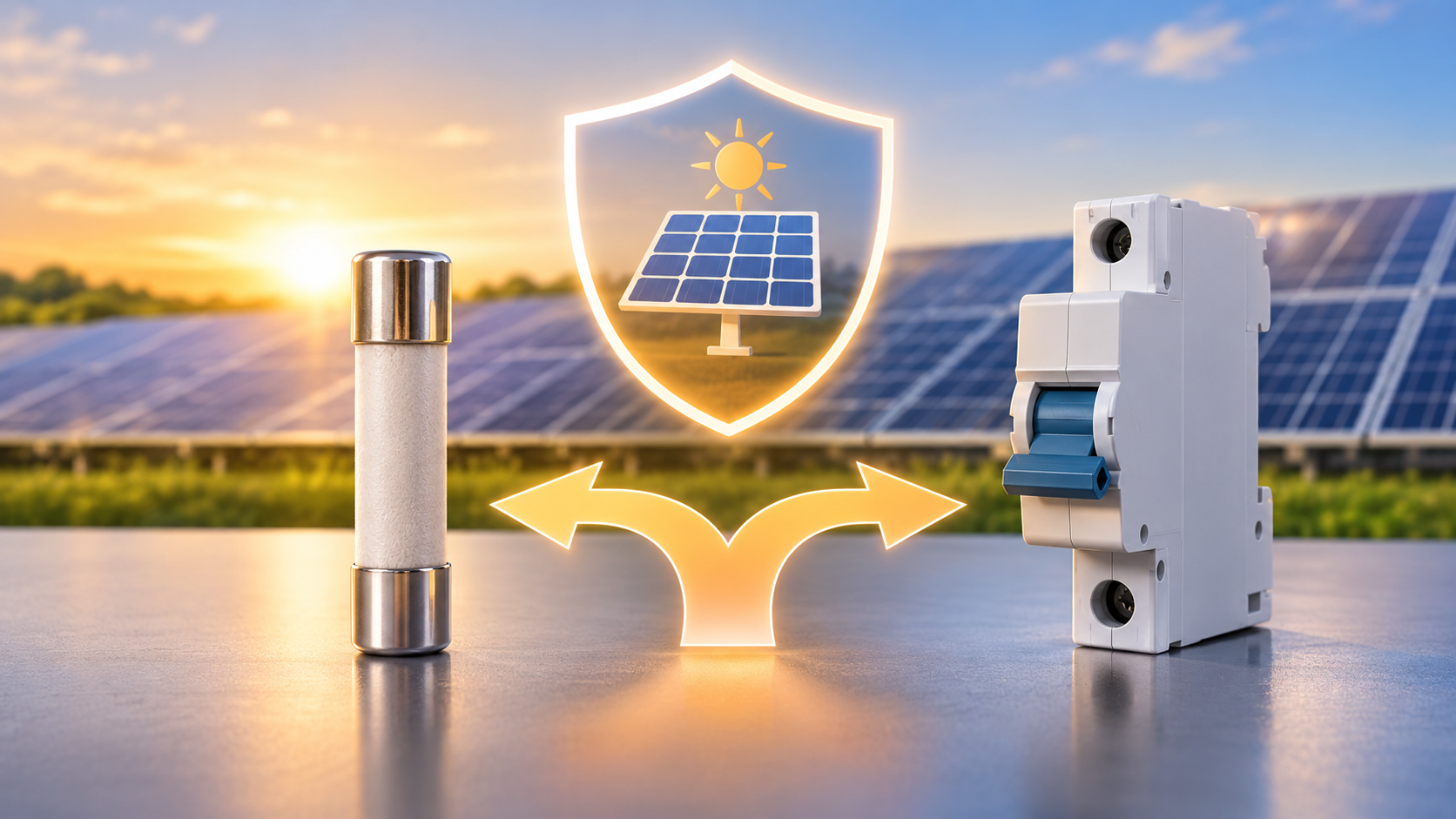
When comparing solar fuse protection vs. circuit breaker, it is important to understand their operating principles, interruption capabilities, response characteristics, and suitability for different solar installations.
Solar fuses are commonly used for string-level overcurrent protection, while DC circuit breakers offer resettable protection and convenient circuit isolation. Choosing the right solution depends on system voltage, current ratings, available fault current, configuration, and applicable electrical standards.
In this guide, we will explore the differences between solar fuses and circuit breakers, compare their advantages and limitations, and explain how to select the appropriate protection device for your solar PV system.
1. Why Is Overcurrent Protection Important in Solar PV Systems?
Solar photovoltaic systems generate electricity through interconnected solar modules. These modules are often arranged into strings, which may be connected in parallel to increase the overall power output.
Although solar installations are designed for long-term operation, electrical faults can occur because of damaged cables, insulation failures, defective modules, incorrect wiring, or environmental conditions.
Overcurrent protection helps prevent excessive current from damaging electrical components and creating dangerous operating conditions.
Without suitable protection, an electrical fault may cause:
-
Overheating of electrical cables and connections.
-
Damage to solar modules and other system components.
-
Insulation deterioration and electrical fires.
-
Equipment failure and unexpected system downtime.
-
Dangerous DC arcing during fault conditions.
Unlike alternating current (AC), direct current (DC) does not naturally pass through zero during each electrical cycle. Consequently, interrupting a DC fault can be more challenging because electrical arcs may continue until the circuit is effectively interrupted.
This makes selecting appropriately rated DC protection devices particularly important in solar installations.
2. What Is Solar Fuse Protection?
A solar fuse is an electrical protection device specifically designed to protect photovoltaic circuits against excessive current.
It contains a calibrated metallic element that melts when the current exceeds its operating characteristics for a sufficient period. Once the element melts, the circuit opens and interrupts the current flow.
Photovoltaic systems commonly use gPV-rated fuse-links designed specifically for solar applications.
These fuses are engineered to handle the operating characteristics of PV circuits, including continuous current generation and the potential reverse currents that can occur in parallel-connected strings.
Key Advantages of Solar Fuse Protection
1. Fast Fault Interruption
Solar fuses can respond rapidly to high overcurrent conditions. Their operating characteristics help limit the energy released during an electrical fault, reducing potential damage to cables and connected equipment.
2. High Breaking Capacity
PV fuse-links are available with high DC breaking capacities. This is particularly important in large solar installations where multiple parallel strings may contribute significant fault current.
3. Reliable Operation
Solar fuses have relatively simple internal construction and contain no mechanical switching mechanism. This reduces the possibility of mechanical wear or contact-related failure.
4. Effective DC Arc Extinguishing
Many photovoltaic fuse-links use specially designed arc-quenching materials, such as silica sand, to help extinguish the electrical arc when the fuse element melts.
5. Compact Design
Solar fuses are generally compact and can be installed in photovoltaic combiner boxes, making them suitable for string-level protection.
Limitations of Solar Fuses
Despite their advantages, solar fuses also have certain limitations:
-
They are single-use protection devices and must be replaced after operation.
-
Identifying a blown fuse may require electrical testing.
-
Incorrect fuse selection can cause unnecessary operation or inadequate protection.
-
Replacement requires the circuit to be made safe and the underlying fault to be investigated.
Solar fuses are particularly useful when dependable string-level overcurrent protection and high DC fault-interruption capability are required.
3. What Is a DC Circuit Breaker?
A DC circuit breaker is an automatically operated electrical switching device designed to interrupt current when an overload or short circuit occurs.
Unlike a fuse, which operates by melting a metallic element, a circuit breaker uses a mechanical tripping mechanism to open its electrical contacts.
Depending on its design, a DC circuit breaker may use thermal, magnetic, or electronic protection mechanisms.
When an abnormal current is detected, the breaker trips and separates its contacts, interrupting the electrical circuit.
After the fault has been identified and corrected, many circuit breakers can be manually reset and returned to service.
Key Advantages of DC Circuit Breakers
1. Resettable Protection
One of the biggest advantages of circuit breakers is that they can generally be reset after a fault has been investigated and resolved. This eliminates the need to replace a fuse every time the protective device operates.
2. Convenient Operation
Circuit breakers provide a straightforward method of opening and closing electrical circuits. Their operating handles also make their status easier to identify.
3. Circuit Isolation
Suitable DC circuit breakers can provide a convenient means of disconnecting electrical equipment during inspection and maintenance.
However, the device must be specifically rated for the required switching and isolation function.
4. Multiple Protection Functions
Depending on their design, DC circuit breakers can provide overload protection, short-circuit protection, and manual switching within a single device.
Limitations of DC Circuit Breakers
Although circuit breakers offer convenience, they also have certain limitations:
-
Their mechanical components can experience wear over time.
-
Their interruption performance depends on the specific DC voltage and fault-current ratings.
-
Contact damage or welding may occur if the breaker is exposed to fault conditions beyond its rated capabilities.
-
Some models have lower breaking capacities than comparable PV fuse-links.
-
Initial purchase costs may be higher for certain applications.
It is important to remember that not every DC circuit breaker is suitable for photovoltaic applications. The device must have appropriate DC ratings and verified interruption performance for the intended system.
4. Solar Fuse Protection vs. Circuit Breaker: Key Differences
Understanding the differences between solar fuses and DC circuit breakers makes it easier to determine which protection solution is appropriate for a particular PV installation.
The following table compares their main characteristics.
| Comparison Factor | Solar Fuse | DC Circuit Breaker |
|---|---|---|
| Operating principle | Melts a calibrated metallic element | Opens contacts through a tripping mechanism |
| Reset capability | Cannot be reset | Generally resettable |
| Fault response | Fast, depending on fault current and fuse characteristics | Depends on the trip mechanism and fault current |
| Breaking capacity | Often available with high breaking capacities | Varies significantly by model |
| Arc extinguishing | Commonly uses an arc-quenching filling material | Uses an arc chute and other DC arc-control mechanisms |
| Mechanical components | No moving switching mechanism | Contains mechanical components |
| Maintenance | Requires replacement after operation | Can generally be reset after fault investigation |
| Fault indication | Requires inspection or electrical testing | Usually provides a visible trip indication |
| Installation | Commonly used in PV string fuse holders and combiner boxes | Used for protection and switching where appropriately rated |
| Initial cost | Often economical for individual string protection | May have a higher initial cost |
| Typical application | PV string overcurrent protection | Circuit protection and disconnection |
Important: Actual operating times, breaking capacities, costs, and performance vary according to the manufacturer's specifications and the exact device selected. Neither device should be considered universally superior based on general comparisons alone.
5. Why Are Solar Fuses Commonly Used in PV Combiner Boxes?
A photovoltaic combiner box collects electrical output from multiple solar strings and combines them into a common DC output.
Because several strings may be connected in parallel, a fault in one string can create a reverse-current condition.
For example, if one string develops a short circuit or module fault, the other parallel-connected strings may feed current back into the affected string.
This reverse current can exceed the safe current-carrying capacity of the affected conductors or damage individual solar modules.
Solar string fuses help prevent these conditions by interrupting excessive reverse current.
Main Benefits of Solar Fuses in Combiner Boxes
-
Provide individual overcurrent protection for PV strings.
-
Help prevent damaging reverse-current conditions.
-
Offer high DC fault-interruption capabilities when correctly selected.
-
Support reliable protection in high-voltage photovoltaic installations.
-
Provide a compact protection solution for multiple solar strings.
However, string fuses are not automatically required in every PV configuration. Their necessity depends on the number of parallel strings, module characteristics, maximum permissible series fuse rating, and applicable electrical standards.
Proper engineering calculations are essential before selecting the protection arrangement.
6. When Should You Use a Solar Fuse Instead of a Circuit Breaker?
Solar fuses are generally preferred when the primary requirement is reliable overcurrent protection at the individual PV string level.
They are particularly suitable for applications involving multiple parallel-connected strings, where reverse-current protection is important.
Consider using PV-rated fuse-links when:
-
Designing photovoltaic string protection systems.
-
Installing multi-string solar combiner boxes.
-
Protecting PV modules and conductors against excessive reverse current.
-
Working with high-voltage DC photovoltaic installations.
-
Requiring a protection device with a suitably high DC breaking capacity.
The selected fuse must meet the system's maximum operating voltage, current requirements, breaking capacity, and applicable PV protection standards.
A correctly selected gPV fuse can provide dependable protection against specific PV overcurrent conditions.
7. When Should You Use a DC Circuit Breaker?
DC circuit breakers are useful when circuit protection and convenient switching or disconnection are required.
They can be suitable for applications where the system design requires a resettable protective device and the selected breaker meets all relevant electrical ratings.
Common applications include:
-
DC distribution circuits.
-
Suitable solar inverter input circuits.
-
Solar system maintenance and isolation points.
-
DC equipment protection.
-
Applications requiring a visible switching mechanism.
For solar installations, it is essential to select a breaker specifically designed and tested for the intended DC application.
Its rated operating voltage, continuous current, breaking capacity, trip characteristics, and switching capabilities must all be verified.
A standard AC circuit breaker should never be substituted for a DC-rated device without explicit manufacturer approval for the application.
8. Can Solar Fuses and Circuit Breakers Be Used Together?
Yes. In many photovoltaic installations, using both solar fuses and DC circuit breakers provides a practical protection arrangement.
Rather than treating them as competing devices, system designers can assign each component a specific protection function.
For example, a typical solar PV protection arrangement may include:
String-Level Protection:
PV-rated fuses are installed on individual strings to protect against excessive reverse current and other relevant overcurrent conditions.
Combiner Output Protection:
An appropriately rated DC circuit breaker or load-break switch can provide a means of disconnecting the combined PV output, depending on the system design.
Inverter Protection:
Additional protection and switching arrangements may be incorporated at the inverter input, as required by the inverter manufacturer and applicable electrical standards.
Benefits of a Combined Protection Approach
Using both devices where appropriate can offer several advantages:
-
Individual protection for parallel-connected solar strings.
-
Convenient circuit disconnection during maintenance.
-
Improved protection coordination.
-
Better fault identification and troubleshooting.
-
Greater flexibility in system design.
However, simply installing both devices does not automatically improve system safety. Their ratings and operating characteristics must be coordinated to ensure that the correct device operates under the expected fault conditions.
9. Important Factors When Selecting Solar Fuses and DC Circuit Breakers
Choosing the correct protection device requires more than comparing current ratings or purchase prices.
Several technical factors should be considered during photovoltaic system design.
1. System Voltage
The protection device must have a DC voltage rating equal to or greater than the maximum possible circuit voltage.
For solar PV installations, this calculation should consider the open-circuit voltage of the modules and the temperature-dependent increase in voltage under low-temperature conditions.
For example, a 1500V DC photovoltaic system requires protection devices specifically rated for the maximum system voltage.
2. Current Rating
The selected fuse or circuit breaker must provide appropriate protection for the connected conductors and equipment.
Selection should consider:
-
Module short-circuit current.
-
Expected operating current.
-
Number of parallel strings.
-
Cable ampacity.
-
Module maximum series fuse rating.
-
Ambient temperature and installation conditions.
The protection device must be correctly coordinated with the current-carrying capacity of the circuit.
3. Breaking Capacity
Breaking capacity is one of the most important considerations when selecting DC protection devices.
It represents the maximum prospective fault current that a protective device can safely interrupt under specified conditions.
The device's DC breaking capacity must be sufficient for the maximum available fault current at its installation point.
Selecting a device with insufficient breaking capacity can result in dangerous failure during a short circuit.
4. DC Arc Extinguishing Capability
DC electrical arcs are more difficult to interrupt than AC arcs because DC current does not naturally cross zero.
Therefore, protective devices must incorporate suitable arc-extinguishing designs.
PV fuse-links and DC circuit breakers use different arc-interruption technologies, and their performance must be verified for the intended voltage and current conditions.
5. Applicable Standards
Compliance with relevant electrical standards is essential for safe photovoltaic system operation.
Important standards include:
-
IEC 60269-6: Requirements for fuse-links used to protect photovoltaic energy systems.
-
IEC 60947-2: Requirements for low-voltage circuit breakers.
-
IEC 62548: Design requirements for photovoltaic arrays.
Depending on the installation location, additional national regulations and requirements may apply.
For example, installations in Germany must also consider applicable VDE requirements and relevant national electrical installation regulations.
6. Installation Environment
Environmental conditions can influence the performance and service life of electrical protection devices.
Factors such as ambient temperature, humidity, dust, ventilation, and enclosure design should be considered.
Solar combiner boxes installed outdoors must provide appropriate environmental protection to maintain safe and reliable operation.
10. Common Mistakes When Choosing Solar Fuse Protection
Incorrect selection of protective devices can compromise the safety and reliability of a photovoltaic installation.
Some common mistakes include:
Using General-Purpose Fuses Instead of PV-Rated Fuses
Not every DC fuse is suitable for photovoltaic applications. Solar installations require fuse-links with appropriate PV ratings and operating characteristics.
Ignoring Maximum System Voltage
A fuse may have the correct current rating but an insufficient DC voltage rating. Always verify the maximum system voltage before installation.
Selecting a Device Based Only on Current Rating
Current rating alone does not determine whether a fuse or circuit breaker is suitable. Breaking capacity, voltage rating, trip characteristics, and coordination are equally important.
Using AC Circuit Breakers in DC Applications
AC and DC circuit breakers have different interruption requirements. An AC-rated breaker must not be used in a DC circuit unless it is explicitly approved for that application.
Ignoring Reverse-Current Protection
Parallel-connected PV strings can create reverse-current conditions. System designers must evaluate the available fault current and determine whether individual string protection is required.
Failing to Coordinate Protective Devices
Poor coordination can cause the wrong device to operate during a fault, potentially interrupting more of the installation than necessary.
Avoiding these mistakes helps improve electrical safety, reduce equipment damage, and support long-term photovoltaic system performance.
11. Solar Fuse Protection vs. Circuit Breaker: Which Is Better?
There is no universal answer because both devices serve important functions in photovoltaic electrical protection.
However, their suitability differs depending on the application.
Solar Fuses Are Generally Better for:
-
Individual PV string overcurrent protection.
-
Reverse-current protection in parallel-connected strings.
-
Applications requiring high DC breaking capacity.
-
Compact protection arrangements in solar combiner boxes.
DC Circuit Breakers Are Generally Better for:
-
Resettable circuit protection.
-
Convenient manual switching.
-
Suitable DC distribution applications.
-
Circuit isolation where the device is rated for that function.
For many solar PV installations, a combination of PV-rated string fuses and appropriately rated DC switching devices provides a practical solution.
The final decision should always be based on the system's electrical characteristics, protection requirements, and applicable standards rather than assuming that one device is always better than the other.
12. Frequently Asked Questions (FAQs)
Q1. What is the main difference between a solar fuse and a circuit breaker?
The main difference is their operating mechanism. A solar fuse interrupts excessive current by melting a calibrated metallic element and must generally be replaced after operation. A circuit breaker uses a mechanical or electronic tripping mechanism to open the circuit and can usually be reset after the fault has been investigated and corrected.
Q2. Are solar fuses better than DC circuit breakers?
Solar fuses can offer advantages in PV string protection, particularly where high DC breaking capacity and reverse-current protection are required. DC circuit breakers offer resettable operation and convenient switching. The better option depends on the electrical requirements and intended protection function.
Q3. Why are gPV fuses used in solar systems?
gPV fuses are specifically designed for photovoltaic applications. They provide overcurrent protection for PV circuits and help interrupt excessive reverse currents in parallel-connected solar strings.
Q4. Can I use a normal DC fuse in a solar PV system?
Not necessarily. A general-purpose DC fuse may not have the operating characteristics or certification required for photovoltaic applications. Always select a fuse specifically rated for the intended PV circuit and its maximum voltage, current, and fault conditions.
Q5. Can a DC circuit breaker replace a solar fuse?
In some applications, a suitably rated DC circuit breaker may provide the required overcurrent protection. However, it must meet the system's voltage, breaking capacity, trip characteristics, and applicable PV protection requirements. It should not be considered an automatic replacement for a gPV fuse.
Q6. Do solar panels need both fuses and circuit breakers?
Not every solar installation requires both devices. The protection arrangement depends on the number of parallel strings, module specifications, available fault current, inverter requirements, and local electrical regulations.
Q7. What is the difference between gPV and gG fuses?
gPV fuses are specifically designed for photovoltaic circuit protection, while gG fuses are general-purpose full-range fuse-links commonly used for cable and equipment protection in general electrical installations. They have different application requirements and operating characteristics and should not be treated as interchangeable.
Q8. What is the breaking capacity of a solar fuse?
The breaking capacity depends on the specific fuse design and its rated voltage. PV fuse-links are available with different DC breaking capacities, making it important to check the manufacturer's technical documentation and ensure the selected rating exceeds the maximum prospective fault current.
Conclusion
Choosing between solar fuse protection and circuit breakers is an important part of designing a safe and reliable photovoltaic installation.
Solar fuses provide effective overcurrent protection for PV strings, particularly in systems where parallel connections can create reverse-current conditions. Their high DC breaking capacity, compact construction, and application-specific operating characteristics make them valuable components in solar combiner boxes.
DC circuit breakers, on the other hand, offer resettable protection and convenient switching capabilities. They are useful in applications where circuit isolation and manual operation are required, provided they meet the necessary DC protection and interruption ratings.
For many photovoltaic installations, the most effective solution is not choosing one device over the other but using each device according to its intended function.
Ultimately, proper system calculations, suitable equipment ratings, protection coordination, and compliance with applicable electrical standards are essential for ensuring long-term solar PV system safety and performance.



