
 eaton-bussmann-series-dc-fuses-catalog-ca135009en-us.pdf  | [Eaton Bussmann PV Fuses] | 0 kB |
What Sizes of Fuses Do You Need in Your Solar Array?
Choosing the correct fuse size for your solar array is essential for protecting your solar panels, electrical wiring and connected equipment. Whether you are installing a small campervan solar system, an off-grid installation or a larger residential solar array, understanding solar fuse sizing can help prevent electrical faults, overheating and potential fire hazards.
However, not every solar array requires individual fuses for every panel. The number of panels connected in parallel, their short-circuit current ratings and their maximum series fuse ratings all influence whether additional overcurrent protection is necessary.
So, what size fuse do you need for your solar array? In this guide, we explain how to determine the correct solar fuse size, when fuses are required and where they should be installed.
Why Do Solar Arrays Need Fuses?
Solar panels generate direct current (DC) electricity. When multiple panels are connected together, the electrical current available in the system can increase, particularly when panels are wired in parallel.
If one solar panel develops an internal fault or short circuit, electricity from the other connected panels may flow backwards into the faulty panel. This additional current can exceed the panel's rated capacity, potentially damaging internal components, cables and connectors.
Without suitable overcurrent protection, excessive current can cause:
-
Overheating of electrical cables and connections.
-
Damage to solar panel cells and internal wiring.
-
Failure of bypass diodes and other components.
-
Electrical equipment damage.
-
Increased risk of electrical fires.
Solar fuses are designed to interrupt excessive current before it causes serious damage. They help isolate faulty circuits while allowing the remaining parts of the solar array to continue operating where the system design permits.
When Does a Solar Array Need Fuses?
Whether your solar array requires fuses depends primarily on how the solar panels are connected and how much reverse current could flow through an individual panel or string.
The two most important specifications to check are:
1. Solar Panel Short-Circuit Current (Isc)
Short-circuit current, commonly identified as Isc on a solar panel specification label, represents the maximum current the panel produces under specified short-circuit test conditions.
When solar panels are connected in parallel, their short-circuit currents are added together.
For example, three panels with a short-circuit current of 10.2 amps each would produce a combined array short-circuit current of:
10.2A × 3 = 30.6A
2. Maximum Series Fuse Rating
The maximum series fuse rating is specified by the solar panel manufacturer. It indicates the maximum permitted rating of the overcurrent protection device used to protect the panel or string, subject to the manufacturer's instructions.
For example, a solar panel with a maximum series fuse rating of 15 amps should not be protected by a fuse with a higher rating.
Comparing these two specifications helps determine whether individual string protection is required.
Under applicable photovoltaic electrical code requirements, overcurrent protection may be omitted only when the conductors have sufficient ampacity and the current from all sources does not exceed the maximum overcurrent protection rating specified for the equipment.
When these conditions are not met, suitable overcurrent protection is necessary.
How to Calculate the Correct Solar Fuse Size
Selecting the correct solar fuse size involves more than simply choosing a fuse based on the total wattage of your solar panels.
You need to consider the panel's electrical specifications, the number of parallel strings, the cable capacity and the applicable electrical regulations.
Follow these steps when determining the appropriate protection.
Step 1: Check the Solar Panel Specifications
Start by examining the manufacturer's specification label or datasheet for each solar panel.
Look for the following information:
-
Short-circuit current (Isc).
-
Maximum power current (Imp).
-
Maximum series fuse rating.
-
Maximum system voltage.
-
Temperature and operating specifications.
These figures provide the information needed to calculate the circuit's current requirements and select suitable overcurrent protection.
Step 2: Determine How Your Solar Panels Are Connected
Solar panels can be connected in series, parallel or a combination of both.
The wiring arrangement significantly affects the current flowing through your solar array.
Series-connected solar panels
When solar panels are connected in series, their voltages are added together while the current remains approximately the same.
For example, three solar panels with an operating current of 9.8 amps connected in series will still produce approximately 9.8 amps of operating current.
Therefore, connecting additional panels in series does not normally increase the current available from the string.
Parallel-connected solar panels
When solar panels are connected in parallel, their currents are added together while the voltage remains approximately the same.
For example, three panels with a short-circuit current of 10.2 amps connected in parallel produce a combined short-circuit current of 30.6 amps.
This increase in available current is particularly important because current from healthy parallel strings can flow into a faulty string.
Step 3: Calculate the Total Short-Circuit Current
To calculate the total short-circuit current of a parallel solar array, multiply the short-circuit current of one panel by the number of parallel-connected panels or strings, assuming identical panels operating under the same specified conditions.
For example:
-
Number of parallel panels: 3.
-
Short-circuit current per panel: 10.2A.
-
Total array short-circuit current: 30.6A.
The result helps establish whether the potential current exceeds the maximum series fuse rating of an individual panel.
Remember that a more detailed system calculation must also account for applicable design factors and other current sources.
Step 4: Compare the Current with the Maximum Series Fuse Rating
Suppose each solar panel has a maximum series fuse rating of 15 amps.
With three parallel-connected panels, the total short-circuit current is 30.6 amps.
If one panel develops an internal short circuit, the other two panels could potentially supply:
10.2A × 2 = 20.4A
This reverse current could exceed the faulty panel's permitted protection rating.
Individual string overcurrent protection is therefore required where the applicable electrical code and equipment specifications establish that protection is necessary.
Step 5: Select the Appropriate Fuse Rating
Once you have established that fuses are required, the next step is selecting the correct fuse rating.
The fuse must be suitable for the calculated circuit current while remaining within the maximum series fuse rating specified by the solar panel manufacturer.
It must also be coordinated with the conductor ampacity and applicable electrical code requirements.
Solar photovoltaic circuits commonly use specialised gPV fuses designed for DC photovoltaic applications.
When selecting a fuse, consider:
-
Rated current in amperes.
-
Rated DC voltage.
-
DC breaking capacity.
-
Time-current characteristics.
-
Temperature derating.
-
Compatibility with the fuse holder.
-
Maximum series fuse rating of the solar panel.
Do not automatically assume that a 15A fuse is suitable simply because the panel has a 15A maximum series fuse rating. The actual fuse selection must satisfy all applicable design requirements.
What Happens If You Do Not Fuse a Solar Array?
Consider a solar array consisting of three parallel-connected panels, each with a short-circuit current of 10.2 amps.
If one panel develops an internal short circuit, the other two panels may feed current into the faulty panel.
The combined reverse current could reach approximately 20.4 amps under the assumed conditions.
If the faulty panel has a maximum series fuse rating of 15 amps, this current presents a potential hazard.
Excessive current can damage the panel's internal wiring, connectors and other electrical components.
Installing appropriately rated individual string fuses can interrupt this reverse current when it exceeds the fuse's operating characteristics.
This helps isolate the faulty circuit and reduces the possibility of overheating and electrical damage.
Why Some Solar Arrays Do Not Need Individual Fuses
Not every solar installation requires individual fuses for each panel or string.
Consider an array containing three identical 200W solar panels connected in series.
Each panel has:
-
Short-circuit current: 10.2A.
-
Operating current: 9.8A.
-
Maximum series fuse rating: 15A.
Because the panels are connected in series, the current remains approximately 10.2 amps rather than increasing to 30.6 amps.
If a panel develops an internal fault, the current available from the other panels in the string may still remain within the panel's permitted current limits.
In this situation, individual string fuses may not provide additional overcurrent protection and may not be required under the applicable code conditions.
However, this does not mean that the entire solar installation can operate without electrical protection.
Conductors, batteries, charge controllers, inverters and other components may require separate overcurrent protection.
Always assess each circuit individually.
Where Should Fuses Be Installed in a Solar Array?
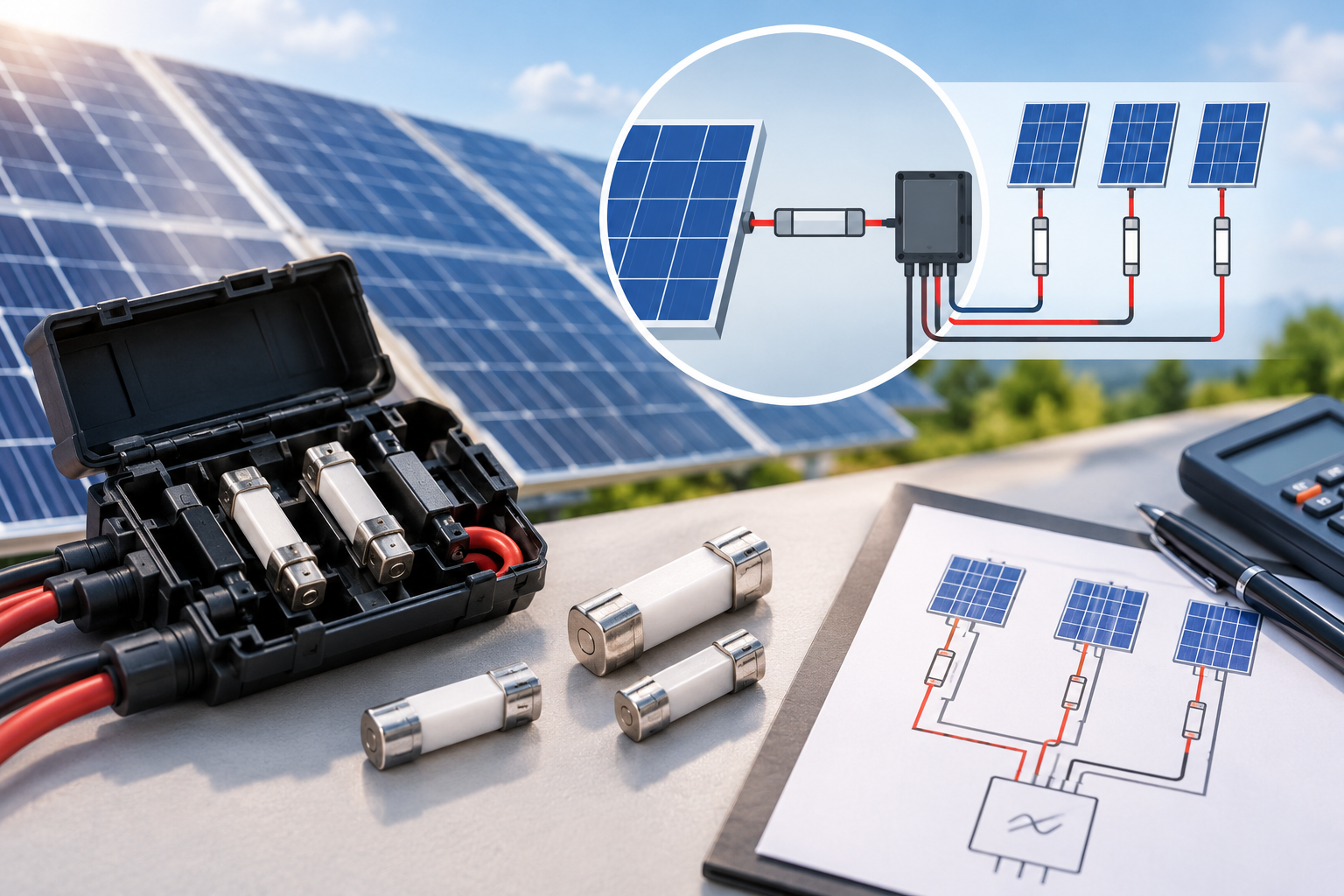
When individual string fuses are required, they are generally installed on the positive conductors of the individual solar strings before those strings are combined at a combiner box or common connection point.
This arrangement allows a fuse to isolate a faulty string without unnecessarily disconnecting the other strings.
Typical locations requiring consideration include:
Individual solar string connections
Each parallel string may require its own overcurrent protection device to prevent excessive reverse current from other strings.
Solar combiner boxes
A combiner box brings multiple solar strings together. It commonly houses individual string fuses and other protective components.
Battery connections
Battery circuits require appropriately sized overcurrent protection because batteries can supply very high fault currents. Battery fuse sizing must be calculated separately from solar panel string fuse sizing.
Inverter connections
Depending on the system design and equipment requirements, additional protection may be needed on the DC and AC sides of the inverter.
The exact protection arrangement depends on the electrical system design and applicable installation regulations.
How to Choose the Right Solar DC Fuse
Choosing a fuse involves more than matching its ampere rating to the expected current.
The following factors should be considered before installing a solar fuse.
1. Current Rating
The fuse's current rating must be appropriate for the maximum calculated circuit current and must not exceed the equipment manufacturer's maximum permitted protection rating.
It must also coordinate with the cable's allowable current capacity.
2. Voltage Rating
Solar installations can operate at relatively high DC voltages, particularly in larger photovoltaic systems.
The fuse must have a DC voltage rating equal to or greater than the maximum possible circuit voltage under the relevant design conditions.
Never assume that a fuse designed for AC applications is suitable for a DC solar circuit.
3. Breaking Capacity
Breaking capacity refers to the maximum fault current a fuse can safely interrupt at its specified voltage.
Solar installations, particularly those incorporating batteries, can produce substantial fault currents.
The fuse must have sufficient DC breaking capacity for the prospective fault current at its installation point.
4. Fuse Type
Photovoltaic installations commonly use gPV-rated fuses specifically designed for solar DC applications.
These fuses are designed to operate under the electrical characteristics of photovoltaic circuits, including their relatively sustained current conditions.
Using an unsuitable fuse can compromise the protection of the entire installation.
5. Environmental Conditions
Temperature, enclosure ventilation and installation location can affect fuse performance.
High ambient temperatures may require derating, depending on the fuse manufacturer's specifications.
Always check the operating conditions and compatibility of the fuse and holder.
Common Mistakes When Selecting Solar Fuses
Incorrect fuse selection can reduce the effectiveness of an otherwise well-designed solar installation.
Some common mistakes include:
-
Choosing a fuse based only on the solar panel's wattage.
-
Ignoring the maximum series fuse rating.
-
Forgetting that parallel-connected panels increase current.
-
Installing a fuse with an insufficient DC voltage rating.
-
Using an AC-only fuse in a DC photovoltaic circuit.
-
Selecting a fuse with inadequate breaking capacity.
-
Ignoring cable ampacity and temperature derating.
-
Using the same fuse rating for solar strings and battery connections.
-
Assuming every solar array requires individual panel fuses.
Avoiding these mistakes helps ensure that your solar array has appropriate protection against overcurrent conditions.
Frequently Asked Questions About Solar Fuse Sizes
What Size Fuse Do I Need for a 100W Solar Panel?
The correct fuse size for a 100W solar panel depends on its electrical specifications, particularly its short-circuit current and maximum series fuse rating.
Panel wattage alone is not sufficient to determine the correct fuse size.
Always check the manufacturer's datasheet and calculate the required protection according to the applicable electrical regulations.
Do I Need a Fuse for Every Solar Panel?
Not necessarily.
Individual panel or string fuses are generally required when the potential reverse current from other parallel-connected strings can exceed the panel's permitted protection rating.
Some series-connected solar arrays may not require individual string fuses if the applicable overcurrent protection exemption conditions are satisfied.
Do Solar Panels Connected in Series Need Fuses?
Series-connected panels carry approximately the same current throughout the string.
Consequently, connecting panels in series does not increase the available current in the same way as parallel connections.
However, the need for overcurrent protection must still be evaluated according to the complete system design and applicable electrical requirements.
What Does Maximum Series Fuse Rating Mean?
The maximum series fuse rating is the maximum permitted overcurrent protection device rating specified by the solar panel manufacturer.
It helps prevent excessive current from damaging the panel's internal components, wiring and connections.
Can I Use a Normal Fuse for a Solar Panel?
A fuse used in a photovoltaic DC circuit must have suitable DC voltage and breaking capacity ratings, as well as appropriate current and operating characteristics.
Specialised gPV fuses are commonly used for this purpose.
A general-purpose fuse should not be used unless it is specifically rated and suitable for the application.
Should I Fuse Both Positive and Negative Solar Wires?
The required fuse arrangement depends on the system's earthing configuration, conductor arrangement and applicable electrical regulations.
In many common unearthed PV string arrangements, overcurrent protection is installed in the positive conductor. Additional or alternative protection arrangements may be required in other configurations.
Follow the equipment manufacturer's instructions and the applicable electrical code.
Conclusion: Choosing the Correct Fuse Size for Your Solar Array
Selecting the correct fuse size is an important part of designing a safe and reliable solar power system.
The most important factors are the solar panel's short-circuit current, maximum series fuse rating, number of parallel-connected strings, conductor ampacity and maximum system voltage.
Remember that parallel connections increase the available current, potentially creating reverse-current conditions that can damage a faulty panel. Individual string fuses provide protection where these conditions require it.
However, adding fuses unnecessarily can introduce additional electrical connections and nuisance tripping without improving protection.
Always calculate the required fuse rating rather than relying on a standard size or the solar panel's wattage alone. Ensure that the selected fuse has suitable DC voltage, breaking capacity and current characteristics.
Finally, follow the electrical regulations applicable to your installation and have the system designed, checked and installed by a qualified solar electrician.
Proper fuse selection helps protect your solar panels, electrical equipment and wiring while supporting the safe and efficient operation of your solar array.



