
 eaton-bussmann-series-high-speed-fuses-application-guide-br132015en-en-us.pdf  | [Eaton Bussmann Fuses Technical Guide] | 0 kB |
Do You Need a Fuse Between a Battery and an Inverter? Everything You Need to Know
When installing a battery and inverter system, safety should always be a top priority. One of the most common questions among solar installers, off-grid system owners, and battery users is: Do you need a fuse between a battery and an inverter?
The short answer is yes. A properly sized fuse should be installed between the battery and the inverter to protect the electrical system against excessive current, short circuits, overheating, and potential fire hazards.
A battery can deliver a very high amount of current, especially when a short circuit occurs. Without suitable overcurrent protection, the connecting cables may overheat, insulation can melt, and electrical components may become damaged.
In this guide, we will explain why a fuse is necessary between a battery and an inverter, how to select the correct fuse size, where to install it, and what happens when the fuse blows.
Why Do You Need a Fuse Between a Battery and an Inverter?
A fuse is an essential safety component in a battery inverter system. Its primary function is to interrupt the electrical current when it exceeds a predetermined safe level.
The battery supplies DC (direct current) power to the inverter, which converts it into AC (alternating current) electricity for household appliances and other electrical equipment.
During normal operation, current flows from the battery to the inverter through connecting cables. However, electrical faults, short circuits, or excessive loads can cause the current to increase beyond the safe capacity of the wiring.
Installing a suitable fuse between the battery and inverter helps prevent these situations from becoming dangerous.
The main reasons to install a fuse include:
1. Protection Against Short Circuits
A short circuit can occur when positive and negative conductors come into unintended contact or when damaged insulation creates an unwanted electrical connection.
Batteries can supply extremely high fault currents. Without adequate protection, these currents can cause cables to overheat rapidly.
A properly selected fuse interrupts the circuit when excessive current flows, helping prevent damage to the wiring and reducing the risk of fire.
2. Protection Against Overcurrent
An inverter may draw more current than expected because of excessive electrical loads, equipment faults, or abnormal operating conditions.
A correctly rated fuse helps protect the circuit by disconnecting the battery when the current exceeds the permitted level.
3. Protection for Battery Cables
Battery cables carry substantial DC current, particularly in low-voltage inverter systems.
If the cables are too small or experience a short circuit, they can overheat and potentially cause a fire.
The fuse should be selected to protect the cable, ensuring that the wiring is not exposed to current levels beyond its safe carrying capacity.
4. Reduced Risk of Electrical Fires
Electrical fires can occur when excessive current causes cables, terminals, and insulation to overheat.
A properly installed battery fuse provides an important layer of protection by interrupting dangerous fault currents before they cause further damage.
For this reason, battery-to-inverter overcurrent protection should never be overlooked.
What Does a Fuse Do Between a Battery and an Inverter?
A fuse acts as a protective device connected in series with the battery and inverter circuit.
It contains a metal element designed to melt when excessive current flows through it for a sufficient period.
Under normal operating conditions, electricity passes through the fuse without interruption.
However, when the current exceeds the fuse's operating characteristics, the internal element heats up and eventually melts, opening the circuit.
This stops the flow of current from the battery to the inverter.
It is important to understand that a fuse does not prevent every electrical problem. Instead, it limits the consequences of overcurrent conditions by disconnecting the circuit when its rated operating characteristics are exceeded.
What Size Fuse Do You Need Between a Battery and an Inverter?
Choosing the correct fuse size is one of the most important parts of installing a battery inverter system.
The appropriate fuse rating depends on several factors, including:
-
Inverter power rating (watts).
-
Battery voltage (volts).
-
Maximum DC input current.
-
Inverter efficiency.
-
Continuous and surge power requirements.
-
Battery cable size and current-carrying capacity.
-
Fuse manufacturer's recommendations.
A common starting point for estimating the DC current required by an inverter is:
DC Current (A) = Inverter Power (W) ÷ Battery Voltage (V) ÷ Inverter Efficiency
For example, consider a 2,000W inverter connected to a 12V battery system with an assumed efficiency of 90%.
DC Current = 2,000 ÷ 12 ÷ 0.90
DC Current = approximately 185A.
This means the inverter may draw approximately 185A from the battery when operating at its rated output under these assumptions.
The actual current can vary depending on battery voltage, inverter efficiency, operating conditions, and electrical load.
The fuse should not simply be selected by adding an arbitrary percentage to this calculated current. The manufacturer's recommendations, applicable electrical standards, cable ampacity, and fuse time-current characteristics must all be considered.
Fuse Size for Different Inverter Capacities
The following table provides approximate operating-current calculations for common inverter capacities.
Assumptions: 90% inverter efficiency and nominal battery voltage.
| Inverter Power | 12V Battery | 24V Battery | 48V Battery |
|---|---|---|---|
| 1,000W | 93A | 46A | 23A |
| 2,000W | 185A | 93A | 46A |
| 3,000W | 278A | 139A | 69A |
| 4,000W | 370A | 185A | 93A |
| 5,000W | 463A | 231A | 116A |
These figures are estimates of operating current, not recommended fuse ratings.
Always check the inverter manufacturer's specified fuse or breaker rating before installation.
Why Does Battery Voltage Matter When Selecting a Fuse?
Battery voltage has a significant effect on the current required to operate an inverter.
For the same inverter power, a lower-voltage battery system requires more current than a higher-voltage system.
For example, a 2,000W inverter operating from a 12V battery draws approximately twice the current of the same inverter operating from a 24V battery, assuming similar efficiency.
This is why 12V inverter systems generally require thicker cables and higher-current protection than comparable 24V or 48V systems.
Selecting the correct fuse and cable combination is essential for maintaining safe operating conditions.
Does Cable Thickness Affect Battery Fuse Size?
Yes. Cable thickness is one of the most important considerations when choosing a fuse for a battery and inverter.
A cable must be capable of safely carrying the current required by the inverter.
If the cable is too thin, excessive current can cause it to overheat, potentially damaging its insulation and creating a fire hazard.
The fuse must therefore be selected to protect the cable as well as the connected electrical equipment.
When determining the correct cable size, consider:
-
Maximum continuous current.
-
Cable length between the battery and inverter.
-
Acceptable voltage drop.
-
Cable insulation temperature rating.
-
Installation environment and ambient temperature.
-
Cable installation method and applicable derating factors.
A longer cable may require a larger conductor to maintain an acceptable voltage drop.
Remember that installing a higher-rated fuse does not make an undersized cable safe. The fuse rating must remain within the safe current-carrying capacity of the protected conductor.
Where Should You Install a Fuse Between a Battery and an Inverter?
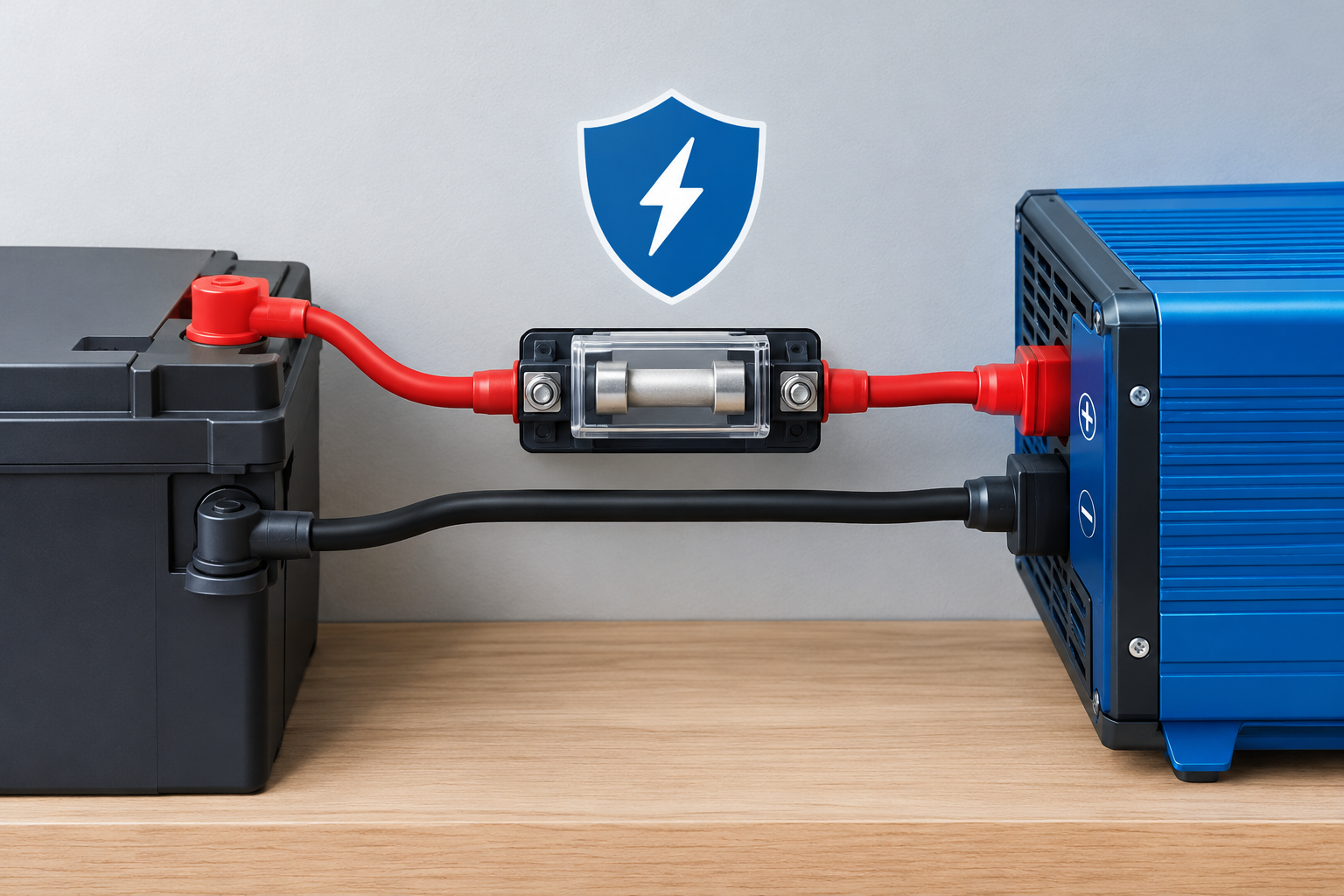
The battery fuse should generally be installed in the positive DC cable, as close to the battery's positive terminal as practical.
This positioning helps protect the cable along its length if a short circuit occurs between the battery and inverter.
A typical battery-to-inverter connection follows this arrangement:
-
Battery positive terminal.
-
DC-rated fuse and suitable fuse holder.
-
Positive cable connecting to the inverter.
-
Inverter positive terminal.
The negative cable connects the battery's negative terminal to the inverter's negative terminal according to the system manufacturer's wiring instructions.
The fuse holder and fuse must be suitable for the DC system voltage and the prospective fault current.
It is particularly important to select a fuse with an adequate DC interrupting rating. A fuse that is suitable for AC applications may not necessarily be suitable for a high-current DC battery circuit.
Always follow the inverter manufacturer's installation instructions and applicable electrical regulations.
What Happens When the Fuse Between a Battery and Inverter Blows?
When the fuse blows, it interrupts the electrical connection between the battery and inverter.
As a result, the inverter will usually shut down immediately because it can no longer receive power from the battery.
Any appliances connected to the inverter will also stop receiving electricity.
A blown fuse is not necessarily a sign that the fuse itself is defective. It may indicate an underlying electrical problem that needs attention.
Common reasons include:
1. Excessive Electrical Load
Connecting too many appliances to an inverter can cause it to exceed its rated capacity.
High-power appliances such as refrigerators, air conditioners, pumps, and power tools may also require significant starting current.
If the inverter or DC circuit experiences excessive current, the fuse may operate to protect the system.
2. Short Circuit
A short circuit in the battery cables, inverter connections, or connected equipment can produce extremely high current.
The fuse is designed to interrupt this current and reduce the risk of serious damage.
3. Damaged or Undersized Wiring
Damaged insulation, loose connections, incorrect cable sizing, and poor installation practices can contribute to electrical faults.
These problems should be investigated before replacing the fuse.
4. Internal Inverter Fault
An internal inverter failure can also cause excessive current and repeated fuse operation.
If the fuse blows again after replacement, the inverter should be inspected by a qualified technician.
Important: Never replace a blown fuse with one that has a higher current rating simply to prevent it from blowing again. Doing so may remove the intended protection and increase the risk of overheating or fire.
Always identify and correct the underlying problem before restoring power.
Can You Connect a Battery to an Inverter Without a Fuse?
Technically, an inverter may operate without an external fuse in certain circumstances, but this does not make the installation safe.
A battery can deliver very high short-circuit current. If a fault occurs in an unprotected cable, the resulting heat can damage the wiring and surrounding equipment.
Even if an inverter includes internal protection, this does not necessarily protect the entire battery cable between the battery and inverter.
An internal inverter fuse may protect the inverter itself, but an external battery fuse is needed to provide suitable protection for the connecting cable.
For this reason, a properly designed battery inverter installation should include appropriate external overcurrent protection.
Should You Use a DC Fuse or an AC Fuse Between a Battery and Inverter?
A battery supplies DC electricity, so the protective fuse installed in the battery-to-inverter circuit must be suitable for DC applications.
DC and AC electrical systems have different interruption characteristics.
In an AC circuit, the current naturally passes through zero during each cycle, helping an electrical arc extinguish.
DC current does not have the same natural zero-crossing characteristic. Consequently, interrupting high DC fault currents can be more challenging.
When selecting a battery fuse, check the following specifications:
-
DC voltage rating.
-
Current rating.
-
DC interrupting capacity.
-
Fuse operating characteristics.
-
Compatibility with the fuse holder.
-
Suitability for the battery chemistry and application.
Using an appropriately rated DC fuse helps ensure that the protective device can safely interrupt the current under the expected fault conditions.
How to Choose the Right Fuse for Your Battery and Inverter System
Selecting a suitable fuse requires more than matching the fuse's ampere rating to the inverter's power rating.
Follow these important steps:
Step 1: Check the inverter specifications
Find the inverter's recommended external fuse or circuit breaker rating, maximum DC input current, and battery voltage requirements.
Step 2: Calculate the expected DC current
Use the inverter power, battery voltage, and efficiency to estimate the operating current.
Step 3: Select the correct cable size
Choose cables that can safely carry the required current while maintaining acceptable voltage drop.
Step 4: Select a suitable fuse
Choose a fuse with an appropriate current rating, DC voltage rating, interrupting capacity, and time-current characteristic.
Ensure that its rating does not exceed the permissible protection level of the cable.
Step 5: Install the fuse correctly
Install the fuse in the positive battery cable, close to the battery, following the manufacturer's installation instructions.
Step 6: Inspect the installation
Check cable connections, terminal tightness, insulation, fuse holder compatibility, and overall installation quality before energising the system.
For larger battery installations and high-current inverter systems, professional electrical design and installation are strongly recommended.
Frequently Asked Questions (FAQs)
1. Do I Need a Fuse Between a Battery and an Inverter?
Yes. A suitably rated fuse should be installed between the battery and inverter to protect the connecting cables and electrical system against excessive current and short circuits.
2. What Happens If I Do Not Install a Fuse Between the Battery and Inverter?
Without appropriate overcurrent protection, a short circuit can cause extremely high current to flow through the battery cables. This can result in overheating, damaged insulation, equipment failure, and potentially an electrical fire.
3. What Size Fuse Do I Need for a 2,000W Inverter?
The correct fuse size depends on battery voltage, inverter efficiency, maximum DC input current, cable capacity, and manufacturer specifications.
For example, a 2,000W inverter operating at 90% efficiency draws approximately 185A from a nominal 12V battery. This is an operating-current estimate, not a recommended fuse rating.
4. Should the Fuse Be Installed on the Positive or Negative Battery Cable?
The battery fuse is generally installed in the positive DC cable, as close to the battery positive terminal as practical. Always follow the system manufacturer's wiring requirements and applicable electrical standards.
5. Can I Use a Circuit Breaker Instead of a Fuse?
Yes, a properly rated DC circuit breaker can provide overcurrent protection in a battery inverter system. However, it must have suitable DC voltage, current, and interrupting ratings for the application.
6. Why Does My Battery Inverter Fuse Keep Blowing?
Repeated fuse failures may indicate an overloaded inverter, short circuit, damaged wiring, incorrect fuse selection, or an internal inverter fault.
Investigate the underlying problem before installing a replacement fuse.
7. Does Every Inverter Have a Built-In Fuse?
Some inverters include internal fuses or electronic protection features, but these do not necessarily provide protection for the entire battery cable. External battery-side overcurrent protection may still be required.
Conclusion
Installing a fuse between a battery and an inverter is an essential part of designing a safe and reliable battery power system.
A correctly selected fuse helps protect battery cables and connected equipment against short circuits and excessive current. It also reduces the risk of overheating, electrical damage, and fire.
However, choosing the right fuse involves more than considering inverter wattage. Battery voltage, cable size, inverter efficiency, DC voltage rating, interrupting capacity, and manufacturer recommendations must all be taken into account.
Whether you are installing a small 12V inverter or a large 48V battery energy storage system, appropriate DC overcurrent protection should always be part of the electrical design.
Remember: The right fuse, correctly installed and coordinated with the cable, is a small but critical component of battery inverter safety.



