
 eaton-bussmann-series-high-speed-fuses-application-guide-br132015en-en-us.pdf  | [Eaton Bussmann series high speed fuses application guide] | 0 kB |
Can an AC Fuse Be Used for DC? Understanding the Key Differences
Introduction
Fuses are essential safety components in electrical systems. They protect circuits, equipment, and wiring from excessive current by interrupting the electrical supply when a fault occurs. However, not all fuses are designed for the same applications. One common question among electrical engineers, technicians, and equipment manufacturers is: Can an AC fuse be used for DC?
Although AC (Alternating Current) and DC (Direct Current) fuses may look similar, they have different electrical characteristics and interruption requirements. Using an AC fuse in a DC circuit without checking its specifications can create serious safety risks, including electrical arcing, overheating, and equipment damage.
In this article, we explain whether an AC fuse can be used for DC, the differences between AC and DC fuses, the potential risks, and how to select the right fuse for your application.
Can an AC Fuse Be Used for DC?
The short answer is: Sometimes, but only if the fuse is specifically rated or approved for the DC voltage and current conditions of the application.
An AC-rated fuse should not automatically be considered suitable for DC applications. The main reason is the difference in how alternating current and direct current behave when a fuse operates.
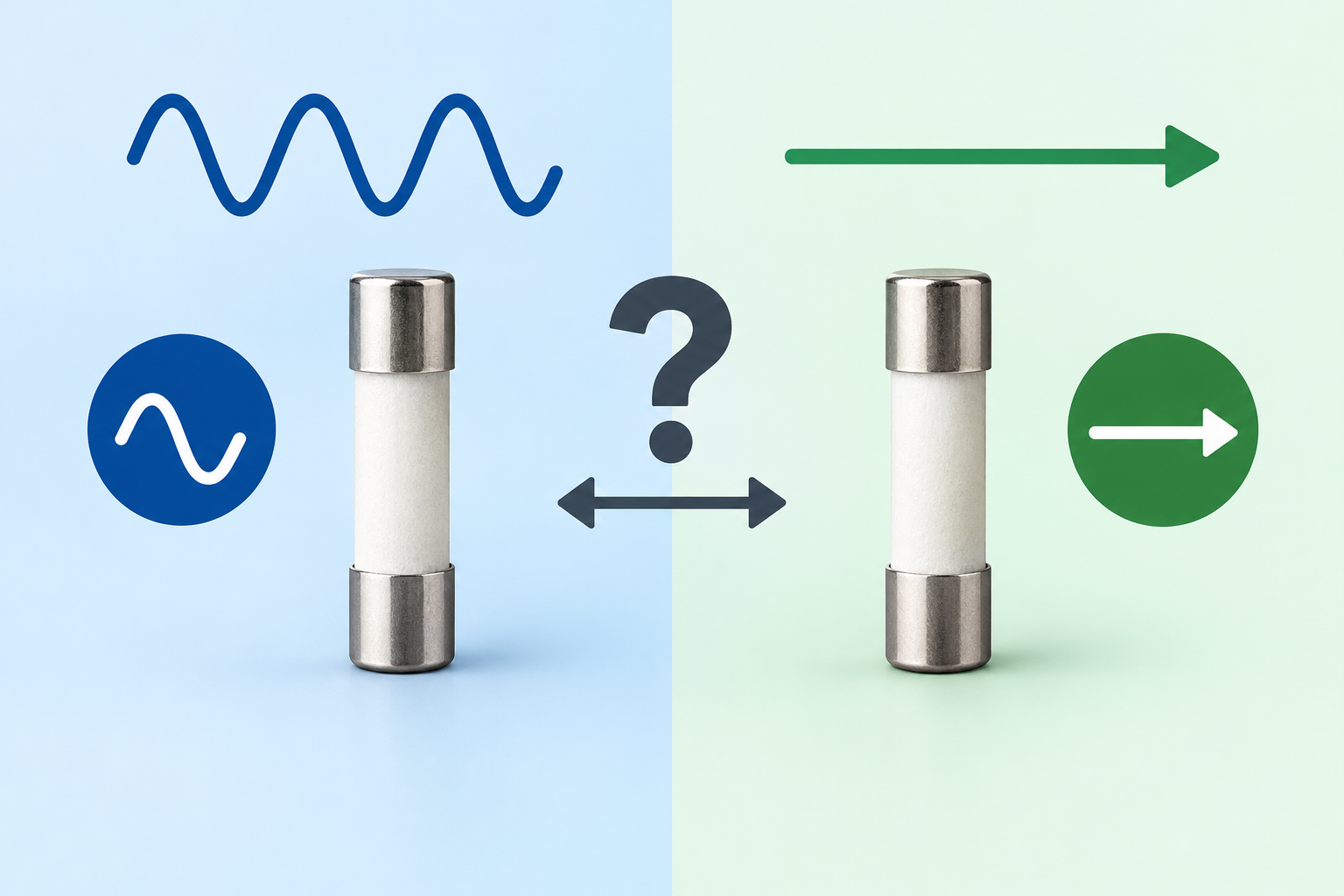
In an AC circuit, the current periodically changes direction and passes through zero. This natural zero-current point helps extinguish the electrical arc that forms when the fuse element melts.
In a DC circuit, the current flows continuously in one direction and does not naturally pass through zero. As a result, an electrical arc can continue after the fuse element melts, making it more difficult to interrupt the current safely.
Therefore, a fuse designed for AC may not be able to break a DC circuit effectively, even if its rated current appears suitable.
Important: An AC fuse can only be used in a DC circuit when its manufacturer provides an adequate DC voltage and breaking-capacity rating for the intended application.
What Is the Difference Between AC and DC Fuses?
The primary difference between AC and DC fuses is their ability to interrupt current and extinguish electrical arcs.
1. Current Characteristics
AC current periodically changes direction, typically following a sinusoidal waveform. It naturally reaches zero twice during each cycle, providing opportunities for an electrical arc to extinguish.
DC current flows in one direction with a relatively constant polarity. Because there is no natural zero crossing, the arc may continue for longer after the fuse element melts.
2. Arc Extinction
Arc extinction is one of the most important considerations in fuse design.
When a fuse operates, its internal element melts and creates a gap in the electrical circuit. An electrical arc may form across this gap.
-
AC fuse: The alternating current naturally reaches zero, helping the arc disappear.
-
DC fuse: The continuous current can sustain the arc, requiring the fuse to use suitable arc-quenching construction and design features.
DC fuses may incorporate longer interruption paths, specialised arc-quenching materials, or other design measures to extinguish the arc safely.
3. Voltage Rating
Voltage rating is another critical difference.
A fuse's AC voltage rating cannot automatically be applied to DC circuits. The fuse must have a specified DC voltage rating that meets or exceeds the maximum operating voltage of the circuit.
For example, a fuse rated for 250 V AC is not necessarily suitable for a 250 V DC application. Its DC interruption capability may be significantly different.
4. Breaking Capacity
Breaking capacity, also known as interrupting rating, refers to the maximum fault current a fuse can safely interrupt at a specified voltage and under specified test conditions.
Because DC arcs are more difficult to extinguish, a fuse's DC breaking capacity may differ substantially from its AC breaking capacity.
Always check the relevant DC breaking-capacity specification rather than relying on the AC rating.
What Happens If You Use an AC Fuse in a DC Circuit?
Using an AC fuse in a DC application without confirming its DC rating can lead to several potential problems.
1. Persistent Electrical Arcing
The most significant risk is an electrical arc that continues after the fuse element melts. Unlike AC, DC has no natural current zero crossing to help extinguish the arc.
A persistent arc can prevent the circuit from being safely disconnected.
2. Overheating and Fire Hazards
If the fuse cannot interrupt the fault current effectively, the resulting heat and electrical energy may damage surrounding components, wiring, and insulation. In severe cases, this can create a fire hazard.
3. Equipment Damage
An improperly selected fuse may fail to provide the expected protection during an overload or short circuit. Sensitive electrical equipment, power supplies, batteries, and other connected components may consequently be exposed to dangerous fault conditions.
4. Fuse Failure
A fuse that is unsuitable for DC interruption may not operate as intended. Its element may melt, but the electrical arc can continue conducting current.
This defeats the main purpose of the fuse: safely interrupting an abnormal current condition.
Can a DC Fuse Be Used for AC?
In many cases, a DC-rated fuse may also be suitable for AC applications, but this must not be assumed.
The fuse must have an appropriate AC voltage rating, current rating, and breaking capacity for the circuit.
A fuse designed for high-voltage DC interruption may have construction features that also support AC applications. However, the manufacturer's specifications and applicable approvals must always be checked.
The key principle is that a fuse must be suitable for the actual electrical conditions, regardless of whether it is installed in an AC or DC circuit.
How to Choose the Right Fuse for a DC Application
Selecting the correct DC fuse is essential for reliable electrical protection. Several technical parameters should be considered before installation.
1. Check the DC Voltage Rating
The fuse's DC voltage rating must be equal to or higher than the maximum voltage that can occur in the circuit.
Consider the maximum system voltage rather than only its nominal operating voltage. This is particularly important in battery systems and solar photovoltaic installations, where operating conditions can affect the actual voltage.
2. Determine the Rated Current
The rated current should be selected according to the circuit's normal operating current, conductor capacity, equipment requirements, and applicable electrical standards.
A fuse with an excessively low current rating may operate unnecessarily, while one with an excessively high rating may not provide adequate protection.
3. Verify the Breaking Capacity
The breaking capacity must be sufficient to interrupt the maximum prospective short-circuit current at the specified DC voltage.
This is especially important in battery energy storage systems because batteries can deliver very high fault currents.
4. Consider the Time-Current Characteristics
Time-current characteristics describe how quickly a fuse operates at different current levels.
Different applications require different protection responses. For example, circuits with high starting currents may need a fuse with suitable time-delay characteristics to avoid unnecessary operation.
The selected fuse should coordinate with the protected equipment and other protective devices.
5. Check the Operating Environment
Temperature, humidity, vibration, installation conditions, and enclosure design can influence fuse performance.
For applications involving high temperatures or demanding operating conditions, derating requirements and manufacturer recommendations should be considered.
6. Confirm Applicable Standards
Always verify that the fuse meets the relevant safety and performance standards for its intended application.
Depending on the application, this may include IEC or UL requirements. Product certification, test reports, and technical datasheets should also be reviewed.
Common Applications of DC Fuses
DC fuses are widely used in electrical systems where reliable overcurrent protection is essential.
Some common applications include:
Solar Photovoltaic Systems
Solar panels generate DC electricity. DC-rated photovoltaic fuses help protect solar strings, combiner boxes, and other components against overcurrent and short-circuit faults.
Battery Energy Storage Systems
Battery systems can deliver substantial fault currents. Properly selected DC fuses help protect battery modules, connections, and associated power conversion equipment.
Electric Vehicles
Electric vehicles use high-voltage DC battery systems. Specialised automotive DC fuses provide protection for battery packs, power distribution systems, and electrical components.
Industrial DC Power Systems
Industrial equipment, DC power supplies, control systems, and telecommunications infrastructure may require dedicated DC fuse protection.
Energy Conversion Equipment
Inverters, converters, and other power electronic devices often contain DC circuits that require suitable overcurrent protection.
Frequently Asked Questions (FAQs)
1. Can I use a 250V AC fuse for 12V DC?
It may be possible if the fuse has an adequate DC voltage rating and breaking capacity for the application. However, an AC rating of 250V alone does not confirm its suitability for DC. Always check the manufacturer's datasheet.
2. Why are DC fuses more difficult to design than AC fuses?
DC fuses must interrupt continuous current without relying on natural current zero crossings. This makes arc extinction more challenging, particularly at higher voltages and fault currents. Therefore, DC fuse designs may require specialised arc-quenching structures and materials.
3. Are AC and DC fuses interchangeable?
No, not automatically. Some fuses have both AC and DC ratings, but others are designed and tested for only one type of current. Always verify the voltage rating, breaking capacity, and manufacturer's specifications before substitution.
4. Does a fuse's current rating change between AC and DC?
The rated current is primarily related to the fuse element's thermal behaviour and is not automatically different simply because the circuit uses AC or DC. However, operating conditions, frequency, waveform, and fuse design can affect performance. The manufacturer's specified ratings should always be followed.
5. What is the main advantage of using a DC-rated fuse?
A DC-rated fuse is specifically designed and tested to interrupt direct current safely under its stated operating conditions. It provides suitable arc-extinguishing performance and helps protect electrical equipment from overloads and short circuits.
6. Can a higher-rated AC fuse replace a lower-rated DC fuse?
Not necessarily. A higher AC voltage or current rating does not guarantee adequate DC interruption capability. Selecting a replacement based only on its current rating can create serious safety risks.
Conclusion
So, can an AC fuse be used for DC? The answer depends on its design, voltage rating, and breaking capacity.
Although AC and DC fuses perform the same basic function of protecting electrical circuits against excessive current, their interruption requirements are different. The absence of natural current zero crossings in DC systems makes arc extinction more challenging, particularly at higher voltages.
An AC fuse should never be used in a DC application simply because its current rating matches the circuit requirements. Always verify the manufacturer's DC voltage rating, breaking capacity, time-current characteristics, and relevant safety certifications.
Choosing the correct fuse is essential for protecting electrical equipment, improving system reliability, and maintaining electrical safety.



