
 eaton-bussmann-series-photovoltaic-fuses-catalogue-ca135004en.pdf  | [Eaton Bussmann PV Fuses] | 0 kB |
How Do Photovoltaic Fuses Work With Other Protection Components in a Solar System?
Introduction
Solar energy systems rely on several electrical components working together to generate, convert, and distribute electricity safely and efficiently. While solar panels and inverters receive much of the attention, electrical protection components play an equally important role in ensuring system reliability, preventing equipment damage, and reducing potential fire hazards.
Among these components, photovoltaic (PV) fuses are essential for protecting solar installations against overcurrent conditions, short circuits, and reverse current faults. However, a photovoltaic fuse does not operate independently. It works alongside other protection devices, including circuit breakers, surge protection devices (SPDs), DC isolator switches, and grounding systems.
Each protection component performs a specific function, and their coordinated operation creates a comprehensive electrical safety system.
Understanding how photovoltaic fuses work with other protection components helps solar installers, electrical engineers, system designers, and solar energy professionals make better decisions when designing and maintaining photovoltaic installations.
This article explores the role of PV fuses, their interaction with other solar protection components, and why proper coordination is essential for long-term system performance.
1. What Are Photovoltaic Fuses and Why Are They Important?
Photovoltaic fuses are specialised electrical protection devices designed specifically for the direct current (DC) characteristics of solar power systems.
Unlike conventional electrical fuses, PV fuses are engineered to operate under the unique conditions of photovoltaic installations, including high DC voltages, continuous current generation, and potentially persistent electrical arcs.
Their primary function is to interrupt excessive current when an electrical fault occurs.
In a typical solar installation, multiple solar panels are connected in series to form strings. Several strings may then be connected in parallel to increase the overall current output.
When one string experiences a short circuit or another electrical fault, current from the healthy parallel strings may flow back into the damaged string. This reverse current can exceed the safe operating limits of solar modules, cables, and connectors.
A properly selected photovoltaic fuse detects this excessive current and interrupts the affected circuit before significant damage occurs.
Key Functions of Photovoltaic Fuses
PV fuses provide several important protective functions:
-
Overcurrent protection: Interrupt excessive current before cables and electrical components overheat.
-
Short-circuit protection: Disconnect faulty circuits when dangerous short-circuit currents occur.
-
Reverse current protection: Prevent excessive backfeed current from healthy parallel strings into a faulted string.
-
Equipment protection: Help protect solar modules, wiring, connectors, and other electrical components.
-
Fire prevention: Reduce the risk of overheating and electrical fires caused by sustained fault currents.
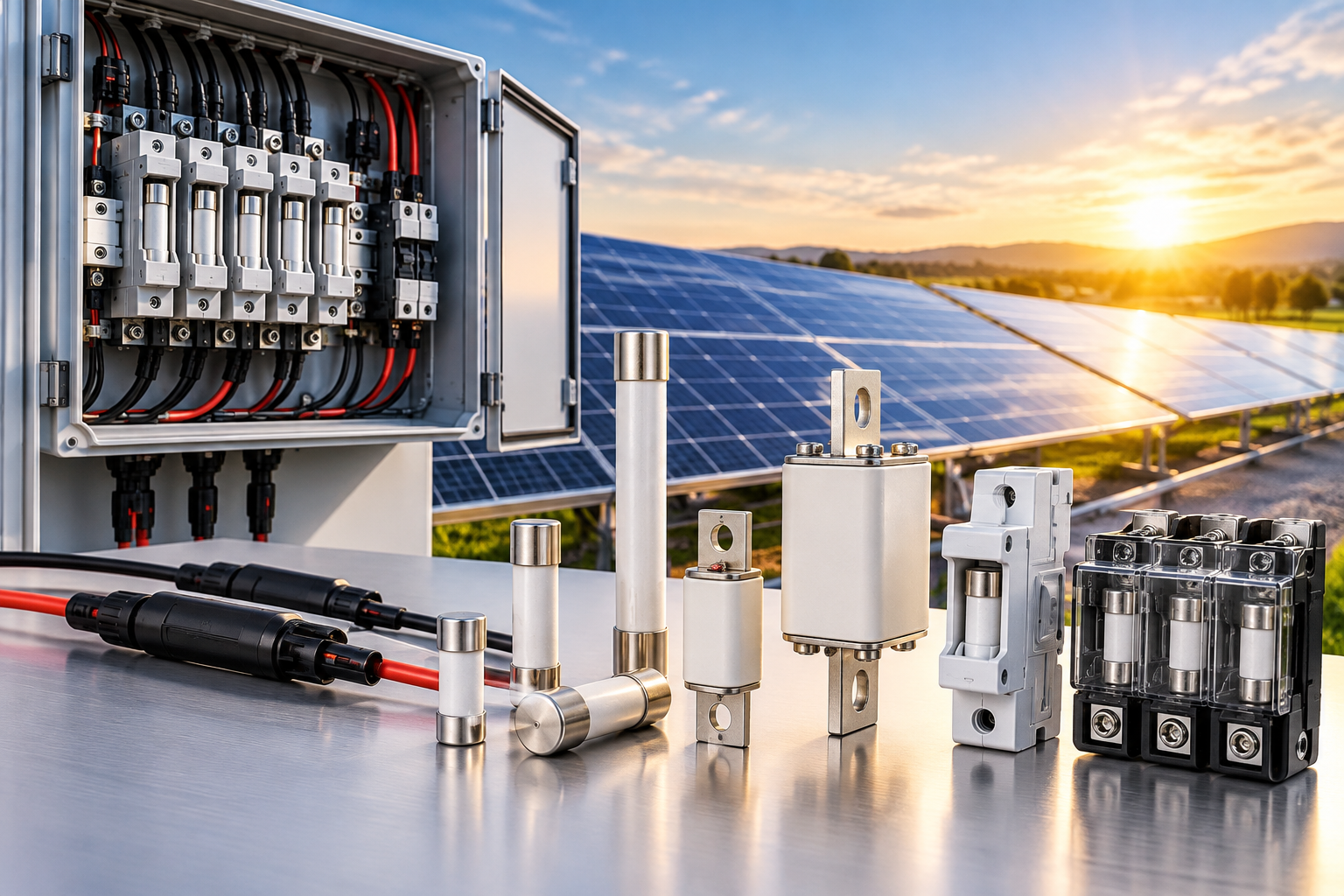
Photovoltaic fuses are commonly installed in string combiner boxes, DC distribution enclosures, and other designated protection points.
For reliable operation, they must be specifically rated for photovoltaic applications and selected according to the system's maximum DC voltage, operating current, and expected fault conditions.
2. How Do PV Fuses Work With Solar Circuit Breakers?
Circuit breakers and photovoltaic fuses are both overcurrent protection devices. However, they operate differently and often serve different purposes within a solar installation.
A PV fuse contains a calibrated metal element that melts when excessive current flows through it for a sufficient period. Once the element melts, the electrical circuit is interrupted.
A circuit breaker, on the other hand, uses a mechanical switching mechanism to disconnect a circuit when an overcurrent or short-circuit condition is detected.
Depending on its design, a circuit breaker may use thermal and magnetic tripping mechanisms.
How They Work Together
In a solar power system, photovoltaic fuses typically provide individual string-level protection, while circuit breakers can protect larger distribution circuits and downstream electrical equipment.
For example:
-
PV fuses protect individual solar strings against excessive reverse current.
-
DC circuit breakers provide overcurrent protection for designated DC distribution circuits.
-
AC circuit breakers protect inverter output circuits and downstream AC distribution systems.
This arrangement creates multiple layers of protection throughout the installation.
If an individual solar string develops a fault, its associated fuse can disconnect that string without necessarily interrupting the operation of the entire solar array.
Meanwhile, a correctly selected upstream circuit breaker provides additional protection for the larger circuit it serves.
Why Proper Coordination Matters
The relationship between PV fuses and circuit breakers is particularly important when designing a selective protection system.
Protection coordination, also known as selectivity or discrimination, aims to ensure that the protective device closest to a fault operates first whenever the system design and available fault current permit.
Without proper coordination, an upstream protective device may trip unnecessarily, disconnecting a larger portion of the solar installation.
This can increase system downtime and reduce energy production.
Therefore, fuse ratings, circuit breaker characteristics, interrupting capacities, and conductor specifications must be evaluated together.
3. How Do Photovoltaic Fuses Work With Surge Protection Devices?
Surge protection devices (SPDs) provide another essential layer of protection in photovoltaic installations.
While PV fuses primarily protect against excessive current, surge protection devices are designed to protect electrical equipment against transient overvoltages.
These voltage surges may result from:
-
Nearby or direct lightning activity.
-
Switching operations in electrical networks.
-
Sudden voltage disturbances.
-
Electromagnetic interference associated with lightning events.
Excessive transient voltage can damage sensitive solar equipment, including inverters, monitoring systems, and other electronic components.
Understanding the Different Protection Functions
PV fuses and surge protection devices address different electrical risks.
A photovoltaic fuse responds to excessive current by interrupting the circuit.
An SPD responds to transient overvoltage by temporarily providing a low-impedance path for surge current, diverting it away from sensitive equipment toward the appropriate protective earthing system.
Once the surge has passed, the SPD returns to its normal operating condition if it has not reached the end of its service life or failed.
How They Work Together
In a typical photovoltaic installation, DC surge protection devices are installed at appropriate points between the solar array and inverter.
The SPD limits transient overvoltages, while PV fuses provide overcurrent protection for the relevant DC circuits.
Some surge protection devices also incorporate or require dedicated backup overcurrent protection.
In such cases, the backup fuse or circuit breaker must be selected according to the SPD manufacturer's specifications and the installation's electrical characteristics.
This coordination is important because an SPD can experience a failure condition that results in a sustained short circuit.
The associated protective device must be capable of safely disconnecting the failed SPD under the specified conditions.
Important: Standard PV string fuses should not automatically be considered substitutes for the dedicated backup protection required by a surge protection device.
Both components must be selected according to their intended functions.
4. How Do PV Fuses Work With DC Isolator Switches?
DC isolator switches are essential safety components in photovoltaic installations.
Their primary purpose is to provide a means of disconnecting electrical circuits during maintenance, inspection, troubleshooting, or emergency procedures.
Solar panels continue generating electricity whenever they receive sufficient sunlight. Consequently, disconnecting the AC supply does not automatically eliminate the DC voltage generated by the solar array.
A properly rated DC isolator allows authorised personnel to separate designated sections of the solar installation safely.
Differences Between PV Fuses and DC Isolators
Although both components can interrupt electrical circuits, their functions are different.
Photovoltaic fuses:
-
Automatically interrupt circuits when excessive current occurs.
-
Protect against specified overcurrent and short-circuit conditions.
-
Operate without manual intervention.
-
Must be replaced after operation.
DC isolator switches:
-
Provide manual electrical disconnection.
-
Allow designated circuits to be isolated for maintenance.
-
Can be operated by authorised personnel.
-
Must have suitable DC voltage, current, and load-breaking ratings for their intended application.
How They Complement Each Other
Consider a solar installation with several parallel PV strings.
Individual string fuses protect the strings against excessive reverse current. A DC isolator provides a means of disconnecting the relevant section of the array from the inverter.
If a string develops an electrical fault, its fuse can interrupt the faulty circuit automatically.
If maintenance is subsequently required, the appropriate DC isolator can be operated according to the system's safe isolation procedure.
Together, these components provide automatic fault protection and controlled electrical disconnection.
It is important to understand that a DC isolator is not necessarily an overcurrent protection device. It should not replace a properly rated photovoltaic fuse or DC circuit breaker.
5. How Do Photovoltaic Fuses Work With Grounding and Earthing Systems?
Grounding, also known as earthing, is another important element of solar electrical protection.
Its purpose is to provide an appropriate protective connection for exposed conductive parts and help control dangerous touch voltages under fault conditions.
In photovoltaic installations, grounding and bonding arrangements may include:
-
Solar panel frames.
-
Mounting structures.
-
Inverter enclosures.
-
Metallic cable enclosures.
-
Electrical distribution equipment.
These conductive parts are connected to the protective earthing system as required by the applicable electrical installation standards.
The Relationship Between PV Fuses and Grounding
PV fuses and grounding systems perform complementary functions.
Grounding provides a protective electrical path under specified fault conditions, while fuses interrupt excessive current when the circuit conditions cause them to operate.
For example, if insulation damage causes an electrical conductor to contact an exposed metallic enclosure, the grounding system helps establish a fault-current path.
Depending on the system configuration and fault characteristics, an appropriate protective device may then disconnect the affected circuit.
However, not every ground fault will produce enough current to operate a conventional fuse. This is particularly important in certain ungrounded or high-resistance photovoltaic systems.
Therefore, grounding must be combined with appropriate fault detection, insulation monitoring, and overcurrent protection where required.
Grounded and Ungrounded PV Systems
The arrangement of photovoltaic fuses depends partly on the grounding configuration.
In certain grounded systems, overcurrent protection is generally applied to ungrounded conductors, subject to applicable exceptions and installation requirements.
In ungrounded systems, both DC conductors may require overcurrent protection.
The correct arrangement must be determined according to the system design and relevant electrical standards.
6. How Do PV Fuses Work With Solar Inverters?
Solar inverters convert the DC electricity generated by photovoltaic modules into alternating current (AC) for use in buildings or connection to the electrical grid.
As one of the most important components in a solar power system, the inverter requires suitable protection on both its DC input and AC output sides.
DC-Side Protection
On the DC side, photovoltaic fuses protect designated string circuits against excessive current.
Additional protective components may include:
-
DC circuit breakers.
-
DC isolator switches.
-
DC surge protection devices.
-
Insulation monitoring and fault detection systems.
These components help protect the electrical connection between the solar array and inverter.
AC-Side Protection
After the inverter converts DC electricity into AC electricity, a different set of protective devices is used.
These may include:
-
AC circuit breakers.
-
Residual current devices (RCDs), where required.
-
AC surge protection devices.
-
Protective earthing and bonding systems.
Each device addresses a specific electrical hazard.
For example, AC circuit breakers provide overcurrent protection for the relevant AC circuits, while appropriately selected RCDs provide additional protection against residual currents.
AC surge protection devices help protect equipment against transient overvoltages on the AC network.
Why DC and AC Protection Must Be Coordinated
DC and AC electrical circuits have different operating characteristics.
DC current does not naturally pass through zero as AC current does. Consequently, interrupting a DC fault current can be more challenging because electrical arcs may persist.
For this reason, photovoltaic fuses, DC circuit breakers, and DC isolators must have ratings specifically suitable for their intended DC applications.
Using an AC-rated protective device in a DC circuit without an appropriate DC rating can create serious safety risks.
7. The Role of PV Fuses in Solar Combiner Boxes
A solar combiner box is an electrical enclosure that brings together multiple photovoltaic string circuits before connecting them to downstream equipment.
It is one of the most common locations for photovoltaic overcurrent protection.
In larger solar installations, several strings are connected in parallel. Their combined output is then directed toward an inverter or another distribution stage.
Why Are PV Fuses Installed in Combiner Boxes?
When multiple strings operate in parallel, healthy strings can contribute reverse current to a faulty string.
This current may exceed the maximum current that the damaged string or its components can safely withstand.
String fuses help prevent this condition by disconnecting the affected circuit when the specified overcurrent threshold and operating time are reached.
A typical solar combiner box may contain:
-
PV string fuses and fuse holders.
-
DC surge protection devices.
-
DC disconnect switches.
-
Output terminals and distribution connections.
-
Monitoring or measurement equipment.
The exact configuration depends on the system's size, design, and protection requirements.
How Multiple Protection Components Work Together
Consider a solar installation containing several parallel photovoltaic strings.
Each string has an appropriately rated fuse.
The strings connect to a combiner box, where their electrical outputs are combined.
A surge protection device helps limit transient overvoltages, while an appropriately rated DC isolator provides a means of disconnecting the combined circuit.
A downstream DC circuit breaker or other protective device may provide additional protection for the output circuit, depending on the installation design.
If one string develops a fault, its fuse can isolate the affected circuit while the remaining strings continue operating, provided no other protection or control condition requires a wider shutdown.
This arrangement improves fault containment and can reduce unnecessary system interruptions.
8. Why Is Proper Coordination Between Solar Protection Components Important?
A reliable photovoltaic installation requires more than simply installing individual protective devices.
Each component must be selected and coordinated according to the electrical characteristics of the system.
Poor coordination can result in inadequate fault protection, unnecessary disconnections, equipment damage, and potential safety hazards.
Several factors must be considered during system design.
1. Correct Voltage Ratings
PV fuses, circuit breakers, isolators, and surge protection devices must have suitable voltage ratings.
The maximum possible PV array voltage must be calculated by considering the modules' open-circuit voltage and the effect of the lowest expected operating temperature.
The protective device must be suitable for the resulting maximum system voltage.
2. Correct Current Ratings
Fuse selection must account for the maximum expected PV circuit current, applicable design factors, and the maximum series fuse rating specified for the modules.
An undersized fuse may operate unnecessarily during normal conditions.
An oversized fuse may fail to provide adequate protection.
3. Breaking Capacity
The breaking capacity of a fuse or circuit breaker must be sufficient to interrupt the maximum prospective fault current under the specified operating conditions.
This is particularly important in DC photovoltaic systems, where electrical arcs can be difficult to extinguish.
4. Selective Coordination
Protective devices should be coordinated so that the device closest to the fault operates first whenever practicable.
This helps minimise unnecessary shutdowns and improves system availability.
5. Environmental Conditions
Solar installations are frequently exposed to high temperatures, humidity, dust, vibration, and changing weather conditions.
Protection components must be suitable for their installation environment.
Fuse holders and enclosures should also provide appropriate protection against environmental exposure.
6. Compliance With Applicable Standards
PV protection components must meet the relevant electrical safety and performance standards.
Depending on the installation and jurisdiction, important standards may include:
-
IEC 60269-6 for fuse-links used in photovoltaic energy systems.
-
IEC 62548-1 for photovoltaic array design requirements.
-
IEC 61643-31 for surge protective devices used on the DC side of photovoltaic installations.
-
IEC 60364 for low-voltage electrical installations.
Compliance should always be assessed against the latest applicable editions and national requirements.
9. Common Mistakes When Selecting and Installing PV Protection Components
Even high-quality protection components may fail to provide adequate protection if they are incorrectly selected or installed.
Some common mistakes include:
Using conventional fuses instead of PV-rated fuses
Photovoltaic circuits have specific DC voltage and current characteristics. Conventional fuses may not provide the required performance under PV operating conditions.
Selecting incorrect fuse ratings
Fuse ratings must be coordinated with module specifications, string current, cable ampacity, and maximum system voltage.
Ignoring reverse current protection
In parallel-connected solar strings, reverse current can damage modules and associated wiring if appropriate protection is not provided.
Using AC-rated devices in DC circuits
AC and DC circuits have different interruption characteristics. Protective devices must be rated for their intended application.
Ignoring SPD backup protection requirements
Surge protection devices may require dedicated backup overcurrent protection. Failing to provide the specified protection can compromise system safety.
Neglecting regular inspections
Loose connections, damaged insulation, corrosion, overheating, and deteriorated protective devices can reduce the effectiveness of the entire protection system.
Regular inspection and maintenance help identify potential problems before they develop into serious electrical faults.
10. Best Practices for Designing a Reliable Solar Protection System
A properly designed solar protection system should provide coordinated protection throughout the entire electrical installation.
The following practices can help improve overall safety and reliability:
-
Calculate system voltage and current accurately: Consider the maximum PV open-circuit voltage, short-circuit current, temperature variations, and number of parallel strings.
-
Use dedicated photovoltaic fuses: Select fuse-links designed for PV applications and suitable for the system's DC voltage and current requirements.
-
Install appropriate surge protection: Evaluate lightning exposure, cable lengths, installation characteristics, and equipment requirements when selecting DC and AC SPDs.
-
Provide suitable DC isolation: Ensure that designated PV circuits can be safely disconnected for maintenance and emergency procedures.
-
Coordinate circuit breakers and fuses: Check operating characteristics, breaking capacities, and selectivity between protective devices.
-
Implement proper grounding and bonding: Ensure exposed conductive parts are connected according to the applicable electrical installation requirements.
-
Follow manufacturer specifications: Observe installation instructions, operating limits, and backup protection requirements for every component.
-
Schedule regular maintenance: Inspect fuses, holders, electrical connections, enclosures, and other protection components for signs of deterioration or damage.
These practices help create a comprehensive protection strategy that supports safe operation and long-term solar system performance.
Conclusion
Photovoltaic fuses play a critical role in protecting solar power systems against overcurrent conditions, short circuits, and reverse current faults. However, their effectiveness depends on how well they work alongside other electrical protection components.
Circuit breakers provide additional overcurrent protection, surge protection devices help control transient overvoltages, DC isolators enable safe disconnection, and grounding systems help manage electrical fault conditions.
Solar inverters also require coordinated protection on both their DC input and AC output sides.
When these components are correctly selected, rated, and installed, they create multiple layers of electrical protection that help prevent equipment damage, improve system reliability, and reduce safety risks.
Ultimately, photovoltaic system protection should be approached as an integrated engineering process rather than a collection of independent devices. Proper coordination between PV fuses and other protection components is essential for building a safe, efficient, and dependable solar energy installation.
Frequently Asked Questions (FAQs)
1. What is the main function of a photovoltaic fuse in a solar system?
The primary function of a photovoltaic fuse is to protect designated DC circuits against excessive current. It interrupts the circuit when current exceeds its specified operating characteristics, helping prevent damage to solar modules, cables, and other electrical components.
2. Do solar panels need fuses?
Not every photovoltaic installation requires individual string fuses. Their necessity depends on the number of parallel strings, potential reverse current, module specifications, conductor ratings, and applicable electrical standards. Multiple parallel strings commonly require string-level overcurrent protection.
3. What is the difference between a PV fuse and a DC circuit breaker?
A PV fuse uses a metal element that melts when excessive current flows through it. A DC circuit breaker uses a mechanical switching mechanism to interrupt an overcurrent condition. Fuses must generally be replaced after operation, whereas suitable circuit breakers can normally be reset after the fault has been investigated and resolved.
4. Can a photovoltaic fuse protect against lightning?
A PV fuse is not designed to provide primary lightning or transient overvoltage protection. Surge protection devices are specifically designed to limit transient overvoltages and divert surge currents away from sensitive equipment.
5. Why are PV fuses installed in solar combiner boxes?
PV fuses are commonly installed in combiner boxes to protect individual parallel-connected strings. They help prevent excessive reverse current from healthy strings flowing into a faulty string.
6. Do PV fuses work with surge protection devices?
Yes. PV fuses and surge protection devices provide complementary protection. Fuses protect against overcurrent, while SPDs limit transient overvoltages. Depending on the SPD design, dedicated backup overcurrent protection may also be necessary.
7. What standards apply to photovoltaic fuses?
IEC 60269-6 is an important international standard covering fuse-links for photovoltaic energy systems. Fuse selection and installation must also comply with applicable PV system design requirements and local electrical regulations.
8. How often should solar protection components be inspected?
Inspection frequency depends on the installation environment, system design, operating conditions, and applicable maintenance requirements. Periodic professional inspections should check fuse holders, connections, isolators, surge protection devices, grounding connections, and other electrical components for damage or deterioration.



