
 eaton-bussmann-series-photovoltaic-fuses-catalogue-ca135004en.pdf  | [Eaton Bussmann PV Fuses] | 0 kB |
What Is the Difference Between an Ordinary Fuse and a Photovoltaic Fuse?
Fuses play an essential role in electrical safety by protecting circuits and equipment from overcurrent and short-circuit faults. They are designed to interrupt the flow of electricity when the current exceeds a specified limit, helping prevent equipment damage, overheating, and potential fire hazards.
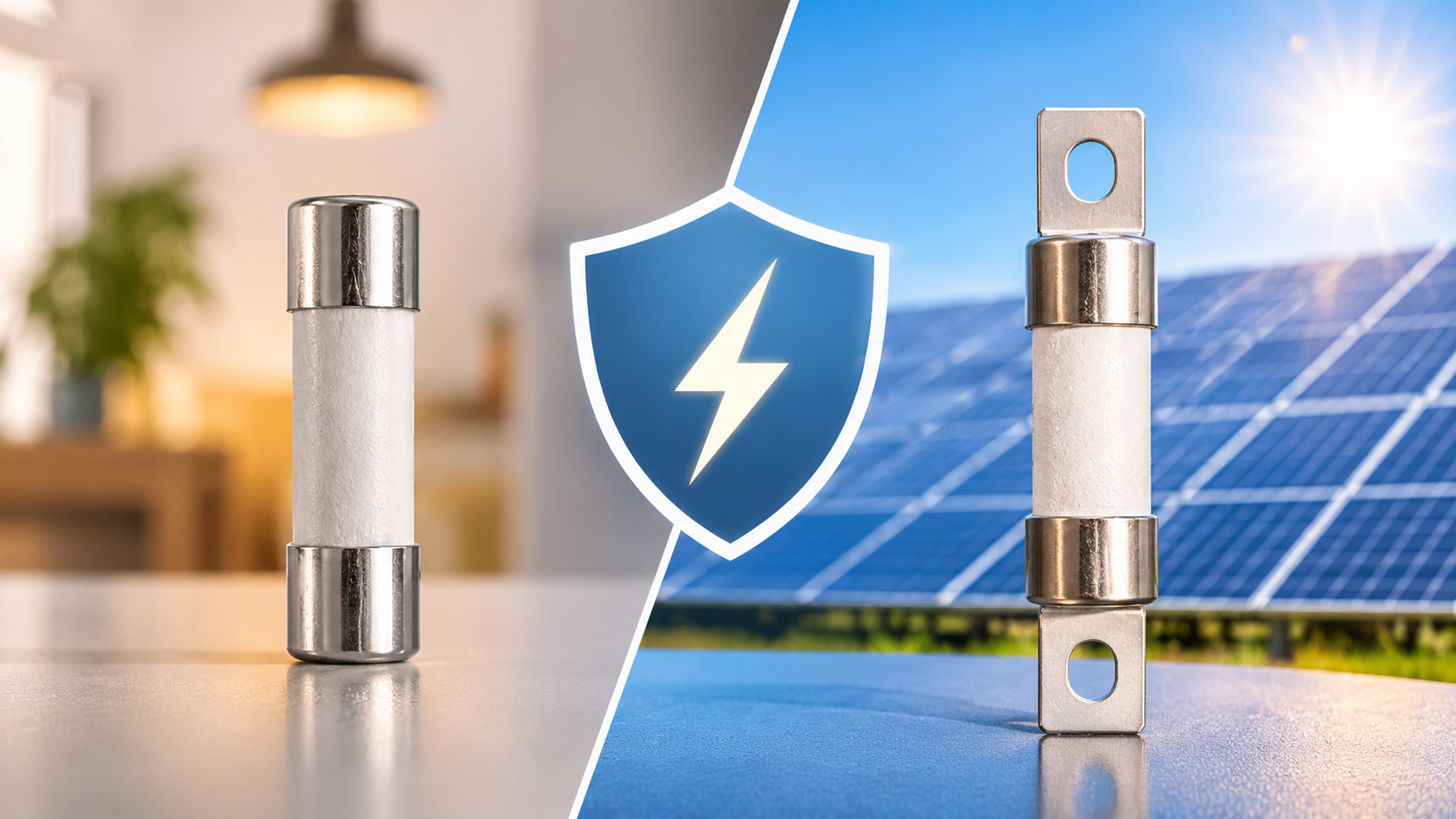
However, not all fuses are suitable for every electrical application. Ordinary fuses and photovoltaic (PV) fuses may perform the same basic function, but they differ significantly in their design, electrical ratings, breaking capacity, and application requirements.
With the growing adoption of solar energy, photovoltaic fuses have become increasingly important for protecting solar power generation systems. Understanding the difference between an ordinary fuse and a photovoltaic fuse is essential when selecting the right protection device.
In this article, we will explore their working principles, technical characteristics, applications, and key differences to help you make an informed decision.
1. What Is an Ordinary Fuse?
An ordinary fuse is a basic electrical protection device designed to protect electrical circuits against excessive current caused by overloads or short circuits.
It typically consists of a metal fuse element enclosed in a protective housing. When the current flowing through the fuse exceeds its rated capacity for a sufficient period, the fuse element heats up and melts, interrupting the electrical circuit.
Ordinary fuses are commonly used in residential, commercial, and industrial electrical systems.
Main Applications of Ordinary Fuses
Ordinary fuses are widely used in:
-
Household electrical appliances.
-
Lighting and distribution circuits.
-
Computers and electronic equipment.
-
Industrial control panels.
-
General-purpose power supply systems.
-
Automotive electrical circuits.
Main Characteristics of Ordinary Fuses
1. General-Purpose Circuit Protection
Ordinary fuses are designed to protect conventional electrical circuits against overloads and short circuits.
2. Different Voltage and Current Ratings
They are available in various current and voltage ratings to accommodate different electrical applications. The appropriate rating depends on the circuit requirements.
3. AC and DC Applications
Some ordinary fuses are designed for AC applications, while others are specifically rated for DC circuits. Their suitability depends on the manufacturer's specified voltage and breaking-capacity ratings.
4. Simple Operating Principle
Ordinary fuses operate through the melting of a fuse element when excessive current generates enough heat. Once the element melts, the circuit is interrupted.
2. What Is a Photovoltaic Fuse?
A photovoltaic fuse, also known as a solar PV fuse, is a specialised electrical protection device designed specifically for photovoltaic power generation systems.
Solar power systems have unique electrical characteristics, particularly on the DC side. Unlike conventional AC systems, photovoltaic arrays generate direct current, which presents additional challenges when interrupting fault currents.
For example, DC current does not naturally pass through zero as AC current does. This makes extinguishing an electrical arc more challenging when a fuse operates.
Photovoltaic fuses are therefore designed and tested to provide reliable protection under the operating conditions of solar power systems.
They are commonly installed in solar combiner boxes, photovoltaic string circuits, and other DC protection equipment.
Main Applications of Photovoltaic Fuses
Photovoltaic fuses are primarily used in:
-
Solar photovoltaic panels and arrays.
-
PV string protection circuits.
-
Solar combiner boxes.
-
DC distribution systems.
-
Solar inverter input circuits.
-
Large-scale solar power plants.
-
Commercial and residential solar installations.
Main Characteristics of Photovoltaic Fuses
1. Designed for High-Voltage DC Applications
Photovoltaic fuses are specifically engineered for the voltage levels encountered in solar DC systems. Depending on the application, their rated voltage may reach 1000V DC or 1500V DC and higher.
2. Specialised DC Arc Extinguishing Capability
DC fault interruption is more challenging than AC fault interruption because DC circuits do not have a natural current zero crossing. PV fuses incorporate suitable internal construction and arc-quenching materials to interrupt DC fault currents safely.
3. High Breaking Capacity
Photovoltaic fuses are designed with an appropriate DC breaking capacity to interrupt specified fault currents without causing dangerous rupture or sustained arcing.
4. Protection Against Reverse Current
In photovoltaic arrays, parallel-connected strings can feed fault current into a damaged string. PV fuses help protect individual strings against excessive reverse current when correctly selected and installed.
5. Specialised Operating Characteristics
Photovoltaic fuses are designed to meet the specific protection requirements of solar installations, including their current-voltage characteristics and operating conditions.
3. What Is the Difference Between an Ordinary Fuse and a Photovoltaic Fuse?
Although ordinary fuses and photovoltaic fuses share the same basic purpose, their technical requirements and applications are different.
The following comparison highlights their main differences.
| Comparison Factor | Ordinary Fuse | Photovoltaic Fuse |
|---|---|---|
| Main Application | General electrical circuits | Solar photovoltaic systems |
| Operating Current | AC or DC, depending on the rating | Primarily DC applications on the PV side |
| Voltage Rating | Depends on the application | Designed for high-voltage PV circuits |
| Breaking Capacity | Depends on the fuse design and rating | Designed for specified PV DC fault conditions |
| Arc Extinguishing | Depends on AC/DC design | Specialised DC arc interruption capability |
| Protection Function | Overload and short-circuit protection | PV string overcurrent and reverse-current protection |
| Operating Environment | General electrical environments | Solar installations and associated equipment |
| Applicable Standards | Depends on fuse type and application | Includes photovoltaic-specific fuse requirements |
Let's examine the most important differences in greater detail.
3.1 Difference in Application Scenarios
The most obvious difference between an ordinary fuse and a photovoltaic fuse is their intended application.
Ordinary fuses are designed for general electrical protection. They are commonly installed in household appliances, electrical distribution systems, industrial equipment, and electronic devices.
Photovoltaic fuses, on the other hand, are specifically designed for solar power generation systems. They are typically installed in PV string circuits to protect solar modules, cables, and associated equipment against excessive fault currents.
Because solar systems have different electrical characteristics from conventional electrical circuits, they require specialised protection solutions.
3.2 Difference in Voltage and Current Ratings
Voltage and current ratings are two important factors when selecting an electrical fuse.
Ordinary fuses are available in a wide range of ratings. Their voltage ratings vary according to their intended applications and may include both AC and DC specifications.
Photovoltaic fuses are designed to operate at the relatively high DC voltages commonly found in solar installations.
Modern photovoltaic systems may operate at 1000V DC or 1500V DC, making appropriately rated PV protection devices essential.
It is important to understand that a fuse's rated voltage must be equal to or higher than the maximum circuit voltage under the applicable operating conditions.
The current rating must also be selected according to the PV system design, conductor capacity, and applicable electrical standards.
3.3 Difference in Breaking Capacity
Breaking capacity refers to the maximum fault current that a fuse can safely interrupt at its specified operating voltage.
This is particularly important in photovoltaic systems because multiple parallel-connected solar strings can contribute to reverse fault current.
An ordinary fuse may have a breaking capacity suitable for a conventional electrical circuit but insufficient for a particular high-voltage DC photovoltaic application.
Photovoltaic fuses are designed and tested for specified DC fault conditions, helping ensure safe interruption when a short circuit occurs.
When selecting a PV fuse, both its rated voltage and DC breaking capacity must be considered.
3.4 Difference in Arc Extinguishing Performance
Arc extinguishing is one of the most important technical differences between AC and DC fuse applications.
When an AC fuse interrupts current, the current naturally passes through zero during every cycle. This helps extinguish the electrical arc.
However, DC current does not have a natural zero crossing. Once an arc forms, it can continue to burn unless the fuse is specifically designed to interrupt it.
Photovoltaic fuses incorporate specialised internal structures and arc-quenching materials to help extinguish DC arcs.
This makes them suitable for the demanding interruption requirements of photovoltaic systems.
3.5 Difference in Protection Requirements
Ordinary fuses are generally selected to protect electrical circuits against overloads and short circuits.
Photovoltaic fuses have additional protection requirements because of the unique configuration of solar arrays.
For example, when several PV strings are connected in parallel, a fault in one string may allow current from the other strings to flow into the faulty circuit.
This reverse current can damage solar modules, cables, and other electrical components.
A properly selected photovoltaic fuse helps interrupt excessive reverse current and reduce the risk of equipment damage.
3.6 Difference in Standards and Testing Requirements
Ordinary fuses and photovoltaic fuses are subject to different standards depending on their applications.
General-purpose low-voltage fuses may be designed according to relevant parts of the IEC 60269 series or other applicable standards.
Photovoltaic fuses are covered by IEC 60269-6, which specifies supplementary requirements for fuse-links used to protect solar photovoltaic energy systems.
These requirements address important performance characteristics, including:
-
Rated voltage and current.
-
Breaking capacity.
-
Time-current characteristics.
-
Temperature-related performance.
-
Electrical safety and testing requirements.
Selecting a fuse that meets the appropriate standards helps ensure reliable protection and compatibility with the intended electrical system.
4. Can an Ordinary Fuse Be Used in a Solar Photovoltaic System?
This is one of the most frequently asked questions when designing or installing a solar power system.
The short answer is that an ordinary fuse should not automatically be considered a suitable replacement for a photovoltaic fuse.
Although some conventional fuses may have DC ratings, they are not necessarily designed or tested for the operating conditions of photovoltaic systems.
Before using any fuse in a solar installation, several important factors must be considered:
1. DC Voltage Rating
The fuse must have an appropriate DC voltage rating for the maximum possible system voltage.
2. Breaking Capacity
The fuse must be capable of safely interrupting the prospective fault current under the specified DC operating conditions.
3. Time-Current Characteristics
The fuse must provide suitable protection without unnecessary operation during normal system conditions.
4. Temperature Performance
Solar installations may experience high ambient temperatures. Fuse performance and current-carrying capacity must be evaluated under actual operating conditions.
5. Compliance with Applicable Standards
The fuse should meet the relevant photovoltaic protection requirements and be compatible with the system design.
For these reasons, using a photovoltaic-rated fuse is generally the appropriate choice for PV string protection.
5. How to Choose the Right Photovoltaic Fuse?
Selecting the correct photovoltaic fuse is essential for ensuring the safety and reliability of a solar power generation system.
The following factors should be considered during the selection process.
5.1 Check the Maximum System Voltage
First, determine the maximum DC voltage of the photovoltaic system.
The fuse voltage rating must be suitable for the maximum possible PV circuit voltage, including the effect of low-temperature increases in module open-circuit voltage.
Common photovoltaic fuse voltage ratings include 1000V DC and 1500V DC.
5.2 Determine the Appropriate Current Rating
The fuse current rating should be selected according to the PV module specifications, string configuration, expected operating current, and applicable electrical standards.
It must provide adequate protection while avoiding unnecessary fuse operation during normal conditions.
5.3 Consider the Breaking Capacity
Always verify that the fuse has sufficient DC breaking capacity for the prospective fault current.
This is particularly important in large photovoltaic installations with multiple parallel-connected strings.
5.4 Check Temperature and Environmental Conditions
Photovoltaic installations are frequently exposed to outdoor environmental conditions.
High temperatures can affect fuse performance and current-carrying capacity. Therefore, temperature derating and installation conditions should be considered.
5.5 Verify Standards and Compatibility
Choose photovoltaic fuses that meet the applicable PV fuse standards.
Also, ensure that the fuse is compatible with the fuse holder, combiner box, and other components in the protection circuit.
Correct installation and coordination with the overall protection system are equally important.
6. Why Are Photovoltaic Fuses Important for Solar Power Systems?
Photovoltaic fuses are essential components in solar power system protection.
Their primary function is to interrupt excessive fault currents before they cause serious damage to electrical components.
Here are some important benefits of using appropriately rated photovoltaic fuses.
Prevent Equipment Damage: PV fuses help protect solar modules, cables, connectors, and other electrical components from excessive reverse current and short-circuit faults.
Improve Electrical Safety: Proper overcurrent protection helps reduce the risk of overheating, electrical fires, and other hazards associated with electrical faults.
Protect Individual PV Strings: In parallel-connected photovoltaic arrays, string fuses help isolate faulty circuits and prevent excessive current from flowing through damaged strings.
Improve System Reliability: Properly selected photovoltaic fuses help minimise the impact of electrical faults and support the stable operation of solar power generation systems.
Support Long-Term Performance: Suitable protection devices help reduce the risk of costly equipment failures and unexpected maintenance.
7. Frequently Asked Questions (FAQs)
Q1. What is the main difference between an ordinary fuse and a photovoltaic fuse?
The main difference is their intended application and electrical performance requirements. Ordinary fuses are designed for general electrical circuits, while photovoltaic fuses are specifically designed and tested for the protection requirements of solar PV systems, particularly high-voltage DC circuits.
Q2. Why do solar panels need special photovoltaic fuses?
Solar panels generate DC electricity, and photovoltaic arrays can produce reverse fault currents when multiple strings are connected in parallel. Specialised PV fuses are designed to safely interrupt these fault currents under specified DC operating conditions.
Q3. Can an AC fuse be used in a photovoltaic system?
An AC-only fuse should not be used in a DC photovoltaic circuit. AC and DC interruption characteristics are different. A fuse must have an appropriate DC voltage rating and sufficient DC breaking capacity for the application.
Q4. What voltage ratings are available for photovoltaic fuses?
Photovoltaic fuses are available in different voltage ratings, depending on the system requirements. Common ratings include 1000V DC and 1500V DC. Higher-voltage solutions are also available for specialised applications.
Q5. Where are photovoltaic fuses installed?
Photovoltaic fuses are commonly installed in solar combiner boxes and PV string circuits. They are used to protect individual strings against excessive reverse current and other specified overcurrent faults.
Q6. Which standard applies to photovoltaic fuses?
IEC 60269-6 specifies supplementary requirements for fuse-links used in solar photovoltaic energy systems. Additional national requirements and certifications may also apply depending on the installation location.
Q7. Do photovoltaic fuses protect against lightning and voltage surges?
No. Photovoltaic fuses primarily provide overcurrent protection. Lightning-related surges and transient overvoltages require appropriately selected surge protection devices.
Conclusion
Although ordinary fuses and photovoltaic fuses share the same fundamental operating principle, they are designed for different electrical applications.
Ordinary fuses provide general-purpose overcurrent protection, while photovoltaic fuses are specifically engineered to meet the electrical and safety requirements of solar power generation systems.
Their high-voltage DC ratings, suitable breaking capacity, specialised arc-extinguishing performance, and photovoltaic-specific testing make them essential protection components in modern solar installations.
When selecting a fuse for a photovoltaic system, it is important to consider the maximum system voltage, rated current, DC breaking capacity, operating temperature, and applicable standards.
Choosing the correct photovoltaic fuse helps protect solar equipment, improve electrical safety, and ensure the reliable long-term operation of a solar power generation system.



