
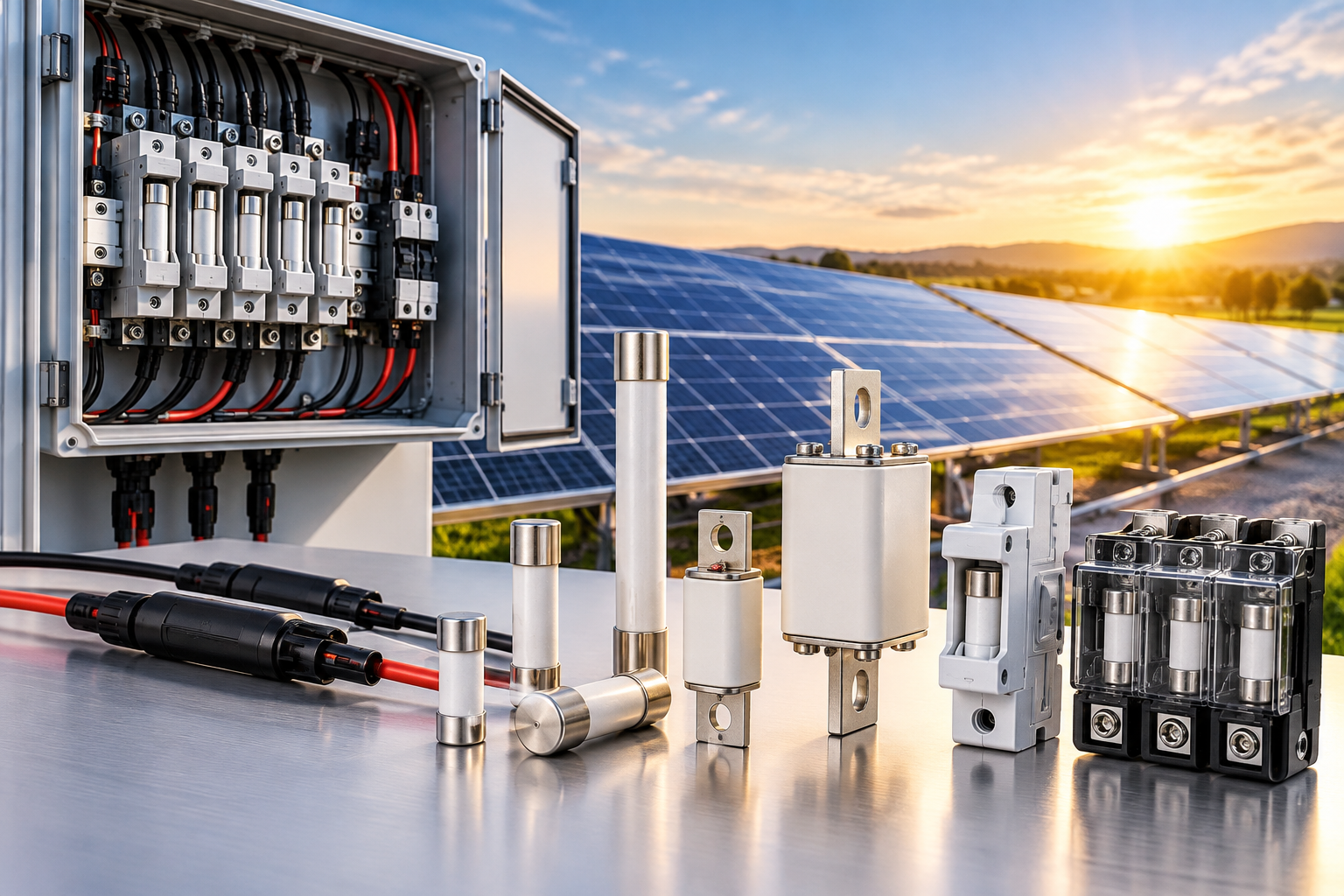
 eaton-bussmann-series-photovoltaic-fuses-catalogue-ca135004en.pdf  | [Eaton Bussmann PV Fuses] | 0 kB |
How to Properly Fuse a Solar PV System: A Complete Guide
Solar photovoltaic (PV) systems are designed to generate clean, renewable electricity, but their safe and reliable operation depends on proper electrical protection. One of the most important components of a solar installation is the fuse. Correctly selecting and installing solar PV fuses helps protect solar panels, electrical cables, inverters, and other equipment from overcurrent conditions, short circuits, and potential fire hazards.
Understanding how to properly fuse a solar PV system is essential for installers, electrical engineers, system designers, and solar professionals. Choosing the wrong fuse rating or installing a fuse incorrectly can compromise system performance, increase maintenance costs, and create serious safety risks.
This guide explains how solar PV fuses work, how to select the correct fuse size, where to install fuses, and how to maintain them for long-term system reliability.
What Is a Solar PV Fuse?
A solar PV fuse is an electrical protection device specifically designed to protect photovoltaic circuits against excessive current. It interrupts the electrical circuit when the current exceeds a predetermined level, helping prevent damage to cables, solar modules, and connected electrical equipment.
Unlike conventional electrical installations, solar PV systems operate with direct current (DC). DC circuits present particular challenges because there is no natural current zero-crossing to help extinguish an electrical arc. Therefore, solar installations require fuses specifically rated for photovoltaic DC applications.
Photovoltaic fuses are commonly used in solar combiner boxes, string circuits, and other DC distribution points. They provide protection against reverse currents and certain short-circuit and overcurrent conditions.
Why Is Proper Fusing Important in Solar PV Systems?
Proper fuse selection and installation are essential for maintaining the safety, efficiency, and reliability of a photovoltaic installation.
Here are the main reasons why solar PV systems require appropriate fuse protection.
1. Protection Against Overcurrent
Overcurrent can occur because of electrical faults, damaged cables, incorrect wiring, or abnormal operating conditions. A correctly rated fuse interrupts excessive current before it causes significant damage to electrical components.
2. Prevention of Electrical Fires
Excessive current can cause cables, connectors, and other components to overheat. If the fault remains undetected, the excessive temperature can damage insulation and potentially cause an electrical fire.
Properly selected fuses help minimise these risks by disconnecting faulty circuits.
3. Protection of Solar Modules
When multiple solar strings are connected in parallel, a fault in one string can allow current from the other strings to flow backwards into the faulty circuit.
This reverse current can damage solar modules and their internal components. Proper string fuse protection helps prevent excessive reverse current.
4. Improved System Reliability
Correctly installed fuses help isolate faulty circuits, making troubleshooting and maintenance easier. They also reduce the risk of damage spreading throughout the PV installation.
How to Properly Fuse a Solar PV System
Properly fusing a solar PV system involves several important steps, from calculating the correct fuse rating to testing and maintaining the installation.
Step 1: Determine the Correct Fuse Size
Selecting the correct fuse rating is one of the most important parts of solar PV system protection.
The fuse rating must be suitable for the solar module's electrical characteristics and the current-carrying capacity of the connected cables.
Start by checking the solar panel manufacturer's datasheet for the following specifications:
-
Short-circuit current (Isc).
-
Open-circuit voltage (Voc).
-
Maximum series fuse rating.
-
Maximum system voltage.
The short-circuit current is particularly important when calculating the required fuse current rating.
A commonly used sizing approach in installations following the applicable NEC requirements is:
Fuse Rating = Isc × 1.56
Where:
-
Isc = Solar module short-circuit current.
-
1.56 = Combined sizing factor accounting for continuous current and irradiance-related considerations.
For example, suppose a solar module has a short-circuit current of 11A.
Fuse rating = 11A × 1.56
Fuse rating = 17.16A.
The next suitable standard fuse rating may be 20A, provided it satisfies all other protection requirements.
Important: The selected fuse rating must never exceed the maximum series fuse rating specified by the solar module manufacturer. Cable ampacity, operating temperature, applicable electrical standards, and system design must also be considered.
The 1.56 multiplier is not a universal rule for every installation. Fuse sizing requirements differ depending on the applicable electrical code and installation conditions.
Step 2: Choose the Correct Type of Solar PV Fuse
Not all electrical fuses are suitable for photovoltaic applications.
Solar PV systems require fuses designed and tested for DC operation at the system's maximum operating voltage.
A commonly used category is the gPV fuse, which is specifically designed for photovoltaic protection.
When selecting a solar PV fuse, consider the following factors:
DC Voltage Rating
The fuse voltage rating must be equal to or greater than the maximum possible system voltage.
The maximum PV voltage should be calculated using the module open-circuit voltage and the expected minimum operating temperature.
For example, a photovoltaic installation operating at a maximum voltage of 1,500V DC requires appropriately rated 1,500V DC fuse protection.
Using a fuse with an insufficient voltage rating can prevent safe interruption of the DC fault current.
Current Rating
The fuse current rating must be high enough to carry normal operating current without unnecessary interruptions but low enough to provide effective overcurrent protection.
Breaking Capacity
The breaking capacity must be sufficient to safely interrupt the maximum prospective fault current under the specified operating conditions.
Photovoltaic Compatibility
Choose fuses specifically designed for photovoltaic applications and compliant with the relevant standards, such as IEC 60269-6.
Step 3: Identify the Correct Fuse Installation Locations
Correct fuse placement is essential for effective solar PV system protection.
Fuses are commonly installed at specific points in the photovoltaic electrical circuit.
Solar String Circuits
String fuses protect individual photovoltaic strings against excessive reverse current caused by faults in parallel-connected strings.
They are generally installed in the positive and/or negative string conductors, depending on the system's grounding arrangement and applicable electrical requirements.
Solar Combiner Boxes
Combiner boxes bring together multiple solar strings before the combined DC output is transferred to the inverter.
Individual string fuses are commonly installed inside these boxes to protect each string independently.
Inverter DC Input
DC overcurrent protection and isolation arrangements should be designed according to the inverter manufacturer's requirements and the applicable electrical standards.
Some inverters include integrated protection devices, while others require external protective equipment.
Battery Connections
For solar installations incorporating battery storage, suitable overcurrent protection must also be installed in the battery circuits.
Battery protection requires separate consideration because batteries can supply substantial fault currents.
Fuse selection must account for battery voltage, maximum available fault current, cable capacity, and the manufacturer's specifications.
Step 4: Install the Fuse in a Suitable Fuse Holder
The fuse holder is just as important as the fuse itself.
An unsuitable or poorly installed fuse holder can create excessive contact resistance, overheating, and electrical connection problems.
When installing a solar PV fuse holder, consider the following:
-
Select a holder compatible with the fuse dimensions and electrical ratings.
-
Ensure the holder is rated for the required DC voltage and current.
-
Use components suitable for the environmental conditions inside the installation.
-
Ensure electrical contacts are clean and properly secured.
-
Install the holder in an appropriate enclosure.
-
Follow the manufacturer's specified installation torque.
-
Allow sufficient space for heat dissipation.
The fuse and holder should be electrically and mechanically compatible. Physical compatibility alone does not guarantee safe operation.
Step 5: Connect the Fuse Correctly
Incorrect wiring can compromise the protective function of a fuse.
During installation, ensure that all connections follow the approved electrical design and component instructions.
Important considerations include:
-
Confirm positive and negative conductor identification.
-
Follow the manufacturer's connection diagrams.
-
Use cables with the correct cross-sectional area.
-
Ensure terminals are properly tightened.
-
Avoid loose connections and damaged conductors.
-
Verify that the fuse holder is correctly installed.
Never assume that all PV fuse holders have identical connection arrangements. Always follow the specific component documentation.
Step 6: Test the Solar PV System After Installation
After installing the fuses, the complete photovoltaic protection arrangement should be inspected and tested by a qualified professional.
Testing helps identify installation problems before the system enters normal operation.
Important inspection and testing activities include:
Visual Inspection: Check fuse holders, terminals, cables, enclosures, and connections for visible damage or incorrect installation.
Electrical Testing: Perform the required insulation resistance, polarity, continuity, and other electrical tests in accordance with the applicable installation standards and equipment instructions.
Thermal Inspection: Use an infrared thermometer or thermal imaging camera to identify abnormal temperature increases around fuses and electrical contacts under suitable operating conditions.
Operational Verification: Confirm that the inverter and PV system operate within their specified electrical parameters.
Any abnormal readings, overheating, or unexpected fuse operation should be investigated before the installation is considered satisfactory.
Important Maintenance Points for Solar PV Fuses
Installing the correct fuse is only the beginning. Regular inspection and maintenance are necessary to maintain reliable protection throughout the operating life of a solar PV system.
The following maintenance practices can help prevent common fuse-related problems.
1. Monitor Ambient Temperature
High ambient temperatures can affect fuse performance and reduce the available current-carrying capacity.
Solar combiner boxes can experience elevated internal temperatures, particularly when installed in direct sunlight or poorly ventilated locations.
Always consider temperature derating when selecting fuses.
2. Inspect Fuse Holders and Electrical Contacts
Loose or deteriorated electrical contacts can increase contact resistance and generate excessive heat.
During scheduled inspections, check for:
-
Discolouration around terminals.
-
Signs of overheating.
-
Corrosion or oxidation.
-
Cracked or damaged fuse holders.
-
Loose electrical connections.
Damaged components should be replaced with suitable, correctly rated equipment.
3. Replace Damaged Fuses Correctly
When replacing a fuse, always use a replacement with the correct electrical specifications.
Never install a fuse with a higher current rating simply because the original fuse keeps operating.
Repeated fuse operation usually indicates an underlying problem that must be investigated.
Before replacing a fuse, the circuit must be safely isolated using the approved procedure. Appropriate protective equipment and safe working practices are essential.
4. Perform Regular Thermal Inspections
Infrared temperature measurements can help identify abnormal heating in fuse links, fuse holders, and connection terminals.
Thermal inspections are particularly useful in large commercial and industrial solar installations, where multiple strings and electrical connections operate continuously.
Unusual temperature differences between similar components may indicate poor contact, excessive current, or an incorrectly selected fuse.
5. Maintain Proper Ventilation
Adequate ventilation helps prevent excessive temperatures inside combiner boxes and electrical enclosures.
Ensure that enclosures are installed according to their environmental and thermal specifications.
Common Mistakes to Avoid When Fusing a Solar PV System
Even a well-designed solar installation can experience problems when fuse selection and installation are handled incorrectly.
Avoid these common mistakes:
Using AC Fuses in DC Applications
AC and DC fuse ratings are not interchangeable. Always select a fuse with an appropriate DC voltage rating and interruption capability.
Choosing the Wrong Current Rating
An undersized fuse may interrupt normal operation unnecessarily, while an oversized fuse may fail to provide adequate protection.
Ignoring Maximum System Voltage
The fuse voltage rating must account for the maximum PV open-circuit voltage under the coldest expected conditions.
Ignoring Temperature Derating
High temperatures can affect fuse performance. Failing to account for thermal conditions may lead to nuisance fuse operation.
Using Incompatible Fuse Holders
A fuse and its holder must be compatible in terms of dimensions, electrical ratings, contact characteristics, and thermal performance.
Neglecting Regular Maintenance
Overlooking damaged fuse holders, loose terminals, and overheating can increase the risk of electrical faults.
Frequently Asked Questions About Solar PV Fuses
1. Why Do Solar PV Systems Need Special Fuses?
Solar PV systems generate direct current, which requires protective devices capable of safely interrupting DC fault currents at the relevant system voltage.
Photovoltaic fuses are designed specifically for the electrical and operating conditions associated with solar installations.
2. What Type of Fuse Is Used in Solar PV Systems?
gPV fuses are commonly used in photovoltaic systems. They are specifically designed for PV circuit protection and are covered by the IEC 60269-6 standard.
The correct fuse must also have suitable voltage, current, and breaking-capacity ratings.
3. How Do I Calculate the Correct Solar PV Fuse Size?
A commonly used NEC-based sizing formula is:
Fuse Rating = Solar Module Isc × 1.56
The result must then be checked against the module's maximum series fuse rating, conductor ampacity, temperature derating requirements, and applicable local regulations.
4. Where Should Fuses Be Installed in a Solar PV System?
Fuses are commonly installed in PV string circuits and combiner boxes.
Additional overcurrent protection may be required at inverter and battery connections, depending on the system design and manufacturer's requirements.
5. Do All Solar Panels Need Individual Fuses?
Not necessarily.
The requirement for individual string fuses depends on the number of parallel strings, the possible reverse current, module specifications, conductor ampacity, and applicable electrical standards.
A single-string system may not require individual string overcurrent protection under certain conditions. However, the complete system design must always be evaluated.
6. What Happens If the Wrong Fuse Is Installed?
An incorrectly selected fuse can cause unnecessary interruptions, inadequate fault protection, overheating, equipment damage, or failure to safely interrupt a DC fault.
This is why fuse selection must always be based on verified electrical specifications.
7. How Often Should Solar PV Fuses Be Inspected?
Inspection frequency depends on the installation environment, operating conditions, maintenance programme, and applicable regulations.
Commercial and industrial installations should have a documented preventive maintenance schedule that includes fuse holders, electrical contacts, and thermal inspections.
Conclusion
Properly fusing a solar PV system is essential for electrical safety, equipment protection, and long-term operational reliability.
The process involves calculating the appropriate fuse rating, selecting a photovoltaic-rated DC fuse, identifying the correct installation locations, using compatible fuse holders, making secure electrical connections, and performing regular inspections.
Particular attention should be given to system voltage, short-circuit current, conductor ampacity, temperature derating, and the maximum series fuse rating specified by the solar module manufacturer.
By following appropriate engineering practices and applicable electrical standards, solar installers and system designers can reduce electrical risks, improve system reliability, and help ensure that photovoltaic installations operate safely and efficiently throughout their service life.
Remember: Solar PV fuse selection and installation should always be carried out or verified by qualified electrical professionals. Never work on live PV circuits or replace fuses without following the appropriate isolation and safety procedures.



