
 eaton-bussmann-series-high-speed-fuses-application-guide-br132015en-en-us.pdf  | [Eaton Bussmann Fuses Technical Guide] | 0 kB |
How to Avoid Wrong Use of AC Fuses in DC Circuits
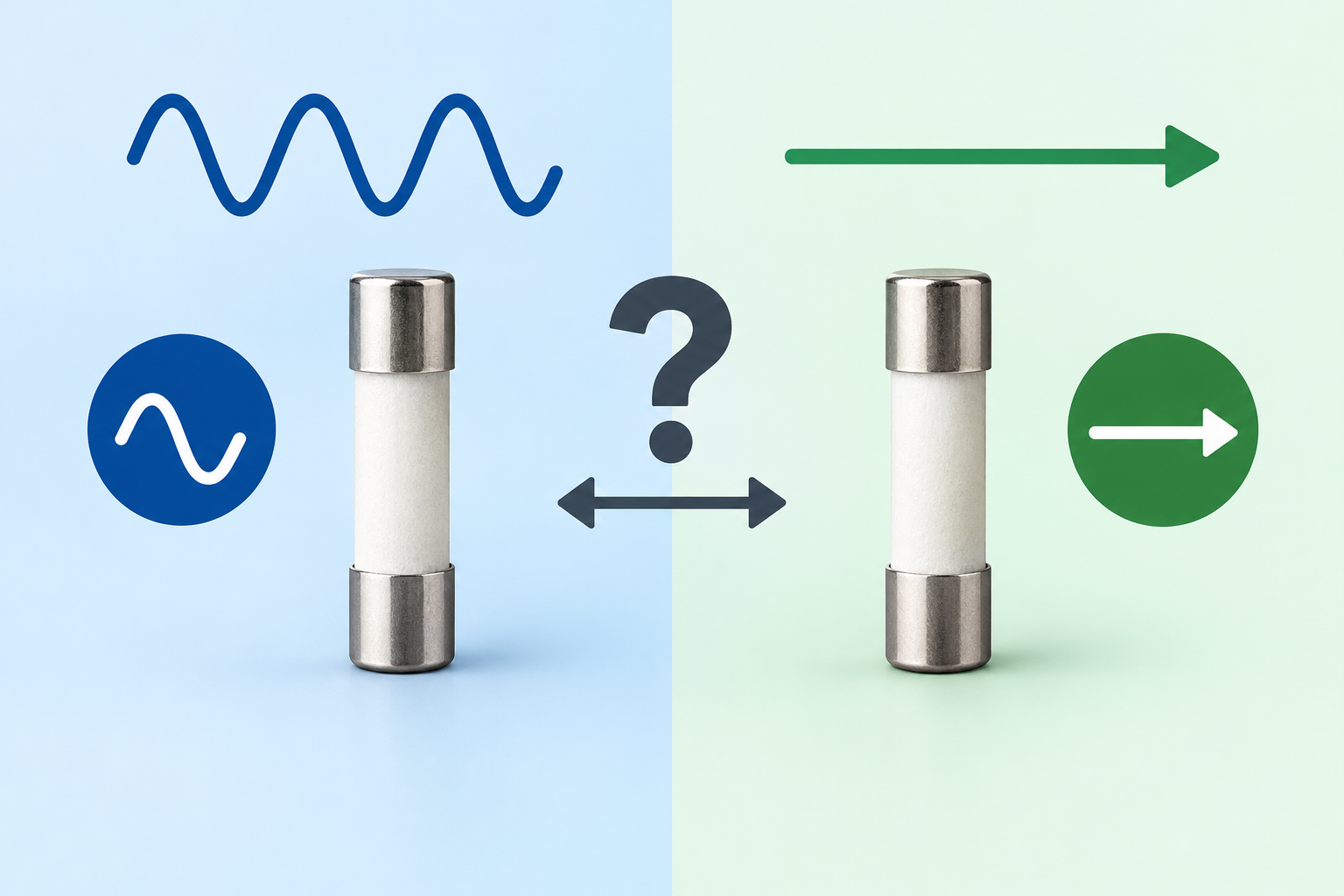
Choosing the correct fuse is essential for maintaining electrical safety and protecting equipment from overcurrent, short circuits, and potential fire hazards. However, one common mistake in electrical installations is using an AC fuse in a DC circuit without checking its suitability.
Although AC and DC fuses may look similar and perform the same basic function, their operating characteristics and interruption capabilities are different. Using an incorrectly rated AC fuse in a DC application can result in dangerous electrical arcing, equipment damage, and even electrical fires.
Understanding the differences between AC and DC fuses, their voltage ratings, and their application requirements can help prevent incorrect fuse selection and improve electrical system safety.
In this article, we explain why AC fuses should not be used in DC circuits without proper verification and how to select the right fuse for reliable DC circuit protection.
1. Understanding the Difference Between AC and DC Fuses
The primary difference between AC and DC fuses lies in how they interrupt electrical current.
AC (Alternating Current) periodically changes direction. In a 50 Hz AC system, the current passes through zero twice during each cycle, creating 100 natural current zero crossings per second. These zero-current points help extinguish the electrical arc when a fuse operates.
DC (Direct Current) flows continuously in one direction. Unlike AC, DC does not naturally pass through zero during normal operation. Consequently, interrupting DC current is more challenging because the electrical arc can continue even after the fuse element melts.
DC fuses are specifically designed with internal structures and arc-quenching mechanisms to extinguish this arc safely.
Therefore, an AC fuse should never automatically be considered suitable for DC applications simply because its current rating appears appropriate.
2. Why Using AC Fuses in DC Circuits Can Be Dangerous
Using an AC-rated fuse in a DC circuit without confirming its DC interruption capability can create several safety risks.
Continuous Electrical Arcing
When a fuse element melts, an electrical arc may form between the separated ends. In an AC circuit, the current naturally reaches zero, helping extinguish the arc.
In a DC circuit, current continues flowing in the same direction. This can sustain the arc for a longer period.
If the fuse is not designed to interrupt DC current, the arc may persist, potentially causing overheating, damage to the fuse holder, or electrical fire.
Incorrect Voltage Rating
Fuse voltage ratings are not necessarily interchangeable between AC and DC applications.
A fuse rated for a particular AC voltage may have a significantly lower DC voltage rating because DC interruption requires greater arc-extinguishing capability.
For example, a fuse rated at 1000V AC might have a DC rating of 500V or 750V, depending on its construction and testing.
It is important to check the manufacturer's specifications rather than assume that an AC voltage rating is suitable for DC operation.
Delayed Fault Interruption
Some AC fuses are designed around the electrical characteristics of alternating current. Their operating performance may not provide the required protection in DC applications.
In photovoltaic systems, for example, the available fault current can be relatively limited. A fuse that does not operate correctly under these conditions may fail to protect cables and electrical components effectively.
Increased Risk of Equipment Damage
An incorrectly selected fuse may fail to interrupt a DC fault safely. This can expose cables, connectors, circuit breakers, and other electrical components to excessive temperatures and electrical stress.
Selecting a fuse specifically rated for the application helps reduce these risks.
3. Can an AC Fuse Be Used in a DC Circuit?
An AC fuse can only be considered for DC applications if its manufacturer explicitly specifies an appropriate DC voltage rating and confirms its suitability for the intended operating conditions.
The following factors must be evaluated:
-
DC voltage rating of the fuse.
-
Rated current and operating characteristics.
-
Maximum prospective short-circuit current.
-
DC breaking or interrupting capacity.
-
Circuit configuration and polarity requirements.
-
Ambient operating temperature.
-
Fuse holder compatibility.
A common misconception is that an AC fuse can always be used in a DC circuit by reducing its voltage rating by 50%.
Although a 50% reduction is sometimes mentioned as a general guideline, it is not a universal engineering rule. The actual DC voltage rating depends on the fuse design, construction, and verified interruption performance.
Important: Never rely on an estimated AC-to-DC voltage conversion. Always use the manufacturer's published DC ratings and technical documentation.
4. How to Select the Correct Fuse for DC Circuits
Selecting the correct DC fuse requires more than matching the rated current. Engineers and installers should consider several electrical and environmental factors.
Step 1: Determine the DC Operating Voltage
First, identify the maximum operating voltage of the DC circuit.
The selected fuse must have a DC voltage rating equal to or greater than the maximum voltage that may occur under normal operating conditions.
For solar photovoltaic systems, this includes considering the maximum possible string voltage under low-temperature conditions.
Step 2: Calculate the Required Current Rating
Determine the maximum expected operating current and select a fuse with an appropriate rated current.
For photovoltaic applications, the short-circuit current (Isc) of the solar modules is an important parameter.
A commonly used sizing approach under applicable photovoltaic design rules is:
Required fuse current rating = Isc × Number of parallel strings × 1.56
For example, consider a solar installation with two parallel strings, each having a short-circuit current of 6.35A.
The calculation is:
6.35A × 2 × 1.56 = 19.81A
The appropriate standard fuse rating must then be selected according to applicable electrical codes, module specifications, conductor ampacity, and the maximum series fuse rating permitted by the module manufacturer.
The calculation is a starting point, not a substitute for complete system verification.
Step 3: Check the DC Breaking Capacity
Breaking capacity refers to the maximum fault current that a fuse can safely interrupt at its specified voltage.
DC circuits can produce significant fault currents, particularly in battery storage systems and high-power electrical installations.
Always ensure that the selected fuse has an adequate DC breaking capacity for the prospective short-circuit current at the installation point.
Step 4: Consider Ambient Temperature
Temperature has a direct impact on fuse performance.
Fuses installed in outdoor solar combiner boxes, electrical cabinets, or other high-temperature environments may experience increased operating temperatures.
High ambient temperatures can affect the fuse's current-carrying capability and operating characteristics.
Always consult the manufacturer's temperature derating curves and apply the appropriate correction factors when selecting a fuse.
Step 5: Verify Cable Compatibility
The selected fuse must also provide appropriate protection for the connected conductors.
Its current rating should not exceed the permissible current-carrying capacity of the protected cable, after considering installation conditions and applicable derating factors.
Proper coordination between the fuse and cable helps prevent conductor overheating during overload and fault conditions.
Step 6: Check the Fuse Holder Rating
Selecting a DC-rated fuse is not enough if the fuse holder is only suitable for AC applications.
The fuse holder must also have appropriate DC voltage and current ratings and sufficient short-circuit withstand or interrupting capability for the installation.
Always verify the ratings of the complete fuse assembly.
5. The Importance of DC Fuses in Solar Photovoltaic Systems
Solar photovoltaic systems are among the most common applications where incorrect AC fuse selection can create serious problems.
Solar panels generate DC electricity, which flows through PV strings, combiner boxes, and inverter input circuits.
When multiple PV strings are connected in parallel, reverse current from healthy strings can flow into a faulty string under certain fault conditions.
Without appropriate overcurrent protection, this reverse current may damage solar modules, cables, and connectors.
DC-rated photovoltaic fuses are designed to provide suitable protection under the specific electrical conditions found in solar installations.
Their main functions include:
-
Protecting PV modules against excessive reverse current.
-
Preventing cable overheating.
-
Reducing the risk of electrical fires.
-
Protecting combiner boxes and electrical connections.
-
Improving the reliability of photovoltaic installations.
For photovoltaic applications, fuse selection should also consider the relevant PV fuse standards, including IEC 60269-6 for gPV fuse links.
Using appropriately rated and tested photovoltaic fuses helps ensure that the protection system performs as intended.
6. Common Mistakes to Avoid When Selecting Fuses for DC Applications
Incorrect fuse selection often results from overlooking important technical specifications.
Here are some common mistakes to avoid:
1. Assuming AC and DC ratings are interchangeable
A fuse with an appropriate AC rating is not automatically suitable for DC applications. Always verify its DC rating.
2. Ignoring DC breaking capacity
The fuse must safely interrupt the maximum prospective DC fault current. An inadequate breaking capacity can result in dangerous arcing.
3. Selecting a fuse based only on current rating
Current rating is only one selection parameter. Voltage rating, breaking capacity, operating characteristics, and environmental conditions are equally important.
4. Ignoring temperature derating
High ambient temperatures can affect fuse performance. Always consider the installation environment and manufacturer's derating information.
5. Using incompatible fuse holders
The fuse holder must also be suitable for the DC circuit's voltage and current requirements.
6. Overlooking applicable electrical standards
Different applications have specific fuse requirements. Solar PV installations, battery energy storage systems, and industrial DC circuits may require different fuse characteristics.
7. Which Standards Should Be Considered When Selecting DC Fuses?
Compliance with relevant electrical standards is an important part of safe fuse selection.
Some important standards include:
-
IEC 60269: General requirements for low-voltage fuses.
-
IEC 60269-6: Supplementary requirements for fuse links used in solar photovoltaic energy systems.
-
UL 2579: Requirements covering photovoltaic fuse links.
The applicable standard depends on the intended application, installation location, and regulatory requirements.
Always verify that the fuse has the necessary certifications and technical approvals for the intended DC application.
8. AC Fuse vs. DC Fuse: Key Differences
Understanding the differences between AC and DC fuses makes it easier to select the right protection device.
| Parameter | AC Fuse | DC Fuse |
|---|---|---|
| Current flow | Alternating direction | One direction |
| Natural current zero | Yes | No |
| Arc interruption | Generally easier | More challenging |
| Arc extinguishing | Uses AC current zero crossings | Requires suitable arc-quenching design |
| Voltage rating | Specified for AC | Specified for DC |
| Breaking capacity | Depends on AC rating | Depends on DC rating |
| Typical applications | AC distribution systems | Solar PV, batteries, and DC power systems |
Although both types of fuses protect electrical circuits against excessive current, their interruption requirements are different.
The correct selection must always be based on the actual electrical specifications of the application.
9. Best Practices for Safe DC Fuse Installation
Following good installation practices helps ensure reliable circuit protection.
Consider these recommendations:
-
Always select a fuse with a clearly specified DC voltage rating.
-
Confirm that the rated current matches the circuit design.
-
Check the DC breaking capacity against the available fault current.
-
Use fuse links designed for the specific application.
-
Verify fuse holder compatibility.
-
Follow manufacturer installation instructions.
-
Consider temperature and environmental derating.
-
Inspect fuse connections regularly for signs of overheating or corrosion.
-
Replace damaged fuses with components having the same required electrical characteristics.
-
Ensure installation and maintenance are carried out by qualified electrical professionals.
These precautions can significantly reduce the risk of electrical failures and improve the long-term reliability of DC systems.
Conclusion
Avoiding the incorrect use of AC fuses in DC circuits is essential for electrical safety and reliable system operation.
Although AC and DC fuses may look similar, their ability to interrupt electrical current differs significantly. The absence of natural current zero crossings in DC systems makes arc interruption more challenging and requires appropriate fuse construction and ratings.
Before selecting a fuse for any DC application, always verify its DC voltage rating, current rating, breaking capacity, temperature characteristics, and compatibility with the fuse holder.
For solar photovoltaic systems, battery storage installations, and industrial DC applications, choosing appropriately rated and certified DC fuses is particularly important.
By following the correct selection procedures and installation practices, engineers and installers can improve electrical protection, prevent unnecessary equipment damage, and ensure safer DC circuit operation.
Frequently Asked Questions (FAQs)
1. Why should AC fuses not be used directly in DC circuits?
AC fuses are generally designed to interrupt current using the natural zero crossings of alternating current. DC current does not naturally reach zero, making arc interruption more difficult. An AC fuse without a suitable DC rating may fail to interrupt the fault safely.
2. What happens if an AC fuse is used in a DC circuit?
Using an unsuitable AC fuse in a DC circuit can cause sustained electrical arcing, overheating, fuse failure, equipment damage, and potentially fire hazards.
3. Can a 1000V AC fuse be used in a 1000V DC circuit?
Not automatically. The DC voltage rating may be significantly lower than the AC rating. The manufacturer's specifications must explicitly confirm that the fuse is suitable for the required DC voltage and fault conditions.
4. How do I identify whether a fuse is suitable for DC applications?
Check the product markings and technical datasheet for a specified DC voltage rating, rated current, DC breaking capacity, and applicable certifications. If the DC rating is not clearly specified, do not assume that the fuse is suitable for DC applications.
5. Why are DC fuses important in solar PV systems?
DC fuses protect photovoltaic modules, cables, and electrical components against excessive reverse current and overcurrent conditions. They help reduce the risk of overheating, equipment damage, and electrical fires.
6. What is the difference between a gPV fuse and a standard AC fuse?
A gPV fuse is specifically designed for photovoltaic DC applications. It is tested against the relevant requirements of IEC 60269-6 and is intended to provide overcurrent protection under the operating conditions of solar PV systems.
7. Does a DC fuse need a special fuse holder?
Yes. The fuse holder must have appropriate DC voltage and current ratings and be compatible with the selected fuse. Using an unsuitable holder can compromise the safety and performance of the protection system.



