
 eaton-bussmann-series-high-speed-fuses-application-guide-br132015en-en-us.pdf  | [Eaton Bussmann Fuses Technical Guide] | 0 kB |
Proper Torque for M6 and M8 Fuse Bolts: Recommended Specifications and Installation Guide
Proper torque for M6 and M8 fuse bolts is essential for maintaining safe, reliable, and efficient electrical connections. In high-current electrical systems, including electric vehicles, solar power installations, battery energy storage systems, and industrial equipment, correctly tightened fuse connections help prevent overheating, voltage drops, and unexpected electrical failures.
Applying insufficient torque can result in loose connections and increased electrical resistance. Excessive tightening, on the other hand, may damage threads, deform terminals, or crack fuse housings.
So, what is the correct torque for M6 and M8 fuse bolts? The answer depends on several factors, including bolt grade, terminal material, lubrication, and the mechanical specifications of the fuse assembly.
This guide explains recommended M6 and M8 fuse bolt torque values, proper tightening procedures, common installation mistakes, and essential maintenance practices.
1. Why Is Proper Torque Important for Fuse Bolts?
Fuse bolts create both mechanical and electrical connections. Their primary purpose is to maintain sufficient contact pressure between conductive surfaces, ensuring stable current transmission.
Correct tightening torque is important for several reasons.
Prevents Electrical Overheating
Loose fuse connections increase contact resistance. When electrical current passes through a high-resistance connection, additional heat is generated.
For example, in a 200A electrical circuit, an additional contact resistance of 0.5 milliohms can generate approximately 20 watts of localized heat.
Continuous overheating can damage insulation, terminals, and surrounding components.
Ensures Stable Electrical Performance
Proper bolt torque maintains consistent contact pressure between the fuse terminal and connecting conductor.
This helps reduce voltage drops, minimize energy losses, and maintain reliable electrical performance.
Protects Fuse Terminals and Housings
Overtightening can damage threaded connections, deform metal terminals, and place excessive mechanical stress on fuse housings.
In severe cases, excessive tightening may compromise the structural integrity of the fuse assembly.
Improves Long-Term Reliability
Electrical systems frequently experience vibration, temperature changes, and thermal cycling.
Correctly installed fuse connections are better equipped to withstand these operating conditions and maintain reliable performance.
2. Recommended Torque Specifications for M6 and M8 Fuse Bolts
The appropriate tightening torque depends on bolt diameter, mechanical strength grade, surface condition, and lubrication.
The following table provides typical starting torque ranges for M6 and M8 steel bolts.
M6 and M8 Fuse Bolt Torque Chart
| Bolt Size | Bolt Grade | Lubrication Condition | Recommended Torque |
|---|---|---|---|
| M6 | 8.8 | Dry, zinc-plated | 9–11 Nm |
| M6 | 8.8 | Light oil or threadlocker | 8–10 Nm |
| M6 | 10.9 | Dry | 11–13 Nm |
| M8 | 8.8 | Dry | 20–23 Nm |
| M8 | 8.8 | Lubricated | 18–21 Nm |
| M8 | 10.9 | Dry | 23–26 Nm |
These values are general reference ranges rather than universal specifications. The fuse manufacturer's recommended tightening torque must always take priority.
M6 Fuse Bolt Torque
M6 fuse bolts are commonly used in compact electrical assemblies, including automotive electrical systems, battery connections, and smaller power distribution equipment.
For a standard grade 8.8 M6 steel bolt, a typical dry tightening torque is approximately 9–11 Nm.
When lubrication is applied, the required torque may decrease because lubrication reduces friction between the threads and contact surfaces.
For aluminium terminals, lower tightening torque may be necessary. In some applications, an M6 connection may require a maximum torque of approximately 8 Nm, depending on the terminal design.
M8 Fuse Bolt Torque
M8 fuse bolts are frequently used in higher-current electrical connections where greater mechanical strength and contact pressure are required.
For a standard grade 8.8 M8 steel bolt, a typical dry tightening torque is approximately 20–23 Nm.
Lubricated M8 connections generally require a lower torque setting.
However, some fuse assemblies have lower mechanical limits than the bolts themselves. Always check the specified torque for the complete fuse and terminal assembly.
3. Factors That Affect M6 and M8 Fuse Bolt Torque
Selecting the correct torque involves more than identifying the bolt diameter. Several technical factors influence the final tightening requirement.
Bolt Strength Grade
Bolt strength grades determine the mechanical properties of fasteners.
Common grades include:
-
Grade 8.8: Commonly used for general industrial and electrical fastening applications.
-
Grade 10.9: Offers higher tensile strength and can support higher mechanical loads.
A higher bolt strength grade does not automatically mean that a higher tightening torque is suitable for the fuse assembly. Terminal and housing limitations must also be considered.
Lubrication Conditions
Lubrication significantly affects the relationship between tightening torque and bolt preload.
A dry bolt experiences greater friction during tightening than a lubricated bolt.
Applying lubricant without adjusting the torque specification can produce excessive clamping force and potentially damage the connection.
Terminal Material
The material of the fuse terminal is another important consideration.
Copper terminals: Copper generally provides good electrical conductivity and mechanical stability.
Aluminium terminals: Aluminium requires additional attention because of its lower mechanical strength and potential creep under sustained pressure and elevated temperatures.
For aluminium connections, always follow the terminal manufacturer's torque recommendations.
Operating Temperature and Vibration
High-current electrical systems experience temperature fluctuations during normal operation.
Repeated heating and cooling can affect joint pressure. Vibration may also contribute to loosening if the connection is not properly designed and assembled.
For this reason, torque requirements should account for the actual operating environment.
4. How to Tighten M6 and M8 Fuse Bolts Correctly
Following a consistent installation procedure helps ensure reliable electrical connections and reduces the risk of mechanical damage.
Step 1: Clean the Contact Surfaces
Remove dirt, dust, oxidation, and other contaminants from the terminal and connecting surfaces.
Clean contact areas help establish a stable electrical connection.
Use cleaning products and methods suitable for the terminal material.
Step 2: Inspect the Bolt and Terminal
Before installation, inspect the bolt, threads, and terminal surfaces.
Look for:
-
Damaged or deformed threads.
-
Corrosion or oxidation.
-
Cracks in the fuse housing.
-
Bent or damaged terminals.
-
Surface contamination.
Replace damaged components before assembly.
Step 3: Check Lubrication Requirements
Determine whether the connection requires dry installation, lubricant, or a specified thread-locking compound.
Do not apply lubricant or threadlocker unless permitted by the assembly specifications.
Remember that changing the friction conditions can significantly affect the resulting clamping force.
Step 4: Start the Bolt by Hand
Carefully insert the bolt and turn it by hand to prevent cross-threading.
The bolt should rotate smoothly without unusual resistance.
Cross-threading can damage the terminal and create an unreliable mechanical connection.
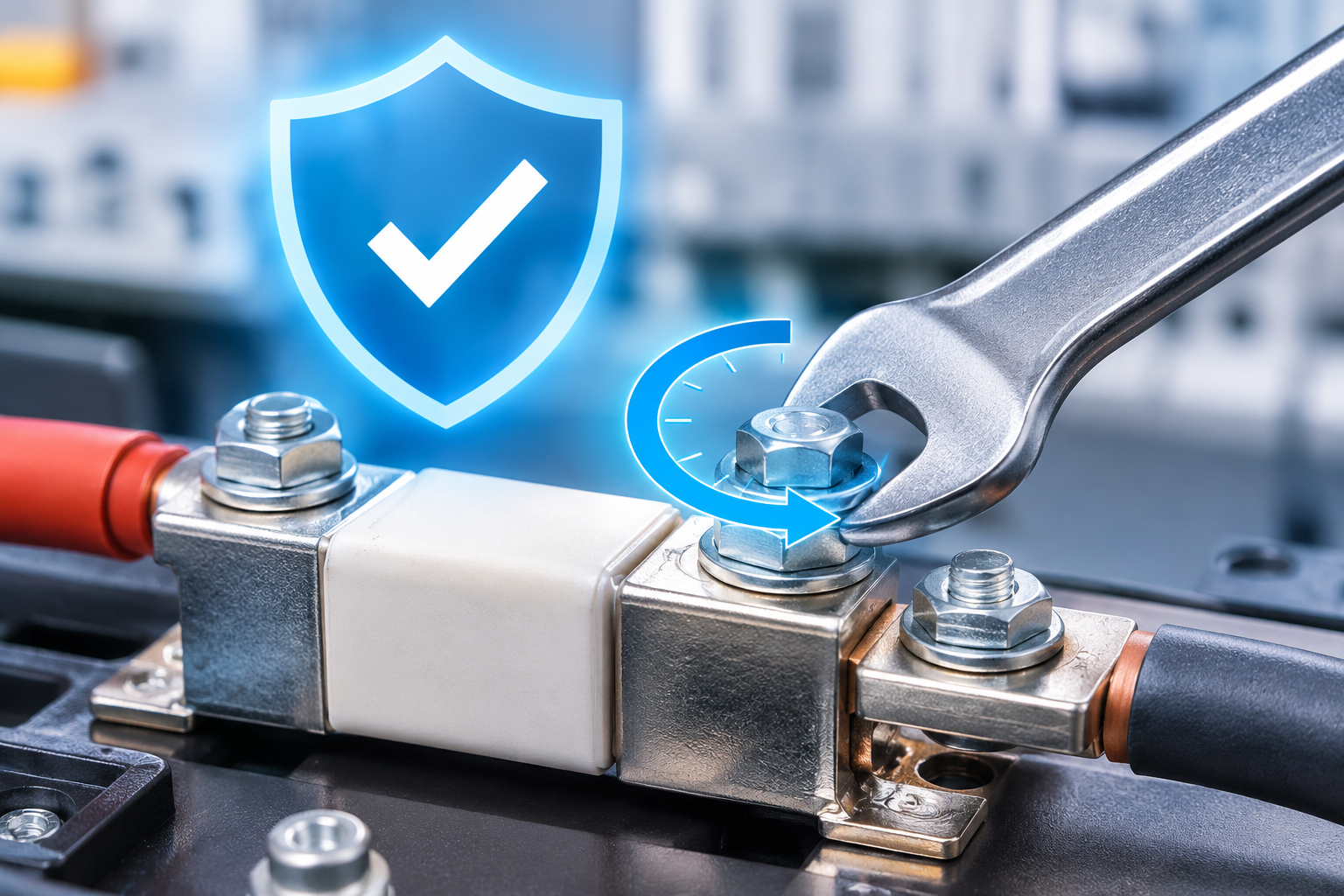
Step 5: Use a Calibrated Torque Wrench
Select a calibrated torque wrench with an appropriate operating range.
Set the wrench according to the specified torque value for the complete fuse assembly.
Avoid using an impact wrench for final tightening because it does not provide sufficiently controlled torque application.
Step 6: Tighten Gradually
Where the assembly instructions permit, tighten the bolt in stages.
A typical approach is to apply approximately 50% of the target torque initially, followed by the specified final torque.
Apply steady pressure and avoid sudden movements.
Step 7: Perform a Final Inspection
After tightening, inspect the connection for proper alignment and mechanical stability.
Do not repeatedly tighten the bolt after reaching the specified torque.
If the connection requires verification, follow the approved inspection procedure.
5. Common Mistakes When Tightening Fuse Bolts
Even experienced technicians can make mistakes during fuse installation. Understanding these problems helps improve electrical safety and assembly quality.
Using Incorrect Torque Values
Applying a generic bolt torque chart without considering the fuse manufacturer's specifications is a common mistake.
The mechanical strength of a bolt does not necessarily represent the maximum torque that a fuse terminal can withstand.
Tightening Without a Torque Wrench
Estimating torque by hand is unreliable, particularly for electrical connections requiring precise clamping pressure.
A calibrated torque wrench provides more consistent and repeatable results.
Ignoring Terminal Material
Copper and aluminium terminals have different mechanical properties.
Using the same torque specification for both materials can lead to insufficient clamping force or terminal damage.
Applying Excessive Lubrication
Lubrication reduces friction and changes the relationship between applied torque and bolt preload.
Using a dry-installation torque specification on a lubricated connection can result in excessive clamping force.
Ignoring Thermal Cycling
Repeated temperature changes can influence the mechanical condition of electrical connections.
Inspection and maintenance intervals should be established according to the equipment manufacturer's recommendations and the operating environment.
Using Damaged Fasteners
Corroded, stretched, or deformed bolts may not maintain the required clamping force.
Damaged fasteners should be replaced rather than reused.
6. Special Considerations for High-Current Fuse Applications
M6 and M8 fuse bolts are widely used in electrical systems where reliable current transmission and overcurrent protection are essential.
Different applications may require additional installation considerations.
Electric Vehicles
Electric vehicle electrical systems operate with high currents and demanding temperature conditions.
Fuse connections must maintain reliable electrical contact while withstanding vibration and repeated operating cycles.
Correct bolt torque helps prevent localized overheating and connection failures.
Battery Energy Storage Systems
Battery energy storage systems contain electrical connections that may operate continuously under significant loads.
Proper fuse bolt tightening helps maintain stable contact resistance and reduces the risk of excessive heat generation.
Solar Power Systems
Solar power installations use electrical protection components to safeguard DC circuits.
Correctly installed fuse connections help maintain dependable electrical performance, particularly in systems exposed to changing environmental temperatures.
Industrial Electrical Equipment
Industrial power distribution systems frequently experience vibration, temperature variations, and continuous electrical loading.
Following consistent torque specifications helps improve connection reliability and simplify maintenance.
7. How to Maintain Reliable Fuse Bolt Connections
Correct installation is only the first step. Regular inspection and maintenance are also important for long-term electrical reliability.
Consider the following practices:
-
Inspect fuse terminals periodically for signs of corrosion or overheating.
-
Check for discoloration, melted insulation, or damaged contact surfaces.
-
Use calibrated torque tools during installation and approved maintenance procedures.
-
Maintain records of torque settings and tool calibration.
-
Follow manufacturer-recommended inspection intervals.
-
Investigate abnormal temperature increases around fuse connections.
-
Replace damaged bolts, terminals, or fuse components.
For aluminium connections, consider the material's long-term creep characteristics when establishing maintenance procedures.
Avoid automatic retightening after a fixed operating period unless specified by the equipment manufacturer. Any torque verification or retightening must follow the approved maintenance procedure.
8. Frequently Asked Questions About M6 and M8 Fuse Bolt Torque
What Is the Recommended Torque for an M6 Fuse Bolt?
A typical dry torque range for an M6 grade 8.8 steel bolt is 9–11 Nm.
However, the correct value depends on the terminal material, lubrication condition, and fuse assembly specifications.
What Is the Recommended Torque for an M8 Fuse Bolt?
For an M8 grade 8.8 steel bolt, a typical dry tightening torque is 20–23 Nm.
Some fuse holders and terminal assemblies require considerably lower values, so always verify the manufacturer's specifications.
Can I Use the Same Torque for M6 and M8 Fuse Bolts?
No. M6 and M8 bolts have different dimensions and mechanical characteristics.
Using the same torque for both sizes may result in insufficient clamping force or excessive mechanical stress.
Does Lubrication Affect Fuse Bolt Torque?
Yes. Lubrication reduces friction between the bolt threads and mating surfaces.
As a result, a lubricated bolt may generate greater clamping force at the same applied torque compared with a dry bolt.
Always use the torque specification corresponding to the actual installation condition.
Can Overtightening Damage a Fuse?
Yes. Excessive tightening can strip threads, deform terminals, crack fuse housings, and compromise the mechanical integrity of the assembly.
In severe cases, the damage may affect the fuse's intended protective performance.
Why Do Fuse Connections Become Hot?
Common causes include loose connections, contaminated contact surfaces, corrosion, damaged terminals, and insufficient contact pressure.
Incorrect bolt torque can contribute to increased contact resistance and localized overheating.
Should Fuse Bolts Be Retightened After Installation?
Not automatically. Some electrical assemblies require torque verification after thermal cycling, while others specify no additional tightening.
Always follow the maintenance instructions provided for the specific fuse and terminal assembly.
9. Conclusion
Choosing the proper torque for M6 and M8 fuse bolts is essential for electrical safety, connection reliability, and long-term equipment performance.
As a general reference, M6 grade 8.8 steel fuse bolts typically require 9–11 Nm under dry conditions, while M8 grade 8.8 bolts typically require 20–23 Nm.
However, these figures should never replace the specific torque recommendations for the fuse assembly.
Bolt grade, terminal material, lubrication, temperature, and mechanical design all influence the correct tightening requirement.
By using calibrated torque tools, following appropriate installation procedures, and performing regular inspections, engineers and technicians can reduce connection resistance, prevent overheating, and improve the reliability of high-current electrical systems.
Ultimately, proper fuse bolt torque is not simply a mechanical requirement. It is an important part of maintaining safe and dependable electrical protection.



