
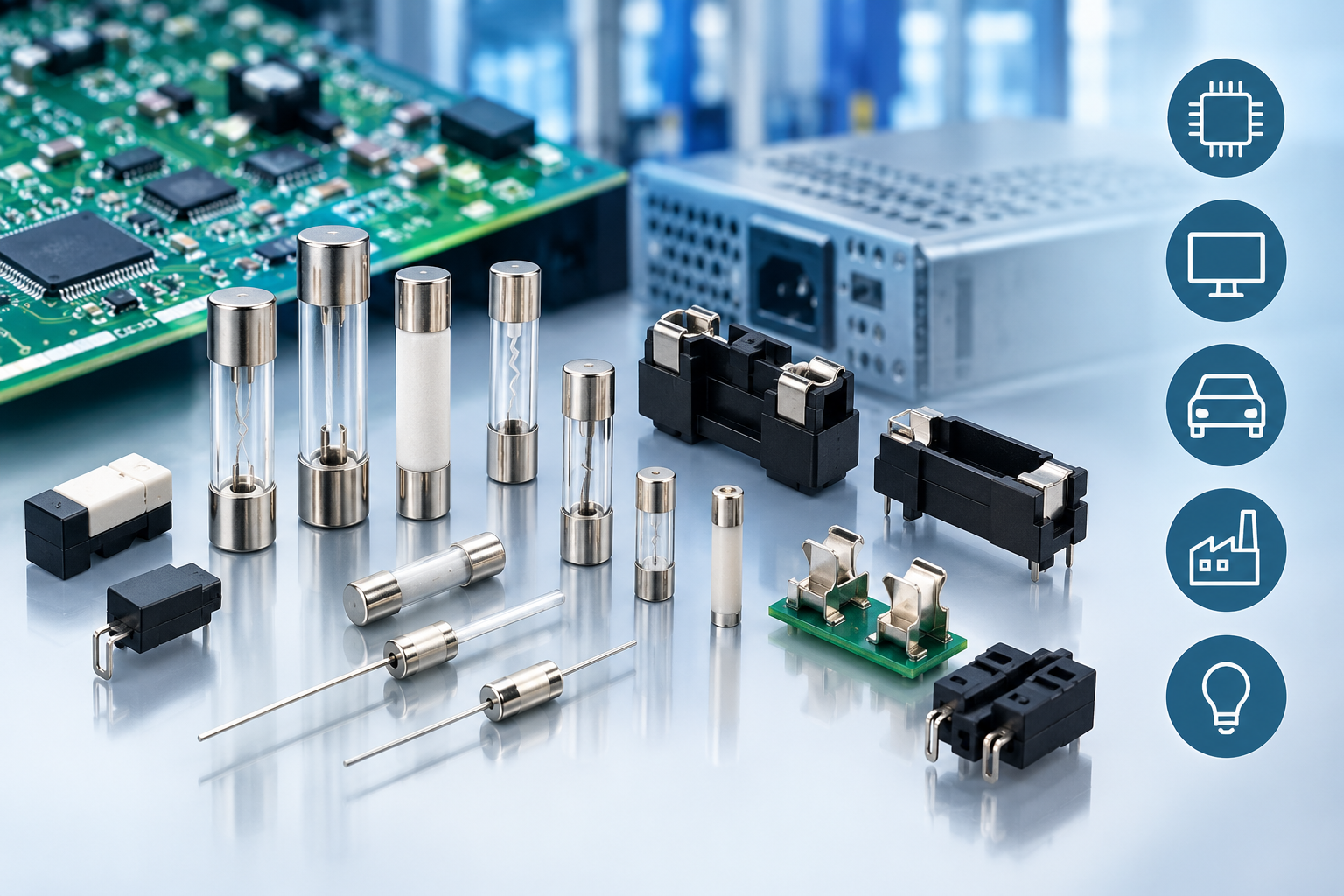
 bus-ele-cat-1007-flc-2018-sec-03-elx.pdf bus-ele-cat-1007-flc-2018-sec-03-elx.pdf | [Eaton Bussmann series Full line catalog: Electronic, PCB and small dimension fuses] | 4609 kB |
Eaton Bussmann Series Full Line Catalog: Electronic, PCB and Small Dimension Fuses
Introduction
Reliable circuit protection is essential for modern electronic equipment, printed circuit boards (PCBs), control systems, and electrical devices. Selecting the right fuse helps protect sensitive components against overcurrent conditions while supporting equipment reliability and safe operation. The Eaton Bussmann Series Full Line Catalog for electronic, PCB, and small dimension fuses provides a comprehensive overview of compact fuse solutions designed for a wide range of electronic applications.
Published in October 2018, Section 3 of the Bussmann Series Full Line Catalog 1007 covers small-dimension fuses, including fast-acting and time-delay designs, as well as PCB fuse holders and fuse clips. It includes several metric and inch-based fuse formats to support different installation requirements and equipment designs.
For engineers, electronics manufacturers, maintenance professionals, and component purchasers, this catalog is a useful technical reference for identifying potential fuse solutions based on dimensions, electrical ratings, mounting arrangements, and application requirements.
What Are Eaton Bussmann Electronic and PCB Fuses?
Eaton Bussmann electronic fuses are compact overcurrent protection components designed to interrupt an electrical circuit when current exceeds the fuse's operating characteristics. They help limit the risk of damage to electronic components, wiring, and circuit assemblies caused by excessive current.
PCB fuses are particularly useful in applications where available installation space is limited. Depending on the design, they may be installed using axial leads, fuse clips, or dedicated fuse holders.
The Eaton Bussmann catalog includes glass-tube and ceramic-tube fuse options in a range of dimensions and performance categories. This variety helps designers compare possible solutions for electronic circuits, printed circuit boards, and other equipment requiring compact circuit protection.
Choosing the correct fuse requires more than matching its physical size. Rated current, operating voltage, breaking capacity, response characteristics, environmental conditions, and applicable approval requirements must all be considered.
Overview of the Eaton Bussmann Small Dimension Fuse Range
Section 3 of the Eaton Bussmann Series Full Line Catalog 1007 organizes its products into several principal categories.
1. 5 × 15 mm Fuses
The 5 × 15 mm range is intended for compact electronic applications where space is an important design consideration.
Featured product families include:
-
C518 and C520: Fast-acting glass-tube fuses available in axial-lead and ferrule configurations, respectively.
-
C515 and C519: Time-delay glass-tube fuses available in axial-lead and ferrule configurations.
-
C517: An axial-lead, fast-acting glass-tube fuse designed for specific electronic circuit protection requirements.
These product families offer different response characteristics and mounting options. Fast-acting versions may be suitable for circuits requiring rapid interruption during overcurrent events, while time-delay versions can accommodate certain temporary current surges when properly selected.
2. IEC 5 × 20 mm Fuses
The 5 × 20 mm format is widely used in electronic equipment and compact electrical assemblies. The catalog includes multiple IEC-format fuse families with different operating characteristics and breaking capacities.
Key product families include:
-
S500 and S500-V: Fast-acting glass-tube fuses.
-
GDB: A fast-acting fuse family in the 5 × 20 mm category.
-
S501 and S501-V: Fast-acting ceramic-tube fuses designed for higher breaking capacity than the corresponding low-breaking-capacity range.
-
GDA: A fast-acting fuse family in this category.
-
S505, S506, S505H and related variants: Time-delay fuse options, with specifications varying by product family.
-
GDC: A time-delay fuse family listed in the catalog.
The choice between glass and ceramic construction, fast-acting and time-delay performance, and different breaking capacities depends on the electrical characteristics of the protected circuit.
3. UL 5 × 20 mm Fuses
The catalog also covers 5 × 20 mm fuses associated with UL-oriented product families.
These include:
-
GMA and GMA-V: Fast-acting fuses.
-
GMC and GMC-V: Time-delay fuses.
-
GMD and GMD-V: Time-delay fuse options.
These families give equipment designers additional choices when selecting small-dimension fuses for electronic devices and assemblies. The relevant product datasheet should be checked to confirm the exact current rating, voltage rating, approvals, and mounting configuration required for a particular design.
4. Inch-Based Small Dimension Fuses
For applications designed around inch-based fuse dimensions, the catalog includes several established fuse formats.
| Fuse dimensions | Product families | General characteristic |
|---|---|---|
| 1/4 × 5/8 inch | AGA | Fast-acting |
| 1/4 × 7/8 inch | AGW | Fast-acting |
| 1/4 × 1 inch | AGX | Fast-acting |
| 1/4 × 1-1/4 inch | AGC, ABC, GBB | Fast-acting |
| 1/4 × 1-1/4 inch | MDL, MDQ, MDA and related variants | Time-delay |
The catalog includes additional variants within these families. Their electrical ratings and approvals are not necessarily interchangeable, even when their physical dimensions are similar.
When replacing an existing fuse, always verify the original part number and the manufacturer's technical specifications rather than selecting a replacement based on size alone.
Fast-Acting vs. Time-Delay Fuses: Which Should You Choose?
One of the most important decisions in fuse selection is choosing the appropriate response characteristic.
Fast-Acting Fuses
Fast-acting fuses are designed to interrupt overcurrent conditions quickly according to their specified time-current characteristics. They may be appropriate for circuits containing components that are sensitive to excessive current or where substantial startup surges are not expected.
Potential applications include:
-
Electronic circuit protection
-
Printed circuit board assemblies
-
Sensitive electronic components
-
Power supply circuits requiring rapid overcurrent interruption
The required operating speed depends on the protected components, expected fault current, and overall circuit design.
Time-Delay Fuses
Time-delay fuses are designed to tolerate certain temporary current surges before opening, according to their specified time-current characteristics. They can be useful in circuits with startup currents or short-duration current peaks.
Potential applications include:
-
Circuits with capacitive charging currents
-
Equipment with temporary startup surges
-
Electronic systems with fluctuating operating loads
-
Circuits where nuisance fuse operation must be avoided without compromising protection
A time-delay fuse should not be selected simply to prevent repeated fuse failures. Frequent operation may indicate an underlying fault, incorrect fuse sizing, or an unsuitable circuit design.
Why Fuse Coordination Matters
Both fast-acting and time-delay fuses must be selected to suit the circuit's normal operating current, inrush current, fault conditions, and component withstand limits. The fuse's rated current alone does not determine whether it will provide adequate protection.
Engineers should consult time-current curves, temperature derating guidance, breaking-capacity specifications, and the relevant manufacturer datasheets before finalizing a design.
PCB Fuse Holders and Fuse Clips
In addition to standalone fuses, the Eaton Bussmann catalog covers fuse holders and clips used to integrate replaceable fuses into electronic equipment.
These accessories can simplify installation and maintenance by providing a defined mounting arrangement and electrical contact points.
5 × 20 mm Fuse Holders
The catalog lists the following 5 × 20 mm holder families:
-
H15-V
-
H15-H
-
HTC-60M
These products are intended for compatible 5 × 20 mm fuse installations. Selection should account for mounting orientation, electrical ratings, available space, and the intended service environment.
1/4 × 1-1/4 Inch Fuse Holders
The catalog also includes the following holder families for compatible 1/4 × 1-1/4 inch fuses:
-
HBH-I and HBH-M
-
HBV-I and HBV-M
-
HBW-I and HBW-M
Different holder configurations can support different mounting arrangements. The exact dimensions, installation requirements, and electrical specifications should be verified against the relevant product datasheet.
PCB Fuse Clips
For designs using directly mounted fuse clips, the catalog includes several options for 5 mm and inch-based fuse formats.
Examples include:
-
HTC-15M and HTC-140M
-
HTC-200M and HTC-210M
-
1A3399, 1A5018, 1A5601 and 1A5602
-
1A1119, 1A1120, 1A1907 and 1A3398
-
1A4533 and 1A4534
-
5681, 5682, 5674, 5960, 1A3400 and 5592
These catalog numbers cover different clip sizes and configurations. Compatibility with the intended fuse diameter, terminal arrangement, PCB footprint, current rating, and thermal conditions must be confirmed before use.
Common Applications of Electronic and Small Dimension Fuses
Compact fuses are used in many types of electrical and electronic equipment. The appropriate product depends on the system's operating conditions and protection requirements.
Consumer Electronics
Electronic devices may use small-dimension fuses to protect internal circuits against excessive current. Compact formats can help designers integrate protection without consuming unnecessary board space.
Power Supplies and Electronic Control Units
Power conversion and control circuits may experience startup surges or fault currents. Selecting a fuse with suitable time-current characteristics and breaking capacity is important for protecting these systems.
Printed Circuit Board Assemblies
PCB-mounted fuse clips and compatible fuse holders can make it easier to incorporate replaceable protection components into an assembly. The mounting method should be matched to the mechanical design and expected operating temperature.
Industrial Electronics
Control panels, instrumentation, and industrial electronic equipment can require compact overcurrent protection for specific branches or subsystems. Fuse selection must account for the applicable voltage, prospective fault current, environmental conditions, and equipment standards.
Lighting and Ballast Circuits
Certain fuse models in the catalog have ratings and application information relevant to lighting or ballast protection. These applications require careful verification of the fuse's voltage rating, interruption capability, and suitability for the circuit involved.
These examples are general application categories, not a guarantee that every fuse family is suitable for every device. The manufacturer's specifications should always determine final selection.
How to Select the Correct Eaton Bussmann Fuse
Choosing a suitable fuse requires a systematic review of the electrical, mechanical, and regulatory requirements.
Step 1: Determine the Required Fuse Dimensions
Identify the physical format required by the equipment, such as 5 × 15 mm, 5 × 20 mm, or one of the inch-based sizes. Check the available mounting space and the dimensions of the existing fuse or holder.
Step 2: Confirm the Rated Current
Determine the circuit's normal operating current and assess expected current variations. The fuse rating must be selected according to the circuit design, conductor protection requirements, component limits, and manufacturer guidance.
Step 3: Verify the Voltage Rating
The fuse must be suitable for the circuit's operating voltage and current type. AC and DC applications can impose different interruption requirements, so a rating for one type of circuit must not automatically be assumed valid for the other.
Step 4: Select the Correct Response Characteristic
Decide whether a fast-acting or time-delay fuse is appropriate based on the circuit's inrush current, fault conditions, and protection objectives. Use the product's time-current data to confirm the selection.
Step 5: Check Breaking Capacity
Breaking capacity, also called interrupting rating, indicates the fault current a fuse can safely interrupt under specified conditions. The selected fuse must have an adequate breaking capacity for the prospective short-circuit current of the application.
Step 6: Review Approvals and Compliance
Confirm the approvals and regulatory requirements applicable to the finished equipment and the target market. Approval status may vary by model, current rating, voltage rating, and product variant.
Step 7: Match the Mounting Configuration
Determine whether the application requires a ferrule fuse, an axial-lead fuse, a PCB fuse clip, or a dedicated fuse holder. Verify the mechanical footprint and electrical compatibility of all associated components.
Step 8: Check Temperature and Operating Conditions
Ambient temperature, PCB heating, enclosure design, and sustained operating current can affect fuse performance. Review applicable derating information and ensure that the selected fuse operates within its specified limits.
Why Use the Eaton Bussmann Series Full Line Catalog?
The Eaton Bussmann Series Full Line Catalog brings together information about multiple compact fuse families and associated mounting accessories in one technical reference.
Its main benefits for product selection include:
-
Broad product coverage: Multiple metric and inch-based fuse dimensions are included.
-
Different response characteristics: Fast-acting and time-delay options support different circuit requirements.
-
Multiple mounting arrangements: Ferrule and axial-lead configurations, fuse clips, and holders are covered.
-
Technical comparison: Product descriptions, catalog numbers, ratings, and approval information help narrow the range of potential solutions.
-
Support for maintenance and procurement: Identifying a specific product family can make it easier to establish the requirements for replacement parts and sourcing.
The catalog is dated October 2018. Although it remains a useful reference for understanding the listed product families, engineers and buyers should verify current availability, ordering information, approvals, and specifications before purchasing or using a component in a new design.
Frequently Asked Questions
What does the Eaton Bussmann electronic fuse catalog cover?
Section 3 of the Bussmann Series Full Line Catalog 1007 covers electronic, PCB, and small-dimension fuses. It includes 5 × 15 mm fuses, IEC and UL 5 × 20 mm families, several inch-based fuse formats, PCB fuse holders, and fuse clips.
What is the difference between a 5 × 15 mm and a 5 × 20 mm fuse?
The main physical difference is the nominal fuse-body size. However, the two formats may also differ in their available current ratings, voltage ratings, response characteristics, construction, and approvals. They should not be treated as interchangeable without confirming the relevant specifications and mounting compatibility.
Are fast-acting and time-delay fuses interchangeable?
No. They have different time-current characteristics and may respond differently to startup surges and fault currents. A replacement must match the requirements of the protected circuit, not merely the physical size and rated current.
What is the purpose of a PCB fuse holder?
A PCB fuse holder provides a mounting and electrical connection arrangement for a compatible fuse. Depending on its design, it can support easier fuse replacement and simplify integration into a printed circuit board assembly.
How do I identify the correct Bussmann replacement fuse?
Start with the existing fuse's catalog number, physical dimensions, current and voltage ratings, response characteristic, and breaking capacity. Then verify the replacement's specifications and approvals against the original application requirements. If any key specification is unknown, consult the equipment manufacturer or a qualified electrical engineer before substitution.
Is the 2018 catalog sufficient for current purchasing decisions?
The catalog is a valuable technical reference, but it was published in October 2018. Product availability, ordering codes, approvals, and specifications may change. Confirm current product documentation and purchasing details before placing an order.
Conclusion
The Eaton Bussmann Series Full Line Catalog for electronic, PCB, and small dimension fuses provides a detailed overview of compact circuit protection solutions for electronics manufacturers, design engineers, maintenance teams, and procurement specialists.
With fast-acting and time-delay fuses, multiple metric and inch-based formats, and compatible PCB mounting accessories, the catalog helps users identify product families for further technical evaluation.
The key to successful fuse selection is to balance physical dimensions with rated current, operating voltage, time-current characteristics, breaking capacity, temperature conditions, mounting requirements, and applicable approvals. By checking these parameters against current manufacturer documentation, users can make more informed decisions when specifying or replacing Eaton Bussmann electronic and PCB fuses.



