
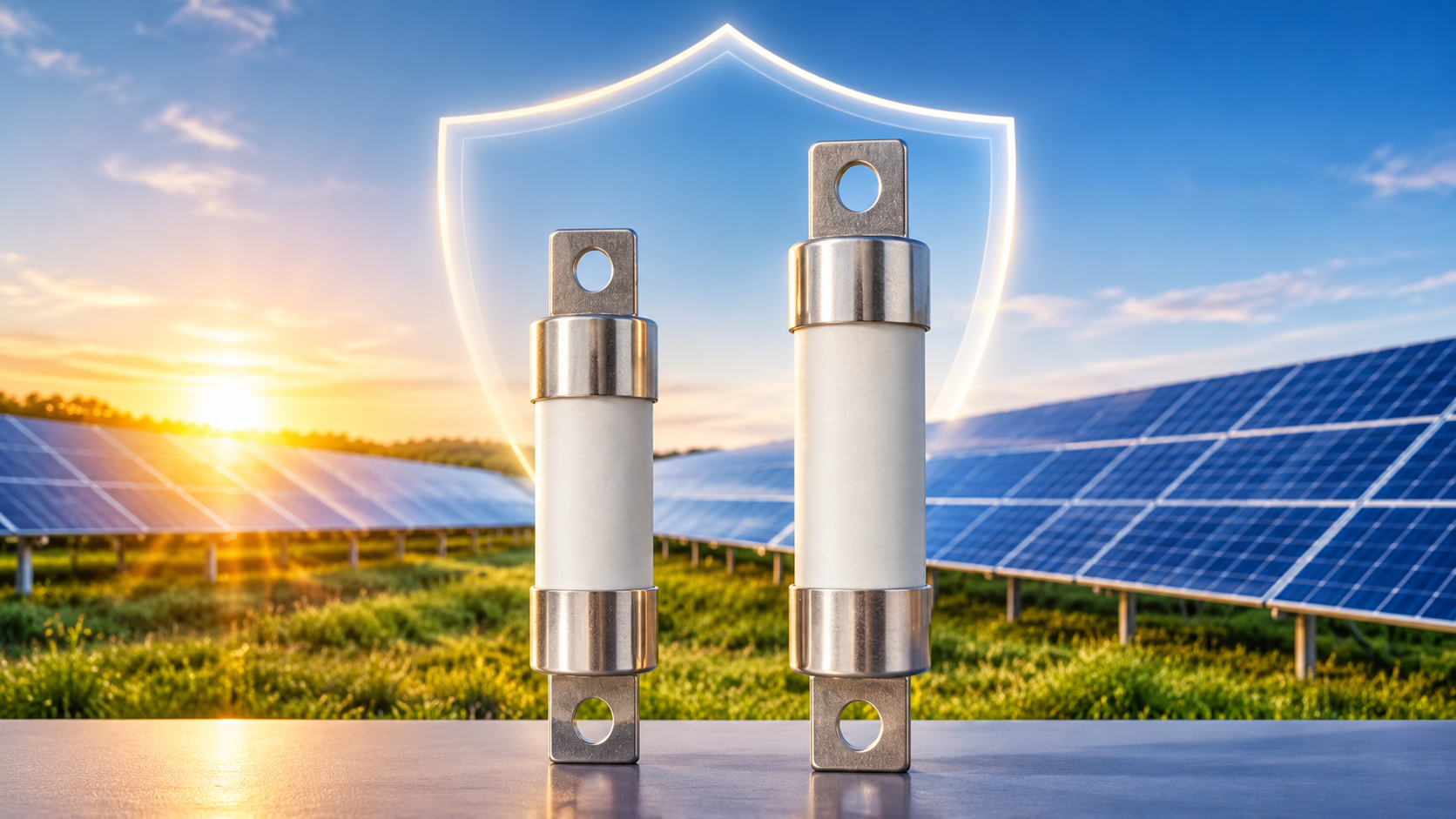
 eaton-bussmann-series-high-speed-fuses-application-guide-br132015en-en-us.pdf  | [Eaton Bussmann Fuses Technical Guide] | 0 kB |
| eaton-bussmann-series-photovoltaic-fuses-catalogue-ca135004en.pdf | [Eaton Bussmann PV Fuses] | 0 kB |
Ceramic or Melamine Fuse Tubes? Understanding the Differences and Choosing the Right Material
When selecting a fuse for photovoltaic (PV) systems, industrial applications or high-voltage DC circuits, the material of the fuse tube is an important factor to consider. Two commonly used materials are ceramic and glass-fibre-reinforced melamine. Although both provide electrical insulation and help protect the internal components of a fuse, they differ in their mechanical properties, impact resistance and practical applications.
So, which is better: ceramic or melamine fuse tubes?
The answer depends on the operating environment, electrical requirements and overall fuse construction. Understanding the differences between these materials can help engineers, installers and purchasing professionals make informed decisions when selecting the right fuse for their applications.
What Is a Fuse Tube and Why Does Its Material Matter?
A fuse tube is an essential component of a cartridge fuse. It surrounds the internal fuse element and provides electrical insulation while containing the heat and pressure generated during the interruption of an electrical fault.
A typical high-voltage DC photovoltaic fuse consists of several components:
-
Fuse element: A precisely designed metal conductor that melts when excessive current flows through the circuit.
-
Insulating tube: Provides electrical insulation and contains the internal arc during fuse operation.
-
Metal end caps: Connect the fuse to the electrical circuit.
-
Quartz sand: Absorbs heat and helps extinguish the electrical arc.
When a short circuit occurs, the fuse element melts and creates an electrical arc. Quartz sand absorbs energy and helps transform the arc into a high-resistance path, allowing the current to be interrupted safely.
The fuse tube must withstand the resulting temperature and internal pressure without cracking or losing its insulating properties.
This is particularly important in 1000VDC and 1500VDC photovoltaic systems, where interrupting a DC fault can be challenging.
Therefore, the choice of fuse tube material is not simply an aesthetic or manufacturing consideration. It contributes to the overall safety, reliability and performance of the fuse.
1. Ceramic Fuse Tubes: Advantages and Disadvantages
Ceramic has been used in electrical fuse manufacturing for many years. It is widely recognised for its excellent thermal stability, electrical insulation and dimensional consistency.
Advantages of Ceramic Fuse Tubes
Excellent heat resistance
Ceramic materials can withstand high operating temperatures, making them suitable for demanding electrical applications. Their thermal stability helps maintain the structural integrity of the fuse during operation.
Reliable electrical insulation
Ceramic provides excellent dielectric properties, helping prevent unwanted current leakage and electrical breakdown.
Proven performance
Ceramic fuse tubes have a long history of use in industrial electrical equipment and various types of high-voltage fuse applications.
Dimensional stability
Ceramic maintains its shape and dimensions under normal operating conditions, supporting consistent manufacturing and assembly.
Disadvantages of Ceramic Fuse Tubes
Despite their advantages, ceramic fuse tubes have one important limitation: brittleness.
Although ceramic is strong, it can crack or break when subjected to mechanical impact. Damage may occur during transportation, installation or handling.
In some cases, small cracks may not be immediately visible. Such damage can potentially compromise the insulation and mechanical integrity of the fuse.
For this reason, ceramic fuse tubes require careful handling, particularly in applications involving long-distance transportation or environments exposed to vibration.
However, this does not mean ceramic fuses are inherently unsafe. A properly manufactured and tested ceramic fuse can provide reliable performance when its complete construction meets the required electrical and mechanical specifications.
2. Melamine Fuse Tubes: Advantages and Disadvantages
Glass-fibre-reinforced melamine is an alternative material used in certain high-voltage DC fuse applications.
Unlike ordinary plastic, this material is a thermosetting composite reinforced with glass fibres. The reinforcement improves its mechanical strength and impact resistance.
Advantages of Melamine Fuse Tubes
Better impact resistance
One of the main advantages of glass-fibre-reinforced melamine is its toughness. Compared with conventional ceramic tubes, it generally offers better resistance to mechanical impacts.
This can reduce the risk of damage during transportation, storage and installation.
Lower risk of brittle cracking
Melamine composite materials are less prone to brittle fracture than ceramic. This makes them particularly useful in applications where mechanical handling conditions are difficult to control.
Lightweight construction
Melamine fuse tubes are relatively lightweight, which can be beneficial for transportation, handling and manufacturing.
Good electrical insulation
Glass-fibre-reinforced melamine provides suitable electrical insulation properties for properly designed and tested fuse applications.
Heat resistance and flame-retardant properties
As a thermosetting composite, reinforced melamine can offer good thermal stability and flame resistance when manufactured using an appropriate material formulation.
Disadvantages of Melamine Fuse Tubes
Although melamine offers several mechanical advantages, its performance depends on the quality of the material and manufacturing process.
Factors such as glass-fibre content, resin formulation, curing conditions and tube wall thickness can influence the final properties.
Furthermore, using a melamine tube does not automatically guarantee superior fuse performance.
The fuse element, quartz sand filling, end-cap connections and overall arc-extinguishing design must all work together to ensure reliable fault interruption.
Consequently, buyers should evaluate the complete fuse rather than selecting a product based solely on its tube material.
3. Ceramic vs. Melamine Fuse Tubes: Key Differences
Understanding the differences between ceramic and glass-fibre-reinforced melamine makes it easier to determine which material is more appropriate for a particular electrical application.
| Comparison | Ceramic Fuse Tube | Melamine Fuse Tube |
|---|---|---|
| Heat resistance | Excellent | Good |
| Electrical insulation | Excellent | Good |
| Mechanical strength | Strong but brittle | Strong and tough |
| Impact resistance | Relatively low | Generally higher |
| Risk of cracking | Higher under mechanical impact | Lower under mechanical impact |
| Weight | Relatively heavier | Relatively lighter |
| Thermal stability | Excellent | Good |
| Handling requirements | Requires careful handling | Generally more impact tolerant |
| Typical applications | Industrial and electrical protection | High-voltage DC and applications requiring improved impact resistance |
Both materials can be suitable for electrical protection applications when the fuse is correctly engineered and tested.
The primary difference is their mechanical behaviour. Ceramic offers established thermal and insulating performance, while glass-fibre-reinforced melamine provides an advantage in impact resistance and handling durability.
4. Which Fuse Tube Is Better for Solar PV Systems?
Solar photovoltaic systems operate under specific electrical and environmental conditions. As solar installations increasingly use 1000VDC and 1500VDC architectures, selecting the correct fuse becomes especially important.
PV fuses are commonly installed in combiner boxes, inverters and DC distribution equipment. They must provide reliable protection against overcurrent and short-circuit faults.
Both ceramic and melamine fuse tubes can be used in appropriately designed photovoltaic fuse links.
However, the application environment can influence which material is preferable.
When to Choose Ceramic Fuse Tubes
Ceramic fuse tubes can be a suitable choice when:
-
The installation environment is relatively stable.
-
Mechanical impact is unlikely.
-
Transportation and handling conditions are well controlled.
-
The fuse has demonstrated the required breaking capacity.
-
The product meets the applicable electrical and safety standards.
For established industrial applications and controlled installation environments, ceramic remains a practical and proven material.
When to Choose Melamine Fuse Tubes
Glass-fibre-reinforced melamine may be preferable when:
-
The fuse will undergo long-distance transportation.
-
Mechanical vibration is expected.
-
Installation involves frequent handling.
-
Improved impact resistance is desirable.
-
The application requires a lightweight fuse construction.
For large-scale solar installations, where equipment may travel long distances before reaching the installation site, improved mechanical toughness can be a practical advantage.
Nevertheless, the final selection should always be based on verified technical specifications and performance testing.
5. Why Are 1500VDC PV Fuses Different from 1000VDC Fuses?
The operating voltage is another critical consideration when selecting a photovoltaic fuse.
Interrupting a DC electrical arc is generally more challenging than interrupting an AC arc because DC current does not naturally pass through zero during each cycle.
As system voltage increases, the fuse must manage greater electrical stress and provide effective arc extinction.
This is why 1500VDC photovoltaic fuses often have different dimensions and internal structures compared with conventional 1000VDC fuse links.
Common cylindrical fuse dimensions include:
-
10 × 38 mm
-
14 × 51 mm
-
22 × 58 mm
-
10 × 65 mm
-
10 × 85 mm
-
14 × 85 mm
Longer fuse bodies can provide additional internal space for arc division and cooling, as well as suitable insulation distances.
However, a longer fuse is not automatically suitable for a higher-voltage application. The fuse element geometry, quartz sand distribution, tube construction and end-cap design must all be engineered for the intended voltage and breaking capacity.
It is also essential to ensure that the fuse dimensions match the corresponding fuse holder.
6. Important Factors to Consider When Selecting a PV Fuse
Whether choosing a ceramic or melamine fuse tube, the material should never be the only selection criterion.
The following technical factors are equally important.
Rated Voltage
The rated voltage of the fuse must be equal to or greater than the maximum possible system voltage.
For photovoltaic installations, the maximum open-circuit voltage should be calculated by considering the number of modules connected in series, module voltage specifications and the lowest expected operating temperature.
A 1000VDC fuse must not be used in a 1500VDC system simply because its current rating is suitable.
Rated Current
The fuse current rating should be selected according to the module short-circuit current, manufacturer's maximum series fuse rating, cable capacity and system design.
Ambient temperature and installation conditions should also be considered.
An incorrectly selected fuse rating may result in unnecessary fuse operation or inadequate circuit protection.
Breaking Capacity
Breaking capacity is one of the most important specifications of a high-voltage DC fuse.
It indicates the maximum prospective fault current that the fuse can safely interrupt under specified test conditions.
A suitable PV fuse must have a verified breaking capacity appropriate for the electrical system.
gPV Utilization Category
Photovoltaic fuse links should be designed for the specific requirements of PV circuit protection.
The gPV utilization category is particularly relevant when selecting fuses for solar applications.
Relevant standards include IEC 60269-6 and UL 248-19. Buyers should verify that the exact fuse model complies with the applicable requirements.
Fuse Holder Compatibility
A fuse must be mechanically and electrically compatible with its holder.
Important considerations include:
-
Fuse dimensions.
-
Rated voltage and current.
-
Contact design.
-
Terminal connections.
-
Temperature rise.
-
Permitted conductor sizes.
Using a fuse with the wrong dimensions or unsuitable contact arrangement can cause overheating and unreliable electrical connections.
7. Why the Complete Fuse Design Matters More Than Tube Material
One common mistake when purchasing photovoltaic fuses is focusing exclusively on whether the fuse tube is ceramic or melamine.
Although the tube material is important, the overall fuse construction determines its actual performance.
A reliable high-voltage DC fuse requires several components to function together:
Fuse element design: The element must have precisely controlled dimensions and melting characteristics to provide the intended protection.
Quartz sand filling: The quantity, particle properties and distribution of quartz sand influence heat absorption and arc extinction.
Fuse tube construction: The tube must withstand the temperature and internal pressure generated during fault interruption.
End-cap connections: Secure electrical connections are essential for minimising contact resistance and preventing excessive heating.
Testing and certification: Electrical performance must be verified under the relevant standards and test conditions.
A fuse with a high-quality tube but poorly designed internal components may still fail to provide reliable protection.
For this reason, engineers and purchasing professionals should request complete technical documentation rather than evaluating products based on material descriptions alone.
8. Frequently Asked Questions About Ceramic and Melamine Fuse Tubes
Is a ceramic fuse tube better than a melamine fuse tube?
Neither material is universally better. Ceramic offers excellent thermal stability and established insulating performance, while glass-fibre-reinforced melamine generally provides better impact resistance and mechanical toughness.
The appropriate choice depends on the installation environment and the complete fuse design.
Are melamine fuse tubes made of plastic?
Not exactly. High-voltage DC fuse tubes described as melamine are typically manufactured from thermosetting melamine composite reinforced with glass fibres.
This is different from ordinary plastic and provides improved mechanical strength, electrical insulation and thermal properties.
Are ceramic fuse tubes suitable for 1500VDC photovoltaic systems?
Yes. Properly designed and tested ceramic fuse links can be suitable for 1500VDC photovoltaic applications.
The rated voltage, breaking capacity, internal construction and relevant certifications must be verified for the exact fuse model.
Why are melamine fuse tubes more resistant to impact?
Glass-fibre reinforcement improves the mechanical toughness of the thermosetting composite. This helps reduce the likelihood of brittle cracking compared with conventional ceramic materials.
Can I replace a ceramic fuse with a melamine fuse?
A replacement should not be selected based on tube material alone.
The replacement fuse must have compatible voltage and current ratings, breaking capacity, utilization category, dimensions and electrical characteristics.
Always verify compatibility with the existing fuse holder and the requirements of the electrical system.
Are transparent glass fuses suitable for solar PV systems?
Transparent glass fuses are commonly used in electronic equipment and low-current control circuits.
They are generally not appropriate substitutes for dedicated 1000VDC or 1500VDC photovoltaic fuse links because their construction and arc-interruption capabilities may not meet the requirements of high-voltage PV protection.
Conclusion: Choosing the Right Fuse Tube Material
The choice between ceramic and melamine fuse tubes depends on the specific requirements of the electrical application.
Ceramic fuse tubes offer excellent thermal stability, reliable insulation and a long history of use in electrical protection equipment. They are suitable for many industrial and photovoltaic applications when correctly designed and tested.
Glass-fibre-reinforced melamine fuse tubes provide improved impact resistance, reduced brittleness and relatively lightweight construction. These properties make them particularly attractive for photovoltaic applications involving long-distance transportation, mechanical vibration or demanding handling conditions.
However, the most important consideration is not simply the tube material. Rated voltage, rated current, breaking capacity, gPV classification, internal fuse construction and verified certification must all be evaluated together.
By considering these factors, engineers, installers and purchasing professionals can select photovoltaic fuses that provide reliable electrical protection, long-term performance and improved system safety.



