
 eaton-bussmann-series-photovoltaic-fuses-catalogue-ca135004en.pdf  | [Eaton Bussmann PV Fuses] | 0 kB |
Do PV Systems Always Require Fuses for Every String?
Solar photovoltaic (PV) systems rely on effective electrical protection to ensure safe, reliable, and efficient operation. One common question during solar system design and installation is: Does every PV string need its own fuse?
The answer is no. Not every PV system automatically requires individual string fuses. The need for overcurrent protection depends on several factors, including the number of parallel strings, potential reverse current, module specifications, cable capacity, inverter configuration, and applicable electrical standards.
Understanding when PV string fuses are necessary helps engineers and installers avoid unnecessary components while maintaining adequate system protection.
In this article, we explain how PV string protection works, when fuses are required, and what factors should be considered when selecting the appropriate protection devices.
1. Understanding PV String Fuses
A PV string consists of multiple solar modules connected in series. Several strings can then be connected in parallel to increase the total current supplied to an inverter or combiner box.
During normal operation, each string generates DC electricity and delivers it to the system. However, if a fault occurs in one string, current from other parallel-connected strings may flow backward into the faulty string.
This phenomenon is known as reverse current.
If the reverse current becomes too high, it can cause excessive heating, damage module components, deteriorate cables, and potentially create a fire hazard.
A PV string fuse provides overcurrent protection by interrupting excessive fault current before it causes damage to the system.
However, installing a fuse in every string is not always necessary. The actual requirement depends on the potential fault current and the electrical limits of the system components.
2. Why Does the Number of Parallel Strings Matter?
The number of parallel-connected strings is one of the most important factors when determining whether string fuses are required.
When multiple strings operate in parallel, they can contribute current to a fault occurring in another string.
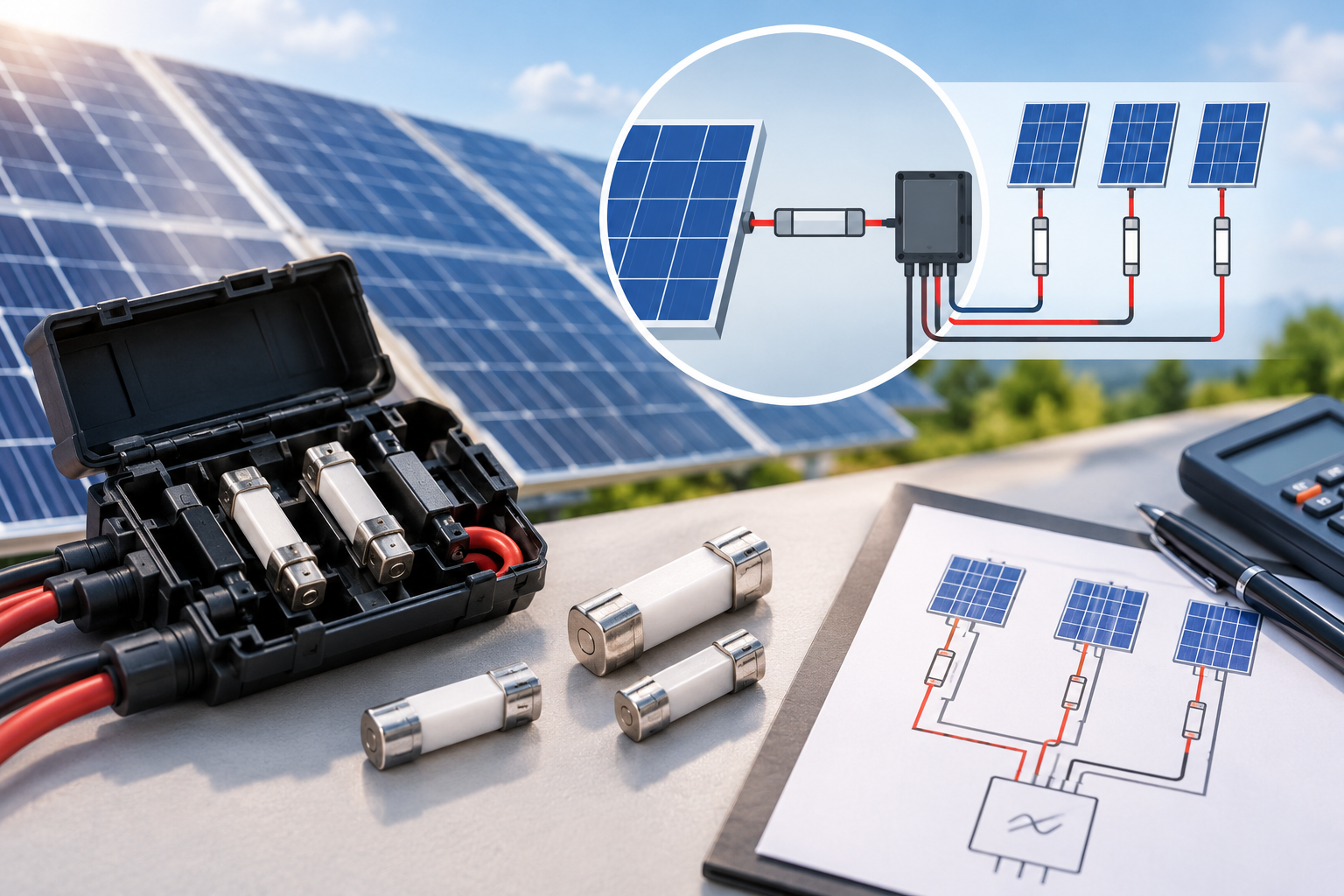
For example, consider a PV array containing three parallel strings.
If one string develops a short circuit or another electrical fault, the remaining two healthy strings may feed reverse current into the faulty string.
The potential reverse current can increase as more parallel strings are added.
This creates a greater risk of exceeding the maximum reverse current that the solar modules and associated conductors can safely withstand.
Does More Than Two Parallel Strings Always Require Fuses?
A common design guideline suggests that individual string fuses should be considered when more than two strings are connected in parallel.
This is a useful starting point, but it should not be treated as a universal rule.
In a system with two parallel strings, the available reverse current may remain within the permitted limits of the modules. However, this depends on the module specifications and actual system configuration.
Similarly, having three or more parallel strings does not automatically determine the final fuse requirement without considering the available fault current.
Engineers should evaluate:
-
The number of parallel-connected PV strings.
-
The short-circuit current of each solar module.
-
The maximum reverse current permitted by the module.
-
The maximum series fuse rating specified by the module manufacturer.
-
The current-carrying capacity of the string cables.
-
The inverter's internal configuration and potential DC backfeed.
The key principle is that string protection should be based on electrical calculations rather than string count alone.
3. When Might PV String Fuses Not Be Necessary?
There are situations in which individual PV string fuses may not be required.
A separate string fuse may be unnecessary when the maximum possible reverse current remains below the permitted limits of the solar modules and conductors.
Typical examples include:
Single-string PV systems
When only one PV string is connected to an inverter input, there are no other parallel strings available to feed reverse current into a faulty string. Nevertheless, other potential sources of fault current and applicable protection requirements must still be evaluated.
Systems with two parallel strings
In some configurations, the reverse current supplied by the remaining healthy string may be lower than the module's maximum permitted reverse current.
If the module specifications, cable ratings, inverter characteristics, and applicable electrical requirements confirm that additional protection is unnecessary, individual string fuses may not be needed.
Inverter inputs with appropriate isolation
Some inverter configurations provide separate inputs with internal electrical isolation or other design characteristics that limit potential reverse-current paths.
However, installers should never assume that separate inverter inputs automatically eliminate the need for string protection. The inverter manufacturer's technical documentation and the complete system design must be reviewed.
Ultimately, the absence of a string fuse should be supported by a proper engineering assessment.
4. When Are PV String Fuses Necessary?
PV string fuses become particularly important when the potential reverse current exceeds the permissible limits of the connected components.
The following situations require careful evaluation.
Multiple Parallel Strings
When several PV strings share a common electrical connection, the combined current from healthy strings can flow into a faulty string.
As the number of parallel strings increases, the potential reverse current may become sufficient to damage solar modules or cables.
Individual string overcurrent protection may therefore be necessary.
High Reverse Current
If the maximum possible reverse current exceeds the module's permitted reverse current, appropriate overcurrent protection must be provided.
The protection device should interrupt the fault current before it causes thermal or electrical damage.
Limited Cable Current Capacity
String cables must be capable of carrying the maximum current that could occur under normal and fault conditions.
If the combined reverse current exceeds the cable's current-carrying capacity, additional protection may be required.
Cable sizing and overcurrent protection should always be considered together.
Potential Inverter or Battery Backfeed
Some PV installations include energy storage systems or inverter configurations that may introduce additional current paths.
These sources can affect the maximum possible fault current within the DC circuit.
Therefore, engineers should evaluate not only the current contributed by parallel PV strings but also any potential backfeed from connected equipment.
5. How to Determine the Maximum Number of PV Strings Without String Fuses
One practical method of evaluating reverse-current protection is to compare the module's maximum permitted reverse current with its short-circuit current.
A simplified calculation is:
Maximum number of parallel strings without additional reverse-current protection:
Maximum number of strings ≈ Module maximum reverse current ÷ Module short-circuit current
For example, assume the following module specifications:
-
Module short-circuit current (Isc): 8.9 A
-
Module maximum reverse current: 15 A
The calculation is:
15 ÷ 8.9 = 1.69
This indicates that two parallel strings may remain within the assumed reverse-current limit, while three parallel strings could exceed it.
Let's examine the potential fault current.
Two parallel strings:
If one string develops a fault, the remaining healthy string may contribute approximately 8.9 A of reverse current.
This is below the assumed 15 A module limit.
Three parallel strings:
If one string develops a fault, the other two strings may contribute:
2 × 8.9 A = 17.8 A
This exceeds the assumed 15 A limit.
Therefore, additional string overcurrent protection would need to be evaluated and, where required, provided.
Important: This is a simplified illustrative calculation, not a complete fuse-selection method. Actual designs must account for applicable design factors, environmental conditions, inverter backfeed, cable ratings, module specifications, and local electrical regulations.
6. How to Select the Correct PV String Fuse
Determining whether a fuse is necessary is only the first step. Selecting the correct fuse rating and specifications is equally important.
An incorrectly selected fuse may fail to provide adequate protection or interrupt normal operating current unnecessarily.
The following parameters should be considered.
1. Fuse Current Rating
The fuse's rated current must be suitable for the PV string's operating and fault-current characteristics.
It must also coordinate with the module's maximum series fuse rating and the current-carrying capacity of the connected cables.
The maximum series fuse rating specified in the module datasheet is an upper limit, not automatically the recommended fuse rating.
2. DC Voltage Rating
PV systems operate at relatively high DC voltages, particularly in large commercial and utility-scale installations.
The fuse must have a DC voltage rating equal to or greater than the maximum possible system voltage under the applicable design conditions.
Engineers should also consider the increase in open-circuit voltage at low temperatures when determining the maximum string voltage.
3. Breaking Capacity
The fuse must be capable of safely interrupting the maximum prospective fault current.
An insufficient DC breaking capacity can result in dangerous arcing and equipment damage.
Therefore, the fuse's breaking capacity must be checked against the maximum available fault current.
4. Operating Temperature
Solar installations are frequently exposed to high ambient temperatures.
Fuse performance can be affected by enclosure temperature, installation conditions, terminal connections, and heat generated by nearby electrical components.
Appropriate temperature derating and installation requirements should be considered during selection.
5. Compatibility with the Fuse Holder
The fuse link and holder must be electrically and mechanically compatible.
Incorrect dimensions, poor contact pressure, loose connections, or unsuitable holders can cause overheating and unreliable operation.
Using components designed for the intended PV DC application helps maintain safe and stable electrical connections.
7. Do PV String Fuses Reduce Solar System Efficiency?
PV fuses introduce a small amount of electrical resistance into the circuit.
When current flows through a fuse element and its contact points, some electrical energy is converted into heat.
This means that a fuse can introduce a small power loss.
However, in a correctly designed and installed PV system, the additional loss is generally limited.
In practice, installation quality can be more important than the small resistance introduced by the fuse itself.
Potential problems include:
-
Poor electrical contact between the fuse and holder.
-
Loose terminal connections.
-
Incorrectly selected fuse holders.
-
Excessive operating temperatures.
-
Unsuitable fuse ratings.
Installing unnecessary protection devices can add components, cost, and potential connection points without providing a corresponding safety benefit.
On the other hand, removing protection devices that are required by the system design can expose equipment to serious electrical hazards.
The objective should always be to achieve the correct balance between electrical safety, reliability, and system efficiency.
8. What Do Electrical Standards Say About PV String Protection?
PV string protection must comply with the applicable electrical standards and installation regulations in the project location.
For installations following IEC-based requirements, IEC 62548-1 addresses PV array design, including DC wiring and electrical protection considerations.
IEC 60269-6 provides specific requirements for fuse links used to protect photovoltaic strings and arrays.
These requirements help establish the appropriate characteristics of protective devices, including their suitability for PV DC applications.
When selecting PV string fuses, engineers should consider:
-
The maximum DC system voltage.
-
The prospective reverse current.
-
The module's maximum series fuse rating.
-
The current-carrying capacity of the conductors.
-
The fuse's rated current and breaking capacity.
-
The installation environment.
-
Applicable national and local electrical regulations.
It is important to remember that compliance cannot be determined by looking at the number of parallel strings alone.
The complete electrical design must be evaluated before deciding whether individual string fuses are required.
9. What Information Is Needed Before Selecting a PV String Fuse?
A fuse selection should never be based solely on a requested current rating, such as 15 A or 20 A.
The electrical characteristics of the complete PV system must be understood first.
The following information is particularly useful:
| Parameter | Why It Matters |
|---|---|
| Module open-circuit voltage (Voc) | Helps determine maximum string voltage |
| Module short-circuit current (Isc) | Establishes the string current characteristics |
| Number of parallel strings | Helps calculate potential reverse current |
| Maximum DC system voltage | Determines the required fuse voltage rating |
| Maximum series fuse rating | Defines the module's permitted fuse rating limit |
| String cable size | Determines conductor current-carrying capacity |
| Inverter configuration | Helps identify possible reverse-current paths |
| Battery backfeed conditions | Identifies additional potential fault-current sources |
| Ambient temperature | Influences fuse and holder operating conditions |
| Fuse holder dimensions | Ensures mechanical and electrical compatibility |
Providing these details allows engineers to determine whether string protection is necessary and select a suitable protective device.
10. Frequently Asked Questions About PV String Fuses
Does every PV string need an individual fuse?
No. Individual PV string fuses are not automatically required in every installation. Their necessity depends on the potential reverse current, module limitations, cable capacity, inverter configuration, and applicable electrical regulations.
Are fuses mandatory when more than two PV strings are connected in parallel?
Not automatically in every configuration. More than two parallel strings is an important indication that reverse-current protection should be evaluated. The final decision must be based on electrical calculations and applicable requirements.
Can a PV system operate safely without string fuses?
Yes, provided the system design demonstrates that additional string overcurrent protection is not necessary and all other applicable protection requirements are satisfied.
What is the maximum series fuse rating of a solar module?
It is the maximum permitted rating of an overcurrent protection device connected in series with the module. The selected fuse must not exceed the manufacturer's specified limit.
Should both positive and negative PV conductors have fuses?
Not necessarily. The required arrangement depends on the system's grounding configuration, inverter design, and applicable electrical regulations. Protection arrangements should be determined through the system design rather than applying one configuration to every installation.
Do PV string fuses affect system efficiency?
Yes, slightly. Fuse elements and contact points introduce electrical resistance, resulting in a small amount of power loss. However, correctly selected and installed fuses generally have a limited impact on overall PV system efficiency.
What type of fuse should be used in a solar PV system?
The selected fuse should be specifically suitable for photovoltaic DC applications, with appropriate voltage rating, current rating, breaking capacity, and operating characteristics. Fuse selection must also comply with the applicable standards and manufacturer specifications.
Conclusion
So, do PV systems always require fuses for every string?
No. The requirement depends on the electrical characteristics and protection needs of the complete PV installation.
The number of parallel strings is an important consideration, but it is not the only factor. Reverse current, module specifications, conductor capacity, inverter configuration, and potential backfeed must all be evaluated.
In some systems, individual string fuses may be unnecessary because the available reverse current remains within the permitted limits of the connected components. In other installations, particularly those with multiple parallel strings, additional overcurrent protection may be essential.
The most reliable approach is to assess the complete system, calculate the potential fault current, review the module datasheet, and follow the applicable electrical standards.
Ultimately, effective PV protection is not about installing the maximum number of fuses. It is about selecting the right protection devices, in the right locations, to ensure long-term electrical safety, reliability, and performance.



