
 eaton-bussmann-series-photovoltaic-fuses-catalogue-ca135004en.pdf  | [Eaton Bussmann PV Fuses] | 0 kB |
What Material Ensures 1500VDC Photovoltaic Fuse Stability?
As solar photovoltaic (PV) systems continue to expand, higher-voltage architectures are becoming increasingly important for improving energy efficiency and reducing installation costs. Among these developments, 1500VDC photovoltaic systems have gained significant attention, particularly in utility-scale solar power plants. However, operating at higher DC voltages also creates greater demands on electrical protection components.
A 1500VDC photovoltaic fuse plays a critical role in protecting solar modules, combiner boxes, inverters, and other electrical equipment against overcurrent and short-circuit faults. Its ability to operate reliably under demanding conditions depends heavily on the materials used in its construction.
So, what materials ensure the stability of a 1500VDC photovoltaic fuse?
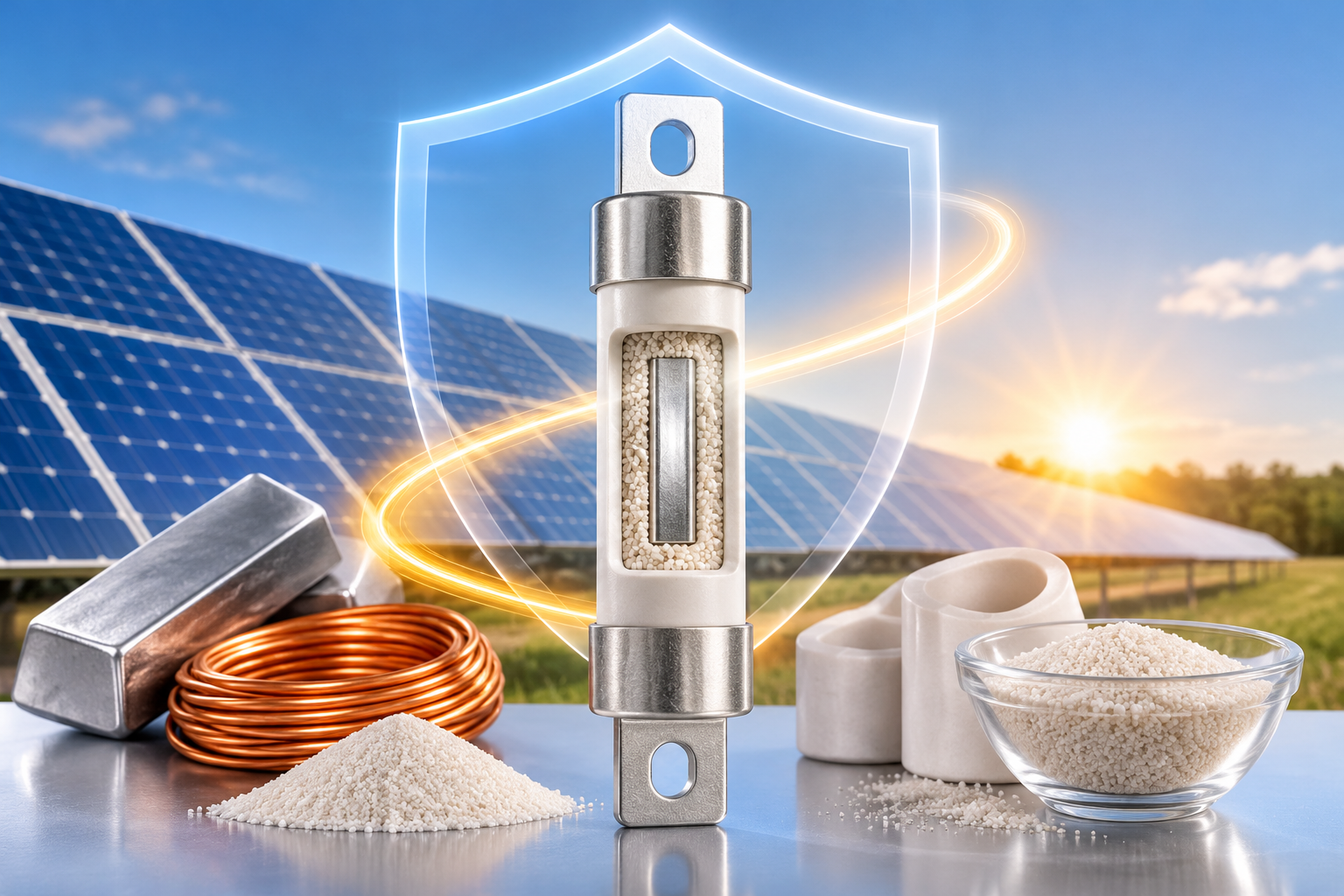
The answer lies primarily in three essential materials: silver or silver-plated copper for the fuse element, high-alumina ceramic for the housing, and high-purity quartz sand for arc extinguishing. Together, these materials provide electrical conductivity, thermal resistance, mechanical strength, and reliable arc interruption.
1. Why Material Selection Matters for 1500VDC Photovoltaic Fuses
Unlike alternating current (AC), direct current (DC) does not naturally pass through zero during each electrical cycle. Consequently, interrupting a DC fault current can be particularly challenging because the electrical arc may continue flowing after the fuse element melts.
At 1500VDC, the energy generated during a short circuit can create extremely high temperatures and internal pressure. Without appropriate materials, a fuse may experience excessive heating, insulation failure, housing damage, or incomplete arc interruption.
The materials used in photovoltaic fuse manufacturing must therefore meet several essential requirements:
-
High electrical conductivity to minimise power losses.
-
Excellent thermal stability under continuous operating conditions.
-
Strong mechanical resistance to withstand internal pressure.
-
Reliable arc-extinguishing performance during fault interruption.
-
Resistance to oxidation, corrosion, and environmental degradation.
-
Consistent electrical characteristics throughout the service life.
Selecting suitable materials helps ensure that a 1500VDC photovoltaic fuse maintains stable performance and provides dependable protection throughout the operating life of a solar installation.
2. Silver or Silver-Plated Copper: The Foundation of Fuse Element Stability
The fuse element is one of the most important components of a photovoltaic fuse. It determines how the fuse responds when excessive current flows through the electrical circuit.
Silver and silver-plated copper are commonly used in high-performance fuse elements because of their excellent electrical and thermal properties.
Excellent Electrical Conductivity
Silver has the highest electrical conductivity among metals under standard conditions. This characteristic helps minimise electrical resistance and reduces unnecessary heat generation during normal operation.
Silver-plated copper combines the excellent conductivity of copper with the surface properties of silver, providing an effective material solution for certain fuse designs.
Stable Melting Characteristics
A photovoltaic fuse must melt within a carefully controlled range when an overcurrent or short-circuit condition occurs.
The consistency of the fuse element material directly influences its melting behaviour, pre-arcing characteristics, and I²t value.
Stable material properties help manufacturers maintain predictable fuse operation and reliable protection coordination.
Oxidation Resistance
Copper can develop an oxide layer when exposed to oxygen, moisture, and elevated temperatures. This oxidation may affect surface contact conditions and electrical performance.
Silver offers better resistance to oxidation under many operating conditions, helping maintain stable electrical characteristics.
For photovoltaic installations designed to operate for decades, material consistency is particularly important.
3. High-Alumina Ceramic: Protecting the Fuse Under Extreme Temperatures
The ceramic housing is another essential material that determines the stability and safety of a 1500VDC photovoltaic fuse.
During short-circuit interruption, the fuse element can generate intense heat and significant internal pressure. The housing must contain these conditions without cracking, deforming, or losing its insulating properties.
High-alumina ceramic is widely used in high-voltage fuse construction because of its excellent physical and electrical characteristics.
High Thermal Resistance
High-alumina ceramic can withstand elevated temperatures without melting or undergoing the type of deformation associated with many organic insulating materials.
This makes it suitable for applications involving the intense heat generated during fuse operation.
Excellent Electrical Insulation
The ceramic housing provides electrical insulation between internal conductive components and the surrounding environment.
Its insulating properties help prevent unwanted current paths and reduce the risk of electrical breakdown.
Mechanical Strength
During DC fault interruption, internal pressure can increase rapidly. A mechanically strong ceramic tube helps contain the pressure generated inside the fuse.
Adequate structural strength is essential for preventing housing rupture and maintaining safe fault interruption.
Thermal Shock Resistance
Photovoltaic installations frequently experience changing ambient temperatures.
High-quality ceramic materials offer good resistance to thermal shock, helping the fuse withstand temperature fluctuations without developing cracks.
Therefore, the quality, density, and manufacturing consistency of the ceramic housing are important factors when evaluating 1500VDC photovoltaic fuse reliability.
4. High-Purity Quartz Sand: Essential for Effective Arc Extinguishing
Quartz sand is a critical internal filling material in many high-voltage current-limiting fuses.
Its primary function is to extinguish the electrical arc generated when the fuse element melts during an overcurrent event.
At 1500VDC, reliable arc interruption is particularly important because DC arcs do not benefit from the natural current-zero crossing found in AC circuits.
Effective Heat Absorption
When the fuse element melts, an electrical arc forms inside the fuse body.
The surrounding quartz sand absorbs substantial thermal energy. Under the intense heat, portions of the filler can undergo melting and form a glass-like material.
This process helps cool the arc and reduces its ability to continue conducting electricity.
Improved Arc Resistance
Quartz sand helps increase the electrical resistance along the arc path.
By cooling the plasma and creating a more resistive interruption environment, the filling material assists in extinguishing the arc.
Consistent Particle Size
The particle size distribution, purity, moisture content, and packing density of quartz sand all influence its arc-quenching performance.
Poor-quality or inconsistently packed filler may reduce interruption efficiency and increase the possibility of arc restriking.
For this reason, manufacturers must carefully control the quality and filling process of the quartz sand used in photovoltaic fuses.
5. Supporting Materials That Improve Photovoltaic Fuse Reliability
Although the fuse element, ceramic housing, and quartz sand are the three primary materials, other components also contribute to overall fuse stability.
End Caps and Electrical Contacts
End caps and contacts are commonly manufactured using conductive metals such as copper or brass, sometimes with silver plating.
Their main functions include:
-
Providing reliable electrical connections.
-
Reducing contact resistance.
-
Minimising temperature rise during normal operation.
-
Maintaining stable mechanical connections.
-
Improving resistance to corrosion.
Poor contact quality can create localised heating, potentially affecting the fuse's long-term performance.
Sealing Materials
The sealing system prevents moisture, dust, and other environmental contaminants from entering the fuse body.
Moisture can negatively affect the insulating and arc-quenching properties of internal materials.
High-quality sealing materials are therefore important for maintaining stable performance in outdoor photovoltaic installations.
Insulating Components
Additional insulating components help maintain electrical separation and prevent unintended current paths.
Their thermal and electrical properties must be compatible with the fuse's rated voltage and operating environment.
6. How Environmental Conditions Affect 1500VDC Photovoltaic Fuse Stability
Solar power plants are often installed in challenging environments. Depending on their location, photovoltaic fuses may experience high temperatures, humidity, salt exposure, dust, and significant temperature fluctuations.
These environmental factors can influence material performance over time.
High-temperature environments
Continuous exposure to elevated temperatures can increase electrical resistance, accelerate material ageing, and affect the fuse's operating characteristics.
High-humidity environments
Moisture may affect internal insulation and compromise the performance of inadequately sealed components.
Coastal environments
Salt-containing air can accelerate corrosion of exposed metallic components, particularly electrical contacts and terminal surfaces.
Desert environments
High ambient temperatures, dust, and substantial daily temperature variations create additional demands on the fuse housing and sealing system.
Cold environments
Low temperatures and repeated thermal cycling require materials with appropriate mechanical strength and resistance to temperature-related stress.
Choosing materials based on the actual installation environment is therefore essential for maintaining reliable photovoltaic system protection.
7. How to Evaluate the Material Quality of a 1500VDC Photovoltaic Fuse
Material specifications alone are not sufficient to establish whether a photovoltaic fuse is suitable for a particular application.
Engineers and procurement professionals should also evaluate the product's electrical performance, manufacturing quality, and test results.
The following factors deserve particular attention.
Rated Voltage and Breaking Capacity
Ensure that the fuse is specifically designed and tested for 1500VDC operation.
Its rated breaking capacity must be sufficient to interrupt the prospective short-circuit current at the installation point.
I²t Characteristics
The pre-arcing and total clearing I²t values indicate the thermal energy associated with fuse operation.
These characteristics help engineers evaluate the fuse's current-limiting performance and coordinate protection with downstream equipment.
Temperature Rise Testing
Temperature rise testing helps determine whether the fuse can operate within acceptable thermal limits under specified operating conditions.
This is particularly important for photovoltaic installations exposed to high ambient temperatures.
Environmental Testing
Humidity, temperature cycling, corrosion, and mechanical durability tests provide useful information about the fuse's ability to withstand challenging operating environments.
Relevant International Standards
When selecting a 1500VDC photovoltaic fuse, engineers should check compliance with applicable photovoltaic fuse requirements, including:
-
IEC 60269-6: Requirements for fuse-links used for the protection of solar photovoltaic energy systems.
-
UL 248-19: Requirements relating to photovoltaic fuse applications.
Always verify the applicable edition, certification scope, rated voltage, and test conditions rather than relying solely on a general standards reference.
8. Why Manufacturing Quality Is as Important as Material Selection
Even high-quality raw materials cannot guarantee reliable fuse performance without proper manufacturing processes.
The stability of a 1500VDC photovoltaic fuse depends on the relationship between material selection, component design, production accuracy, and quality control.
Several manufacturing factors are particularly important:
Fuse element precision: The element's dimensions, material composition, and manufacturing tolerances must be carefully controlled to achieve consistent electrical characteristics.
Ceramic housing quality: Uniform density, dimensional accuracy, and freedom from structural defects help ensure reliable insulation and mechanical protection.
Quartz sand filling process: Consistent particle distribution and filling density are essential for effective arc extinguishing.
Contact assembly: Proper alignment, secure connections, and controlled assembly procedures help minimise contact resistance.
Final performance testing: Electrical and mechanical tests help verify that the finished fuse meets its specified operating requirements.
A comprehensive quality management system helps reduce manufacturing variations and improve the consistency of photovoltaic fuse performance.
9. Conclusion: Three Essential Materials Ensure 1500VDC Photovoltaic Fuse Stability
The stability of a 1500VDC photovoltaic fuse depends on more than its rated voltage or current capacity. Its material composition plays a fundamental role in determining electrical performance, thermal resistance, mechanical strength, and arc interruption capability.
Three materials are particularly important:
-
Silver or silver-plated copper: Provides excellent electrical conductivity, oxidation resistance, and predictable fuse element characteristics.
-
High-alumina ceramic: Offers strong electrical insulation, high-temperature resistance, and mechanical protection.
-
High-purity quartz sand: Absorbs thermal energy, cools the electrical arc, and supports reliable DC fault interruption.
Supporting components, including corrosion-resistant contacts, reliable sealing materials, and insulating structures, further contribute to overall stability.
Ultimately, selecting a reliable 1500VDC photovoltaic fuse requires a combination of suitable materials, precise manufacturing, verified electrical performance, and compliance with relevant safety standards.
As photovoltaic installations continue to adopt higher-voltage architectures, material engineering will remain a key factor in improving system safety, operational reliability, and long-term energy production.
Frequently Asked Questions (FAQs)
1. What is the best material for a 1500VDC photovoltaic fuse element?
Silver and silver-plated copper are commonly used because of their excellent electrical conductivity and favourable oxidation characteristics. The final material selection depends on the fuse design and required electrical performance.
2. Why is ceramic used in 1500VDC photovoltaic fuses?
High-alumina ceramic provides excellent electrical insulation, thermal resistance, and mechanical strength. It helps protect the fuse's internal components during high-temperature fault interruption.
3. What is the function of quartz sand in a photovoltaic fuse?
Quartz sand acts as an arc-quenching medium. It absorbs heat, cools the electrical arc, and helps increase the resistance of the arc path, supporting effective current interruption.
4. Why are 1500VDC photovoltaic fuses different from conventional AC fuses?
DC current does not naturally pass through zero during each cycle. Consequently, DC fault interruption requires suitable fuse designs and materials capable of controlling and extinguishing sustained electrical arcs.
5. How can I improve the service life of a photovoltaic fuse?
Choose a fuse with appropriate electrical ratings, verified material quality, and relevant certifications. Ensure correct installation, suitable operating conditions, clean electrical contacts, and regular inspection according to manufacturer recommendations.
6. Which standards apply to 1500VDC photovoltaic fuses?
IEC 60269-6 and UL 248-19 are important standards to consider when evaluating photovoltaic fuse products. The exact requirements and certification scope should be checked against the specific product and application.



