
 eaton-ev-fuse-catalogue-emob0062-en-us.pdf  | [Eaton EV Fuses] | 0 kB |
Eaton Bussmann EVKR 10 mm Fuses: Features, Specifications and Part Number Guide
Introduction to Eaton Bussmann EVKR 10 mm Fuses
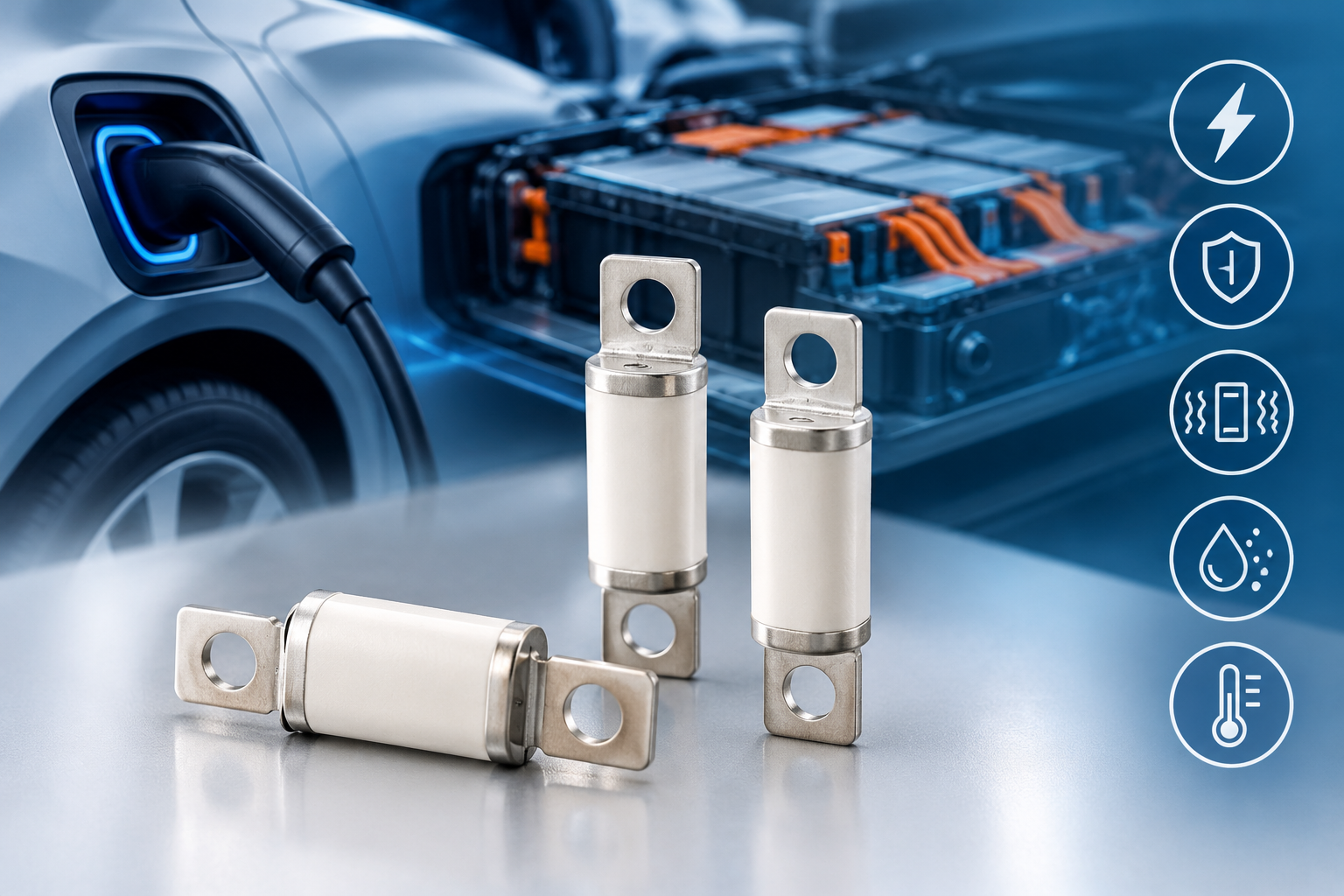
As electric vehicles (EVs) and high-voltage battery systems continue to evolve, reliable circuit protection is essential for maintaining electrical safety, system performance and operational reliability. The Eaton Bussmann EVKR 10 mm fuses are designed for high-voltage DC applications, offering a rated voltage of 1,000 VDC and a maximum breaking capacity of 20 kA.
Available in rated currents of 20A, 25A, 30A, 40A and 50A, the EVKR fuse range supports the protection requirements of high-capacity battery packs and other suitable high-voltage DC electrical systems. Its higher voltage rating and high interrupting capability make it a solution worth considering for engineers and manufacturers developing electric vehicles and battery-powered platforms.
In this guide, we explore the key features, technical specifications, available part numbers, packaging options and installation considerations for Eaton Bussmann EVKR 10 mm fuses.
What Are Eaton Bussmann EVKR 10 mm Fuses?
Eaton Bussmann EVKR 10 mm fuses are high-voltage DC fuses intended for electrical protection applications where high-capacity battery systems require dependable fault-current interruption.
The range is designed to address the demands of higher-voltage battery packs, including the electrical protection requirements associated with vehicle acceleration and driving range. Its 1,000 VDC voltage rating supports higher-voltage system architectures, while its maximum breaking capacity of 20 kA provides a defined upper fault-current interruption capability under the applicable test conditions.
These fuses are available in five rated-current options, allowing designers to select a suitable rating based on the electrical circuit, operating conditions and equipment manufacturer's requirements.
Key features of EVKR 10 mm fuses
-
1,000 VDC rated voltage: Suitable for appropriately designed high-voltage DC systems within the fuse's specified operating limits.
-
20 kA maximum breaking capacity: Provides high fault-current interruption capability under specified conditions.
-
Five current ratings: Available in 20A, 25A, 30A, 40A and 50A versions.
-
High-voltage battery protection: Designed with the needs of high-capacity battery packs in mind.
-
Compact 10 mm designation: Helps identify the fuse series; confirm the actual mounting dimensions and compatibility against the manufacturer's drawing.
-
M5 screw connection: The listed variants use M5 screw connections.
-
Defined operating and storage temperature range: The supplied catalogue data specifies a storage temperature range of −40°C to +85°C.
-
Regulatory material compliance: Listed as RoHS, ELV and REACH compliant.
Technical Specifications of Eaton Bussmann EVKR Fuses
Understanding the electrical and mechanical specifications is essential when selecting a fuse for a high-voltage DC application.
The following table summarises the key technical data supplied for the Eaton Bussmann EVKR 10 mm fuse range.
| Specification | Details |
|---|---|
| Product series | Eaton Bussmann EVKR 10 mm |
| Rated voltage | 1,000 VDC |
| Rated current | 20A, 25A, 30A, 40A and 50A |
| Maximum breaking capacity | 20 kA |
| Minimum breaking capacity, 20A–30A | 200% of rated current (In) |
| Minimum breaking capacity, 40A–50A | 300% of rated current (In) |
| Screw type | M5 |
| Listed weight | 0.01 kg per fuse |
| Storage temperature | −40°C to +85°C |
| Torque limit | 4.5 ± 1 Nm |
| Compliance | RoHS, ELV and REACH |
| Referenced standards | GB/T 31465 and ISO 8820 |
Important: Minimum breaking capacity refers to the minimum fault current at which the fuse is specified to interrupt under applicable conditions. It is not the minimum normal operating current. Likewise, the maximum breaking capacity is not a continuous current rating. Confirm the manufacturer's detailed datasheet for time-current characteristics, mounting dimensions, ambient-temperature limitations and other application-specific requirements.
Why Choose EVKR 10 mm Fuses for High-Voltage DC Applications?
1. Designed for 1,000 VDC systems
High-voltage battery architectures can help manufacturers meet increasing demands for power and energy delivery. The EVKR series has a rated voltage of 1,000 VDC, making it a potential option for compatible high-voltage DC circuit protection designs.
A higher system voltage can also support the use of smaller, more economical conductors when the complete electrical design permits it. Conductor selection must still account for current, temperature rise, insulation, installation conditions and applicable safety requirements.
2. High breaking capacity for battery protection
High-capacity battery packs can deliver substantial fault currents. Selecting a fuse with an appropriate breaking capacity is therefore essential to ensure that a fault can be interrupted safely.
The EVKR range specifies a maximum breaking capacity of 20 kA. This characteristic is particularly relevant when evaluating protection for high-energy battery systems, provided the prospective fault current and other circuit conditions remain within the fuse's verified ratings.
3. Multiple rated-current options
The availability of 20A, 25A, 30A, 40A and 50A versions gives engineers flexibility when designing and maintaining electrical systems.
The correct rating depends on the normal operating current, expected overloads, prospective fault current, conductor ampacity, ambient conditions and the equipment manufacturer's protection requirements. A fuse should never be selected on rated current alone.
4. M5 screw connection
All listed EVKR catalogue variants use an M5 screw connection. This provides a defined mechanical connection specification for compatible mounting arrangements.
The supplied torque limit is 4.5 ± 1 Nm, equivalent to a range of 3.5–5.5 Nm. Always verify the manufacturer's installation instructions and the requirements of the complete terminal assembly before tightening. Excessive or insufficient torque can compromise an electrical connection.
5. Compliance and environmental considerations
The supplied product information identifies the EVKR range as compliant with RoHS, ELV and REACH requirements. It also lists environmental test references for exposure to water vapour and sulphur dioxide.
These details may be relevant to manufacturers assessing material compliance and environmental durability. Confirm the applicable declarations, test reports and precise compliance scope for the specific product variant before using them in formal qualification or regulatory documentation.
Eaton Bussmann EVKR 10 mm Fuse Part Numbers and Packaging Options
The EVKR series includes multiple catalogue SKUs across five rated-current levels. Each current rating is available in four listed catalogue variants: the standard part number, a -T variant, a -B variant and a -1P variant.
The supplied catalogue data distinguishes these variants by packaging quantity. It does not define the exact meaning of each suffix, so buyers should confirm the packaging configuration and any other differences with the supplier before placing an order.
EVKR 20A fuse variants
| Part number | Rated current | Packaging quantity |
|---|---|---|
| EVKR10-20 | 20A | 10 per box |
| EVKR10-20-T | 20A | 270 per box |
| EVKR10-20-B | 20A | 270 per box |
| EVKR10-20-1P | 20A | 180 per box |
EVKR 25A fuse variants
| Part number | Rated current | Packaging quantity |
|---|---|---|
| EVKR10-25 | 25A | 10 per box |
| EVKR10-25-T | 25A | 270 per box |
| EVKR10-25-B | 25A | 270 per box |
| EVKR10-25-1P | 25A | 180 per box |
EVKR 30A fuse variants
| Part number | Rated current | Packaging quantity |
|---|---|---|
| EVKR10-30 | 30A | 10 per box |
| EVKR10-30-T | 30A | 270 per box |
| EVKR10-30-B | 30A | 270 per box |
| EVKR10-30-1P | 30A | 180 per box |
EVKR 40A fuse variants
| Part number | Rated current | Packaging quantity |
|---|---|---|
| EVKR10-40 | 40A | 10 per box |
| EVKR10-40-T | 40A | 270 per box |
| EVKR10-40-B | 40A | 270 per box |
| EVKR10-40-1P | 40A | 180 per box |
EVKR 50A fuse variants
| Part number | Rated current | Packaging quantity |
|---|---|---|
| EVKR10-50 | 50A | 10 per box |
| EVKR10-50-T | 50A | 270 per box |
| EVKR10-50-B | 50A | 270 per box |
| EVKR10-50-1P | 50A | 180 per box |
These catalogue options support different purchasing quantities, from smaller orders to higher-volume requirements. For procurement teams, matching the complete part number is important because variants with the same rated current may have different packaging configurations.
How to Select the Right EVKR 10 mm Fuse
Choosing the correct Eaton Bussmann EVKR fuse requires more than matching the current rating to a circuit's nominal load.
Consider the following factors before ordering or installing a fuse.
Step 1: Confirm the system voltage
Ensure that the fuse's 1,000 VDC rating is appropriate for the maximum DC voltage of the application, including relevant operating and fault conditions. The fuse's DC voltage rating must be suitable for the circuit in which it will be used.
Step 2: Determine the required current rating
Select from the available 20A, 25A, 30A, 40A and 50A options using the circuit's continuous current, expected overloads, ambient temperature and conductor ratings.
Do not automatically choose a fuse with the same ampere rating as the normal operating current. Consult the relevant fuse time-current curves and equipment design requirements.
Step 3: Check prospective fault current
The circuit's prospective short-circuit current must be assessed against the fuse's maximum breaking capacity of 20 kA. The minimum breaking capacity must also be considered, particularly where the available fault current may be relatively low.
The supplied minimum breaking capacity is 200% of rated current for 20A–30A versions and 300% for 40A–50A versions.
Step 4: Verify mechanical compatibility
Confirm the required mounting arrangement, dimensions, terminal configuration and M5 screw connection. The product designation alone should not be used as a substitute for checking the manufacturer's dimensional drawing.
Step 5: Confirm the catalogue SKU
Choose the exact part number and required packaging quantity. The standard variants are listed in boxes of 10, -T and -B variants in boxes of 270, and -1P variants in boxes of 180.
Step 6: Follow installation requirements
The supplied torque specification is 4.5 ± 1 Nm. Use the manufacturer's installation instructions and approved procedures for the relevant equipment. High-voltage DC systems can retain dangerous energy even after power is disconnected, so installation and replacement must be carried out by appropriately qualified personnel under the applicable safety procedures.
Environmental and Standards Information
The supplied Eaton Bussmann EVKR product data includes the following compliance and environmental information:
-
RoHS, ELV and REACH: Listed as compliant with these requirements.
-
Water-vapour exposure: H₂O at 12.5 ppm for 96 hours, referenced to IEC 68-2-43 Kd.
-
Sulphur-dioxide exposure: SO₂ at 25 ppm for 504 hours, referenced to IEC 68-2-42 Kd.
-
Design standards: GB/T 31465 and ISO 8820 are listed as reference standards.
These references help provide context when reviewing a component for an automotive or high-voltage electrical design. The wording “designed to standards (reference)” should not be interpreted as independent certification to every listed standard. Request the applicable technical documentation and conformity evidence when formal compliance is required.
Frequently Asked Questions About Eaton Bussmann EVKR 10 mm Fuses
What voltage are Eaton Bussmann EVKR 10 mm fuses rated for?
The supplied technical data specifies a rated voltage of 1,000 VDC.
What current ratings are available?
The EVKR 10 mm series is listed in 20A, 25A, 30A, 40A and 50A versions.
What is the maximum breaking capacity of the EVKR fuse range?
The specified maximum breaking capacity is 20 kA. Suitability depends on the prospective fault current and the circuit conditions.
What is the minimum breaking capacity?
The minimum breaking capacity is specified as 200% of rated current for the 20A, 25A and 30A versions, and 300% of rated current for the 40A and 50A versions.
What screw connection do these fuses use?
The listed EVKR catalogue variants use an M5 screw connection. The supplied torque specification is 4.5 ± 1 Nm.
What is the storage temperature range?
The catalogue data specifies a storage temperature range of −40°C to +85°C. This is a storage specification and should not be assumed to be the permissible operating-temperature range.
How are EVKR 10 mm fuses packaged?
The standard catalogue variants are supplied in boxes of 10. The -T and -B variants are listed in boxes of 270, while the -1P variants are listed in boxes of 180.
Are Eaton Bussmann EVKR fuses suitable for every electric vehicle?
No. Suitability depends on the vehicle's electrical architecture, rated voltage, operating current, fault-current conditions, mounting arrangement and applicable qualification requirements. Always confirm compatibility with the manufacturer's technical documentation and the vehicle or equipment design authority.
Conclusion: Find the Right Eaton Bussmann EVKR 10 mm Fuse
The Eaton Bussmann EVKR 10 mm fuse series offers a selection of 20A to 50A ratings, a specified voltage rating of 1,000 VDC and a maximum breaking capacity of 20 kA. With M5 screw connections and multiple catalogue packaging options, the range provides engineers and procurement teams with several configurations to evaluate for compatible high-voltage DC protection applications.
When selecting an EVKR fuse, prioritise electrical compatibility, fault-current performance, mounting requirements and the exact catalogue SKU. Reviewing the manufacturer's datasheet and application requirements before purchase helps ensure the selected component is appropriate for the intended system.
Looking for Eaton Bussmann EVKR 10 mm fuses? Compare the available part numbers and packaging quantities, confirm the required current rating, and consult your supplier for current availability and the technical documentation needed for your application.



