
 eaton-ev-fuse-catalogue-emob0062-en-us.pdf  | [Eaton EV Fuses] | 0 kB |
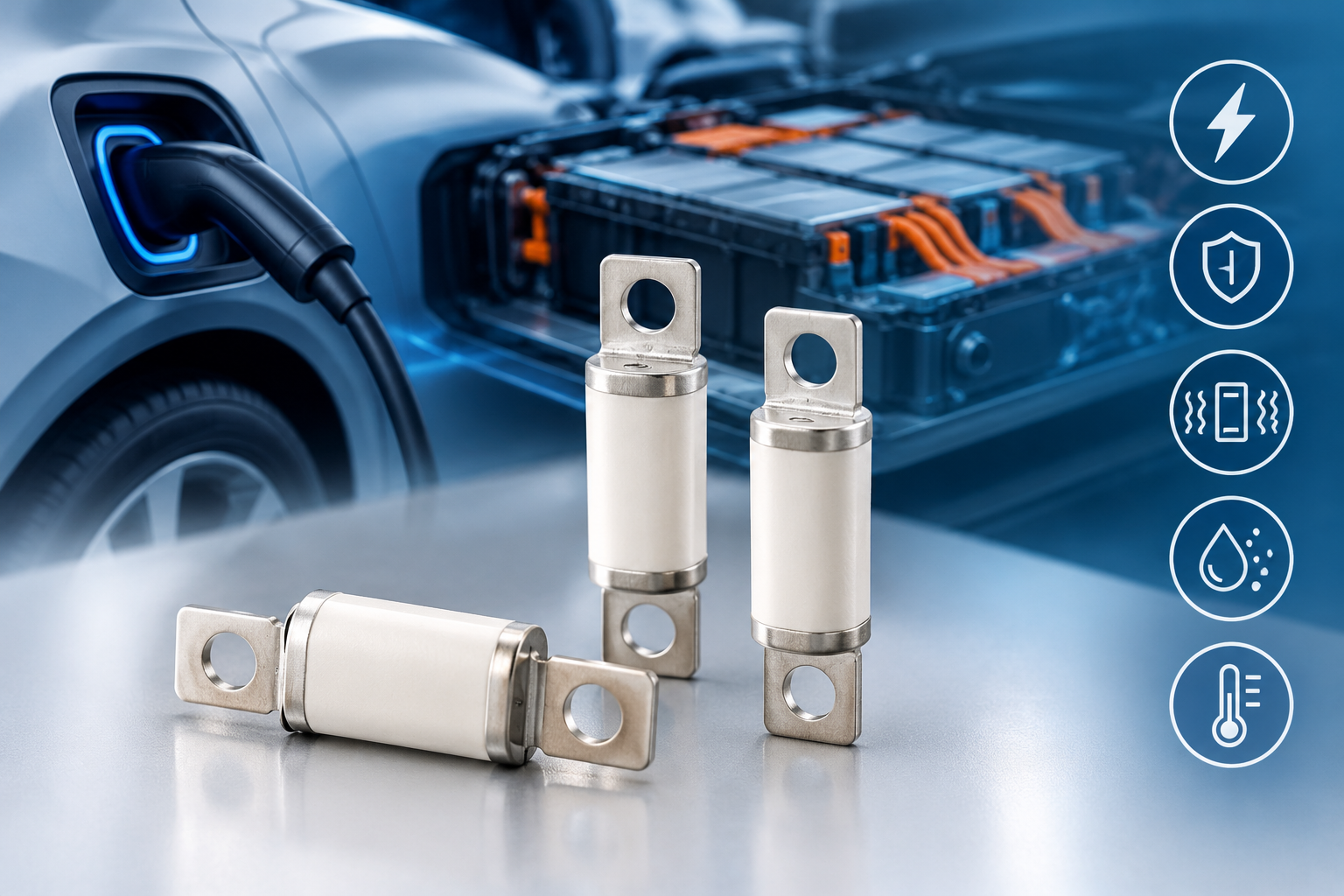
Eaton Bussmann EVK 22 mm Fuses: High-Voltage Protection for Electric Vehicles
As electric vehicle (EV) technology continues to advance, reliable high-voltage circuit protection is essential for battery safety, system performance, and operational reliability. Eaton Bussmann EVK 22 mm fuses are designed to support high-voltage electric vehicle battery systems, offering a rated voltage of up to 1000 VDC, current ratings from 15 A to 600 A, and a maximum breaking capacity of 25 kA.
Designed for demanding automotive applications, EVK 22 mm fuses combine high-voltage protection capabilities with standards-based design and automotive manufacturing quality requirements. They are a solution to consider for engineers, system integrators, and EV manufacturers developing high-voltage battery packs and associated electrical systems.
In this guide, we explore the key features, technical specifications, applications, and available catalog information for Eaton Bussmann EVK 22 mm fuses.
What Are Eaton Bussmann EVK 22 mm Fuses?
Eaton Bussmann EVK 22 mm fuses are high-voltage DC protection components intended for electric vehicle battery systems and related automotive electrical applications.
High-voltage battery packs require suitable protection against excessive current and electrical faults. A correctly selected fuse helps interrupt fault currents within its specified operating limits, reducing the risk of damage to electrical components and supporting overall system protection.
The EVK series offers a high rated voltage and a broad current range, making it relevant to EV designs with different battery capacities, power requirements, and electrical architectures.
Key characteristics include:
-
High voltage rating: Rated up to 1000 VDC.
-
Wide current range: Available within a specified range of 15 A to 600 A.
-
High breaking capacity: Maximum breaking capacity of 25 kA.
-
Automotive-focused design: Designed with reference to recognised automotive and fuse standards.
-
Quality manufacturing: Manufactured under IATF 16949 and VDA 6.3 automotive quality systems.
-
Environmental compliance: RoHS compliant, with a REACH declaration available upon request.
These characteristics make the EVK 22 mm fuse family worth evaluating for high-voltage battery protection and other suitable EV electrical applications.
Eaton Bussmann EVK 22 mm Fuses: Technical Specifications
Understanding the technical data is essential when selecting a fuse for an electric vehicle battery system. The following table summarises the supplied specifications for the EVK 22 mm series.
| Technical parameter | Specification |
|---|---|
| Product series | Eaton Bussmann EVK 22 mm |
| Rated voltage | 1000 VDC |
| Rated current range | 15–600 A |
| Maximum breaking capacity | 25 kA |
| Minimum breaking current for ratings up to and including 200 A | 1.35 × rated current (In) |
| Minimum breaking current for ratings above 200 A | 2 × rated current (In) |
| Reference standards | UL 248-20, ISO 8820-8, JASO D622 |
| Automotive quality systems | IATF 16949 / VDA 6.3 |
| RoHS status | Compliant |
| REACH documentation | Available upon request |
| Specified storage temperature | −40°C to +85°C for the listed catalog entries |
| Listed screw type | M6 |
| Listed torque limit | 9 ± 1 (unit to be confirmed against the manufacturer’s datasheet) |
Important: Confirm the complete part number, individual fuse rating, electrical characteristics, and installation requirements against the latest manufacturer documentation before specifying or purchasing a fuse.
Key Features and Benefits of EVK 22 mm Fuses
1. High-Voltage Protection up to 1000 VDC
Modern electric vehicles increasingly use high-voltage battery architectures to support efficient power delivery and charging performance. A fuse with a rated voltage of 1000 VDC can be suitable for systems designed within that voltage limit, provided its other electrical and application requirements are also satisfied.
The high voltage rating of Eaton Bussmann EVK 22 mm fuses supports efficient and economical system design for high-voltage battery packs.
For engineers, selecting a fuse with an appropriate DC voltage rating is particularly important because interrupting direct current can present different challenges from interrupting alternating current. The selected fuse must be suitable for the system's maximum operating voltage and anticipated fault conditions.
2. Current Ratings from 15 A to 600 A
The EVK 22 mm series covers a rated current range of 15 A to 600 A, providing options for different electrical load requirements.
This range allows designers to evaluate suitable fuse ratings for battery connections, power distribution circuits, and other compatible high-current EV applications.
However, selecting the correct ampere rating involves more than matching the fuse to the normal operating current. Engineers should also consider:
-
Continuous operating current and load profile.
-
Ambient temperature and thermal conditions.
-
Cable ampacity and connection design.
-
Overload and short-circuit characteristics.
-
Coordination with other protective devices.
-
Applicable automotive safety requirements.
Correct fuse selection helps ensure that the protective device is appropriate for the intended circuit and its operating environment.
3. Maximum Breaking Capacity of 25 kA
Breaking capacity is a critical consideration in high-voltage battery protection.
Eaton Bussmann EVK 22 mm fuses have a specified maximum breaking capacity of 25 kA. This indicates the stated maximum fault current the fuse is designed to interrupt under its applicable test conditions.
The manufacturer highlights the high interrupting rating as a feature supporting long-range and fast-acceleration EV battery systems.
For practical system design, the available prospective short-circuit current must be assessed carefully. The selected fuse must have adequate interrupting capability for the fault conditions at its installation point, at the applicable system voltage.
4. Defined Minimum Breaking Current
The supplied technical information specifies different minimum breaking current multipliers depending on the fuse's rated current.
-
For ratings up to and including 200 A: 1.35 × In.
-
For ratings above 200 A: 2 × In.
Here, In represents the fuse's rated current.
For example, a hypothetical 100 A fuse would have a stated minimum breaking current of 135 A under the supplied criterion. A hypothetical 300 A fuse would have a corresponding value of 600 A.
These calculations illustrate the specified multipliers; they do not establish a fuse's complete time-current behaviour or its suitability for a particular circuit. Consult the manufacturer's detailed datasheet for the relevant operating characteristics and test conditions.
5. Automotive Manufacturing Quality
Reliability is essential in automotive electrical systems, where protective components must meet demanding manufacturing and quality expectations.
The EVK 22 mm series is manufactured under IATF 16949 and VDA 6.3 automotive quality systems.
IATF 16949 is an automotive quality management system standard, while VDA 6.3 is an established process-audit framework used within the automotive industry. These frameworks support quality management and manufacturing process control.
For automotive manufacturers and suppliers, this manufacturing context is an important consideration when evaluating components for vehicle electrical architectures.
Standards and Environmental Compliance
The supplied product information references the following standards:
-
UL 248-20: A fuse standard relevant to supplementary fuse requirements and applications.
-
ISO 8820-8: An automotive road-vehicle fuse standard covering particular fuse designs.
-
JASO D622: An automotive industry standard referenced in the product information.
The EVK 22 mm series is also described as RoHS compliant, while a REACH declaration is available upon request.
Standards references should be checked against the latest product documentation to establish the precise scope of conformity, the applicable edition, and any required approvals for the intended market.
For procurement teams, obtaining the relevant declarations and technical documents before qualification can help streamline component approval and product compliance processes.
Applications of Eaton Bussmann EVK 22 mm Fuses
The high-voltage rating and broad current range make the EVK 22 mm series a candidate for evaluation in suitable electric vehicle electrical systems.
Potential application areas include:
High-Voltage EV Battery Packs
Battery packs require protection against excessive current and short-circuit faults. A suitably selected EVK fuse may form part of a battery protection strategy, subject to system voltage, fault-current analysis, and manufacturer application guidance.
Electric Power Distribution
High-current electrical distribution circuits may require dedicated protective devices to help protect conductors and connected equipment against fault conditions.
High-Power Electric Vehicle Architectures
Vehicles designed for high power output, rapid acceleration, or demanding energy delivery may require robust electrical protection. Fuse selection must account for actual load profiles, prospective fault currents, and the complete electrical design.
Automotive Electrification Projects
EV manufacturers, engineering teams, and system integrators can evaluate the series when developing or upgrading high-voltage electrical systems.
These are potential application areas rather than a confirmation that every EVK variant is approved for every listed use. Check the individual part's ratings, approvals, mounting requirements, and intended application before integrating it into a system.
Eaton Bussmann EVK 22 mm Fuse Catalog Numbers
The supplied catalog information includes 60 A, 70 A, and 80 A entries under the part-number format EVK22-XX-T.
| Part number format | Rated current | Packaging quantity | Screw type | Weight | Storage temperature | Torque limit |
|---|---|---|---|---|---|---|
| EVK22-XX-T | 60 A | 100 per box | M6 | Not specified | −40°C to +85°C | 9 ± 1 |
| EVK22-XX-T | 70 A | 100 per box | M6 | Not specified | −40°C to +85°C | 9 ± 1 |
| EVK22-XX-T | 80 A | 100 per box | M6 | Not specified | −40°C to +85°C | 9 ± 1 |
Catalog note: The supplied part numbers contain the placeholder “XX”. Obtain the complete manufacturer part number for each current rating before placing an order. The torque value is reproduced as provided; its unit should be verified against the official datasheet. Weight is listed as NA in the supplied information and has therefore not been assigned a numerical value.
Although the series has a stated current range of 15 A to 600 A, the three entries above represent only the catalog variants included in the supplied data.
How to Select the Right EVK 22 mm Fuse
Selecting the correct fuse is an important step in developing a safe and reliable EV electrical system. Consider the following factors before choosing a variant.
1. Confirm the maximum system voltage.
Ensure the fuse's DC voltage rating is suitable for the battery pack and the maximum voltage that can occur under the intended operating conditions.
2. Determine the required current rating.
Evaluate normal operating current, continuous loading, transient conditions, and the thermal environment rather than selecting a fuse solely by nominal load current.
3. Calculate prospective short-circuit current.
Verify that the fuse's breaking capacity is sufficient for the expected fault current at the installation point.
4. Review minimum breaking current and time-current characteristics.
Confirm that the fuse can operate appropriately for the relevant fault conditions. Obtain the complete manufacturer's performance curves and specifications.
5. Check mechanical and thermal requirements.
Verify the mounting arrangement, M6 connection details where applicable, terminal requirements, installation torque, and storage and operating temperature limits.
6. Confirm standards and documentation.
Review the applicable standards, declarations, manufacturer datasheet, and any additional requirements for the vehicle platform or target market.
A fuse should always be selected as part of a coordinated electrical protection strategy, with the final design validated by qualified engineering personnel.
Why Consider Eaton Bussmann EVK 22 mm Fuses?
Eaton Bussmann EVK 22 mm fuses offer several features relevant to high-voltage electric vehicle design: a 1000 VDC rated voltage, current ratings from 15 A to 600 A, a maximum breaking capacity of 25 kA, and manufacturing under recognised automotive quality systems.
Their stated design features address the requirements of high-voltage battery systems, including the need for suitable fault-current interruption and efficient electrical system design.
For engineers and procurement specialists, the most important next step is to match the specific fuse variant to the electrical, mechanical, thermal, and compliance requirements of the application.
Frequently Asked Questions About EVK 22 mm Fuses
What is the rated voltage of Eaton Bussmann EVK 22 mm fuses?
The stated rated voltage is 1000 VDC, making the series a candidate for compatible high-voltage DC applications within its specified limits.
What current ratings are available?
The stated series range is 15 A to 600 A. The supplied catalog entries include 60 A, 70 A, and 80 A variants.
What is the maximum breaking capacity?
The specified maximum breaking capacity is 25 kA. The actual suitability of a fuse depends on the prospective fault current, system voltage, and applicable test conditions.
Which standards are referenced?
The supplied product information references UL 248-20, ISO 8820-8, and JASO D622. Confirm the applicable standards and product documentation for the specific variant.
Are EVK 22 mm fuses RoHS compliant?
Yes. The supplied product information identifies the series as RoHS compliant. A REACH declaration is available upon request.
What is the packaging quantity?
The three supplied catalog entries specify 100 fuses per box. Confirm packaging details for the exact part number when ordering.
What is the storage temperature range?
The listed catalog entries specify a storage temperature range of −40°C to +85°C. Confirm the latest datasheet for the selected variant and distinguish storage limits from operating temperature limits.
Conclusion
Eaton Bussmann EVK 22 mm fuses are designed for high-voltage electric vehicle battery systems and related automotive electrical applications. With a rated voltage of 1000 VDC, a current range of 15 A to 600 A, and a maximum breaking capacity of 25 kA, the series offers key specifications for engineers evaluating high-voltage DC circuit protection.
Its referenced automotive standards, RoHS compliance, and automotive manufacturing quality systems add further considerations for component selection and qualification.
When specifying an EVK 22 mm fuse, always verify the complete catalog number, electrical ratings, interrupting characteristics, mounting requirements, and current manufacturer documentation.
Looking for Eaton Bussmann EVK 22 mm fuses? Compare the available current ratings and confirm the exact part number and technical requirements with your authorised supplier to identify the appropriate solution for your EV battery protection application.



