
 eaton-ev-fuse-catalogue-emob0062-en-us.pdf  | [Eaton Bussmann EV Fuses] | 0 kB |
The Working Principle of EV Fuses: How Eaton Bussmann Fuses Protect Electric Vehicles
Introduction: Why EV Fuses Are Essential for Electric Mobility
Electric vehicles place demanding requirements on electrical safety. High-voltage batteries, powerful electric drive systems, and modern charging equipment operate at high voltages and currents. A short circuit or sustained overload can damage sensitive electronic components and create significant safety risks.
EV fuses (Electric Vehicle Fuses) play a central role in electrical protection. They interrupt the circuit when an excessive current occurs, helping protect batteries, power electronics, cables, and other electrical components from damage.
The Eaton Bussmann series offers fuse solutions specifically developed for hybrid and electric vehicles. Depending on the product, the portfolio includes fuses rated for voltages from 500 to 1,000 V DC and currents from 10 to 1,600 A. These options address different protection requirements across modern electric vehicle architectures.
But how exactly does an EV fuse work? What role does arc suppression play, and what should engineers consider when selecting the right Eaton Bussmann fuse?
1. What Is an EV Fuse?
An EV fuse is an electrical protection device designed for the operating conditions of electric and hybrid vehicles. It protects electrical circuits against overcurrents, particularly short circuits and certain overload conditions.
Unlike fuses used in many conventional low-voltage applications, high-voltage fuses for electric vehicles must not only carry substantial currents but also safely interrupt high DC voltages.
Three characteristics are particularly important:
-
Fast current interruption: Limits the energy released into a circuit during an electrical fault.
-
High breaking capacity: Safely interrupts high prospective short-circuit currents under specified operating conditions.
-
Precise coordination: Matches the protection characteristics to the battery, cables, power electronics, and actual vehicle load profile.
Eaton Bussmann EV fuses are designed for these demanding operating conditions. Correct fuse selection and sizing help protect electrical components and improve the overall safety of the system.
2. How Does an EV Fuse Work? The Working Principle Step by Step
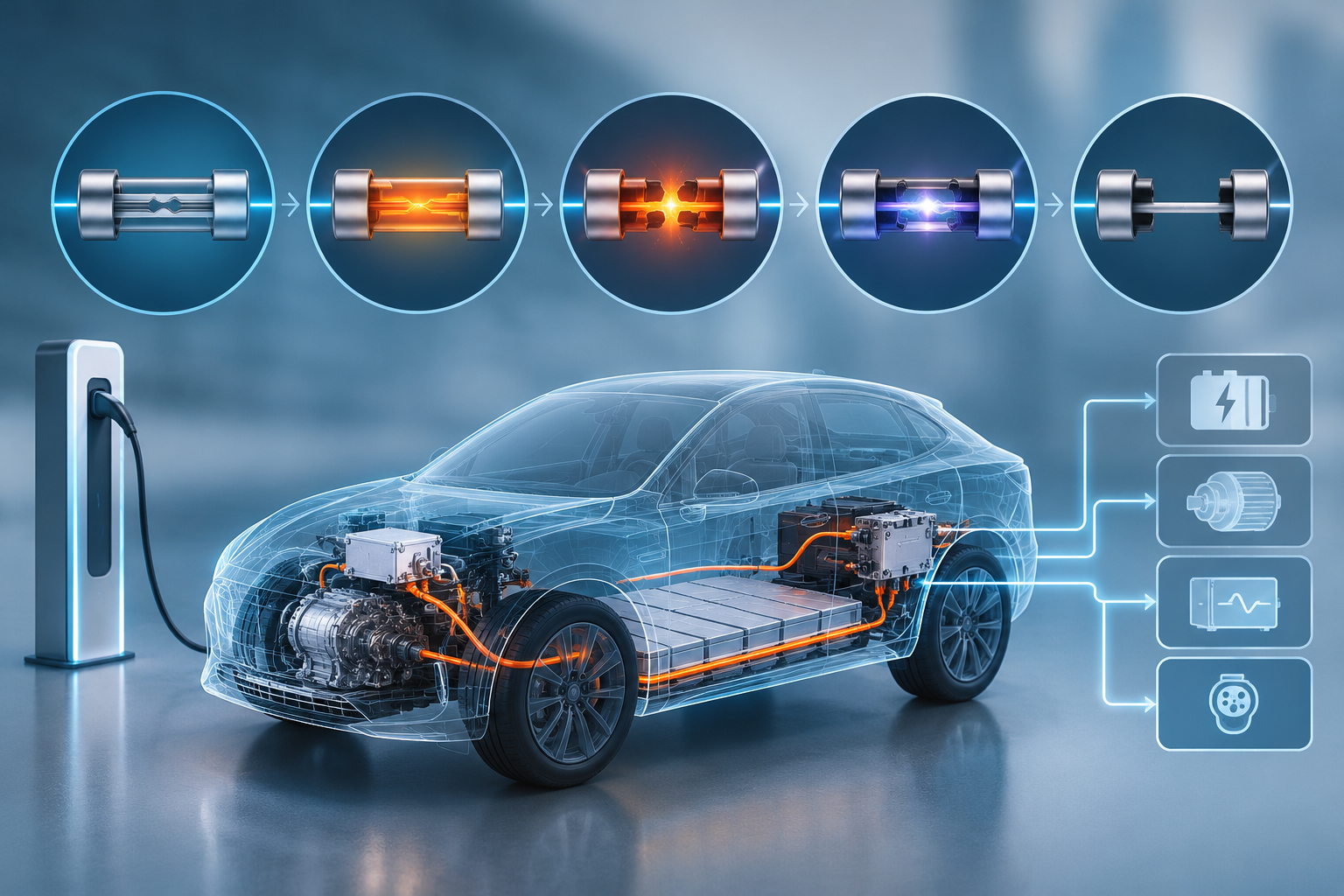
The working principle of EV fuses is based on a fundamental physical process: When current becomes excessive, the fuse element heats up until it melts and interrupts the electrical circuit. In high-voltage applications, safely extinguishing the resulting electrical arc is also essential.
Step 1: Normal Operation – Maintaining Current Flow
During normal vehicle operation, current flows through the conductive fuse element. The element is designed to carry the specified operating current without overheating under the defined operating conditions.
Fuse selection takes several factors into account, including:
-
Rated current and operating voltage
-
Ambient temperature
-
Thermal conditions within the installation
-
Load cycles and temporary current peaks
These factors are important when selecting and sizing an Eaton Bussmann EV fuse for a particular application.
Step 2: Overcurrent – Increasing Heat Generation
When a short circuit or overload occurs, current rises beyond the intended operating range. This increases the power dissipated in the fuse element.
The relationship can be expressed using the following formula:
P = I² × R
Where:
-
P represents electrical power dissipation.
-
I represents current.
-
R represents electrical resistance.
Because power dissipation increases with the square of the current, a significant increase in current can cause rapid heating. The fuse element is designed to respond to specific fault conditions by melting when the applicable operating limits are exceeded.
Step 3: The Fuse Element Interrupts the Circuit
When the thermal stress exceeds the design limit, the fuse element melts at designated points, breaking the conductive path.
The time required for interruption depends on the magnitude of the overcurrent, the fuse characteristics, and the duration of the fault.
During a severe short circuit, the fuse must respond quickly to limit let-through energy. Under a moderate overload, the response time may be considerably longer.
Eaton Bussmann EV fuses are designed with defined time-current characteristics to meet specific protection requirements. This allows engineers to coordinate the fuse with the protected components and the overall vehicle architecture.
Step 4: Arc Suppression in DC Applications
Melting the fuse element does not necessarily mean that electrical conduction stops immediately. An electrical arc can form between the separated ends of the fuse element.
This is particularly important in DC applications. Unlike AC, direct current does not have a natural periodic zero crossing that helps extinguish the arc.
High-voltage DC fuses must therefore control and extinguish the arc. Depending on the fuse design, this can involve an insulating housing and arc-quenching filler materials that absorb energy and help cool and extinguish the arc.
The specific construction and interruption characteristics vary by fuse type. The essential requirement is that the fuse must be rated for the applicable DC voltage and expected fault current.
Step 5: Safe Interruption of the Fault Current
Once the arc has been extinguished, current flow is interrupted, limiting the further supply of electrical energy to the fault location.
A correctly selected Eaton Bussmann EV fuse can help reduce the risk of damage to batteries, inverters, cables, and other electrical components.
However, a fuse cannot prevent every type of electrical damage. Its effectiveness depends on the fault conditions, available short-circuit current, interruption characteristics, and correct integration into the overall electrical protection system.
3. What Are the Main Components of an EV Fuse?
The exact construction varies by product. However, several fundamental components are important for understanding how an EV fuse works.
| Component | Function |
|---|---|
| Fuse element | Carries current during normal operation and interrupts the current path under specified overcurrent conditions. |
| Housing | Provides electrical insulation and mechanical protection while withstanding the thermal stresses associated with interruption. |
| Arc-quenching system | Helps extinguish the electrical arc that can form when the fuse element melts. |
| Electrical terminals | Provide a reliable connection between the fuse and the protected circuit. |
When selecting an Eaton Bussmann fuse, these characteristics must be considered alongside the technical specifications of the individual product. Not every EV fuse has the same construction or supports the same voltage and current ranges.
4. Eaton Bussmann EV Fuses: Protection for Modern Vehicle Architectures
The Eaton Bussmann series has been developed to address the electrical protection requirements of hybrid and electric vehicles. It includes different fuse configurations for high-voltage circuits, battery systems, power electronics, and other electrical applications.
Key portfolio characteristics include:
-
Wide voltage range: Depending on the product, ratings range from 500 to 1,000 V DC.
-
Various current ratings: Product variants cover currents from 10 to 1,600 A.
-
Compact, fast-acting designs: Suitable for different installation and protection requirements.
-
High breaking capacity: Defined according to the specifications and intended application of each product.
-
Application-specific sizing: Simulations of individual drive cycles and operating conditions can support fuse selection and validation.
-
Traceability and quality assurance: Serial numbers and date codes support product identification and traceability.
Available ratings and characteristics vary by product family. Rated voltage, rated current, and breaking capacity must always be verified against the technical specifications of the selected fuse.
Why Is Fast Short-Circuit Interruption Important?
A short circuit in a high-voltage battery system can generate extremely high currents. The longer a fault current continues to flow, the more energy can be released at the fault location.
A fast-acting fuse can limit let-through energy, reducing the electrical and thermal stress placed on cables, contacts, and power semiconductors.
Eaton Bussmann EV fuses are designed to provide short-circuit protection for sensitive electronic components. Actual interruption times depend on the specific fuse type and the electrical fault conditions.
5. Where Are Eaton Bussmann EV Fuses Used?
EV fuses are used at various points throughout an electric vehicle's electrical system. The required characteristics depend on the specific application.
High-Voltage Battery and Main Battery Circuit
The fuse protects the designated current path between the battery, power distribution system, and drive system against excessive current.
Key selection factors include maximum system voltage, potential short-circuit current, and the required interruption characteristics.
Inverters and Power Electronics
The inverter converts electrical energy into the form required by the electric drive. A suitably selected fuse can protect the relevant circuit during a fault and help limit stress on sensitive power components.
Charging Systems and Charging Electronics
Onboard chargers and associated electrical circuits require protection matched to their operating conditions. The current type, voltage, and potential fault conditions must be considered when selecting the appropriate fuse.
Auxiliary Systems and Electrical Circuits
Electrical auxiliaries and supporting systems also require suitable overcurrent protection. Different fuse designs and current ratings may be appropriate depending on the voltage level and current requirements.
Eaton Bussmann offers different fuse solutions that can be selected according to their technical specifications and the requirements of the vehicle architecture.
6. How to Select the Right EV Fuse: Key Sizing Criteria
Selecting an appropriate EV fuse is an important part of electrical system design. A fuse must carry normal operating currents without unnecessary interruptions while reliably clearing faults within the required limits.
The following criteria are particularly important.
1. Rated Voltage
The fuse's DC voltage rating must be suitable for the maximum possible operating voltage of the protected circuit. Relevant operating states and voltage tolerances must also be considered.
2. Rated Current
The rated current must be appropriate for the continuous load, ambient temperature, and thermal conditions within the installation.
A higher current rating is not automatically better. An oversized fuse may compromise the protection provided to certain components.
3. Breaking Capacity
The fuse's breaking capacity must be sufficient for the prospective fault current under the specified operating conditions. This is particularly important in high-voltage battery systems, where available short-circuit currents can be substantial.
4. Time-Current Characteristics
The fuse must be coordinated with normal operating currents, temporary current peaks, and potentially dangerous overcurrents.
The time-current curve of the selected product is essential for evaluating its suitability and coordination with other protective devices.
5. Temperature and Installation Conditions
Ambient temperature, contact resistance, cooling, and installation conditions affect the fuse's thermal behavior. Current-carrying capacity must therefore be assessed under the actual operating conditions.
6. Coordination with the Battery Management System
The battery management system (BMS) monitors relevant battery parameters and can initiate protective measures when faults are detected.
The fuse complements these electronic protection functions by physically interrupting the current when its operating conditions require it.
Both protection layers must be coordinated. A fuse does not replace the BMS or other required protection and disconnection devices.
7. EV Fuses vs. Conventional Fuses: What Is the Difference?
EV fuses differ from many conventional fuses primarily in their design for high-voltage DC applications, high fault currents, and demanding operating profiles.
| Feature | Conventional Fuse | High-Voltage EV Fuse |
|---|---|---|
| Application | Depends on fuse type, including low-voltage circuits | High-voltage and other electrical vehicle circuits |
| Voltage | Depends on the specific rating | Depending on the design, suitable for high-voltage DC applications |
| Short-circuit protection | Depends on time-current characteristics and breaking capacity | Designed for the specified fault conditions of vehicle circuits |
| Arc suppression | Depends on AC or DC ratings | Designed for specified operating and interruption conditions |
| Mechanical requirements | Depend on the application | Must account for relevant automotive operating conditions |
| Sizing | Based on the circuit and load profile | Considers battery characteristics, load profile, temperature, and fault current |
Not every conventional fuse is limited to low-voltage applications, and not every EV fuse is suitable for every high-voltage circuit. The technical specifications and approvals of the individual product must always be checked.
8. Why Consider Eaton Bussmann Fuses in Electric Vehicle Development?
When developing an electric vehicle, engineers must balance safety, packaging, weight, and reliable operation. Fuses are an important part of the overall electrical protection strategy.
The Eaton Bussmann series offers several relevant advantages for vehicle developers:
-
Adaptability to different vehicle architectures: Different designs and electrical ratings support application-specific fuse selection.
-
Fast protection response: Suitable fuse types can limit fault energy under short-circuit conditions.
-
Consideration of real-world load profiles: Simulation and technical validation can support the selection of an appropriate fuse.
-
Integration into high-voltage systems: Different product configurations address varying voltage and current requirements.
-
Quality-focused manufacturing: Manufacturing under an IATF 16949 quality management system supports the requirements of automotive applications.
The actual benefits depend on the selected product family, correct sizing, and integration into the overall electrical system.
Conclusion: Understanding the Working Principle of EV Fuses
EV fuses are an essential part of the electrical protection strategy in modern electric vehicles. Their working principle relies on the controlled heating and melting of a fuse element when excessive current flows. In high-voltage applications, safely extinguishing the resulting electrical arc is equally important.
Eaton Bussmann EV fuses combine application-specific design, fast protection response, and high breaking capacity to address the requirements of modern battery, drive, and charging systems.
Reliable protection depends on more than rated voltage and rated current. Breaking capacity, time-current characteristics, thermal conditions, and coordination with other protective components are equally important.
By considering these factors early in the development process, engineers can establish an important foundation for safe, reliable, and high-performance electrical systems in electric mobility.
Note: The selection and sizing of a specific Eaton Bussmann fuse must be based on the relevant product datasheet and actual application conditions. High-voltage systems must be designed, installed, and serviced exclusively by appropriately qualified personnel.



