
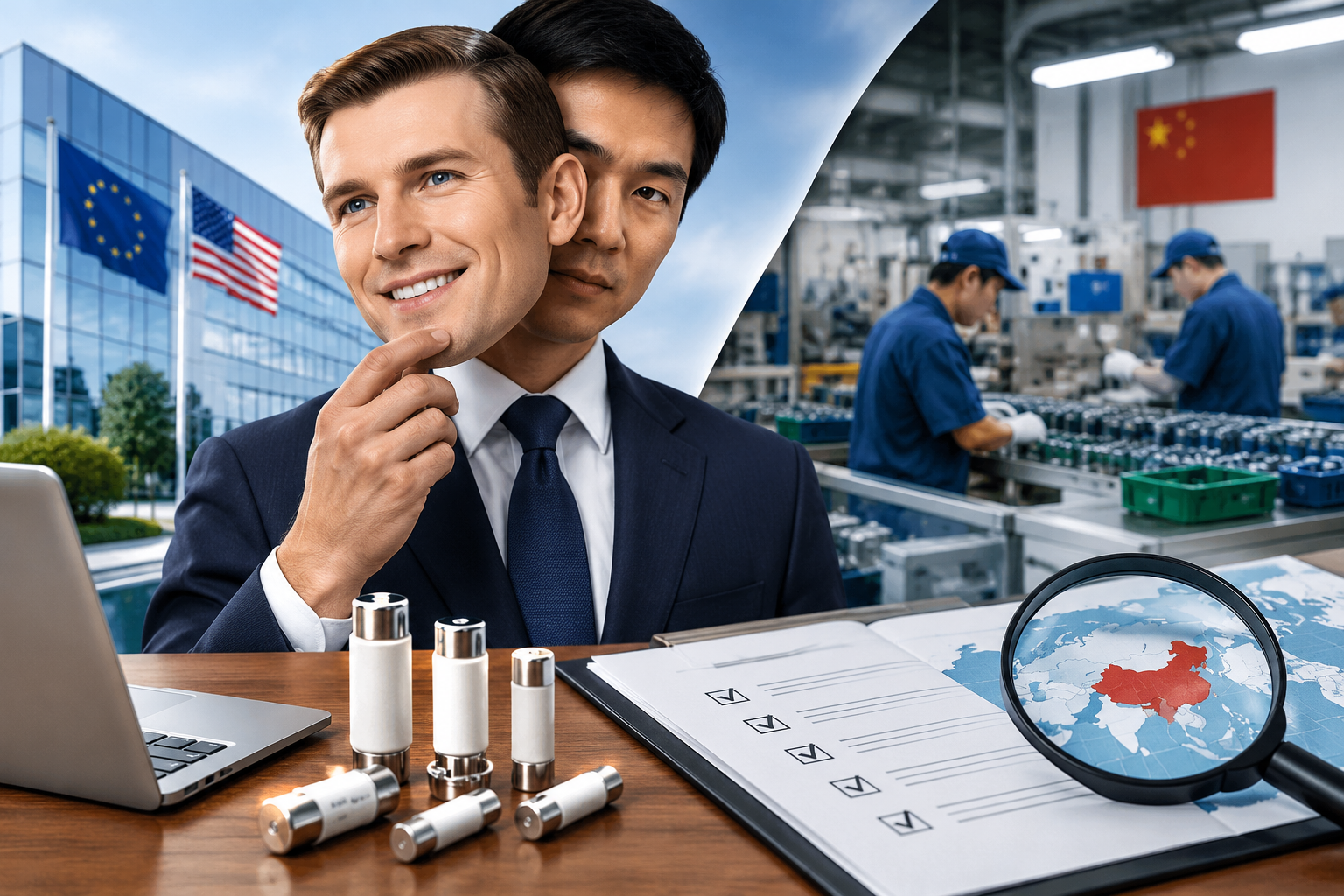
White Monkey Companies in the Fuse Industry: How to Identify a Fake Western Fuse Manufacturer
Introduction: Is Your Western Fuse Supplier Really Western?
In the international electrical protection industry, a company's identity matters. Industrial buyers, distributors, OEMs, and electrical engineers need to know who manufactures their fuses, where production takes place, and whether the supplier has the engineering expertise and quality systems it claims to possess.
However, a professional English-language website, a Western-sounding company name, a European business address, and photographs of foreign executives do not necessarily mean that a company is a Western fuse manufacturer.
Some businesses may use foreign employees, impressive management titles, local company registrations, and international branding to create the appearance of a Western-led industrial company. In certain cases, the actual manufacturing operation, ownership, or commercial control may be based elsewhere.
This phenomenon deserves particular attention in the fuse industry, where product reliability, technical documentation, certification, and traceability are essential.
The question for industrial buyers is straightforward: Are you dealing with an established Western fuse manufacturer, a legitimate international subsidiary, an independent distributor, or a business using Western branding to create a misleading impression?
Understanding the difference is an important part of responsible supplier selection.
1. What Is the White Monkey Phenomenon?
The term white monkey describes a practice reported in China and other parts of Asia in which foreign individuals are hired primarily for their appearance, nationality, or perceived association with Western expertise and prestige.
According to the Wikipedia article on the white monkey phenomenon, such individuals may appear in advertising, promotional activities, business events, and company presentations. In some reported cases, foreigners have been presented as executives or founders even when their practical responsibilities do not match their public image.
The underlying marketing principle is simple: a foreign face can make a business appear more international, sophisticated, or credible to prospective customers.
In industrial markets, this raises an important question. Could a similar strategy be used to make a company appear to be an established Western manufacturer of electrical fuses?
The possibility should not be confused with proof that any particular company engages in this practice. International businesses legitimately employ foreign executives, maintain overseas subsidiaries, and recruit specialists from different countries.
The concern arises when the public image of a business materially misrepresents its actual ownership, management, engineering capabilities, or manufacturing operations.
2. How a Company Can Create the Appearance of a Western Fuse Manufacturer
A company seeking international customers may develop a brand that appears European or American while conducting its main manufacturing activities in another country.
There is nothing inherently wrong with this arrangement. Many legitimate international manufacturers operate through subsidiaries, regional offices, distributors, and local sales companies.
The problem begins when the presentation obscures important facts.
Hiring foreign employees for credibility
One potential warning sign is a foreign employee whose public-facing role appears designed primarily to reassure Western customers.
For example, a person might be introduced on a website as a senior European executive, technical director, or international business leader. Yet the employee's actual duties, decision-making authority, technical background, and relationship with the manufacturing operation may be unclear.
A foreign employee is not evidence of deception. The relevant questions are whether the person holds the stated position, has the advertised responsibilities, and can substantiate the expertise attributed to them.
For a fuse supplier, a claimed technical director should be able to discuss relevant engineering matters, such as fuse time-current characteristics, breaking capacity, temperature rise, applicable standards, testing procedures, and product qualification.
Creating an impressive corporate image
Another potential warning sign is a polished corporate presentation that cannot be matched to verifiable operations.
A company may use:
-
Professional photographs of foreign personnel.
-
A sophisticated English-language website.
-
Western-style branding and marketing materials.
-
Claims of international engineering expertise.
-
References to European quality, standards, or manufacturing traditions.
-
An address in a Western country that is not clearly connected to production or engineering.
None of these elements is suspicious on its own. Legitimate companies use them too.
The important step is to determine whether the marketing claims correspond to independently verifiable business activities.
Using a local company name
A business may establish a company in Germany, the United Kingdom, the United States, or another Western market under a local-sounding name.
That company might operate as a sales office, importer, distributor, subsidiary, or regional representative of an overseas manufacturer. Such structures are common and can be entirely legitimate.
However, registration in a Western country does not, by itself, prove that a company manufactures products there, is independently Western-owned, or operates its own engineering facilities.
Buyers should establish the legal entity's role, its ownership and control where verifiable, and the actual location of the manufacturing process.
A local registered business and a local manufacturing operation are two different things.
3. Warning Sign: Overqualified Candidates Hired for Unclear Roles
One potential indicator of a company prioritising appearance over substance is a mismatch between an employee's advertised qualifications, job title, and actual responsibilities.
Consider a hypothetical example.
A company recruits an experienced engineer with a strong technical background and advertises the position as an international director. The employee's actual work, however, consists primarily of answering emails, attending trade fairs, appearing in promotional photographs, or forwarding customer enquiries to an overseas office.
This arrangement does not automatically establish misconduct. Small businesses frequently use broad job titles, and employees can legitimately have mixed responsibilities.
Nevertheless, repeated inconsistencies between job descriptions, seniority, expertise, and real decision-making authority warrant further investigation.
For industrial buyers, the useful questions include:
-
Does the technical director have genuine responsibility for product engineering?
-
Can the advertised engineering team answer detailed technical questions?
-
Who approves product designs and changes?
-
Who manages manufacturing quality and corrective actions?
-
Who signs off on testing and product compliance?
-
Does the company employ personnel with the skills required for its stated activities?
The problem with inflated management titles
Job titles such as Director of Engineering, Chief Technical Officer, European Managing Director, or Head of Global Manufacturing can sound impressive.
Their meaning depends on the organisation behind them.
At a small business, a director may have substantial responsibilities. At another business, a similarly titled employee may have limited authority or no involvement in manufacturing decisions.
The title alone is not the issue. The concern is an inability to substantiate the responsibilities and authority that the title implies.
For a genuine fuse manufacturer, technical credibility should be demonstrated through engineering competence, documented processes, and accountable decision-makers—not simply through impressive titles.
4. Warning Sign: A Western Brand Without Verifiable Western Manufacturing
One of the most important distinctions in industrial sourcing is the difference between a manufacturer's location, a company's registered office, and the origin of its products.
A business might have:
-
A registered company in Europe.
-
A sales office serving European customers.
-
A foreign executive responsible for international sales.
-
A website that emphasises Western identity.
-
Products manufactured by a separate company overseas.
This can describe a perfectly legitimate business model. A European importer or distributor does not need to manufacture its own products to serve customers responsibly.
The issue is whether the company clearly communicates its role.
If a business presents itself as a Western fuse manufacturer but cannot demonstrate that it carries out the manufacturing activities it claims, customers should seek clarification.
Questions to ask a purported Western fuse manufacturer
Before placing a significant order, request clear answers to the following questions:
-
Where are the fuses physically manufactured? Ask for the manufacturing site's legal name and location.
-
Who owns the manufacturing facility? Establish whether the factory belongs to the supplier, a parent company, or an independent contract manufacturer.
-
Who designs the products? Determine which organisation is responsible for engineering, product specifications, and design changes.
-
Who performs the testing? Ask for the identity of the laboratory and relevant test reports.
-
Who is responsible for product compliance? Confirm which legal entity makes the applicable declarations and assumes the relevant responsibilities.
-
Can the manufacturing operation be independently verified? Request a factory audit, a live technical meeting, or other proportionate evidence.
-
Can the supplier trace products to a specific production site and batch? Check whether records connect the delivered fuses to their actual manufacturer and production history.
A transparent supplier should be able to explain its business model without relying solely on marketing language.
5. Warning Sign: International Branding That Conceals Ownership or Control
Corporate structures can be complicated. A company might be owned by an overseas parent, controlled through multiple subsidiaries, or operated under a brand different from its registered legal name.
Such structures are not inherently problematic.
The risk arises when a supplier uses a local identity to imply a different ownership, management, or operational reality than the evidence supports.
For example, a hypothetical company called Western European Fuse Technologies GmbH might be registered in Germany but function primarily as a sales entity for a manufacturer based abroad.
That arrangement is not inherently deceptive. If the company accurately identifies itself as a sales subsidiary or distributor, customers can assess it accordingly.
However, if its marketing implies that its products are designed and manufactured in Germany, buyers should ask for evidence supporting those specific claims.
How to investigate a company's legal identity
Useful checks include:
-
Search the relevant national company register.
-
Confirm the exact registered legal name and registration number.
-
Review available information about directors and shareholders.
-
Check published annual accounts and business filings where available.
-
Investigate the relationship between the local entity and the claimed parent company.
-
Verify the registered office, operational address, and manufacturing address separately.
-
Compare the company's legal identity with the entity named on quotations, invoices, contracts, and product documentation.
The European Commission provides information about company law and the interconnection of European business registers.
Depending on the jurisdiction, beneficial ownership information may also be available through appropriate official channels, subject to applicable access and privacy rules.
These checks help buyers distinguish between a genuine manufacturer, an overseas-owned local subsidiary, a distributor, and a business whose public claims do not match its documented structure.
6. How to Distinguish a Genuine Western Fuse Manufacturer From a Western-Looking Brand
A supplier's nationality or the appearance of its website is not a reliable measure of manufacturing capability.
A better approach is to assess evidence across several independent areas.
| Verification area | What to check |
|---|---|
| Legal identity | Registered entity, directors, ownership information where available, and contractual counterparty |
| Manufacturing | Actual production site, equipment, processes, personnel, and factory audit evidence |
| Engineering | Design responsibility, engineering staff, technical answers, and change-control procedures |
| Product testing | Relevant test reports, laboratory identity, and traceability to the supplied product |
| Certification | Authenticity, scope, model numbers, applicable standards, and issuing organisation |
| Supply chain | Actual manufacturer, subcontractors, component sources, and batch traceability |
| Corporate claims | Whether statements about Western origin, local production, or engineering are supported by evidence |
Check the technical documentation
For fuse products, request the relevant datasheets, product specifications, test reports, and declarations of conformity where applicable.
Verify that the documentation refers to the exact product family, model, rating, and manufacturing source being offered.
Depending on the fuse type and intended application, relevant standards may include IEC 60269 for low-voltage fuses or IEC 60282-1 for high-voltage current-limiting fuses.
A document displaying a familiar standard or certification logo is not sufficient on its own. The scope and authenticity of the evidence must be checked, and any claimed certification should be verified with the issuing body or relevant database where possible.
Look beyond the website
A genuine manufacturing operation should be capable of providing evidence appropriate to its activities.
This may include factory audit records, quality management documentation, calibration records, production inspection procedures, testing facilities, and traceability systems.
Not every legitimate manufacturer performs every activity in-house. Outsourced testing, contract manufacturing, and specialist laboratories can all be legitimate arrangements.
What matters is that the supplier explains these relationships clearly and can demonstrate effective control over the products it supplies.
7. Why This Matters in the Fuse Industry
Electrical fuses are safety-related components used to protect equipment and electrical installations against excessive current and fault conditions.
Choosing a supplier based on branding rather than verified product capability can create several risks.
Product quality and consistency
Customers need confidence that products meet their specified electrical and mechanical requirements and remain consistent between production batches.
Without adequate traceability and quality controls, investigating a defective batch or implementing corrective action can become more difficult.
Certification and compliance
A company's marketing claims cannot replace valid product-specific evidence.
Purchasers should confirm that relevant documentation applies to the actual fuse being supplied and that the responsible legal entity is clearly identified.
Engineering support
Industrial customers may require assistance with ratings, coordination, application suitability, replacement selection, or failure analysis.
A company that presents itself as a manufacturer should clearly explain where technical responsibility resides and how customers can obtain competent support.
Accountability and after-sales service
If a product fails or a technical dispute arises, buyers need to know which legal entity is responsible for contractual obligations, warranty claims, and applicable product responsibilities.
A transparent supplier structure makes accountability easier to establish.
Long-term supply security
Understanding the real manufacturing source is also important for continuity of supply, change management, product lifecycle planning, and supply-chain risk assessment.
These concerns apply to suppliers of every nationality. They are not unique to Chinese businesses or Western companies.
8. A Practical Due Diligence Checklist for Fuse Buyers
Before approving a new supplier, procurement teams can use the following checklist.
-
Verify the company's registered legal identity.
-
Identify the actual manufacturer of the proposed fuse.
-
Establish the manufacturing country and production site.
-
Clarify the ownership relationship between the supplier and factory.
-
Confirm who is responsible for design and engineering changes.
-
Request product-specific technical documentation and relevant test reports.
-
Verify claimed certifications with the appropriate issuing organisation.
-
Confirm batch identification and traceability procedures.
-
Assess the technical competence of the people providing engineering support.
-
Compare the company's public claims with its official records and contractual documents.
-
Request an independent factory audit when justified by the risk and commercial importance.
-
Ensure the purchase contract identifies the responsible legal entity and applicable warranty obligations.
This process is more reliable than attempting to judge a company from its name, website, or employees' appearance.
The European Commission's due diligence guidance and its explanation of due diligence provide further context for assessing business partners, ownership, operations, and supply-chain relationships.
9. Why Transparency Is More Important Than Nationality
The purpose of supplier verification should not be to exclude businesses because they are Chinese-owned, employ foreign executives, or manufacture products outside Europe.
International manufacturing is a normal feature of modern industry. Chinese manufacturers can be technically sophisticated, and Western brands can outsource production internationally. A Western-registered company can be a distributor rather than a factory, while an overseas-owned company can operate a genuine manufacturing facility in Europe.
The distinction is between transparent and misleading business practices.
A company should not need to imply that its products are Western-made if they are manufactured elsewhere. Nor should it need to exaggerate its engineering resources or management structure to demonstrate that it can serve international customers.
Buyers should evaluate the evidence, not the ethnicity of the employees or the country associated with a brand.
The same standards should apply to every prospective supplier.
Conclusion: Verify the Manufacturer Behind the Brand
The white monkey phenomenon highlights how a foreign face or executive title can sometimes be used to create an impression of international credibility. In industrial markets, this provides a useful starting point for thinking critically about corporate presentation—but it is not proof that a particular company is misleading its customers.
When evaluating a Western-looking fuse business, buyers should look beyond the brand and establish the facts: who owns and controls the business, where its products are manufactured, who is responsible for engineering, what evidence supports its technical claims, and which legal entity stands behind the products.
A local company name, an impressive director title, or a foreign employee cannot independently establish that a business is a Western fuse manufacturer.
The most reliable supplier is the one whose identity, manufacturing origin, engineering capability, product documentation, and responsibilities can all be independently verified.
For procurement teams, distributors, OEMs, and electrical engineers, this is the foundation of informed sourcing and long-term supplier confidence.
Frequently Asked Questions
What is a white monkey company?
The phrase refers to a business associated with the practice of using foreign individuals primarily to create a perception of international status or credibility. The term does not establish that any particular company is fraudulent.
How can I identify a fake Western fuse manufacturer?
Verify the legal entity, ownership information where available, manufacturing location, product documentation, engineering responsibility, and traceability. Investigate material inconsistencies between marketing claims and independently verifiable evidence.
Does a Western company name mean the fuses are manufactured in Europe?
No. A company can be registered in Europe while importing products manufactured elsewhere. Check the actual manufacturing location and the accuracy of any claims about product origin.
Is hiring a foreign director a warning sign?
Not by itself. International companies routinely employ foreign directors and engineers. The relevant question is whether the person's role, expertise, and decision-making authority match the company's claims.
Can a Chinese-owned company be a genuine Western manufacturer?
Yes. Ownership nationality does not determine manufacturing capability or business legitimacy. A Chinese-owned company can operate a genuine Western manufacturing facility, just as a Western-owned company can manufacture products in China.
What should I verify before buying industrial fuses?
Confirm the manufacturer's identity, production location, applicable standards, product-specific test evidence, traceability, engineering support, and contractual accountability. Use independent verification proportionate to the technical and commercial risks.



