
 eaton-bussmann-series-high-speed-fuses-application-guide-br132015en-en-us.pdf | [Eaton Bussmann Fuses Technical Guide] | 2677 kB |
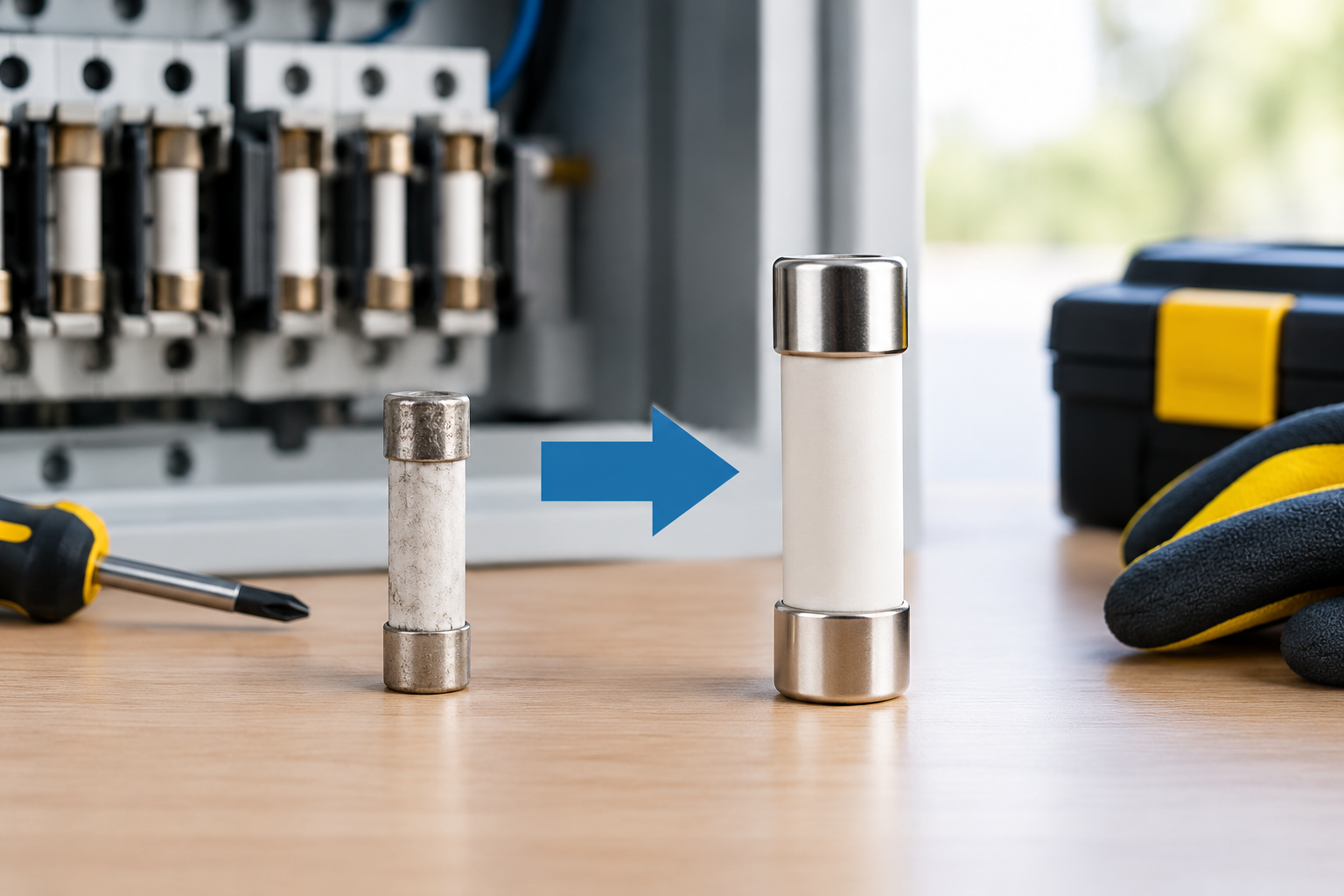
How to Replace a No-Name Fuse with an Eaton Bussmann Quality Fuse: A Step-by-Step Guide
Introduction
When a fuse needs replacing, choosing the right replacement is essential for electrical safety, reliable performance, and long-term equipment protection. While cheap, no-name fuses may seem like an affordable option, their quality, consistency, and suitability for a particular application can be difficult to verify.
Eaton Bussmann quality fuses are a trusted choice for many electrical protection applications, offering a broad range of fuse types designed to meet specific electrical requirements and applicable industry standards.
But how do you replace a no-name fuse with an Eaton Bussmann fuse, and what should you consider before making the switch?
In this step-by-step guide, we explain how to identify the correct replacement, compare the advantages of Eaton Bussmann fuses with cheap alternatives, and make a safer, more informed choice.
Why Replace a Cheap No-Name Fuse with an Eaton Bussmann Fuse?
Not all fuses offer the same level of documented performance, manufacturing consistency, or application suitability. Although two fuses may look identical, they may differ in their electrical characteristics and ability to interrupt a fault safely.
Here are the key advantages of choosing an Eaton Bussmann fuse over an unverified, low-cost alternative.
1. Reliable and Consistent Quality
Eaton Bussmann fuses are part of an established electrical protection product range. Selecting a fuse with documented specifications helps you verify that its performance characteristics are suitable for the intended application.
With an unknown fuse, important details may be missing, unclear, or difficult to validate.
2. Verified Electrical Specifications
A fuse must do more than fit into a fuse holder. Its rated current, rated voltage, breaking capacity, time-current characteristics, and other relevant specifications must match the application.
Eaton Bussmann offers product documentation that can help electrical professionals identify the appropriate fuse for a particular circuit.
3. Appropriate Fault-Current Protection
During an electrical fault, a fuse must interrupt current within its designed operating limits. The ability to safely interrupt the prospective fault current is particularly important in industrial equipment, power distribution systems, and other demanding applications.
Choosing a suitably rated Eaton Bussmann fuse helps ensure that the specified breaking capacity and operating characteristics are appropriate for the circuit.
4. A Broad Range of Fuse Types
Different electrical applications require different types of protection. Eaton Bussmann offers fuse solutions for various applications, including industrial control systems, motor circuits, power distribution, and electronic equipment.
This range makes it easier to select a product designed for the specific protection requirements rather than relying on a generic replacement.
5. Better Traceability and Technical Documentation
Product identification, datasheets, and technical specifications are important when maintaining electrical systems. Established manufacturers generally provide more comprehensive product information than an unidentified supplier.
This documentation supports correct product selection, maintenance records, and compliance with applicable equipment requirements.
6. Lower Risk of Incorrect Fuse Selection
A fuse that fits physically is not necessarily electrically compatible. Replacing an unknown fuse with a properly selected Eaton Bussmann product can help reduce the risk of using a fuse with unsuitable ratings or characteristics.
Important: A reputable brand alone does not guarantee that a particular fuse is suitable. The exact Eaton Bussmann replacement must be verified against the original fuse specifications and the equipment manufacturer's requirements.
Step-by-Step Guide: How to Replace a No-Name Fuse with an Eaton Bussmann Fuse
Follow these steps to identify and select a suitable replacement. Fuse replacement should only be carried out by a person competent to work on the relevant electrical equipment.
Step 1: Switch Off and Isolate the Equipment
Before inspecting or replacing a fuse, switch off the equipment and isolate it from every relevant power source.
For electrical installations and industrial equipment, the correct isolation procedure may include locking out the supply and verifying that the circuit is de-energised using suitable test equipment.
Never assume that switching off a machine or removing a plug has made every part of the equipment safe. Capacitors, auxiliary supplies, batteries, and other energy sources may remain hazardous.
If the fuse is part of a live electrical installation, high-energy circuit, or equipment you are not qualified to service, contact a qualified electrician or authorised technician.
Step 2: Remove and Inspect the Existing No-Name Fuse
Once the equipment has been safely isolated and verified as de-energised, inspect the existing fuse.
Look for markings such as:
-
Rated current, usually expressed in amperes (A).
-
Rated voltage, expressed in volts (V).
-
Fuse type or product series.
-
Time-current characteristic, such as fast-acting or time-delay.
-
Breaking capacity, sometimes called interrupting rating.
-
Size, dimensions, and mounting style.
-
Relevant standard or approval markings.
-
Manufacturer name, part number, or other identification codes.
Take note of the markings and, where appropriate, record the fuse dimensions.
If the fuse has no identifiable markings, do not guess its ratings based on its physical appearance. Consult the equipment documentation, circuit diagram, original bill of materials, or a qualified electrical professional to establish the correct specification.
Step 3: Identify the Correct Electrical Ratings
This is the most important step when replacing a no-name fuse with an Eaton Bussmann fuse.
Compare the original fuse's documented characteristics with the requirements of the circuit. Check the following:
Rated current: The replacement must have the correct current rating specified for the application. Installing a higher-rated fuse to stop repeated blowing can expose wiring and equipment to dangerous overheating.
Rated voltage: The fuse must be suitable for the circuit's operating voltage and the relevant AC or DC application.
Breaking capacity: The fuse must be capable of safely interrupting the prospective fault current at the point where it is installed.
Operating characteristic: A fast-acting fuse and a time-delay fuse do not behave identically. The correct characteristic depends on the circuit and its normal operating current, including any permitted inrush current.
Fuse category and application: Some fuses are designed for general circuit protection, while others are intended for specific applications such as motor protection or semiconductor protection.
Physical dimensions and connections: The fuse must fit the intended holder or mounting arrangement without modification.
Also verify any required coordination with upstream and downstream protective devices, as well as the equipment manufacturer's specifications.
Never select a replacement solely because its dimensions and current rating appear to match.
Step 4: Find a Suitable Eaton Bussmann Replacement
Once the required specifications have been established, identify an Eaton Bussmann fuse that meets them.
Use the original manufacturer's documentation, equipment documentation, or the technical specifications for the relevant Eaton Bussmann product family to compare the available options.
Check that the proposed replacement matches the required:
-
Current and voltage ratings.
-
Breaking capacity.
-
Time-current characteristics.
-
Fuse class or application category, where applicable.
-
Physical size and terminal configuration.
-
Applicable standards and approvals.
-
Environmental and operating requirements.
If the original no-name fuse cannot be identified, a qualified professional should determine the circuit's protection requirements before a replacement is chosen.
Do not assume that every Eaton Bussmann fuse is interchangeable with every generic fuse. The correct product depends on the application and its technical requirements.
Step 5: Verify Compatibility with the Fuse Holder and Equipment
Before installation, confirm that the selected Eaton Bussmann fuse is compatible with the fuse holder, equipment, and intended circuit.
The replacement must fit the designated mounting arrangement correctly. Avoid forcing a fuse into a holder, modifying terminals, or using improvised adapters.
Check the equipment manufacturer's instructions for any restrictions on replacement fuse types. In some installations, a change in fuse type may affect protective coordination, certification, or the equipment's specified safety performance.
If the equipment documentation specifies an exact fuse type or approved part number, follow that requirement or obtain the necessary technical approval before substituting another product.
Step 6: Install the Replacement Fuse Safely
Only install the fuse after the equipment has been properly isolated and the correct replacement has been confirmed.
A competent person should follow the equipment manufacturer's installation instructions and applicable electrical safety procedures. The fuse and its holder must be installed correctly, with no damaged contacts, loose connections, or unsuitable components.
Never bridge a fuse, bypass the protective device, or replace it with a fuse that has a higher current rating simply because the original fuse repeatedly opens.
If the holder is damaged, overheated, corroded, or shows signs of arcing, address the underlying problem before returning the equipment to service.
Step 7: Investigate Why the Original Fuse Failed
A blown fuse is often a symptom of another problem rather than the root cause of a failure.
Before returning equipment to operation, investigate why the original fuse opened. Possible causes include:
-
A short circuit.
-
An overloaded circuit.
-
A faulty motor or electrical component.
-
Excessive inrush current.
-
Damaged wiring or insulation.
-
A loose or deteriorated connection.
-
An incorrectly specified or defective fuse.
Replacing the fuse without investigating the cause can lead to another failure or create a safety hazard.
If the cause cannot be identified confidently, have the equipment assessed by a qualified electrician or technician.
Step 8: Complete the Final Safety Checks
Before the equipment is returned to service, verify that the replacement fuse is correctly installed and that all protective covers and barriers are restored.
The responsible person should confirm that the equipment is ready for operation in accordance with the manufacturer's procedures and applicable safety requirements.
Where required, perform appropriate electrical tests and functional checks. Monitor the equipment according to the applicable commissioning or maintenance procedure.
If the replacement fuse blows again, stop and investigate the underlying fault rather than repeatedly installing new fuses.
Eaton Bussmann vs. Cheap No-Name Fuses: What Is the Difference?
The key difference is not simply the brand name or purchase price. It is whether the fuse's technical characteristics, quality controls, and suitability for the intended application can be established.
| Feature | Eaton Bussmann quality fuses | Cheap no-name fuses |
|---|---|---|
| Product documentation | Manufacturer datasheets and technical information are available for many products | Documentation may be limited or difficult to verify |
| Specification verification | Established product identification supports selection and traceability | Markings and specifications may be unclear or incomplete |
| Range of applications | Broad range of products for different protection requirements | Range and application suitability vary by supplier |
| Standards and approvals | Relevant ratings and approvals can be checked for the specific product | Claims and markings may require additional verification |
| Product traceability | Established manufacturer and product identification | Manufacturer or product origin may be uncertain |
| Selection support | Manufacturer technical documentation can assist product selection | Technical support may be limited |
| Purchase price | May cost more initially | Often cheaper upfront |
The comparison above is general. Not every inexpensive fuse is poor quality, and not every branded fuse is appropriate for every application. Evaluate the exact product, its documentation, and its suitability rather than relying on price or appearance alone.
Are Eaton Bussmann Fuses Worth the Extra Cost?
For many applications, selecting a properly specified fuse from an established manufacturer is a sensible investment in electrical protection.
The initial purchase price is only one part of the overall cost. Incorrect fuse selection can contribute to equipment downtime, repeat failures, damage to components, troubleshooting expenses, and potentially serious safety incidents.
Eaton Bussmann fuses can offer practical advantages through documented specifications, identifiable product ranges, and application-specific options. These features help maintenance teams and electrical professionals make informed replacement decisions.
However, no fuse can eliminate every electrical risk. Correct sizing, installation, circuit design, maintenance, and fault investigation remain essential.
Common Mistakes to Avoid When Replacing a No-Name Fuse
Avoid these common mistakes when choosing an Eaton Bussmann replacement:
-
Choosing by size alone. A physically compatible fuse may have unsuitable electrical characteristics.
-
Increasing the current rating. A higher-rated fuse may no longer provide the intended protection.
-
Ignoring breaking capacity. The fuse must safely interrupt the prospective fault current.
-
Replacing a time-delay fuse with a fast-acting fuse without verification. Different operating characteristics can affect circuit performance.
-
Assuming all branded fuses are interchangeable. Each replacement must meet the equipment's technical requirements.
-
Installing a new fuse without investigating the cause of failure. A recurring fault may indicate a more serious electrical problem.
-
Working on energised equipment without the required competence and precautions. Electrical isolation and verification are essential.
Frequently Asked Questions
Can I replace any no-name fuse with an Eaton Bussmann fuse?
No. You must select an Eaton Bussmann fuse that meets the electrical, mechanical, and application requirements of the original fuse and the equipment. If the original specifications are unknown, establish the correct requirements before choosing a replacement.
Are Eaton Bussmann fuses better than cheap generic fuses?
Eaton Bussmann provides an established range of electrical protection products with manufacturer documentation and identifiable specifications. These features can make product selection and verification more reliable. However, the quality and suitability of any generic fuse must be assessed individually.
Can I use a fuse with a higher amp rating?
Not unless the equipment manufacturer or a qualified design professional has explicitly established that the change is appropriate. Increasing the current rating can compromise protection and create overheating or fire risks.
What if my original fuse has no markings?
Do not estimate its rating from its size or appearance. Check the equipment manual, circuit diagram, original parts list, or manufacturer's technical information. If necessary, ask a qualified electrician or technician to determine the correct specification.
Why does my replacement fuse keep blowing?
Repeated fuse failures may indicate an overload, short circuit, faulty component, excessive inrush current, or another electrical problem. Stop replacing the fuse repeatedly and have the underlying cause investigated.
Do Eaton Bussmann fuses last longer than no-name fuses?
Service life depends on the fuse design, operating conditions, fault history, and application. It would be inaccurate to claim that every Eaton Bussmann fuse lasts longer than every generic alternative. The key priorities are correct selection, documented performance, and suitability for the intended circuit.
Conclusion: Choose the Right Eaton Bussmann Fuse for Reliable Protection
Replacing a no-name fuse with an Eaton Bussmann quality fuse is an opportunity to improve product traceability and make a more informed electrical protection choice.
The process starts with safe isolation, identification of the original fuse, verification of the required electrical ratings, and selection of a compatible Eaton Bussmann replacement. It also involves checking the fuse holder, investigating the cause of the original failure, and following the correct installation and safety procedures.
While cheap no-name fuses may offer a lower initial purchase price, a properly specified fuse with verifiable technical information can help reduce uncertainty during maintenance and replacement.
The most important rule is simple: choose the fuse that meets the circuit's actual protection requirements, not merely the one that fits. With careful selection and correct installation, Eaton Bussmann fuses can be a valuable part of a well-designed and properly maintained electrical protection system.



