
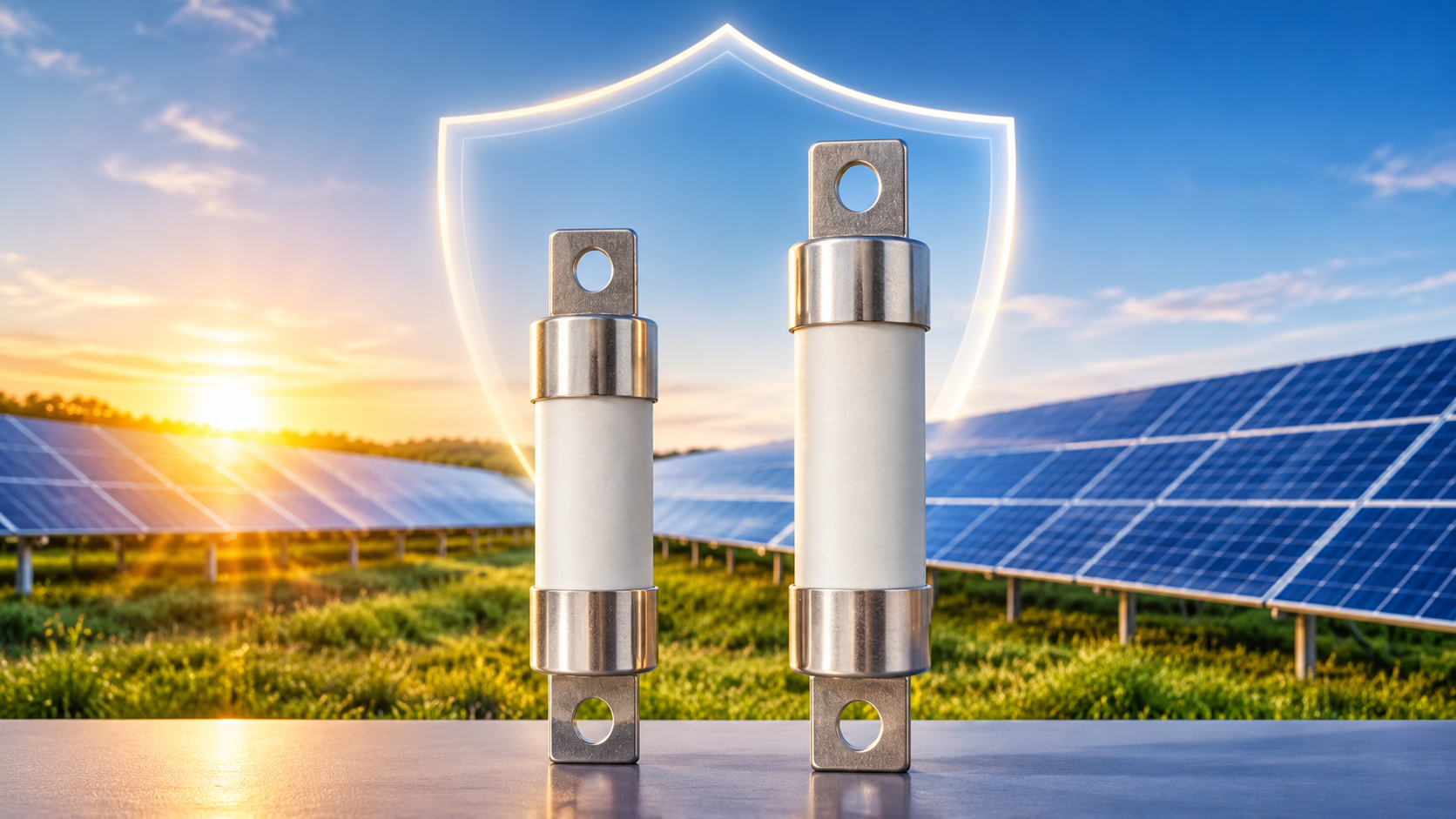
 eaton-bussmann-series-dc-fuses-catalog-ca135009en-us.pdf  | [Eaton Bussmann DC Fuses] | 0 kB |
Where Are DC Fuses Used in Solar PV Systems?
Introduction
Solar photovoltaic (PV) systems generate electricity through direct current (DC), which must be safely managed and protected before it reaches the inverter. One of the most important components used for this purpose is the DC fuse.
DC fuses in solar PV systems help protect electrical circuits, cables and solar modules from overcurrent conditions, including reverse current caused by faults in parallel-connected PV strings. By interrupting excessive current, they reduce the risk of equipment damage, overheating and electrical hazards.
However, DC fuses are not installed in exactly the same locations in every solar installation. Their placement depends on the system configuration, number of parallel strings, electrical ratings and applicable installation requirements.
So, where are DC fuses used in solar PV systems? Let's explore their main installation locations, functions and selection considerations.
1. PV String Circuits and Combiner Boxes
One of the most common applications of DC fuses in solar PV systems is string-level circuit protection.
A solar PV array typically consists of multiple solar panels connected in series to form individual strings. Several strings may then be connected in parallel to increase the system's total power output.
When multiple strings operate in parallel, a fault in one string can allow current from the healthy strings to flow backwards into the faulty circuit. This reverse current may exceed the permitted limits of the solar modules and connecting cables.
String fuses help prevent this situation by disconnecting the affected circuit when the current exceeds the fuse's operating limits.
How Do String Fuses Work?
In a typical PV combiner box, each incoming solar string may be connected through an individual fuse link and fuse holder before reaching the common DC busbar.
For example, consider a solar installation with six parallel PV strings. If one string develops a fault, the remaining five strings may contribute reverse current towards the faulty string.
The fuse installed in the affected string is designed to interrupt this excessive current when necessary, helping protect the modules and associated wiring.
Depending on the system design and applicable electrical requirements, string fuses may be installed in one or both DC poles. They can also be integrated into other DC protection equipment.
2. Solar Array and Sub-Array Output Circuits
Another important application of DC fuses is at the output of solar array sections and sub-arrays.
When multiple PV strings are combined, their output current increases. The combined circuit therefore requires appropriate protection based on its current-carrying capacity and the electrical characteristics of the connected equipment.
In some installations, larger DC fuse links are installed at the combiner box output or sub-array output.
These fuses can provide protection for outgoing conductors and help coordinate the protection system with downstream DC equipment.
Why Are Output Fuses Important?
Array output fuses can serve several purposes:
-
Protect outgoing DC cables against excessive current.
-
Help isolate faulty sections of a PV array.
-
Reduce the risk of conductor overheating.
-
Support coordination between upstream and downstream protection devices.
-
Improve the overall safety and reliability of the solar installation.
However, an output fuse is not automatically required in every combiner box. Its necessity depends on the available current sources, cable ratings, system configuration and downstream equipment requirements.
3. Near the Inverter DC Input
DC fuses may also be installed near the DC input of a solar inverter.
The inverter is responsible for converting the DC electricity generated by solar panels into alternating current (AC) for use in electrical installations or connection to the power grid.
Before reaching the inverter, DC power may pass through a combiner box and other protective devices.
Depending on the system architecture, a fuse or fused switching device may be installed between the combiner box and the inverter.
What Is the Purpose of an Inverter-Side DC Fuse?
An inverter-side fuse helps protect the relevant incoming DC circuit against excessive current.
It is important to understand that this fuse does not automatically protect every internal component of the inverter. Internal inverter protection is determined by the equipment's design and manufacturer specifications.
Some modern inverters also include integrated string fuses in their DC input sections, reducing the need for separate external string protection equipment.
Therefore, the installation design should always consider the inverter's built-in protection features and electrical requirements.
4. Do All Solar PV Strings Need DC Fuses?
No. Not every solar PV string requires an individual fuse.
The need for string-level overcurrent protection depends on the number of parallel strings and the amount of potential reverse current under fault conditions.
For example:
-
Single-string systems: Generally do not have other parallel strings capable of feeding reverse current into a faulty string.
-
Two-string systems: Depending on the module specifications and possible fault current, additional string fusing may not be necessary.
-
Multiple-string systems: As the number of parallel strings increases, the potential reverse current also increases, making string fuses more likely to be necessary.
Before deciding whether DC fuses are required, installers and system designers should evaluate several factors:
-
Maximum possible reverse current.
-
Solar module maximum series fuse rating.
-
DC cable current-carrying capacity.
-
Number of parallel-connected PV strings.
-
Inverter and combiner box specifications.
-
Applicable electrical standards and local installation requirements.
Correctly evaluating these parameters helps determine the appropriate protection arrangement for the PV system.
5. How to Select the Right DC Fuse for a Solar PV System
Choosing a suitable DC fuse involves more than matching its rated voltage and current to the solar installation.
A fuse must be compatible with the system's electrical characteristics, installation environment and intended protection function.
Here are the key factors to consider.
5.1 Maximum System Voltage
The fuse must have a DC voltage rating equal to or higher than the maximum possible system voltage.
Solar PV systems can operate at different voltage levels, commonly including 1000V DC and 1500V DC configurations.
The maximum voltage calculation should account for the open-circuit voltage (Voc) of the modules and the expected temperature conditions, rather than relying only on nominal operating voltage.
5.2 Rated Current
The fuse's rated current must be selected according to the circuit's expected operating current and applicable PV protection requirements.
The selection should consider module short-circuit current (Isc), the number of parallel strings, conductor ratings and the maximum series fuse rating specified by the module manufacturer.
An incorrectly rated fuse may cause unnecessary interruptions or fail to provide the required protection.
5.3 Breaking Capacity
Breaking capacity refers to the maximum fault current that a fuse can safely interrupt at its specified voltage.
Because PV installations can experience substantial fault currents, the fuse must have an adequate DC breaking capacity for the application.
5.4 Operating Temperature
Solar PV equipment is frequently installed in outdoor environments where temperatures can become high.
Ambient temperature, enclosure conditions, ventilation and heat dissipation can influence fuse performance.
These factors should be considered when selecting both the fuse link and its compatible fuse holder.
5.5 Fuse Holder Compatibility
The fuse holder is just as important as the fuse itself.
Its voltage rating, current capacity, terminal design and thermal performance must match the selected fuse and installation conditions.
Using an unsuitable fuse holder can create additional resistance, excessive heat and potential reliability problems.
6. What Is a gPV Fuse and Why Is It Used in Solar Systems?
A gPV fuse is a specialised full-range fuse link designed for photovoltaic applications.
The gPV classification is defined under IEC 60269-6, which covers fuse links for solar PV systems.
These fuses are designed to provide overcurrent protection in PV string and array circuits within their specified electrical ratings.
Compared with general-purpose fuse links, photovoltaic fuses are specifically intended to address the operating characteristics and protection requirements of solar DC circuits.
When selecting a gPV fuse, it is important to verify:
-
Rated DC voltage.
-
Rated current.
-
DC breaking capacity.
-
Fuse size and physical dimensions.
-
Compatibility with the fuse holder.
-
Compliance with relevant standards.
The gPV marking alone does not guarantee suitability. All electrical ratings must match the intended application.
7. Can AC Fuses Be Used in Solar PV DC Circuits?
No, an AC voltage rating alone is not sufficient to establish that a fuse is suitable for a DC application.
Although AC and DC fuses may look similar, interrupting DC fault current presents different technical challenges.
In AC circuits, current naturally passes through zero during each cycle, helping extinguish the electrical arc when a fuse operates.
In DC circuits, current does not have the same natural zero-crossing behaviour. Consequently, interrupting a DC fault can be more challenging.
A fuse used in a solar PV circuit must therefore have:
-
An appropriate DC voltage rating.
-
Sufficient DC breaking capacity.
-
A suitable current rating.
-
The correct application classification.
-
Compatibility with the installation requirements.
Using a fuse without an appropriate DC rating can compromise the safety and reliability of the entire PV protection system.
8. Common Mistakes to Avoid When Installing DC Fuses in Solar PV Systems
Correct fuse selection and installation are essential for reliable solar PV operation. Some common mistakes include:
1. Selecting a fuse based only on rated current
Voltage, breaking capacity, module specifications and installation conditions must also be considered.
2. Ignoring reverse current
Failing to calculate potential reverse current in parallel-connected strings can result in inadequate circuit protection.
3. Using an AC-rated fuse in a DC application
A suitable DC voltage rating and breaking capacity are essential for safe fault interruption.
4. Ignoring fuse holder specifications
An incompatible fuse holder may lead to poor electrical contact and excessive heat generation.
5. Overlooking operating temperature
High ambient temperatures and limited enclosure ventilation can affect fuse performance.
6. Installing unnecessary fuses
Adding fuses without evaluating the actual circuit configuration can increase system complexity and maintenance requirements.
Following the equipment manufacturer's instructions and applicable electrical standards helps avoid these problems.
Conclusion
DC fuses play an important role in protecting solar photovoltaic systems against excessive current and electrical faults. Their most common installation locations include PV string circuits, combiner boxes, array output circuits and, where required, inverter DC input connections.
However, not every solar installation requires fuses in all these locations. The correct protection arrangement depends on the number of parallel strings, potential reverse current, module specifications, cable capacity and inverter design.
Selecting the right DC fuse requires careful consideration of voltage rating, current rating, breaking capacity, operating temperature and fuse holder compatibility.
With appropriate fuse selection and installation, solar PV system designers can improve electrical safety, protect valuable equipment and support reliable long-term system operation.
Frequently Asked Questions (FAQs)
1. Where are DC fuses installed in solar PV systems?
DC fuses are commonly installed in PV string circuits, combiner boxes and array or sub-array output circuits. They may also be installed near the inverter's DC input, depending on the system design.
2. What is the main function of a DC fuse in a solar system?
The main function of a DC fuse is to interrupt excessive current caused by electrical faults. It helps protect solar modules, DC cables and connected equipment against damage.
3. Are DC fuses necessary for every solar panel?
No. Individual panel-level fuses are not universally required. Fuse requirements depend on the number of parallel-connected strings, potential reverse current, module specifications and applicable installation standards.
4. What is a PV combiner box fuse?
A PV combiner box fuse is a protective device installed in an incoming solar string circuit or, where required, at the combined output. It helps isolate faulty circuits and protect connected conductors.
5. What does gPV mean on a solar fuse?
gPV identifies a full-range fuse link designed specifically for photovoltaic applications under IEC 60269-6. It is used for overcurrent protection in solar PV string and array circuits.
6. What voltage rating should a solar DC fuse have?
The fuse's rated DC voltage must be equal to or greater than the maximum possible system voltage. Common solar PV system voltage classes include 1000V DC and 1500V DC.
7. Can a normal DC fuse be used in a solar PV system?
Not necessarily. The fuse must have suitable voltage, current and breaking-capacity ratings, along with an appropriate application classification. A photovoltaic-rated fuse is generally selected for PV string and array protection.
8. Why is breaking capacity important for solar DC fuses?
Breaking capacity determines the maximum fault current a fuse can safely interrupt at its specified voltage. An insufficient breaking capacity can compromise the safe interruption of a DC fault.



