
 eaton-bussmann-series-high-speed-fuses-application-guide-br132015en-en-us.pdf  | [Eaton Bussmann Fuses Technical Guide] | 0 kB |
What Is an HRC Fuse? Working Principle, Types, Advantages and Applications
An electrical system needs reliable protection against overcurrent and short circuits to operate safely. One of the most widely used protective devices in electrical distribution and industrial applications is the HRC fuse. Designed to interrupt high fault currents safely, an HRC fuse helps protect electrical equipment, wiring and circuits from potentially serious damage.
But what is an HRC fuse, how does it work, and why is it important in electrical protection systems?
In this guide, we will explain the meaning of an HRC fuse, its construction, working principle, different types, advantages, disadvantages and common applications.
What Is an HRC Fuse?
HRC stands for High Rupturing Capacity. An HRC fuse is an electrical safety device designed to interrupt excessive current, particularly high short-circuit currents, before they can damage electrical equipment or create hazardous conditions.
Unlike conventional fuses, HRC fuses are specifically engineered to withstand and safely break very high fault currents. They feature a strong, enclosed construction that helps contain the heat and electrical arc generated when the fuse element melts.
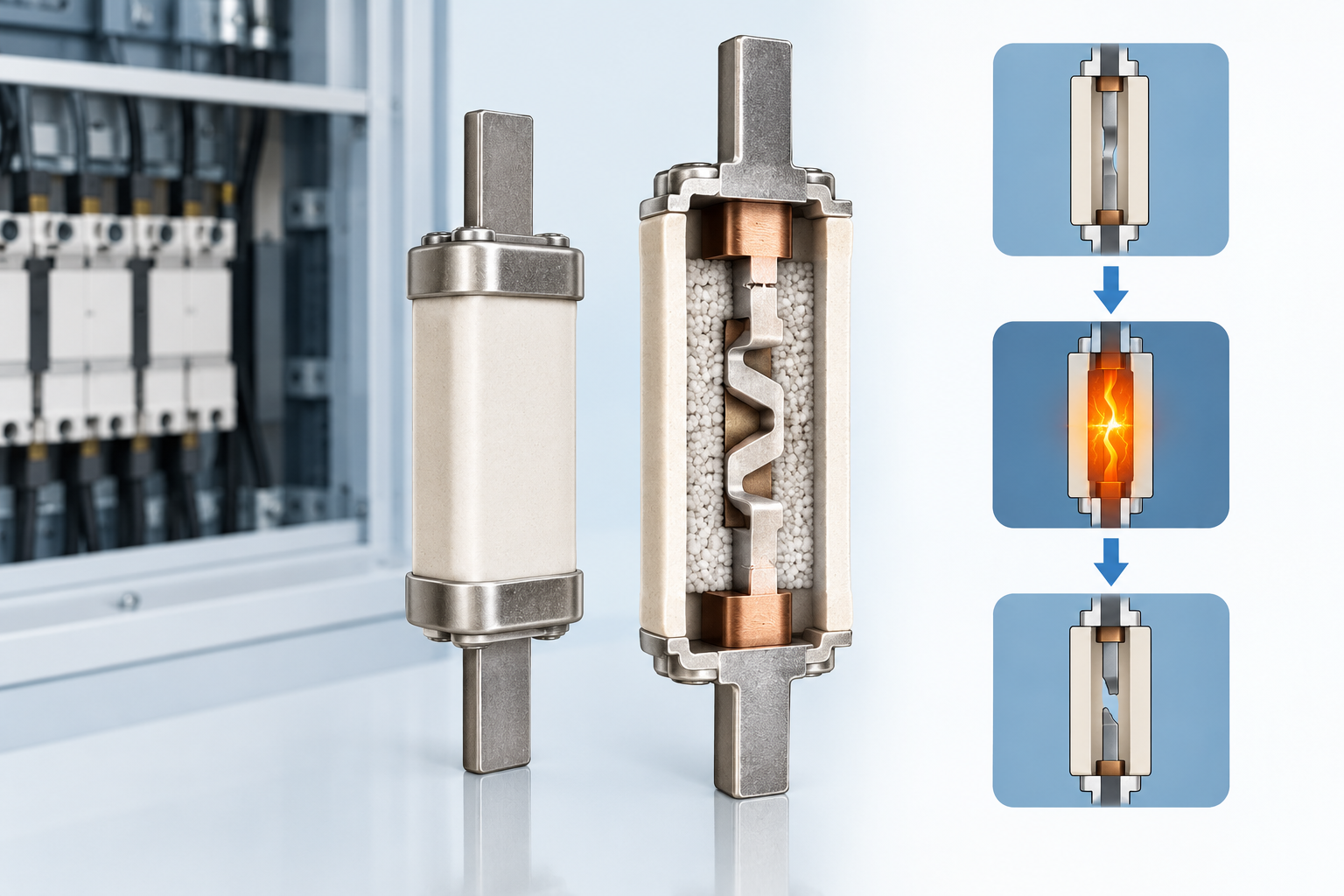
An HRC fuse typically consists of a ceramic body containing a silver or copper fuse element surrounded by an arc-quenching material, commonly quartz powder.
Under normal operating conditions, the fuse element allows electrical current to pass through the circuit. When the current exceeds its specified limit, the element melts and interrupts the electrical supply.
The special filling material helps extinguish the electrical arc, making HRC fuses suitable for applications where high fault-current protection is essential.
Construction of an HRC Fuse
The construction of an HRC fuse is designed to provide reliable protection and safely interrupt high electrical currents.
Its main components include:
1. Ceramic Body
The outer body of an HRC fuse is generally manufactured from heat-resistant ceramic material. It provides mechanical strength and withstands the high temperatures generated during fault conditions.
The enclosed construction also helps contain the electrical arc produced when the fuse operates.
2. Metal End Caps
Metal end caps are fitted at both ends of the ceramic body. These caps provide electrical connections between the fuse element and the circuit.
They also ensure secure installation and reliable electrical contact.
3. Fuse Element
The fuse element is the main current-carrying component of an HRC fuse. It is generally manufactured from silver or copper because of their excellent electrical conductivity.
The element is carefully designed with specific dimensions and sections to achieve the required time-current characteristics.
When excessive current flows through the fuse, the element heats up and eventually melts, disconnecting the circuit.
4. Quartz Powder Filling
The space inside the ceramic body is filled with a special arc-quenching material, commonly quartz powder.
When the fuse element melts during a fault, an electrical arc forms. The quartz filling absorbs heat and helps extinguish the arc, preventing it from continuing to conduct electricity.
This is one of the most important features that allows an HRC fuse to interrupt high fault currents safely.
Working Principle of an HRC Fuse
The working principle of an HRC fuse is based on the heating effect of electric current.
When current flows through a conductor, heat is generated due to its electrical resistance. This heating effect increases as the current increases.
Under normal operating conditions, the fuse element carries the rated current without melting.
However, when an overload or short circuit occurs, excessive current flows through the fuse element. The temperature rises rapidly, eventually causing the element to melt and break the circuit.
The operation can be explained in the following steps:
-
Normal operation: The fuse element carries electrical current within its rated capacity without interruption.
-
Overcurrent condition: An overload or short circuit causes the current to increase beyond the permitted level.
-
Fuse element melting: The increased current generates excessive heat, causing the fuse element to melt.
-
Arc formation: As the fuse element separates, an electrical arc forms between the broken ends.
-
Arc extinguishing: The quartz filling absorbs the generated heat and helps extinguish the arc.
-
Circuit interruption: The electrical path is permanently broken, protecting the connected equipment from further fault current.
An important characteristic of an HRC fuse is its inverse time-current relationship. Generally, the greater the fault current, the faster the fuse operates.
Types of HRC Fuses
HRC fuses are available in different designs to meet the protection requirements of various electrical systems.
The commonly recognised types include:
1. NH Type HRC Fuse
NH fuses, also known as low-voltage high-breaking-capacity fuses, are widely used in industrial electrical installations and power distribution systems.
They are designed to provide protection against overloads and short circuits.
Common applications include:
-
Industrial distribution panels
-
Motor protection circuits
-
Electrical switchboards
-
Transformer protection
-
Power distribution networks
NH fuses are available in different sizes and current ratings to suit different electrical requirements.
2. DIN Type HRC Fuse
DIN-type HRC fuses are designed according to standardised dimensional requirements, making them suitable for use in compatible electrical installations.
They are commonly used in industrial power distribution and electrical protection systems.
Typical applications include:
-
Industrial control panels
-
Transformer protection
-
Switchgear assemblies
-
Feeder protection
-
Electrical distribution equipment
Their standardised dimensions help simplify installation and replacement.
3. Blade-Type Fuse
Blade-type fuses are commonly used in automotive and low-voltage electrical systems.
They feature a compact plastic body with two metal terminals that fit into a compatible fuse holder.
When excessive current flows, the internal fuse element melts and interrupts the circuit.
Common applications include:
-
Automotive electrical systems
-
Vehicle lighting circuits
-
Electronic equipment
-
Low-voltage wiring protection
-
Auxiliary electrical circuits
It is important to note that not every blade-type fuse is an HRC fuse. The actual breaking capacity and protection characteristics depend on the specific fuse design and rating.
Characteristics of an HRC Fuse
HRC fuses have several important electrical and mechanical characteristics that make them suitable for demanding protection applications.
High Breaking Capacity
One of the main characteristics of an HRC fuse is its ability to interrupt high fault currents safely. Its enclosed construction and arc-quenching filling help control the energy released during fuse operation.
Fast Fault Interruption
HRC fuses can respond rapidly to high short-circuit currents, reducing the time that excessive current flows through the electrical system.
Time-Current Characteristics
The operating time of an HRC fuse depends on the magnitude of the current flowing through it.
A higher fault current generally results in a shorter operating time, while smaller overload currents may take longer to cause the fuse to operate.
Reliable Operation
The sealed construction protects the internal fuse element from many external environmental influences, helping provide consistent operating characteristics.
Current-Limiting Capability
Many HRC fuse designs are current-limiting. They can interrupt a short circuit before the prospective fault current reaches its natural peak, reducing the electrical and thermal stress on connected equipment.
Advantages of HRC Fuses
HRC fuses offer several benefits in electrical protection systems.
The main advantages include:
-
High breaking capacity: They can safely interrupt substantial short-circuit currents within their specified ratings.
-
Reliable protection: They provide dependable protection against overloads and short circuits.
-
Fast operation: They can disconnect faulty circuits quickly under high-current conditions.
-
Compact construction: Their enclosed design allows installation in various electrical distribution systems.
-
Low maintenance: They generally require little routine maintenance when correctly installed and operated.
-
Arc containment: The ceramic body and filling material help contain and extinguish the electrical arc.
-
Cost-effectiveness: They can provide an economical solution for protecting electrical equipment.
-
Consistent performance: Their controlled fuse-element design provides predictable time-current characteristics.
Disadvantages of HRC Fuses
Despite their benefits, HRC fuses also have certain limitations.
1. Single-Use Operation
An HRC fuse cannot be reset after it operates. Once the fuse element melts, the complete fuse link must be replaced.
2. Circuit Downtime
If a fuse operates, the affected circuit remains disconnected until the faulty condition is investigated and the fuse is replaced.
3. Correct Rating Is Essential
Selecting an incorrect fuse rating can compromise electrical protection. An unsuitable fuse may operate unnecessarily or fail to provide adequate protection.
4. Replacement Costs
Although HRC fuses generally require little maintenance, replacement is necessary after every operation.
5. Installation Requirements
The fuse must be installed in a compatible fuse holder or switchgear assembly. Incorrect installation can result in poor electrical contact, overheating or unsafe operating conditions.
Applications of HRC Fuses
HRC fuses are widely used in electrical systems where reliable protection against high fault currents is required.
Some of their most common applications include:
Industrial Electrical Systems
Industrial facilities use HRC fuses to protect electrical distribution equipment, control panels, machinery and power circuits against overloads and short circuits.
Motor Protection
HRC fuses can be used as part of motor protection arrangements to interrupt high short-circuit currents. Their selection must be coordinated with the motor's starting current and the other protective devices in the circuit.
Transformer Protection
HRC fuses are used in suitable transformer protection arrangements to interrupt excessive fault currents and help protect electrical distribution equipment.
Power Distribution Systems
Electrical distribution boards and switchgear installations use HRC fuses to protect feeders, cables and connected equipment.
Commercial Buildings
Commercial electrical installations may use HRC fuses in distribution panels and other circuits requiring high-capacity fault protection.
Electrical Control Panels
HRC fuses can protect individual electrical circuits and components within industrial control panels, helping reduce the risk of damage caused by electrical faults.
How to Select the Right HRC Fuse
Choosing the correct HRC fuse is essential for ensuring effective electrical protection.
Several important factors should be considered before selecting a fuse.
1. Rated Current
The current rating should be appropriate for the normal operating current of the circuit and the requirements of the protected equipment.
2. Rated Voltage
The fuse voltage rating must be equal to or higher than the maximum operating voltage of the circuit. AC and DC applications require suitable fuse ratings.
3. Breaking Capacity
The fuse must have sufficient breaking capacity to interrupt the maximum prospective short-circuit current at the installation point.
4. Time-Current Characteristics
The fuse operating characteristics should be compatible with the circuit's normal operating conditions, overload requirements and fault protection objectives.
5. Application Requirements
Consider the type of equipment being protected, including motors, transformers, cables and distribution systems.
6. Physical Dimensions
Ensure the fuse dimensions, mounting arrangement and terminal configuration are compatible with the existing fuse holder or switchgear.
7. Coordination with Other Protective Devices
The selected fuse should coordinate properly with circuit breakers, contactors, overload relays and other protective devices to achieve effective system protection.
Always follow the relevant electrical standards, manufacturer specifications and installation requirements when selecting an HRC fuse.
Difference Between an HRC Fuse and a Normal Fuse
Although both devices protect electrical circuits against excessive current, HRC fuses have specific design features that make them suitable for higher fault-current applications.
| Feature | HRC Fuse | Conventional Fuse |
|---|---|---|
| Breaking capacity | Generally high | Varies by design |
| Construction | Enclosed, typically ceramic | Varies by type |
| Arc control | Special arc-quenching filling | Depends on design |
| Fault protection | Suitable for high fault currents within its rating | Depends on rated breaking capacity |
| Maintenance | Generally low | Generally low |
| Reusability | Single-use | Usually single-use |
The most important difference is the HRC fuse's specialised construction, which allows it to interrupt high fault currents safely when correctly selected.
Frequently Asked Questions About HRC Fuses
1. What does HRC stand for in an electrical fuse?
HRC stands for High Rupturing Capacity. It refers to a fuse designed to safely interrupt high levels of short-circuit current without causing dangerous damage to the surrounding electrical installation.
2. What is the main function of an HRC fuse?
The primary function of an HRC fuse is to protect electrical circuits and equipment against excessive current caused by overloads and short circuits.
3. What material is used inside an HRC fuse?
An HRC fuse generally contains a silver or copper fuse element surrounded by an arc-quenching material, commonly quartz powder. The outer body is typically made of heat-resistant ceramic.
4. Why is quartz powder used in an HRC fuse?
Quartz powder helps absorb the heat generated when the fuse element melts. It also helps extinguish the electrical arc, allowing the fuse to interrupt high fault currents safely.
5. Can an HRC fuse be reused?
No. An HRC fuse is a single-use protective device. Once the fuse element melts and interrupts the circuit, the fuse link must be replaced.
6. What are the common types of HRC fuses?
Common HRC fuse designs include NH and DIN-type fuse links. Blade-type fuses are also widely used in low-voltage applications, although not all blade fuses are classified as HRC fuses.
7. Where are HRC fuses commonly used?
HRC fuses are commonly used in industrial electrical installations, power distribution systems, motor protection circuits, transformer protection arrangements and electrical control panels.
8. What is the main advantage of an HRC fuse?
Its main advantage is its high breaking capacity, which enables it to interrupt substantial short-circuit currents safely within its specified operating limits.
9. What happens when an HRC fuse blows?
When excessive current causes the fuse element to melt, an electrical arc forms. The internal arc-quenching material helps extinguish this arc, permanently breaking the electrical connection and disconnecting the faulty circuit.
10. How do I choose the correct HRC fuse rating?
Consider the circuit's rated current, operating voltage, prospective short-circuit current, fuse breaking capacity, time-current characteristics and the requirements of the protected equipment.
Conclusion
An HRC fuse is an important electrical protection device designed to interrupt high fault currents and protect electrical equipment against overloads and short circuits.
Its robust ceramic construction, carefully designed fuse element and arc-quenching filling material allow it to provide reliable protection in industrial and power distribution applications.
Understanding the construction, working principle, types and characteristics of HRC fuses helps electrical engineers, technicians and system designers make informed decisions when selecting suitable circuit protection devices.
Choosing the correct HRC fuse rating and ensuring proper coordination with other protective equipment are essential for maintaining electrical safety, system reliability and equipment performance.



