
 bus-ele-br-3002-spd-2017.pdf  | [Selecting Protective Devices (SPD) handbook] | 0 kB |
What Is a DC Surge Protective Device? A Complete Guide
Electrical systems rely on a stable and continuous power supply to operate safely and efficiently. However, unexpected voltage spikes caused by lightning strikes, switching operations, or electrical disturbances can damage sensitive components and disrupt system performance. In direct current (DC) applications, these risks make reliable surge protection particularly important.
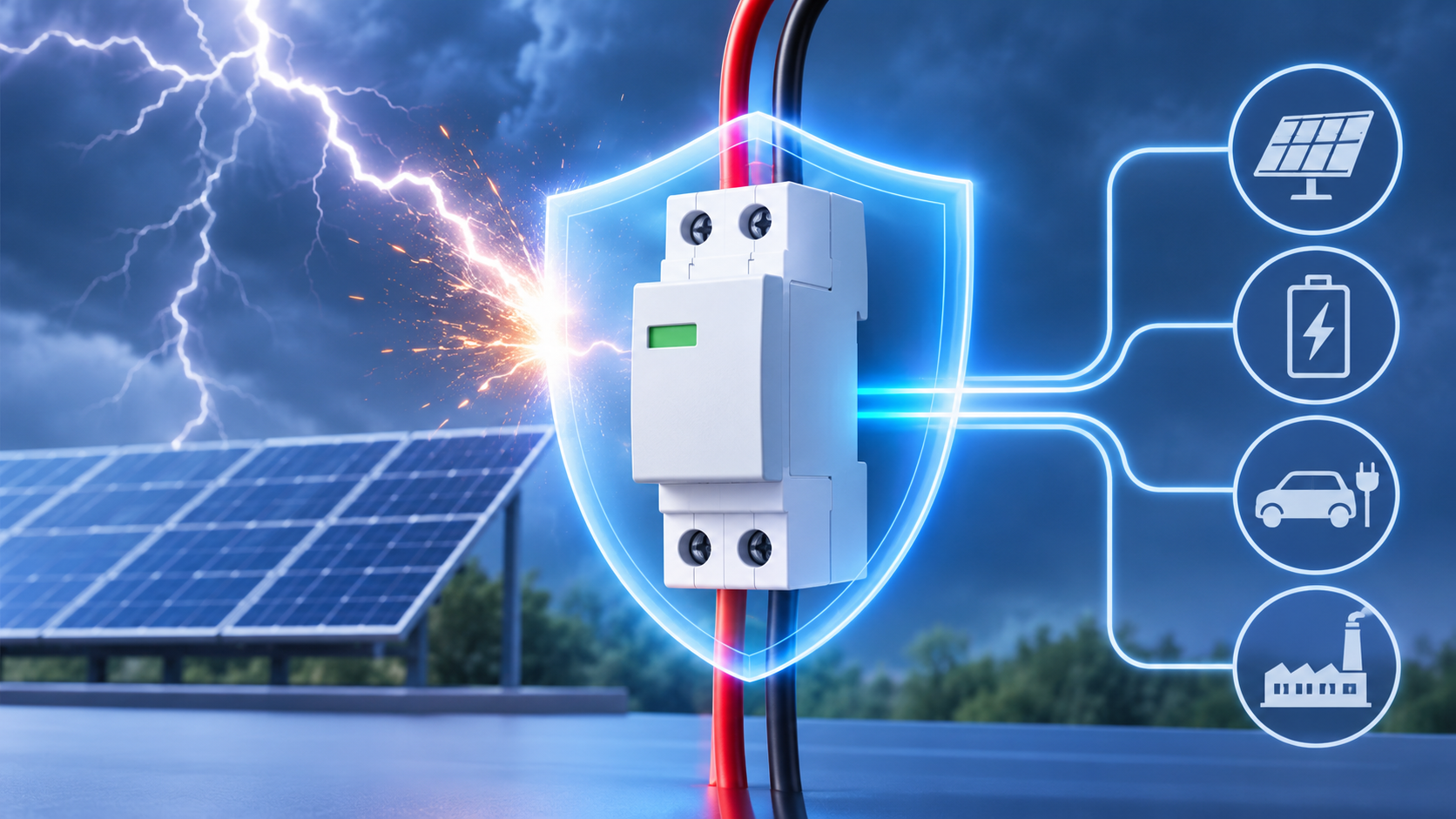
A DC Surge Protective Device (DC SPD) is an essential electrical protection component designed to protect DC-powered equipment from transient overvoltages. It helps prevent damage to solar photovoltaic systems, battery storage installations, electric vehicle charging infrastructure, and industrial DC power systems.
But what exactly is a DC surge protective device, how does it work, and why is it important?
In this guide, we will explore its working principle, key functions, applications, types, and important selection considerations.
1. What Is a DC Surge Protective Device?
A DC Surge Protective Device (DC SPD) is an electrical protection device designed to limit transient overvoltages in direct current electrical systems by diverting excessive surge current safely to the grounding system.
Voltage surges are sudden increases in electrical voltage that can exceed the normal operating voltage of a circuit. These transient events may last only microseconds, but they can cause significant damage to sensitive electrical and electronic equipment.
A DC SPD continuously monitors the voltage in a DC circuit. Under normal operating conditions, it remains in a high-impedance state and allows electrical current to flow without interfering with system operation.
When a voltage surge exceeds its designed protection threshold, the device quickly changes its electrical characteristics, providing a low-impedance path for the surge current. This helps divert excessive energy away from connected equipment.
Once the surge disappears, the device returns to its normal operating condition.
DC surge protective devices are commonly installed in:
-
Solar photovoltaic (PV) systems.
-
Battery energy storage systems.
-
Electric vehicle charging stations.
-
Industrial DC power distribution systems.
-
Telecommunications equipment.
-
DC control and automation systems.
Their primary purpose is to improve electrical safety, protect valuable equipment, and reduce unexpected system downtime.
2. Why Is DC Surge Protection Important?
Direct current systems have become increasingly common in modern electrical infrastructure. Solar energy generation, battery storage, electric transportation, and industrial automation all depend on reliable DC power.
However, these systems can be exposed to different sources of electrical surges.
Unlike alternating current (AC), direct current does not naturally pass through zero voltage during each cycle. Consequently, interrupting DC current and extinguishing electrical arcs can be more challenging.
This makes appropriately designed DC surge protection especially important.
Here are the main reasons why DC surge protective devices are necessary.
2.1 Protection Against Lightning Surges
Lightning is one of the most significant sources of transient overvoltage.
A direct lightning strike or nearby lightning activity can generate extremely high transient voltages in electrical installations. These surges may enter through power cables, grounding systems, or other conductive connections.
A properly selected DC SPD helps limit the resulting overvoltage and safely discharge surge current.
2.2 Protection Against Switching Surges
Electrical switching operations can also generate transient overvoltages.
For example, switching inductive loads, disconnecting electrical circuits, and operating power conversion equipment may create sudden voltage disturbances.
DC surge protective devices help reduce the impact of these transient events on sensitive electrical components.
2.3 Protection of Sensitive Electronic Equipment
Modern DC installations contain sensitive electronic components, including:
-
Solar inverters.
-
Battery management systems.
-
Power conversion equipment.
-
Electronic controllers.
-
Monitoring and communication devices.
Excessive voltage can damage these components, resulting in expensive repairs or equipment replacement.
Installing suitable surge protection helps reduce these risks.
2.4 Improved System Reliability
Unexpected electrical damage can interrupt power generation, storage, and distribution.
By reducing the effects of transient overvoltages, DC SPDs contribute to improved system reliability, reduced maintenance costs, and longer equipment service life.
3. How Does a DC Surge Protective Device Work?
Understanding the working principle of a DC surge protective device helps explain its importance in electrical installations.
A DC SPD typically uses nonlinear voltage-dependent components, such as metal oxide varistors (MOVs), to control transient overvoltages.
Its operation can be divided into three main stages.
Stage 1: Normal Operating Conditions
Under normal voltage conditions, the SPD maintains a high electrical impedance.
Only a very small leakage current flows through its protective components. The device does not significantly interfere with the normal operation of the DC electrical circuit.
Stage 2: Surge Detection and Discharge
When a transient overvoltage occurs and exceeds the device's operating threshold, the protective element rapidly becomes conductive.
Its impedance decreases, creating a path through which excessive surge current can be diverted toward the grounding system or another designated protective path, depending on the circuit configuration.
This limits the voltage appearing across the protected equipment.
Stage 3: Return to Normal Operation
After the transient event disappears, the SPD returns to its high-impedance state.
The protected electrical system can then continue operating normally.
Some surge protective devices also incorporate thermal disconnection mechanisms. These mechanisms help disconnect a protective element if it becomes damaged or overheated, reducing the risk of continued abnormal operation.
4. What Are the Main Components of a DC Surge Protective Device?
A DC surge protective device consists of several important components that work together to provide reliable overvoltage protection.
4.1 Metal Oxide Varistor (MOV)
The metal oxide varistor is one of the most commonly used components in surge protective devices.
It has a nonlinear voltage-current characteristic. Under normal operating conditions, it presents high resistance. When the voltage rises above a specific threshold, its resistance decreases significantly.
This allows it to conduct surge current and limit transient overvoltage.
4.2 Gas Discharge Tube (GDT)
A gas discharge tube is another protective component used in certain surge protection designs.
It contains gas between two electrodes. When the voltage reaches its specified breakdown level, the gas becomes conductive and provides a path for surge current.
GDTs are particularly useful in applications requiring high surge current handling capability.
4.3 Thermal Disconnector
A thermal disconnector helps protect the SPD against overheating.
If a protective component deteriorates or experiences abnormal thermal conditions, the disconnector can isolate it from the circuit.
This helps improve operational safety.
4.4 Indicator Window
Many DC surge protective devices include a visual status indicator.
It allows maintenance personnel to check whether the protective module is operating normally or requires replacement.
A clear indication makes inspection and maintenance easier.
4.5 Connection Terminals
Connection terminals provide the electrical interface between the SPD, DC circuit, and grounding system.
Proper terminal connections and conductor sizing are essential for effective surge protection.
5. What Are the Common Applications of DC Surge Protective Devices?
DC surge protective devices are used in various industries where direct current power systems require protection against transient overvoltages.
Some of their most common applications include the following.
5.1 Solar Photovoltaic Systems
Solar photovoltaic installations are among the most important applications of DC surge protection.
Solar panels generate DC electricity, which is transmitted through DC cables to an inverter for conversion into AC power.
Because solar panels are often installed on rooftops or in large outdoor areas, they can be exposed to lightning-related electromagnetic disturbances.
DC SPDs are commonly installed at appropriate locations, such as:
-
Solar panel combiner boxes.
-
DC distribution cabinets.
-
Inverter DC input terminals.
-
Other DC circuit interfaces requiring surge protection.
They help protect solar modules, inverters, and associated electrical equipment against transient overvoltages.
5.2 Battery Energy Storage Systems
Battery energy storage systems store electrical energy and release it when required.
These installations contain battery modules, battery management systems, power converters, and monitoring equipment.
Transient overvoltages can affect sensitive electronic components and disrupt system operation.
DC surge protective devices help reduce these risks and improve the reliability of battery storage installations.
5.3 Electric Vehicle Charging Stations
Electric vehicle charging infrastructure increasingly uses high-voltage DC technology.
DC fast-charging equipment contains power conversion systems, electronic controllers, and communication components that require reliable electrical protection.
Appropriately rated DC SPDs help protect these systems against transient overvoltages caused by lightning and switching operations.
5.4 Industrial DC Power Systems
Industrial facilities use DC power for automation, control systems, motors, and specialized equipment.
Unexpected voltage spikes can interrupt production and damage sensitive electrical components.
Installing DC surge protection at suitable points in the electrical distribution system helps improve operational continuity.
5.5 Telecommunications Systems
Telecommunications infrastructure frequently uses DC power supplies to operate communication equipment.
Surge protection helps reduce the possibility of electrical disturbances damaging power distribution equipment, monitoring systems, and sensitive electronic devices.
6. What Are the Different Types of DC Surge Protective Devices?
DC surge protective devices can be classified according to their protection capabilities and intended installation environments.
The two commonly discussed protection categories are Type 1 and Type 2.
6.1 Type 1 DC Surge Protective Device
A Type 1 SPD is designed to discharge high-energy surge currents associated with direct lightning current effects.
It is generally used in installations where lightning current may enter the electrical system, particularly where external lightning protection systems are present and the installation design requires this level of protection.
Type 1 devices are tested using an impulse current waveform, commonly represented by 10/350 μs.
6.2 Type 2 DC Surge Protective Device
A Type 2 SPD is designed to protect electrical systems against induced lightning surges and switching-related transient overvoltages.
It is commonly installed in DC distribution systems, solar combiner boxes, and inverter input circuits.
Type 2 devices are generally tested using an 8/20 μs current waveform.
6.3 Type 1+2 DC Surge Protective Device
A Type 1+2 SPD combines the protection functions of Type 1 and Type 2 devices.
It is designed to handle high-energy lightning-related surges as well as other transient overvoltages.
These devices are used in installations where both protection requirements need to be addressed within a coordinated protection arrangement.
The appropriate SPD type depends on the lightning risk, electrical installation design, grounding arrangement, and applicable standards.
7. What Is the Difference Between AC and DC Surge Protective Devices?
Although AC and DC surge protective devices share the same basic purpose, their electrical characteristics and application requirements are different.
Understanding these differences is essential when selecting the correct protection device.
| Comparison | AC Surge Protective Device | DC Surge Protective Device |
|---|---|---|
| Electrical system | Alternating current | Direct current |
| Current direction | Changes periodically | Remains in one direction |
| Voltage characteristics | Alternates periodically | Generally maintains a constant polarity |
| Zero crossing | Naturally occurs during each cycle | No natural periodic zero crossing |
| Arc interruption | Generally easier due to current zero crossing | Requires specific DC arc-quenching design |
| Common applications | AC distribution systems | Solar PV, battery storage, and DC power systems |
| Voltage rating | Designed for specified AC voltage | Designed for specified DC voltage |
One of the most important differences is the interruption of electrical current.
In AC systems, current naturally reaches zero during every cycle, helping extinguish electrical arcs.
In DC systems, there is no natural periodic zero crossing. Therefore, DC surge protective devices require designs specifically suitable for DC operating conditions.
An AC surge protective device should never be assumed suitable for a DC circuit. The protection device must have the correct DC voltage rating and be designed and tested for the intended application.
8. How to Choose the Right DC Surge Protective Device?
Selecting the correct DC SPD is essential for achieving effective electrical protection.
Several technical parameters should be considered before choosing a device.
8.1 Maximum Continuous Operating Voltage (Uc)
Maximum continuous operating voltage refers to the highest voltage that can be continuously applied to the SPD without causing it to operate improperly.
The selected Uc rating must be compatible with the maximum expected operating voltage of the DC system.
For solar PV installations, the maximum open-circuit voltage of the PV array under the lowest expected operating temperature must be considered.
Choosing an SPD with an insufficient voltage rating can result in premature degradation or failure.
8.2 Voltage Protection Level (Up)
The voltage protection level indicates the voltage that may appear across the SPD terminals during specified surge test conditions.
A lower Up value generally provides better voltage limitation.
The selected protection level should be sufficiently below the impulse withstand capability of the equipment being protected, with an appropriate safety margin.
8.3 Nominal Discharge Current (In)
Nominal discharge current represents the surge current an SPD can withstand under specified test conditions using an 8/20 μs waveform.
This parameter is important when evaluating the device's ability to handle repeated surge events.
8.4 Maximum Discharge Current (Imax)
Maximum discharge current represents the maximum surge current an SPD can withstand under specified test conditions using an 8/20 μs waveform.
A suitable Imax rating should be selected according to the expected surge environment and installation requirements.
8.5 Impulse Discharge Current (Iimp)
Impulse discharge current is particularly relevant for Type 1 surge protective devices.
It describes the device's ability to withstand high-energy lightning impulse currents, typically tested using a 10/350 μs waveform.
8.6 Short-Circuit Current Rating
The short-circuit current rating indicates the fault current conditions under which the SPD can safely operate when correctly installed with the specified protective devices.
This parameter is particularly important in high-current DC installations, including photovoltaic and battery storage systems.
8.7 Number of Poles and Connection Configuration
DC surge protective devices are available in different electrical configurations.
The appropriate configuration depends on the system's grounding arrangement, circuit design, and protection requirements.
The number of poles and connection arrangement should always match the electrical installation.
9. Where Should a DC Surge Protective Device Be Installed?
Correct installation is just as important as selecting the appropriate SPD.
The location of a DC surge protective device affects its ability to limit transient overvoltages effectively.
Common installation locations include:
Solar PV systems:
-
Near the DC output of photovoltaic arrays.
-
Inside or near PV combiner boxes.
-
At inverter DC input connections.
Battery storage systems:
-
At suitable DC distribution points.
-
Near battery system interfaces where required by the protection design.
-
At power conversion equipment connections.
Industrial DC systems:
-
At DC power distribution panels.
-
Near sensitive electronic equipment.
-
At cable entry points and system interfaces requiring protection.
The SPD should generally be installed with short connecting conductors to minimize additional voltage drops caused by surge current.
Proper grounding and equipotential bonding are also essential.
Long connection wires can increase the effective voltage appearing across protected equipment during a surge event, reducing the overall effectiveness of the protection system.
Installation should follow the manufacturer's instructions and applicable electrical safety requirements.
10. Which Standards Apply to DC Surge Protective Devices?
International standards establish the performance, testing, and installation requirements for surge protective devices.
Some important standards and technical documents include:
IEC 61643-31: Covers surge protective devices connected to the DC side of photovoltaic installations.
IEC 61643-41: Addresses surge protective devices for low-voltage DC power systems.
IEC 60364-5-53: Provides requirements concerning the selection and installation of electrical protection and switching devices, including surge protection.
IEC 60364-7-712: Covers electrical installation requirements for photovoltaic power supply systems.
IEC 62305: Addresses protection against lightning and provides guidance for lightning risk management and protection measures.
Following relevant standards helps ensure that DC surge protective devices are appropriately selected, installed, and coordinated with the overall electrical protection system.
The applicable edition and national adoption should always be checked during system design.
11. What Are the Benefits of Using a DC Surge Protective Device?
Installing an appropriately selected DC SPD offers several important advantages.
1. Equipment Protection
It helps protect sensitive electrical and electronic components against transient overvoltages.
2. Improved Electrical Safety
Proper surge protection reduces the risk of equipment damage caused by electrical disturbances.
3. Reduced Maintenance Costs
Preventing surge-related damage can reduce repair expenses and equipment replacement costs.
4. Improved System Reliability
DC SPDs help minimize unexpected interruptions in solar, industrial, and energy storage installations.
5. Longer Equipment Service Life
Reducing exposure to damaging transient voltages helps protect sensitive electronic components.
6. Better Protection Coordination
When correctly selected and coordinated with other protective devices, DC SPDs contribute to a more comprehensive electrical protection strategy.
12. Frequently Asked Questions About DC Surge Protective Devices
Q1. What does a DC surge protective device do?
A DC surge protective device limits transient overvoltages in direct current electrical systems by diverting excessive surge current through a designated protective path. It helps protect connected equipment against lightning-related and switching-related voltage surges.
Q2. Can I use an AC surge protector in a DC system?
No. An AC SPD should not be used in a DC system unless it has been specifically designed, tested, and rated for that DC application. DC circuits have different electrical and arc-interruption characteristics, requiring appropriate protection devices.
Q3. Is a DC surge protective device necessary for solar panels?
DC surge protection is an important part of many solar PV installations. Solar panels and their associated DC wiring can be exposed to lightning-induced transient overvoltages. A properly selected SPD helps protect the inverter and other connected equipment.
Q4. What is the difference between Type 1 and Type 2 DC SPDs?
Type 1 SPDs are designed to discharge high-energy lightning impulse currents and are tested using a 10/350 μs waveform.
Type 2 SPDs are designed to protect against induced lightning surges and switching transients and are tested using an 8/20 μs waveform.
The appropriate type depends on the installation's lightning protection requirements.
Q5. How long does a DC surge protective device last?
The service life of a DC SPD depends on its design, operating environment, surge exposure, and electrical conditions.
Repeated surge events can gradually degrade its protective components. Regular inspection of the device's status indicator and replacement of damaged or end-of-life modules are important maintenance practices.
Q6. Does a DC surge protective device protect against overcurrent?
No. A DC SPD is primarily designed to protect against transient overvoltages. It does not replace overcurrent protection devices such as fuses or circuit breakers.
Both protection functions may be required in a properly designed DC electrical installation.
Q7. Can a DC SPD protect against direct lightning strikes?
A suitably selected Type 1 DC SPD can discharge a portion of the lightning current when the installation is designed for this purpose. However, an SPD alone cannot provide complete protection against direct lightning strikes.
A comprehensive lightning protection system may require external lightning protection, equipotential bonding, grounding, and coordinated surge protection.
Conclusion
A DC Surge Protective Device (DC SPD) is an important component in modern DC electrical installations. It helps protect equipment against transient overvoltages caused by lightning activity, switching operations, and other electrical disturbances.
From solar photovoltaic systems and battery energy storage installations to electric vehicle charging stations and industrial DC power systems, reliable surge protection plays an essential role in maintaining electrical safety and operational stability.
Understanding the working principle, protection types, technical parameters, and installation requirements of DC SPDs makes it easier to select the right device for a particular application.
Ultimately, choosing a properly rated DC surge protective device and integrating it into a coordinated electrical protection system can significantly reduce the risk of surge-related equipment damage, improve system reliability, and support long-term operational performance.



