
 eaton-bussmann-series-photovoltaic-fuses-catalogue-ca135004en.pdf  | [Eaton Bussmann PV Fuses] | 0 kB |
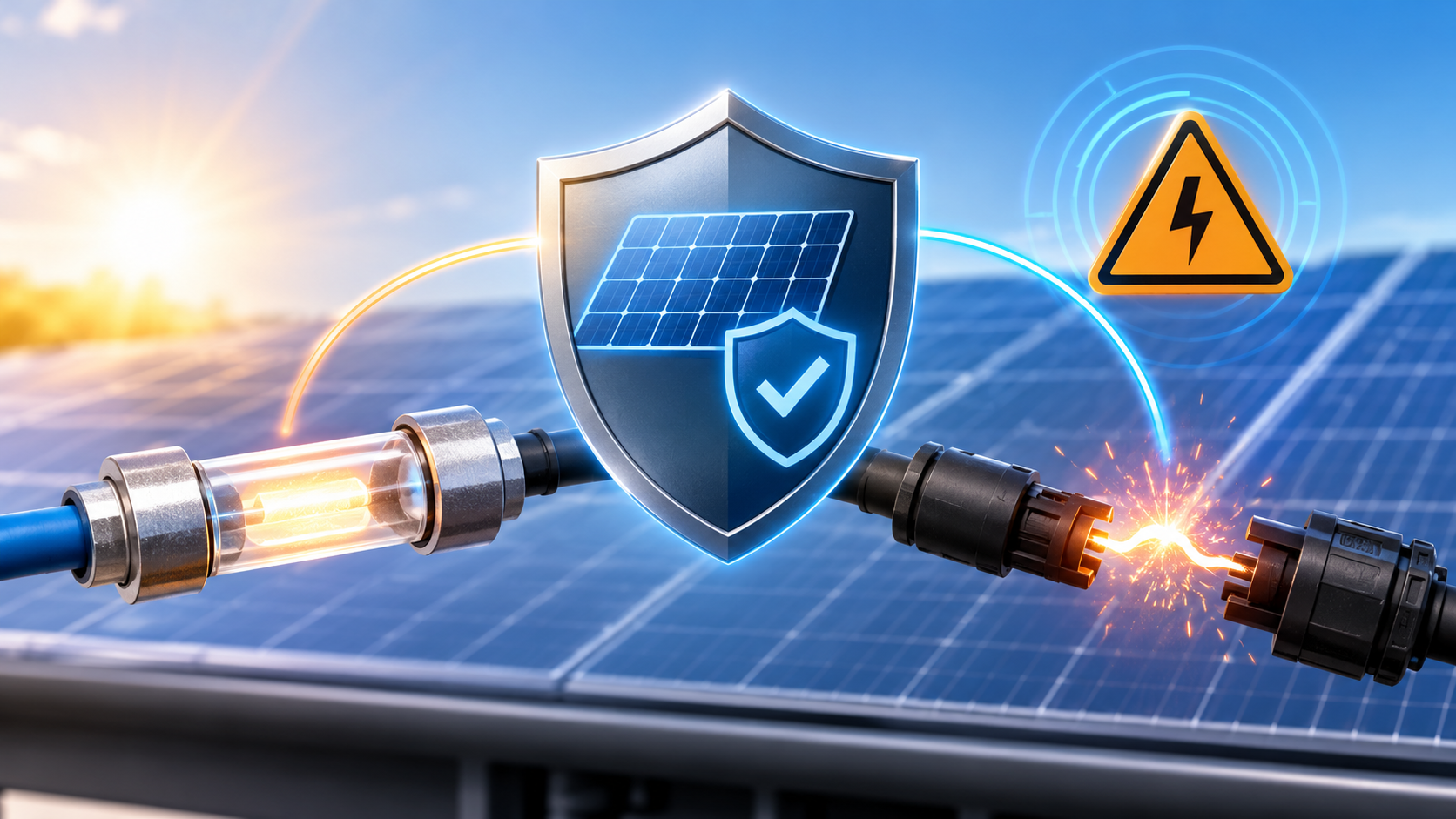
Solar Fuse Protection vs. Arc Faults: Understanding the Differences and Improving PV System Safety
As solar photovoltaic (PV) installations become larger and more powerful, electrical safety is becoming increasingly important. Higher system voltages, complex wiring configurations, and demanding operating conditions introduce potential risks that require reliable protection strategies. Among the most important considerations are solar fuse protection and arc fault prevention.
Although solar fuses and arc fault detection devices both contribute to photovoltaic system safety, they serve different purposes. Understanding how these technologies work, where their protection capabilities overlap, and why they should be used together is essential for designing reliable solar power installations.
This article explores the differences between solar fuse protection and arc faults, explains the importance of photovoltaic-specific fuses, and highlights practical ways to reduce electrical fire risks in solar installations.
1. What Is Solar Fuse Protection?
Solar fuse protection is an essential safety measure designed to protect photovoltaic components against excessive electrical current. A solar PV fuse is specifically engineered to interrupt dangerous overcurrent conditions before they damage cables, connectors, solar modules, or other electrical equipment.
Unlike conventional AC installations, solar photovoltaic systems generate direct current (DC). DC circuits present particular protection challenges because the current does not naturally pass through zero, making it more difficult to interrupt an electrical fault.
Photovoltaic fuses are designed to operate under these demanding DC conditions.
How Do Solar Fuses Work?
A solar fuse contains a calibrated metal element that melts when the electrical current exceeds its specified operating limits for a sufficient period.
When the fuse element melts, an internal arc may form. Special arc-quenching materials help extinguish this arc and safely interrupt the circuit.
The primary functions of solar fuse protection include:
-
Overcurrent protection: Preventing excessive current from damaging electrical components.
-
String protection: Isolating faulty PV strings in parallel-connected solar arrays.
-
Equipment protection: Reducing the risk of damage to cables, connectors, and combiner boxes.
-
Fire risk reduction: Limiting the thermal energy released during certain electrical faults.
-
System reliability: Preventing electrical faults from spreading throughout the installation.
Solar fuses are particularly important in large photovoltaic installations where multiple strings operate in parallel.
If one string develops a fault, current from other parallel strings may flow into the affected circuit. Properly selected string fuses help interrupt this reverse current before it causes significant damage.
2. What Are Arc Faults in Solar PV Systems?
An arc fault occurs when electrical current flows through an unintended gap or damaged connection instead of following its normal conductive path.
This can happen when electrical connections become loose, insulation deteriorates, connectors are damaged, or conductors become exposed.
In photovoltaic systems, arc faults are particularly dangerous because DC electrical arcs can remain sustained.
Unlike AC arcs, which benefit from the natural current zero-crossings that occur during each cycle, DC arcs do not have regular zero-crossing points. Consequently, an established DC arc can continue generating intense heat until the circuit is interrupted.
Common Causes of Solar Arc Faults
Several installation and operating conditions can contribute to arc fault development:
1. Loose Electrical Connections
Loose terminals increase electrical resistance at connection points. This can produce excessive heat and create conditions that lead to arcing.
2. Damaged Cable Insulation
UV exposure, temperature fluctuations, mechanical damage, and environmental deterioration can weaken cable insulation and expose conductive parts.
3. Faulty Connectors
Improperly installed, incompatible, or damaged connectors may develop high-resistance contact points, increasing the likelihood of electrical arcing.
4. Thermal Cycling
Solar installations experience repeated heating and cooling throughout the day. These temperature changes can gradually affect electrical connections and insulation materials.
5. Corrosion and Oxidation
Moisture and environmental exposure can cause corrosion at electrical terminals, increasing contact resistance and creating potential arc fault conditions.
Why Are DC Arc Faults Dangerous?
An electrical arc can produce extremely high temperatures, potentially damaging surrounding components and igniting nearby combustible materials.
In large solar installations, an uncontrolled arc fault may result in:
-
Electrical equipment damage.
-
Melted cables and connectors.
-
Combiner box failures.
-
Solar system shutdowns.
-
Electrical fires.
-
Extended maintenance downtime.
-
Significant financial losses.
Early detection and appropriate circuit protection are therefore essential.
3. Solar Fuse Protection vs. Arc Fault Detection: Key Differences
Solar fuses and arc fault detection devices are complementary technologies, but their operating principles and protection functions are different.
Understanding these differences helps engineers select appropriate protection equipment for photovoltaic installations.
| Comparison | Solar Fuse Protection | Arc Fault Detection |
|---|---|---|
| Primary function | Interrupts excessive current | Identifies electrical arc signatures |
| Operating principle | Melting of a calibrated fuse element | Electronic monitoring and signal analysis |
| Main protection target | Overcurrent and short-circuit conditions | Dangerous electrical arcing |
| Response mechanism | Physical circuit interruption | Detection followed by an alarm or shutdown command |
| Operating method | Passive protection | Active electronic protection |
| Typical installation | PV string circuits and combiner boxes | Inverters and designated monitoring circuits |
| Maintenance | Inspection and replacement after operation | Functional testing and system monitoring |
The Main Difference
A solar fuse responds to electrical current and its associated thermal effects. An arc fault detection device monitors electrical signals to identify characteristics associated with arcing.
This distinction is important because not every arc fault generates enough current to activate a conventional overcurrent protection device.
A series arc, for example, can occur within a damaged conductor or loose connection without producing a substantial increase in circuit current.
In such situations, an arc fault detector may identify the abnormal electrical signature even when a fuse does not operate.
Conversely, a fuse can provide reliable physical interruption when a fault produces sufficient current within its specified operating characteristics.
Neither technology provides complete protection independently.
4. Why 1500V DC Solar Systems Require Special Attention
The adoption of 1500V DC photovoltaic systems has helped improve the efficiency and economics of large-scale solar installations.
Higher operating voltages allow longer PV strings and can reduce the number of parallel circuits, cables, and associated balance-of-system components.
However, higher DC voltage also introduces additional electrical safety considerations.
Increased Arc Fault Risks
Higher voltage can make it easier for an electrical arc to initiate across an insulation gap or damaged connection.
Once established, a DC arc may remain sustained and generate substantial thermal energy.
The consequences can include:
-
Increased electrical stress on insulation.
-
Greater potential for sustained arcing.
-
More demanding interruption requirements.
-
Increased risk of equipment damage.
-
Greater importance of correctly rated protection devices.
For this reason, engineers must ensure that every protective device is suitable for the maximum system voltage and the specific operating conditions.
Why Standard DC Fuses May Not Be Suitable
Not every DC-rated fuse is appropriate for photovoltaic applications.
Solar installations experience fluctuating operating conditions, repeated thermal cycling, and specific fault-current characteristics.
Photovoltaic fuses are designed to address these application requirements.
When selecting a fuse for a 1500V DC installation, engineers should evaluate:
-
Rated DC voltage.
-
Rated current.
-
Breaking capacity.
-
Minimum breaking characteristics.
-
Time-current characteristics.
-
Total clearing I²t.
-
Applicable photovoltaic standards.
Choosing a fuse based solely on its current rating can result in inadequate protection.
5. The Importance of Breaking Capacity and I²t in Solar Fuse Selection
Two important technical parameters in photovoltaic fuse selection are breaking capacity and I²t.
Both influence how effectively a fuse can interrupt a fault and limit the energy released during the interruption process.
What Is Fuse Breaking Capacity?
Breaking capacity refers to the maximum prospective fault current that a fuse can safely interrupt at its specified voltage and operating conditions.
If the prospective fault current exceeds the fuse's rated breaking capacity, the device may not interrupt the fault safely.
Engineers must therefore verify that the selected fuse has an adequate DC breaking capacity for the installation.
Minimum breaking characteristics also deserve attention. Some photovoltaic faults develop under relatively low overcurrent conditions, which means the fuse must be suitable for the expected fault-current range.
What Is I²t?
I²t represents the thermal energy associated with current flowing through a fuse during its operating and interruption process.
It is commonly used to evaluate the energy let through before a protective device clears a fault.
In general, a lower total clearing I²t means less thermal energy is allowed to pass through the fuse during interruption.
This can help reduce thermal stress on protected components.
However, fuse selection should never be based on I²t alone. Voltage rating, current rating, breaking capacity, time-current characteristics, and coordination with other protection devices must also be considered.
6. How Solar Fuses and Arc Fault Detectors Work Together
One common question in photovoltaic system design is whether an installation requires both solar fuses and arc fault detection devices.
In many applications, the answer is yes.
These technologies address different electrical fault conditions and provide complementary layers of protection.
The Role of Solar Fuses
Solar fuses provide passive overcurrent protection.
They operate without electronic monitoring, software, or external control signals.
When a fault produces sufficient current under the fuse's operating characteristics, the fuse element melts and interrupts the circuit.
Their main advantages include:
-
Reliable passive operation.
-
Fast interruption under suitable fault conditions.
-
Protection against excessive current.
-
No dependence on electronic detection algorithms.
-
Suitability for photovoltaic string protection when correctly specified.
The Role of Arc Fault Detection Devices
Arc fault detection devices use electronic monitoring to identify electrical signals associated with arcing.
When the device detects a potentially dangerous arc, it can initiate an alarm or trigger a system shutdown, depending on the installation design.
Their advantages include:
-
Detection of certain series and parallel arc faults.
-
Continuous electrical signal monitoring.
-
Identification of abnormal operating conditions.
-
Additional protection against faults that may not generate sufficient overcurrent to operate a fuse.
Why Both Are Important
A fuse cannot necessarily detect every arc fault, particularly a series arc with limited current.
Similarly, an arc fault detector does not replace the physical overcurrent interruption provided by a correctly selected fuse.
Combining both technologies creates a more comprehensive protection strategy.
The fuse provides overcurrent protection, while the arc fault detection system adds another layer of electrical fault identification and response.
7. Five Practical Ways to Reduce Arc Fault Risks in Solar Installations
Selecting appropriate protection devices is only one part of maintaining photovoltaic system safety.
Installation quality, preventive maintenance, and regular inspections are equally important.
The following practices can help reduce arc fault risks.
1. Inspect and Tighten Electrical Connections
Loose connections are a common contributor to electrical arcing.
During installation and maintenance, technicians should verify that electrical terminals are tightened according to the manufacturer's specified torque values.
Using calibrated torque tools helps ensure consistent connections and reduces the likelihood of excessive contact resistance.
2. Use Compatible and High-Quality Connectors
Connectors should be compatible with the relevant cables and connection systems.
Mixing incompatible connector types or using damaged components can result in poor electrical contact.
Regular inspections should identify signs of discoloration, overheating, corrosion, or physical damage.
3. Inspect Cable Insulation Regularly
Solar cables are exposed to sunlight, temperature changes, moisture, and environmental stress.
Technicians should inspect cables for:
-
Cracks and damaged insulation.
-
Exposed conductors.
-
Abrasion and mechanical damage.
-
Signs of overheating.
-
Moisture-related deterioration.
Damaged cables should be addressed promptly.
4. Select Photovoltaic-Specific Fuses
Fuse selection should reflect the electrical characteristics of the PV installation.
Engineers should verify that the selected fuse is suitable for the system's DC voltage, current, fault conditions, and operating environment.
Using a general-purpose industrial fuse without confirming its suitability for photovoltaic applications can compromise protection performance.
5. Perform Thermal Imaging Inspections
Thermal imaging can help identify abnormal temperature increases at terminals, connectors, fuse holders, and other electrical components.
These inspections can reveal developing problems before they result in equipment failure.
Thermal inspections should be incorporated into an appropriate preventive maintenance programme.
8. Common Mistakes When Selecting Solar Fuse Protection
Incorrect fuse selection can reduce the effectiveness of an otherwise well-designed photovoltaic protection system.
Several common mistakes should be avoided.
Choosing a Fuse Based Only on Rated Current
A fuse's current rating is only one part of its specification. DC voltage rating, breaking capacity, time-current characteristics, and photovoltaic suitability must also be evaluated.
Ignoring Maximum System Voltage
A fuse must be rated for the maximum DC voltage it may experience under the installation's operating conditions.
This is particularly important in high-voltage photovoltaic systems.
Overlooking Breaking Capacity
The fuse must safely interrupt the prospective fault current. Insufficient breaking capacity can create serious safety risks.
Using Conventional Industrial Fuses Without Verification
Not all industrial fuses are designed for the operating characteristics and protection requirements of photovoltaic systems.
Treating Fuses as a Replacement for Arc Fault Detection
Overcurrent protection and arc fault detection perform different functions. Relying on one technology alone may leave certain electrical faults undetected or inadequately protected.
9. What Standards Apply to Photovoltaic Fuse Protection?
International standards help ensure that photovoltaic protection devices meet defined electrical and safety requirements.
One important standard is IEC 60269-6, which addresses supplementary requirements for fuse-links used to protect solar photovoltaic energy systems.
When specifying photovoltaic fuses, engineers should consider applicable requirements relating to:
-
Rated voltage and current.
-
Breaking capacity.
-
Time-current characteristics.
-
Temperature performance.
-
Electrical endurance.
-
Safe fault interruption.
-
Suitability for photovoltaic applications.
It is also important to consider the relevant system-level electrical installation and arc fault protection requirements applicable in the country where the solar installation is located.
Compliance documentation and manufacturer test data should be reviewed before protective devices are approved for installation.
10. Frequently Asked Questions About Solar Fuse Protection and Arc Faults
Q1. Can a solar fuse prevent every arc fault?
No. Solar fuses primarily provide overcurrent protection. Some arc faults, particularly series arcs, may not generate enough additional current to operate a fuse. Dedicated arc fault detection provides an additional layer of protection.
Q2. What is the difference between a solar fuse and an arc fault circuit interrupter?
A solar fuse interrupts excessive current through the melting of a calibrated fuse element. An arc fault circuit interrupter monitors electrical signals and identifies patterns associated with dangerous arcing before initiating an appropriate response.
Q3. Why are DC arc faults more dangerous than AC arc faults?
DC circuits do not have the natural current zero-crossings found in AC systems. As a result, an established DC arc can remain sustained until the electrical circuit is interrupted.
Q4. Are photovoltaic-specific fuses necessary for 1500V DC systems?
Protection devices must be specifically suitable for the system's voltage and application. Photovoltaic-rated fuses are designed to address the particular operating and fault-interruption requirements of solar installations.
Q5. What causes arc faults in solar combiner boxes?
Common causes include loose terminals, damaged insulation, faulty connectors, corrosion, and deteriorating electrical connections. Poor installation practices and repeated thermal cycling can increase the likelihood of these problems.
Q6. Can an arc fault detection device replace a solar fuse?
No. Arc fault detection devices and solar fuses have different protection functions. Arc fault detectors identify certain electrical arcing conditions, while fuses provide physical interruption of excessive current.
Q7. How often should solar fuse protection systems be inspected?
Inspection frequency should follow applicable regulations, equipment manufacturers' recommendations, and the installation's maintenance programme. Regular inspections should include fuse holders, terminals, cable connections, and signs of overheating or physical deterioration.
Conclusion: Combining Solar Fuse Protection and Arc Fault Detection for Better Safety
As photovoltaic installations continue to expand and operate at higher DC voltages, reliable electrical protection is essential for maintaining system safety, performance, and long-term reliability.
Solar fuse protection and arc fault detection play different but equally important roles. Photovoltaic fuses provide passive overcurrent protection, while arc fault detection devices identify abnormal electrical signals that may indicate dangerous arcing.
Neither technology should be considered a complete replacement for the other.
A comprehensive solar protection strategy should combine correctly selected photovoltaic fuses, appropriate arc fault detection, high-quality electrical connections, suitable installation practices, and regular preventive maintenance.
By understanding the differences between solar fuse protection and arc faults, system designers and operators can make better equipment selections, reduce electrical risks, and improve the reliability of photovoltaic installations.



