
 eaton-ev-fuse-catalogue-emob0062-en-us.pdf  | [Eaton Bussmann EV Fuses] | 0 kB |
Selecting Fuse Holders and Disconnectors for 1000V EV Systems
Introduction
As electric vehicle technology continues to advance, high-voltage electrical architectures are becoming increasingly important. Modern electric vehicles, battery packs, DC fast-charging stations and power conversion systems are adopting higher operating voltages to improve energy efficiency, reduce power losses and support faster charging.
In 1000V DC electric vehicle systems, electrical protection is essential for ensuring operational safety, system reliability and long-term performance. While selecting the correct fuse is a critical step, choosing a suitable fuse holder and disconnector is equally important.
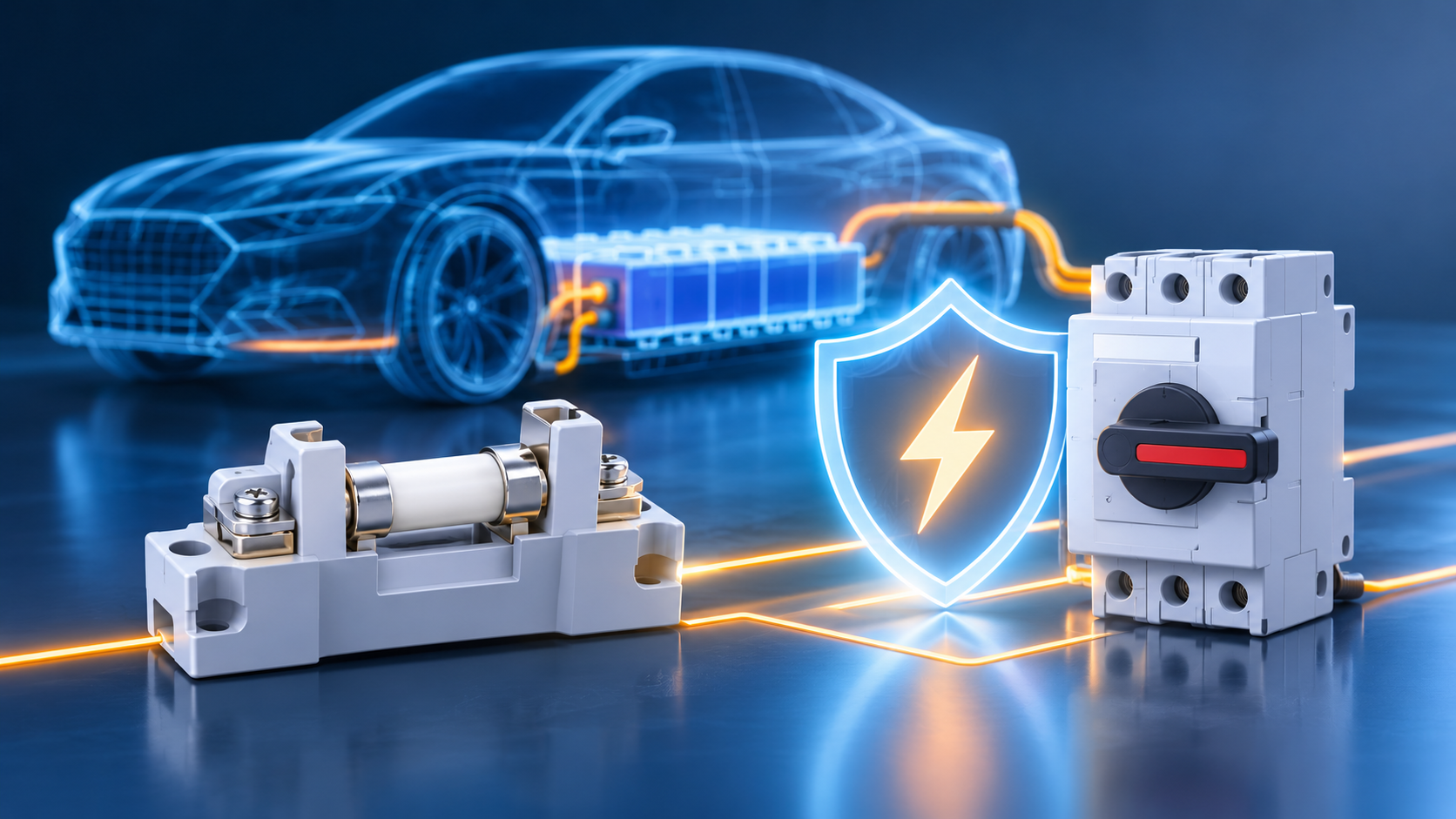
Fuse holders provide secure electrical connections and mechanical support for protective fuses, while disconnectors allow electrical circuits to be safely isolated during maintenance or emergencies. Both components must be designed and rated for the demanding conditions associated with high-voltage DC applications.
This guide explains how to select fuse holders and disconnectors for 1000V EV systems, covering voltage and current ratings, mounting options, DC arc protection, environmental conditions and relevant safety standards.
1. Why 1000V DC EV Systems Require Special Protection
High-voltage DC systems present different electrical challenges compared with conventional AC installations.
In AC circuits, current naturally passes through zero during each cycle, helping extinguish electrical arcs when contacts separate. DC circuits do not have this natural zero-crossing point, making arc interruption significantly more difficult.
When a DC circuit is disconnected under load, an electrical arc can continue between separating contacts. Without suitable arc-extinguishing mechanisms and adequate electrical clearance, this can result in:
-
Contact damage and overheating.
-
Electrical arcing between terminals.
-
Insulation breakdown.
-
Equipment failure.
-
Increased risk of electrical fires.
For this reason, components designed for AC applications cannot automatically be considered suitable for 1000V DC systems.
Fuse holders and disconnectors must have appropriate DC voltage ratings, insulation properties, contact spacing and arc-management capabilities.
When designing EV battery protection systems, engineers should ensure that every protective component is compatible with the maximum operating voltage and potential fault conditions.
2. Key Factors When Selecting Fuse Holders for 1000V EV Systems
A fuse holder does more than accommodate a fuse. It provides a stable electrical connection, supports the fuse mechanically and helps maintain reliable circuit protection under demanding operating conditions.
The following factors should be considered when selecting a fuse holder for a high-voltage electric vehicle application.
2.1 DC Voltage Rating and Electrical Clearance
The voltage rating is one of the most important selection criteria.
For a 1000V EV electrical system, the fuse holder must have an explicitly specified DC voltage rating that meets or exceeds the maximum system voltage.
Electrical clearance and creepage distances must also be appropriate for the operating voltage and installation environment.
Insufficient clearance can increase the possibility of electrical discharge between terminals or between live components and grounded surfaces.
Engineers should consider:
-
Maximum continuous DC operating voltage.
-
Potential voltage transients.
-
Insulation coordination requirements.
-
Clearance between conductive parts.
-
Creepage distance across insulating surfaces.
Selecting a fuse holder specifically tested for high-voltage DC applications helps reduce the risk of insulation failure and electrical arcing.
2.2 Current Rating and Thermal Performance
The current rating determines how much continuous electrical current a fuse holder can safely carry under specified operating conditions.
A suitable fuse holder must support the required operating current without excessive temperature rise.
Thermal performance is particularly important in EV battery enclosures, where components may operate in confined spaces with limited ventilation.
An undersized fuse holder can experience:
-
Excessive contact resistance.
-
Terminal overheating.
-
Insulation deterioration.
-
Premature fuse operation.
-
Reduced component service life.
When selecting a fuse holder, engineers should evaluate the rated current, ambient temperature, contact resistance, conductor size and thermal derating requirements.
The fuse holder and fuse must be treated as a coordinated protection assembly rather than independently selected components.
2.3 Fuse Size and Compatibility
Fuse holders are manufactured for specific fuse dimensions and mounting configurations.
Common fuse dimensions used in electrical protection applications include:
| Fuse Size | Typical Application |
|---|---|
| 10 × 38 mm | Lower-current branch protection |
| 14 × 51 mm | Medium-current circuit protection |
| 22 × 58 mm | Higher-current branch protection |
| NH fuse sizes | High-current battery and distribution protection |
The correct fuse holder must match the physical dimensions, terminal arrangement and electrical specifications of the selected fuse.
Engineers should also verify that the holder supports the fuse's rated voltage, current and breaking capacity.
Using an incompatible fuse holder can create poor electrical contact, excessive heating and mechanical installation problems.
2.4 Mounting Options and Mechanical Stability
Mounting configuration is another important consideration in EV electrical system design.
The selected fuse holder must fit the enclosure, support the required electrical connections and remain mechanically secure during vehicle operation.
Common mounting options include:
DIN Rail Mounting
DIN rail fuse holders are suitable for modular electrical enclosures and compact distribution systems. They allow relatively straightforward installation, replacement and maintenance.
Busbar Mounting
Busbar-mounted fuse holders provide direct connections to conductive busbars. They are particularly useful in high-current battery circuits and power distribution assemblies.
Panel Mounting
Panel-mounted fuse holders are installed directly onto an enclosure or mounting surface. They are often used in custom electrical assemblies where accessibility and component positioning are important.
For electric vehicles, vibration resistance should be carefully evaluated. Secure fastening, reliable terminal connections and suitable mechanical support help prevent loosening during operation.
2.5 Fuse Status Indication
In many EV applications, fuse holders are installed inside sealed battery enclosures or electrical compartments.
Opening these enclosures for routine inspection can increase maintenance time and introduce additional safety risks.
Fuse holders with status indicators can make fault identification easier.
Depending on the design, indication may be provided through:
-
Visual mechanical indicators.
-
LED fuse failure indicators.
-
Auxiliary signal contacts.
-
Remote monitoring interfaces.
Remote indication can be particularly useful in systems where the battery management system needs to identify a blown fuse without requiring immediate physical access to the enclosure.
3. How to Select Disconnectors for 1000V EV Systems
Disconnectors, also known as isolator switches, are essential components in high-voltage electrical systems.
Their primary purpose is to provide electrical isolation so that equipment can be safely inspected, maintained or serviced.
In electric vehicle applications, disconnectors may be used to isolate battery circuits, inverter connections and charging circuits.
Selecting the correct disconnector requires careful evaluation of its electrical, mechanical and environmental characteristics.
3.1 Understanding the Difference Between Fuse Holders and Disconnectors
Fuse holders and disconnectors perform different functions.
A fuse holder provides a secure mounting and electrical connection for a fuse. The fuse itself interrupts excessive current when a fault occurs.
A disconnector provides a means of isolating an electrical circuit from its power source.
A fuse switch disconnector combines switching, isolation and fuse protection functions within a single assembly.
Understanding these differences is important when designing an effective EV protection system.
The components should be selected according to their intended functions and the safety requirements of the overall electrical architecture.
3.2 Rated Voltage and Current
For a 1000V DC EV system, the disconnector must have an appropriate DC operating voltage rating.
Its current rating must also be sufficient for the maximum continuous operating current of the circuit.
Engineers should verify:
-
Rated operational DC voltage.
-
Rated operational current.
-
Number of poles.
-
Permitted switching configurations.
-
Short-circuit coordination requirements.
It is important to distinguish between an isolation rating and a load-switching rating. Not every disconnector is designed to interrupt current under load.
3.3 DC Load-Breaking Capability
DC load-breaking capability is one of the most critical characteristics of a disconnector.
Opening a DC circuit under load can produce a persistent electrical arc. Therefore, a disconnector intended for load switching must incorporate suitable arc-extinguishing technology.
Before selecting a device, engineers should verify its tested operating conditions, including:
-
Rated operational voltage.
-
Rated operational current.
-
Utilisation category.
-
Permitted switching frequency.
-
Load interruption performance.
IEC 60947-3 is an important reference standard for switches, disconnectors, switch-disconnectors and fuse-combination units.
The selected device must be suitable for the actual DC application, not simply carry an AC voltage rating that appears comparable.
3.4 Safe and Reliable Electrical Isolation
A disconnector must provide the required isolation performance when placed in the OFF position.
Depending on the equipment design and applicable safety requirements, this may involve a clearly identifiable isolation position, suitable contact separation and provisions for preventing unintended reconnection.
For EV maintenance applications, safe isolation procedures should also account for stored electrical energy, residual voltage and the possibility of multiple power sources.
A disconnector should therefore be selected as part of a complete electrical safety strategy.
3.5 Environmental Protection and Operating Conditions
Electric vehicle electrical components can be exposed to demanding environmental conditions.
Depending on their location, fuse holders and disconnectors may experience temperature fluctuations, humidity, dust, vibration and mechanical stress.
Important environmental factors include:
Ingress Protection (IP Rating)
The required IP rating depends on the installation location and exposure to dust, moisture and water. Higher protection levels may be necessary for exposed or under-hood installations.
Operating Temperature
The component's permitted temperature range must cover the expected operating and storage conditions.
Thermal derating should be considered when components operate inside sealed enclosures or near heat-generating equipment.
Vibration Resistance
Vehicle operation creates continuous mechanical vibration. Secure mounting, robust terminals and suitable mechanical construction help maintain reliable electrical connections.
Corrosion Resistance
Materials and surface treatments should be appropriate for the installation environment to reduce corrosion and maintain electrical contact quality.
3.6 Number of Poles and Circuit Configuration
High-voltage DC disconnectors may use multiple poles to achieve the required electrical isolation performance.
In some designs, poles can be connected in series according to the manufacturer's tested configuration and specified ratings.
For example, a multi-pole arrangement may be used in a 1000V DC circuit.
However, engineers must never assume that connecting multiple poles in series automatically increases the voltage rating.
The permitted pole configuration, polarity requirements and DC switching characteristics must be explicitly verified in the manufacturer's technical documentation.
4. Important Safety Standards for EV Fuse Holders and Disconnectors
Compliance with relevant electrical standards is essential when selecting protection components for high-voltage EV systems.
Standards establish requirements for electrical performance, insulation, construction, testing and safe operation.
The following standards are particularly relevant:
| Standard | Main Scope | Application |
|---|---|---|
| IEC 60947-3 | Switches, disconnectors and fuse-combination units | Selection of DC disconnectors |
| IEC 60269 Series | Low-voltage fuses and associated fuse systems | Fuse and fuse-holder selection |
| UL 98B | Enclosed and enclosed-type switches for photovoltaic systems | Relevant where applicable to DC switching equipment |
| GB/T 13539 Series | Low-voltage fuses | Fuse protection requirements in China |
Engineers should verify the exact edition, product scope and applicable voltage limits of each standard.
Certification should also be checked against the intended application rather than assumed from a general product declaration.
Using properly tested and certified components helps improve electrical safety, reliability and compliance with project requirements.
5. A Practical Selection Process for 1000V EV Applications
Choosing the right fuse holder and disconnector becomes easier when the selection process follows a structured approach.
The following four steps provide a practical framework.
Step 1: Define the Electrical System Requirements
Start by identifying the electrical characteristics of the EV system.
Important parameters include:
-
Maximum DC operating voltage.
-
Maximum continuous operating current.
-
Prospective short-circuit current.
-
Required fault interruption performance.
-
Ambient and enclosure temperatures.
-
Environmental exposure.
-
Available installation space.
These requirements establish the technical foundation for selecting compatible protection components.
Step 2: Select the Appropriate Fuse Holder
Once the system requirements are defined, evaluate suitable fuse holders.
Check the following:
-
DC voltage rating of at least the required system voltage.
-
Appropriate current-carrying capacity.
-
Compatibility with the selected fuse dimensions.
-
Suitable mounting configuration.
-
Adequate thermal performance.
-
Secure electrical and mechanical connections.
-
Fuse status indication, if required.
The selected holder must be compatible with the fuse and the operating environment.
Step 3: Choose the Correct Disconnector
Next, select a disconnector that meets the isolation and switching requirements of the application.
Verify:
-
DC voltage and current ratings.
-
Load-breaking capability, where required.
-
Suitable contact configuration.
-
Required number of poles.
-
Isolation performance.
-
Environmental protection.
-
Mechanical durability and vibration resistance.
A disconnector designed only for no-load isolation must not be used for load switching unless its specifications explicitly permit it.
Step 4: Verify Standards and System Compatibility
Before finalising the design, review all relevant technical documentation.
Confirm that the fuse holder, fuse and disconnector are suitable for the intended electrical system.
Check applicable IEC or regional standards, product certifications, installation instructions and environmental ratings.
Finally, verify that the selected components can be integrated safely into the battery pack, power distribution unit or charging system.
6. Common Mistakes to Avoid When Selecting EV Protection Components
Even technically suitable components can create system-level problems when selected without considering the complete installation.
The following mistakes should be avoided.
Mistake 1: Using AC-Rated Components in High-Voltage DC Systems
AC and DC ratings are not interchangeable.
A component rated for high-voltage AC may not be capable of safely interrupting the same voltage in a DC application.
Always verify the specified DC voltage and switching performance.
Mistake 2: Ignoring Temperature Derating
The rated current of an electrical component is based on defined operating conditions.
High ambient temperatures, enclosed installations and nearby heat sources can increase component temperature and reduce its effective current-carrying capability.
Always consider temperature derating when selecting fuse holders and disconnectors.
Mistake 3: Overlooking Load-Breaking Performance
Not every disconnector is designed to open a circuit under load.
Using an isolation-only device for load switching can result in severe arcing, contact damage or equipment failure.
Verify the device's operational category and rated switching performance before installation.
Mistake 4: Neglecting Mechanical Vibration
EV systems are exposed to vibration and mechanical stress.
Poorly secured components and unsuitable terminal connections may loosen over time, increasing contact resistance and generating excessive heat.
Use mounting arrangements and connection methods suitable for the expected mechanical conditions.
Mistake 5: Selecting Components Independently
A fuse, fuse holder and disconnector must operate together as part of a coordinated protection system.
Selecting each component solely on its individual voltage and current rating may overlook important factors such as fault current, temperature rise, terminal compatibility and switching performance.
System-level verification is essential for reliable operation.
7. Additional Considerations for EV System Integration
Selecting the correct electrical ratings is only part of the design process.
Successful integration also depends on mechanical compatibility, installation requirements and maintenance accessibility.
Before approving a component for production, engineers should evaluate several additional factors.
Physical Dimensions and Installation Space
The component must fit within the available enclosure while maintaining the required electrical clearances and ventilation.
Terminal and Connection Options
Check whether the design supports cable lugs, busbar connections, screw terminals or other required connection methods.
Maintenance Accessibility
Fuse replacement and circuit isolation should be possible using appropriate service procedures without compromising personnel safety.
Monitoring and Accessories
Auxiliary contacts, remote indicators and mechanical locking accessories may improve system monitoring and maintenance efficiency.
Electrical Coordination
The fuse's voltage rating, current rating and breaking capacity must be suitable for the available fault current. Coordination with other protective devices should also be evaluated.
These considerations help ensure that the selected components perform reliably throughout the operating life of the EV system.
Conclusion
Selecting fuse holders and disconnectors for 1000V EV systems requires more than matching basic voltage and current ratings.
High-voltage DC applications introduce specific challenges related to arc interruption, insulation coordination, thermal performance and electrical isolation. Every component must be appropriate for the actual operating conditions and integrated into a properly coordinated protection system.
When choosing a fuse holder, engineers should prioritise DC voltage rating, current-carrying capacity, fuse compatibility, mounting configuration and thermal performance.
When selecting a disconnector, the main considerations should include DC load-breaking capability, isolation performance, pole configuration, environmental protection and compliance with applicable safety standards.
By following a structured selection process and avoiding common design mistakes, manufacturers and engineers can improve the safety, reliability and serviceability of electric vehicle battery systems, charging infrastructure and high-voltage power distribution equipment.
As EV technology continues to evolve, selecting properly rated and tested electrical protection components will remain essential for developing safer and more efficient high-voltage systems.
Frequently Asked Questions (FAQs)
1. What is a fuse holder used for in a 1000V EV system?
A fuse holder provides secure electrical connections and mechanical support for a fuse. It ensures that the fuse is correctly installed and can safely carry the required operating current under specified conditions.
2. Can an AC-rated fuse holder be used in a 1000V DC EV system?
Not automatically. AC and DC ratings are different because DC electrical arcs are more difficult to extinguish. The fuse holder must have an appropriate DC voltage rating and be tested for the intended application.
3. What is the difference between a fuse holder and a disconnector?
A fuse holder accommodates a fuse, which provides overcurrent protection. A disconnector provides a means of isolating an electrical circuit. A fuse switch disconnector combines switching, isolation and fuse protection functions.
4. Which standard applies to EV fuse holders?
The IEC 60269 series covers low-voltage fuses and associated fuse systems. The applicable requirements should be checked against the specific fuse-holder design and intended application.
5. Which standard is relevant for DC disconnectors?
IEC 60947-3 covers switches, disconnectors, switch-disconnectors and fuse-combination units. The selected device must meet the applicable DC operating and switching requirements.
6. Why is temperature derating important for EV fuse holders?
High temperatures can increase electrical resistance and accelerate insulation ageing. Temperature derating helps ensure that the fuse holder operates within its permitted thermal limits.
7. What should be considered when selecting a disconnector for a 1000V DC system?
Important factors include DC voltage rating, continuous current, load-breaking capability, isolation performance, number of poles, environmental protection and compliance with applicable standards.
8. Can multiple disconnector poles be connected in series for 1000V DC applications?
Some multi-pole disconnectors permit series connection to achieve a specified DC voltage rating. However, the arrangement must follow the manufacturer's tested configuration and technical instructions.



