
 eaton-ev-fuse-catalogue-emob0062-en-us.pdf  | [Eaton Bussmann EV Fuses] | 0 kB |
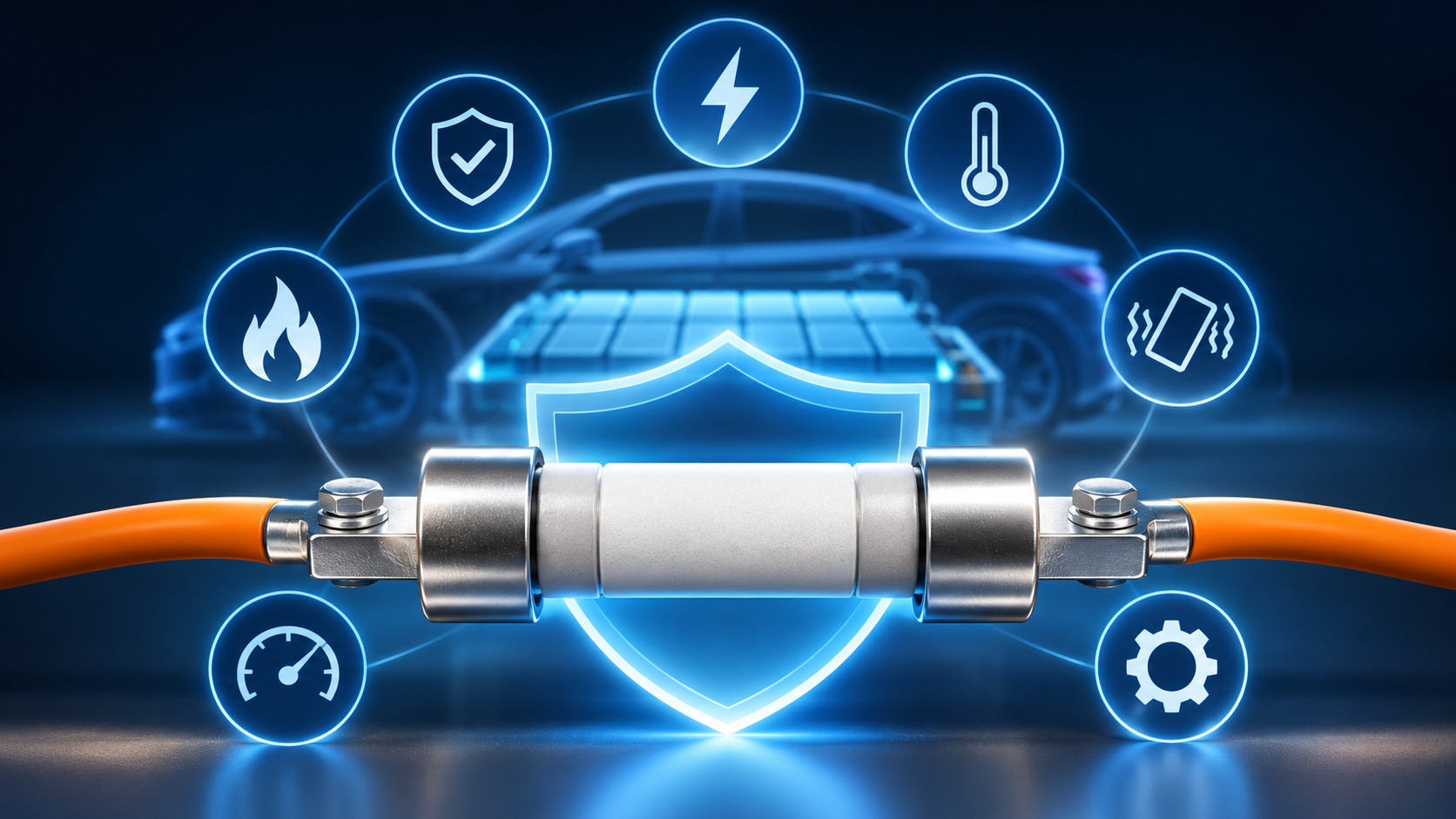
What Makes a Good EV Battery Protection Fuse?
Introduction
Electric vehicles (EVs) rely on advanced battery systems to deliver reliable performance, efficiency, and driving range. At the heart of every electric vehicle is a high-voltage battery pack that stores and supplies the electrical energy needed to power the vehicle. However, these battery systems also operate under demanding electrical and environmental conditions, making effective circuit protection essential.
An EV battery protection fuse plays a critical role in protecting the battery pack, electrical components, and vehicle occupants from potentially dangerous electrical faults. It is designed to interrupt excessive current during short circuits and other fault conditions, helping prevent overheating, equipment damage, and electrical fires.
But what makes a good EV battery protection fuse? Is it simply a matter of choosing the correct voltage and current rating, or are other characteristics equally important?
A reliable EV fuse must combine excellent electrical performance, fast fault interruption, mechanical durability, thermal stability, and compliance with relevant safety standards. This article explores the essential features to consider when selecting a high-performance fuse for electric vehicle battery protection.
1. Appropriate Voltage Rating for High-Voltage Battery Systems
Voltage rating is one of the most important factors when selecting an EV battery protection fuse.
Modern electric vehicles commonly use 400V and 800V battery architectures. The fuse must be capable of safely operating at the maximum voltage of the battery system, including fully charged conditions and potential voltage transients.
Selecting a fuse with an insufficient DC voltage rating can create serious safety risks. When a fuse interrupts a high-current fault, an electrical arc forms between the separated fuse elements. If the fuse cannot extinguish this arc effectively, sustained arcing or re-ignition may occur.
A good EV battery fuse should therefore offer:
-
A DC voltage rating suitable for the maximum battery operating voltage.
-
Sufficient voltage margin for transient conditions.
-
Reliable arc extinction during fault interruption.
-
Stable insulation performance under demanding operating conditions.
For example, an electric vehicle with a 400V battery architecture may require a fuse rated at 500V DC, 800V DC, or another suitable rating depending on its maximum operating voltage and transient requirements. Similarly, 800V battery systems may require 1000V DC protection.
The correct selection must always be based on the actual electrical specifications and validated system requirements.
2. High Continuous Current-Carrying Capacity
An EV battery protection fuse must carry normal operating current without unnecessary interruption or excessive temperature rise.
Electric vehicles experience different current demands depending on driving conditions, acceleration, towing, regenerative braking, and fast charging. The fuse must accommodate these operating conditions while maintaining reliable electrical performance.
However, the rated current printed on a fuse does not always represent its effective current-carrying capability under real-world conditions.
Temperature is an important consideration. Battery enclosures can experience elevated temperatures during vehicle operation and fast charging. Higher ambient temperatures can reduce the effective current-carrying capacity of a fuse, making thermal derating necessary.
When evaluating continuous current performance, engineers should consider:
-
Maximum continuous operating current.
-
Peak current and acceleration requirements.
-
Ambient temperature inside the battery enclosure.
-
Heat generated by the fuse during normal operation.
-
Terminal and connection resistance.
-
Installation conditions and cooling performance.
A properly selected fuse should carry the expected operating current without overheating while remaining capable of responding correctly to abnormal current conditions.
3. High Interrupting Capacity for Short-Circuit Protection
Interrupting capacity, also known as breaking capacity, is another essential characteristic of a good EV battery protection fuse.
Lithium-ion battery packs can deliver extremely high short-circuit currents. A fault within the battery circuit can result in a rapid current increase, generating substantial heat and electrical energy.
The fuse must be capable of safely interrupting the maximum prospective fault current available from the battery pack.
If the interrupting capacity is insufficient, the fuse may rupture, fail to clear the fault, or create additional electrical hazards.
A high-quality EV battery fuse should provide:
-
Sufficient DC breaking capacity.
-
Reliable interruption under high-current fault conditions.
-
Effective arc-quenching performance.
-
Controlled energy release during fuse operation.
-
Consistent interruption performance across specified operating conditions.
Depending on battery design and application, prospective short-circuit currents may reach tens of kiloamperes. Therefore, engineers must calculate the available fault current rather than selecting a fuse based only on the battery's nominal voltage and operating current.
A suitable safety margin should also be considered during component selection.
4. Excellent Arc-Quenching Performance
When a fuse interrupts a high-current DC fault, the electrical arc can produce extremely high temperatures and energy.
Unlike AC circuits, DC circuits do not naturally pass through zero current during every cycle. Consequently, extinguishing a DC arc can be particularly challenging.
A good EV battery protection fuse must be designed to extinguish the arc quickly and safely.
One commonly used arc-quenching material is high-purity quartz sand. It helps absorb energy and suppress the arc when the fuse element melts during a fault.
Important arc-quenching characteristics include:
-
Rapid arc extinction.
-
Low arc voltage where required by the application.
-
Controlled let-through energy.
-
Reliable interruption at the rated DC voltage.
-
Reduced risk of arc re-ignition.
Effective arc management helps minimize damage to surrounding electrical components, busbars, battery management system wiring, and other sensitive equipment.
This is particularly important in high-energy battery systems, where a poorly controlled electrical fault can have serious consequences.
5. Strong Mechanical Construction and Vibration Resistance
Electric vehicles operate in environments where electrical components are continuously exposed to vibration, mechanical shock, and movement.
Road irregularities, acceleration, braking, and vehicle operation can all introduce mechanical stress into the battery protection system.
A fuse with weak mechanical construction or unreliable connections may gradually develop loose terminals or increased contact resistance.
Higher contact resistance can generate additional heat, potentially affecting fuse performance and surrounding components.
A good EV battery protection fuse should feature:
-
Robust terminal construction.
-
Secure bolted connections where appropriate.
-
Strong mechanical support.
-
Resistance to vibration and mechanical shock.
-
Reliable electrical contact over its service life.
Bolted terminal designs are commonly considered for high-current battery applications because they provide secure electrical connections when correctly installed.
Mechanical reliability is just as important as electrical performance when selecting a fuse for long-term EV battery protection.
6. Excellent Thermal Stability and Environmental Protection
Temperature fluctuations are unavoidable in electric vehicle battery systems.
During fast charging and heavy vehicle operation, battery temperatures can rise significantly. When the vehicle is parked or operating in cold environments, temperatures may decrease considerably.
These repeated temperature changes can cause materials to expand and contract, placing additional stress on fuse components and electrical connections.
Humidity and moisture can also contribute to corrosion and insulation deterioration.
A reliable EV battery fuse should therefore provide:
-
Stable performance across its specified temperature range.
-
Good resistance to thermal cycling.
-
Corrosion-resistant materials.
-
Effective protection against moisture ingress where required.
-
Reliable insulation and terminal performance.
Sealed construction and appropriately designed end caps can help protect internal components against environmental exposure.
Choosing a fuse with suitable thermal and environmental characteristics helps improve long-term reliability and reduce the risk of premature component failure.
7. Compact Design and Flexible Installation
Space is a valuable resource in modern electric vehicle battery packs.
Battery manufacturers must balance battery capacity, vehicle weight, thermal management, electrical safety, and available installation space.
The battery protection fuse should therefore provide the required electrical performance without occupying unnecessary space.
Different fuse designs offer different installation advantages.
For example, cylindrical bolt-mounted fuses can provide a compact solution for certain battery protection applications. Square blade fuse designs can accommodate higher-current applications, depending on their size and electrical specifications.
When evaluating fuse dimensions and installation requirements, engineers should consider:
-
Overall fuse dimensions.
-
Terminal configuration.
-
Mounting orientation.
-
Busbar compatibility.
-
Required creepage and clearance distances.
-
Accessibility for maintenance and replacement.
A compact fuse design can help simplify battery pack integration, but physical size should never take priority over electrical safety or reliable fault interruption.
8. Low Power Dissipation and Reliable Electrical Connections
A good EV battery protection fuse should minimize unnecessary power losses during normal operation.
When current flows through a fuse, electrical resistance generates heat. Excessive power dissipation can increase the temperature inside the battery enclosure and reduce overall system efficiency.
High contact resistance at fuse terminals can further increase heat generation.
Engineers should evaluate the following characteristics:
-
Fuse voltage drop under normal operating current.
-
Internal resistance.
-
Power dissipation.
-
Terminal contact resistance.
-
Temperature rise under specified operating conditions.
Lower power dissipation can contribute to improved thermal management and more efficient battery system operation.
However, resistance and temperature-rise performance should always be assessed under representative operating conditions rather than considered in isolation.
9. Integration with the Battery Management System
The battery management system (BMS) monitors important battery parameters, including voltage, current, and temperature.
Although a fuse provides independent physical overcurrent protection, additional monitoring can improve fault identification and system diagnostics.
Some EV fuse designs incorporate a striker pin or other operation-indication mechanism. When the fuse operates, this mechanism can activate an auxiliary switch or monitoring circuit.
This information can then be communicated to the vehicle's control system, depending on the system architecture.
The potential benefits include:
-
Remote indication of fuse operation.
-
Faster fault diagnosis.
-
Improved maintenance efficiency.
-
Better integration with vehicle monitoring systems.
-
Reduced risk of attempting to operate a system with an open fuse.
When selecting an EV battery protection fuse, manufacturers should determine whether an indication feature is required for their application.
It is important to remember that a fuse and a BMS perform different functions. The fuse provides physical circuit interruption, while the BMS monitors battery conditions and manages battery operation.
10. Compliance with Relevant Safety Standards
Safety and reliability are essential requirements for electric vehicle battery protection components.
A good EV battery fuse should be designed and tested according to applicable standards and certification requirements for its intended application.
Relevant evaluation areas include:
-
DC voltage performance.
-
Continuous current-carrying capability.
-
Temperature-rise characteristics.
-
Short-circuit interrupting capacity.
-
Dielectric and insulation performance.
-
Mechanical durability.
-
Environmental resistance.
Applicable fuse standards, including those covering battery applications, should be reviewed during component selection.
Manufacturers should also request supporting technical documentation, including test reports, certification records, dimensional drawings, and detailed product datasheets.
Compliance provides important evidence that a fuse has been evaluated against defined requirements. However, the fuse must still be correctly selected and validated within the complete vehicle electrical system.
How to Choose the Right EV Battery Protection Fuse
Selecting an appropriate EV battery protection fuse requires more than comparing rated voltage and current.
The following five-step process provides a practical starting point for engineers and EV manufacturers.
Step 1: Determine the Maximum Battery Voltage
Identify the battery pack's maximum voltage under fully charged conditions.
Consider potential transient voltages and select a fuse with a suitable DC voltage rating and interruption capability.
Step 2: Calculate the Required Continuous Current
Determine the maximum continuous current expected during normal vehicle operation.
Consider fast charging, driving conditions, ambient temperature, and thermal derating.
The selected fuse must safely carry the required current under actual installation conditions.
Step 3: Calculate the Prospective Short-Circuit Current
Evaluate the maximum available fault current using battery cell specifications, pack configuration, and relevant circuit characteristics.
Confirm that the fuse's DC interrupting rating is sufficient to clear the worst-case fault safely.
Step 4: Evaluate Mechanical and Environmental Requirements
Check the fuse's physical dimensions, mounting arrangement, terminal design, vibration resistance, and environmental protection.
Ensure that the selected component is compatible with the battery enclosure and electrical connections.
Step 5: Verify Safety Features and Technical Documentation
Review the fuse's time-current characteristics, power dissipation, temperature-rise data, and interrupting performance.
Check whether operation indication is required and verify the applicable certifications and test documentation.
Following these steps helps reduce the risk of selecting an unsuitable fuse and improves the overall reliability of the battery protection system.
Common EV Battery Fuse Selection Mistakes to Avoid
Even a fuse with impressive electrical ratings may not provide adequate protection if it is incorrectly selected.
Some common mistakes include:
1. Choosing a fuse based only on nominal battery voltage
The maximum battery voltage and transient conditions must also be considered.
2. Ignoring temperature derating
A fuse that meets the current requirement at room temperature may not provide sufficient capacity inside a hot battery enclosure.
3. Overlooking interrupting capacity
The fuse must be able to safely interrupt the maximum prospective DC short-circuit current.
4. Neglecting mechanical durability
Vibration, loose connections, and poor mounting can compromise long-term performance.
5. Failing to review time-current characteristics
The fuse must coordinate appropriately with other protective devices and withstand normal operating and transient current conditions.
6. Selecting a fuse without checking installation compatibility
Terminal dimensions, mounting requirements, electrical clearances, and busbar connections must all be verified.
Avoiding these mistakes helps engineers achieve a safer and more reliable EV battery protection design.
Conclusion: What Defines a Good EV Battery Protection Fuse?
A good EV battery protection fuse is more than an electrical component with the correct voltage and current ratings. It is a critical safety device that must deliver reliable performance under demanding electrical, thermal, mechanical, and environmental conditions.
The most important characteristics include an appropriate DC voltage rating, sufficient continuous current capacity, high interrupting capability, effective arc-quenching performance, vibration resistance, thermal stability, low power dissipation, and compliance with relevant safety standards.
Equally important is ensuring that the fuse is properly coordinated with the battery pack, busbars, contactors, and battery management system.
As electric vehicle technology continues to develop, battery architectures are becoming increasingly demanding. Selecting a reliable, application-appropriate fuse is therefore essential for improving electrical safety, protecting valuable battery components, and supporting the long-term performance of electric vehicles.
Ultimately, the best EV battery protection fuse is one that has been carefully engineered, thoroughly tested, and correctly matched to the specific requirements of the battery system.
Frequently Asked Questions (FAQs)
1. What is an EV battery protection fuse?
An EV battery protection fuse is an electrical safety device installed in an electric vehicle's battery circuit. It interrupts excessive current during short circuits or other overcurrent conditions, helping protect battery components, electrical systems, and vehicle occupants.
2. Why is interrupting capacity important for EV fuses?
Interrupting capacity determines the maximum fault current a fuse can safely interrupt at its specified voltage. Since EV battery packs can deliver extremely high short-circuit currents, sufficient DC breaking capacity is essential for safe and reliable fault protection.
3. What voltage rating is suitable for an EV battery fuse?
The appropriate voltage rating depends on the battery architecture and maximum operating voltage. Electric vehicles with 400V and 800V battery systems may require fuses rated at 500V, 800V, or 1000V DC, depending on the actual electrical requirements and transient conditions.
4. Why is temperature derating important when selecting an EV fuse?
High temperatures can reduce a fuse's effective current-carrying capability. Temperature derating helps ensure that the fuse can carry the required operating current without overheating under actual battery enclosure conditions.
5. What is the purpose of a striker pin in an EV fuse?
A striker pin provides an indication when a fuse operates. It can activate an auxiliary switch connected to a monitoring system, allowing the vehicle to identify fuse operation and support faster fault diagnosis.
6. What materials are used for arc quenching in EV battery fuses?
High-purity quartz sand is commonly used as an arc-quenching medium. It absorbs energy and helps extinguish the electrical arc generated when the fuse interrupts a fault current.
7. How do I select the right fuse for an electric vehicle battery pack?
Start by identifying the maximum battery voltage, continuous operating current, and prospective short-circuit current. Then evaluate temperature derating, interrupting capacity, mounting requirements, mechanical durability, time-current characteristics, and applicable safety standards.
8. Can one fuse protect an entire EV battery system?
A main battery fuse can provide essential overcurrent protection for the main battery circuit. However, additional protective devices may be required for individual branches, auxiliary circuits, charging systems, and other electrical components. The complete protection strategy should be determined through system-level engineering analysis.



