
 eaton-bussmann-PV-combiner-box-brochure-en-gb-anz.pdf | [PV Combiner Box Solutions] | 6494 kB |
| eaton-bussmann-pv-combiner-box-MN019001EN.pdf | [Bussmann series PV Combiner box - Manual] | 878 kB |
| eaton-switches-infographic-v5-combinerbox-mz008016en-en-us.pdf | [Eaton switches combiner box application] | 184 kB |
Why Photovoltaic Systems Rely on Fuses – A Deep Dive into PV Combiner Box Protection
Introduction
Solar energy has become one of the most important sources of renewable electricity worldwide. As photovoltaic (PV) installations continue to expand across residential, commercial, and industrial applications, ensuring the safety, efficiency, and reliability of solar power systems has become increasingly important.
Although solar panels and inverters receive much of the attention, electrical protection components play an equally essential role in maintaining system performance. Among these components, photovoltaic fuses are particularly important.
A PV fuse protects solar installations against overcurrent conditions, short circuits, and potentially dangerous reverse currents. These protective devices are commonly installed inside PV combiner boxes, where electricity generated by multiple solar panel strings is collected before being transmitted to the inverter.
But why are fuses so important in photovoltaic systems? How do they protect individual solar strings, and what should engineers consider when selecting the right fuse?
This guide explores the importance of PV fuses, their working principles, applications, selection criteria, and contribution to long-term solar system safety.
1. What Is a PV Combiner Box and Why Is It Important?
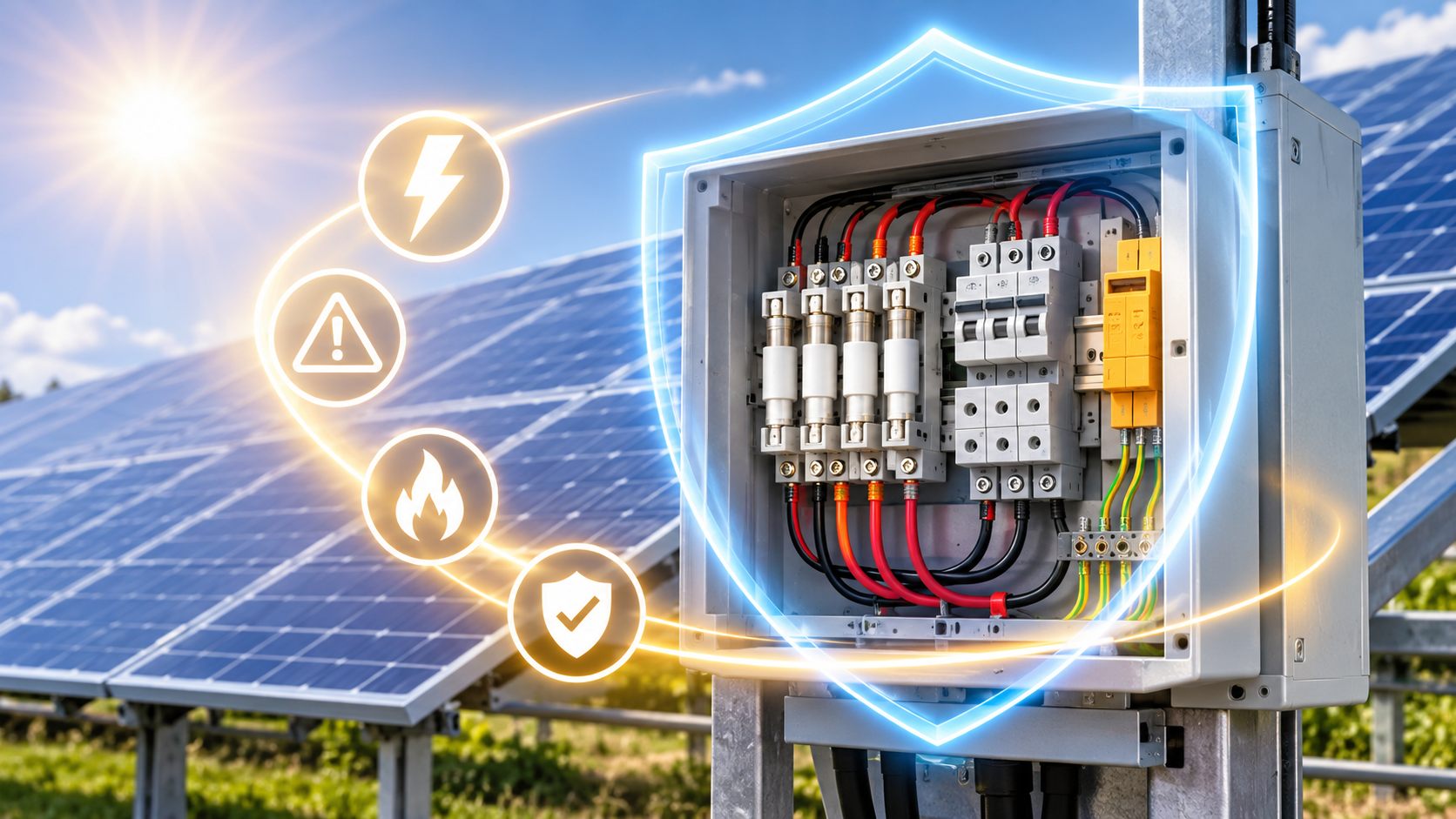
A photovoltaic combiner box is an electrical enclosure that combines the DC outputs of multiple solar panel strings into a common output circuit.
In a typical solar installation, several photovoltaic modules are connected in series to form individual strings. Multiple strings are then connected in parallel to increase the total current available to the system.
Rather than connecting every solar string directly to the inverter, a PV combiner box centralises these connections and provides a convenient location for electrical protection and monitoring components.
A typical PV combiner box may contain:
-
DC photovoltaic fuses.
-
Fuse holders.
-
DC circuit breakers or isolators.
-
Surge protection devices.
-
Positive and negative busbars.
-
Monitoring components.
-
Electrical terminals and connectors.
Among these components, PV string fuses are essential for protecting individual circuits against overcurrent conditions.
Without appropriate overcurrent protection, a fault in one solar string could allow current from other parallel-connected strings to flow backward into the faulty circuit.
This reverse current can cause excessive heating, cable damage, insulation failure, and potentially electrical fires.
Installing correctly rated photovoltaic fuses helps interrupt dangerous fault currents before they cause extensive damage.
2. Why Do Photovoltaic Systems Need Specialised DC Fuses?
Photovoltaic systems operate differently from conventional AC electrical installations. One of their most important characteristics is that solar panels generate direct current (DC).
This creates specific challenges for electrical protection.
2.1 High DC Operating Voltages
Modern solar installations commonly operate at DC system voltages of 600V, 1000V, or 1500V, depending on the system design.
Unlike alternating current, direct current does not naturally pass through zero during each electrical cycle. Consequently, interrupting a DC fault current can be more challenging because the resulting electrical arc may continue for longer.
A fuse used in a photovoltaic installation must therefore have an appropriate DC voltage rating and sufficient breaking capacity.
For example, a 1000V DC photovoltaic fuse is designed for applications within its specified voltage and current limits in solar power systems operating at that voltage level.
Using an unsuitable fuse can result in failed fault interruption, electrical arcing, and serious equipment damage.
2.2 Reverse Current Protection
Reverse current is one of the most important reasons for installing fuses in PV combiner boxes.
When multiple solar strings are connected in parallel, the current generated by healthy strings can potentially flow into a faulty string.
For example, if one string develops a short circuit, the remaining parallel-connected strings may contribute current to the fault.
This can expose the damaged string to current levels exceeding the permissible limits of its modules, cables, and connectors.
A properly selected PV string fuse interrupts excessive reverse current, isolating the affected circuit while allowing other strings to continue operating.
This selective protection helps improve overall system reliability and reduces the consequences of individual string failures.
2.3 Protection Against Electrical Fires
Excessive current generates heat in electrical conductors and connections.
If an overcurrent condition continues, temperatures may rise beyond the safe operating limits of cables, connectors, and other electrical components.
In severe situations, this can damage insulation and create fire hazards.
PV fuses provide a protective interruption mechanism when current exceeds their specified operating characteristics.
By disconnecting the faulty circuit, they help reduce the risk of overheating and prevent electrical faults from spreading through the installation.
2.4 Protection of Inverters and Other Equipment
Solar inverters are critical components responsible for converting DC electricity into usable AC electricity.
Electrical faults on the DC side can affect inverter inputs and associated equipment.
Although an inverter may incorporate its own protective functions, these do not replace appropriately designed string-level overcurrent protection.
PV fuses help limit the impact of faults within the DC collection system, protecting wiring and reducing the likelihood of damage to downstream equipment.
3. How Do PV Fuses Work Inside a Combiner Box?
The working principle of a photovoltaic fuse is relatively straightforward.
A fuse contains a conductive element designed to carry current within a specified operating range.
When current exceeds the fuse's operating characteristics for a sufficient period, the internal element heats up and eventually melts.
This opens the electrical circuit and interrupts the current flow.
In a PV combiner box, individual string fuses are generally installed in series with the relevant string conductors.
Each fuse provides independent overcurrent protection for its associated string.
The protection process can be explained in four stages:
Step 1: Normal Operation
Solar panels generate DC electricity, and current flows through the individual string circuits into the combiner box.
The fuses remain intact while operating conditions stay within their specified limits.
Step 2: Fault Development
A short circuit, insulation failure, wiring problem, or other abnormal condition causes excessive current to flow through a protected circuit.
Step 3: Fuse Operation
When the current and duration exceed the fuse's time-current operating characteristics, the internal fuse element melts.
The fuse interrupts the fault current and isolates the affected circuit.
Step 4: Fault Isolation
The faulty string is disconnected from the common collection circuit, helping protect other components from the consequences of excessive current.
It is important to understand that a fuse does not prevent every possible electrical fault. Instead, it limits the consequences of certain overcurrent conditions by interrupting the circuit when its operating conditions are exceeded.
4. Key Types of Photovoltaic Fuses
Different solar installations require different fuse configurations depending on system voltage, current, and installation requirements.
Several types of photovoltaic fuses are commonly used.
4.1 1000V DC PV Fuses
1000V DC photovoltaic fuses are widely used in commercial and industrial solar installations.
They are designed for applications where the maximum circuit voltage remains within their specified DC voltage rating.
These fuses provide overcurrent protection for solar strings and are available in different current ratings and physical dimensions.
4.2 1500V DC PV Fuses
As utility-scale solar installations become larger, 1500V DC system architectures have become increasingly common.
Operating at higher DC voltages can help reduce current for a given power level, potentially lowering cable losses and improving overall system economics.
However, higher operating voltages require protective devices specifically rated for the application.
1500V DC photovoltaic fuses are designed to provide suitable circuit protection in compatible high-voltage solar installations.
4.3 gPV Photovoltaic Fuses
The gPV fuse is a specialised fuse category intended for photovoltaic applications.
These fuses are designed to protect PV circuits against overcurrent conditions and are commonly installed in solar combiner boxes.
They are available in different voltage ratings, current ratings, and physical configurations.
Selecting a suitable gPV fuse requires considering the electrical characteristics of the solar array and the maximum permissible current of the protected components.
4.4 Cylindrical and NH-Type PV Fuses
PV fuses are available in different physical formats.
Cylindrical cartridge fuses are commonly used in compact combiner box designs because of their relatively small dimensions and convenient installation.
NH-type fuse links may be used in applications requiring different current ratings and physical configurations.
The appropriate fuse format depends on the combiner box design, fuse holder compatibility, electrical specifications, and installation requirements.
5. Important Factors When Selecting PV Combiner Box Fuses
Choosing the correct photovoltaic fuse is essential for achieving reliable electrical protection.
An incorrectly selected fuse may fail to interrupt a dangerous fault or operate unnecessarily during normal system conditions.
Engineers and procurement professionals should evaluate several important parameters.
5.1 Rated DC Voltage
The fuse voltage rating must be equal to or greater than the maximum voltage that can occur in the protected circuit under the relevant operating conditions.
For solar installations, this includes considering the maximum open-circuit voltage of the PV strings under the lowest expected operating temperature.
Common photovoltaic fuse voltage ratings include:
-
600V DC.
-
1000V DC.
-
1500V DC.
The selected fuse must be suitable for the actual system voltage and applicable design requirements.
5.2 Rated Current
Current rating is another critical selection parameter.
The fuse must provide adequate protection without operating unnecessarily during normal solar generation.
Selection should consider:
-
Maximum string current.
-
Module short-circuit current.
-
Relevant design and safety factors.
-
Maximum series fuse rating specified by the module manufacturer.
-
Cable ampacity.
-
Ambient temperature.
-
Applicable electrical installation standards.
An oversized fuse may not provide sufficient protection for the connected conductors and modules.
An undersized fuse may operate unnecessarily under normal environmental and operating conditions.
Therefore, fuse sizing should always be based on a proper electrical calculation rather than simply selecting a commonly used current rating.
5.3 Breaking Capacity
Breaking capacity refers to the maximum prospective fault current that a fuse can safely interrupt under its specified operating conditions.
In photovoltaic installations, fault current can originate from multiple parallel-connected strings.
A suitable PV fuse must have sufficient DC breaking capacity to interrupt the maximum prospective fault current at its rated voltage.
Insufficient breaking capacity can result in dangerous arcing or failure to interrupt the circuit safely.
5.4 Time-Current Characteristics
A fuse's time-current characteristics determine how quickly it operates at different current levels.
This is important because photovoltaic systems experience changing current levels due to variations in sunlight and operating temperature.
The selected fuse should tolerate normal operating conditions while responding appropriately to dangerous overcurrent situations.
Engineers should review manufacturer-provided time-current curves when designing protection systems.
5.5 Environmental Conditions
Solar combiner boxes are frequently installed outdoors and exposed to challenging environmental conditions.
These may include:
-
High ambient temperatures.
-
Temperature fluctuations.
-
Humidity and condensation.
-
Dust and contamination.
-
Ultraviolet exposure.
-
Corrosive environments.
The fuse holder, enclosure, terminals, and associated components should be suitable for the installation environment.
Temperature-related derating requirements must also be considered to ensure reliable fuse operation.
5.6 Physical Dimensions and Compatibility
Physical compatibility is another important consideration.
Common PV fuse dimensions include 10×38 mm, 14×51 mm, and 22×58 mm.
The selected fuse must match the corresponding fuse holder and be suitable for the intended electrical application.
Using incompatible components can create poor electrical contact, excessive contact resistance, overheating, and installation difficulties.
6. Why International Standards Matter for PV Fuses
Electrical safety standards provide important technical requirements for photovoltaic protection devices.
Using appropriately certified and tested components helps ensure that the protection system performs according to its intended specifications.
One important standard is IEC 60269-6, which addresses supplementary requirements for fuse-links used to protect photovoltaic energy systems.
It covers important performance characteristics relevant to PV fuse applications.
When selecting photovoltaic fuses, engineers and purchasing departments should verify:
-
Compliance with applicable photovoltaic fuse standards.
-
Rated DC voltage.
-
Rated current.
-
Breaking capacity.
-
Time-current characteristics.
-
Temperature-related performance.
-
Manufacturer test documentation.
-
Compatibility with the intended fuse holder.
UL certification requirements may also apply to installations designed according to relevant North American electrical standards.
It is important to distinguish between general fuse certification and certification specifically applicable to photovoltaic applications.
A fuse should not be considered suitable for solar installations simply because it carries a high voltage or current rating.
Its intended application and documented performance must also be verified.
7. Common Mistakes When Selecting Solar Combiner Box Fuses
Even experienced installers can make mistakes when specifying photovoltaic protection devices.
Understanding these common issues can help prevent unnecessary equipment failures and improve installation safety.
Mistake 1: Using an AC-Rated Fuse in a DC Application
AC and DC circuits have different interruption characteristics.
A fuse designed for AC applications should not automatically be considered suitable for DC circuits.
The selected fuse must have an appropriate DC voltage rating and breaking capacity.
Mistake 2: Selecting an Oversized Fuse
Some installers assume that a higher current rating provides additional safety.
However, an oversized fuse may allow excessive current to flow through cables and photovoltaic modules before operating.
Fuse ratings must be coordinated with the protected equipment and the maximum permissible series fuse rating.
Mistake 3: Ignoring Temperature Derating
High temperatures can affect fuse performance and current-carrying capacity.
Since PV combiner boxes are often exposed to direct sunlight and high ambient temperatures, derating requirements should be evaluated during system design.
Mistake 4: Ignoring Reverse Current Calculations
Reverse current protection is one of the primary functions of PV string fuses.
The maximum possible reverse current from parallel-connected strings must be considered when determining whether individual string fuses are required and selecting their ratings.
Mistake 5: Using Incompatible Fuse Holders
Even when a fuse has the correct electrical rating, an incompatible holder can compromise electrical safety.
Fuse dimensions, contact compatibility, voltage rating, thermal performance, and installation requirements must all be checked.
Mistake 6: Neglecting Maintenance and Inspection
Fuse connections can deteriorate over time because of thermal cycling, environmental exposure, and mechanical stress.
Periodic inspections should check for visible damage, overheating, corrosion, and loose connections.
Any replacement fuse must meet the original design specifications.
8. Other Applications of PV Fuses in Renewable Energy Systems
Although PV combiner boxes are a major application, photovoltaic fuses are also used in other DC electrical systems.
Solar Inverter Protection
PV fuses can provide overcurrent protection for inverter DC input circuits, depending on the inverter architecture and protection design.
They help isolate faults in the DC power collection system.
Battery Energy Storage Systems
Battery energy storage systems require suitable overcurrent protection because batteries can deliver substantial fault currents.
Fuse selection must account for the battery chemistry, operating voltage, prospective fault current, and system configuration.
Battery protection requires devices specifically suitable for the application rather than assuming that a standard PV string fuse is automatically appropriate.
Solar Charge Controllers
Solar charge controllers regulate the power transferred from photovoltaic modules to battery systems.
Appropriate DC fuses can protect associated wiring and circuits against overcurrent conditions.
DC Distribution Systems
PV fuses can also be incorporated into DC distribution and isolation arrangements where their electrical characteristics match the application.
These installations require careful coordination between protective devices and connected equipment.
9. How Proper PV Fuse Protection Improves Solar System Reliability
A properly designed photovoltaic protection system offers several important advantages.
Improved electrical safety
PV fuses help interrupt excessive current and reduce the risk of overheating, electrical arcing, and fire-related damage.
Individual string protection
Protecting individual solar strings helps isolate faults without necessarily shutting down the entire photovoltaic installation.
Reduced equipment damage
Appropriate overcurrent protection helps safeguard cables, connectors, modules, and associated electrical equipment.
Improved system availability
By isolating certain faulty circuits, properly designed protection systems can help healthy sections of a solar installation remain operational.
Simplified troubleshooting
Individual string protection makes it easier for maintenance personnel to identify and investigate electrical faults within the PV array.
Long-term operational reliability
Correctly specified protective devices contribute to safer operation and help reduce the likelihood of costly equipment failures.
10. Best Practices for PV Combiner Box Protection
To achieve reliable photovoltaic system protection, engineers, installers, and procurement professionals should follow several best practices.
-
Calculate the maximum PV string voltage under the lowest expected operating temperature.
-
Determine the maximum prospective reverse current under relevant fault conditions.
-
Select photovoltaic fuses with appropriate DC voltage and current ratings.
-
Verify that the fuse breaking capacity is sufficient for the calculated fault current.
-
Check compatibility between fuse links and fuse holders.
-
Consider ambient temperature and applicable derating factors.
-
Verify compliance with relevant photovoltaic fuse standards.
-
Coordinate fuse ratings with module, cable, and equipment specifications.
-
Use suitable enclosures and electrical components for the installation environment.
-
Establish regular inspection and maintenance procedures.
Following these practices helps ensure that PV combiner boxes provide effective overcurrent protection throughout the operating life of a solar installation.
Conclusion
Photovoltaic fuses are essential components of modern solar power protection systems.
As solar installations become larger and DC operating voltages increase, the importance of reliable overcurrent protection continues to grow.
Inside a PV combiner box, appropriately selected fuses protect individual solar strings against excessive current and reverse-current conditions. They also help reduce the risk of overheating, electrical fires, and damage to connected equipment.
However, effective protection depends on more than simply installing a fuse. Correct voltage ratings, current ratings, breaking capacity, time-current characteristics, environmental suitability, and standards compliance must all be considered.
For engineers, installers, and procurement professionals, understanding these technical requirements is essential for designing safe and reliable photovoltaic systems.
Ultimately, a properly selected PV fuse is not just a small electrical component. It is an important part of the overall safety, protection, and long-term reliability of a solar energy installation.



