
 eaton-bussmann-series-photovoltaic-fuses-catalogue-ca135004en.pdf  | [Eaton Bussmann PV Fuses] | 0 kB |
Photovoltaic Fuse (PV Fuse): A Comprehensive Guide to Solar PV Protection
Introduction
Solar energy has become one of the most important sources of renewable electricity worldwide. As photovoltaic (PV) installations continue to expand across residential, commercial, and industrial applications, ensuring the safety, reliability, and efficiency of solar power systems has become increasingly important.
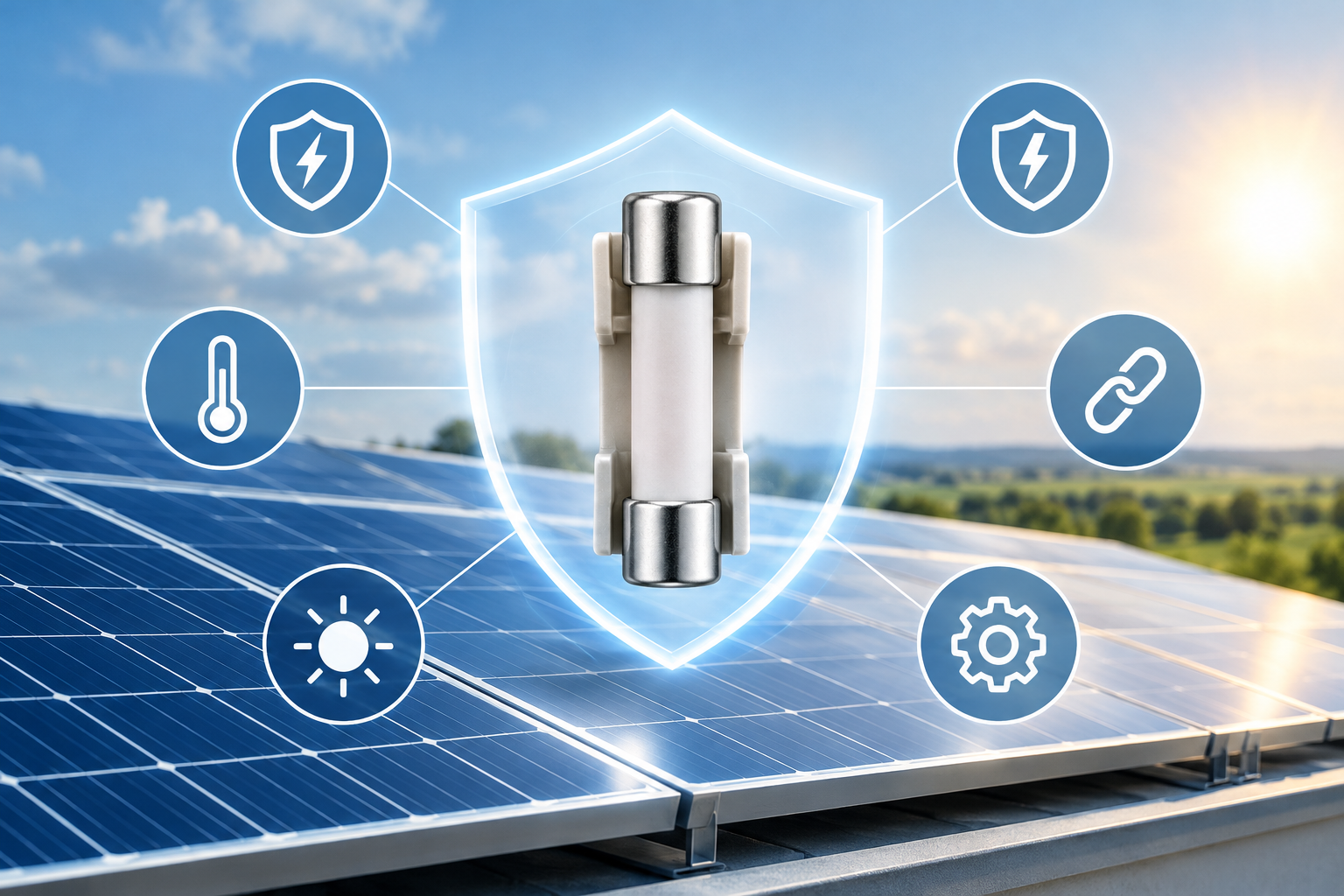
One essential component of a safe solar installation is the photovoltaic fuse, commonly known as a PV fuse. Although relatively small, this protective device plays a critical role in preventing electrical damage caused by overcurrent conditions, short circuits, and other electrical faults.
Unlike conventional electrical fuses, PV fuses are specifically designed to handle the unique operating characteristics of direct current (DC) photovoltaic systems. They provide reliable protection for solar panels, PV strings, combiner boxes, inverters, and associated electrical equipment.
This comprehensive guide explains what a photovoltaic fuse is, how it works, why solar installations require specialised protection, the different types of PV fuses, their applications, and how to select the right fuse for your solar power system.
1. What Is a Photovoltaic Fuse (PV Fuse)?
A photovoltaic fuse (PV fuse) is a specialised electrical protection device designed to protect solar photovoltaic systems against excessive current and short-circuit faults.
Its primary function is to interrupt an electrical circuit when the current exceeds a predetermined safe level. By disconnecting the faulty circuit, the fuse helps prevent overheating, equipment damage, electrical fires, and other potential hazards.
PV fuses are commonly installed in:
-
Solar panel strings
-
Photovoltaic combiner boxes
-
DC distribution systems
-
Solar inverter DC inputs
-
Battery energy storage systems
-
Large-scale solar power plants
A PV fuse differs from a conventional fuse because it is engineered to operate under the specific electrical and environmental conditions of solar installations.
These conditions include:
-
High DC operating voltages.
-
Continuous current generation.
-
Variable solar irradiation.
-
Temperature fluctuations.
-
Low and fluctuating fault currents.
-
Difficult DC arc interruption conditions.
PV-specific fuses are therefore designed to provide dependable overcurrent protection throughout the operating life of a solar power installation.
2. How Does a Photovoltaic Fuse Work?
The working principle of a photovoltaic fuse is based on the thermal effect of electric current.
Under normal operating conditions, electrical current passes through the fuse element without causing it to melt. However, when an overcurrent or short-circuit fault occurs, the increased current generates excessive heat within the fuse element.
Once the temperature reaches the element's melting point, the fuse element melts and interrupts the electrical circuit.
The operating process involves four main stages:
Step 1: Normal Current Flow
During normal solar power generation, current flows through the fuse element within its specified operating limits.
Step 2: Overcurrent Detection
When an electrical fault causes the current to exceed the fuse's operating characteristics, heat begins accumulating in the fuse element.
Step 3: Fuse Element Melting
If the current and its duration reach the fuse's operating threshold, the internal element melts and separates.
Step 4: Electrical Circuit Interruption
The fuse interrupts the current and extinguishes the resulting electrical arc through its internal arc-quenching structure.
This process isolates the faulty section and helps protect other components within the photovoltaic system.
Because DC current does not naturally pass through zero as AC current does, interrupting DC fault currents can be particularly challenging. PV fuses are specifically engineered to address this challenge within their rated operating conditions.
3. Why Do Solar Power Systems Require Specialised PV Fuses?
Using the correct overcurrent protection device is essential for the safe operation of photovoltaic installations.
Solar power systems have several electrical characteristics that make specialised PV fuses necessary.
3.1 High DC Voltage
Modern photovoltaic installations can operate at high DC voltages, including 1,000 VDC and 1,500 VDC.
A fuse must have an appropriate DC voltage rating to safely interrupt fault currents without sustaining an electrical arc.
Using a fuse with an insufficient voltage rating can create serious safety risks.
3.2 Difficult DC Arc Extinction
In AC electrical systems, current naturally passes through zero during every cycle, helping extinguish electrical arcs.
DC systems do not have this natural current-zero point.
Consequently, DC arcs can continue for longer periods and require specialised arc-extinguishing designs.
PV fuses incorporate suitable internal structures to interrupt DC fault currents safely within their specified ratings.
3.3 Low Fault Current Characteristics
Unlike conventional power distribution networks, photovoltaic arrays have relatively limited short-circuit current.
A conventional fuse may not respond appropriately to certain PV fault-current conditions.
PV-specific gPV fuses are designed to provide suitable protection against the overcurrent characteristics associated with photovoltaic installations.
3.4 Outdoor Operating Conditions
Solar installations are frequently exposed to demanding environmental conditions, including:
-
High ambient temperatures.
-
Direct sunlight.
-
Humidity and moisture.
-
Dust and pollution.
-
Seasonal temperature variations.
PV protection devices must be selected according to their operating temperature limits, installation environment, enclosure requirements, and electrical specifications.
3.5 Long-Term Reliability
Solar power systems are designed to operate for decades.
Protection components must therefore provide stable and reliable performance over extended operating periods.
Selecting appropriately rated and certified PV fuses helps improve system safety, minimise maintenance requirements, and reduce the risk of unexpected equipment failures.
4. Different Types of Photovoltaic Fuses
Understanding fuse classifications is important when selecting the correct protection device for a solar installation.
Different fuse types are designed for different protection requirements.
4.1 gPV Fuses – Photovoltaic-Specific Protection
The gPV fuse is specifically designed for photovoltaic applications.
It provides protection against overload and short-circuit currents in solar DC circuits.
Key characteristics include:
-
Designed specifically for PV applications.
-
Suitable for high-voltage DC circuits within rated limits.
-
Designed to handle photovoltaic fault-current characteristics.
-
Provides protection for solar module strings and combiner boxes.
-
Available in different current and voltage ratings.
Typical applications include solar panel strings, PV combiner boxes, and photovoltaic DC distribution systems.
For most applications requiring dedicated PV string protection, gPV fuses are the appropriate fuse category to evaluate.
4.2 gG/gL Fuses – General-Purpose Protection
gG and gL fuses are general-purpose full-range protection devices commonly used in electrical distribution systems.
They provide protection against both overload and short-circuit currents.
Typical applications include:
-
Electrical distribution systems.
-
Cable protection.
-
Industrial power circuits.
-
General low-voltage installations.
Although these fuses are widely used in electrical installations, they should not automatically be considered substitutes for PV-specific fuses.
Their suitability must be evaluated against the actual DC voltage, current, time-current characteristics, and applicable standards of the installation.
4.3 gR/gS Fuses – Semiconductor Protection
Semiconductor fuses are designed to provide rapid protection for sensitive power electronic components.
They are commonly used to protect:
-
Power semiconductor devices.
-
IGBT modules.
-
Rectifiers.
-
Inverter components.
-
Industrial power electronics.
These fuses generally have fast-acting characteristics and are selected according to the semiconductor device's withstand capability and the circuit's fault-current characteristics.
They serve a different protection purpose from standard PV string fuses.
4.4 aBat/gBat Fuses – Battery Protection
Battery protection fuses are designed for energy storage applications.
They help protect battery systems against excessive current and short-circuit conditions.
Common applications include:
-
Battery energy storage systems.
-
Uninterruptible power supply systems.
-
DC battery distribution.
-
Energy storage installations.
Battery circuits can deliver substantial fault currents, making correct fuse selection particularly important.
The fuse must be compatible with the battery system's voltage, prospective fault current, and required interruption capacity.
5. Main Applications of Photovoltaic Fuses
PV fuses are used throughout solar power installations to provide protection at different stages of electricity generation and distribution.
5.1 Solar Panel String Protection
A photovoltaic string consists of multiple solar modules connected in series.
When several strings operate in parallel, a fault in one string can allow current from the remaining strings to flow into the faulty circuit.
This reverse current may cause overheating, cable damage, or other electrical hazards.
PV string fuses help isolate faulty strings and prevent excessive reverse current from damaging solar modules and associated wiring.
5.2 PV Combiner Box Protection
A photovoltaic combiner box collects the output of multiple solar strings and combines them into a common DC output.
String fuses are commonly installed within combiner boxes to provide individual string protection.
Their main functions include:
-
Protecting individual PV strings.
-
Limiting fault propagation.
-
Improving system protection coordination.
-
Helping simplify fault isolation.
-
Reducing the risk of equipment damage.
Correct fuse selection is essential for maintaining the safety and reliability of the entire solar array.
5.3 Solar Inverter Protection
Solar inverters convert the DC electricity generated by photovoltaic modules into AC electricity for household, commercial, or industrial use.
Inverter DC circuits require appropriate protection against overcurrent and short-circuit conditions.
PV fuses may be used in associated DC input and distribution circuits, depending on the inverter design and protection architecture.
The fuse must be selected according to the inverter manufacturer's requirements and the electrical characteristics of the circuit.
5.4 Battery Energy Storage Systems
Modern solar installations increasingly integrate battery energy storage systems.
These systems store excess solar electricity for later use, improving energy availability and system flexibility.
Battery circuits require dedicated overcurrent protection because batteries can deliver significant fault currents.
Appropriately selected battery fuses help protect cables, battery connections, and energy storage equipment against dangerous electrical faults.
It is important to distinguish between PV string fuses and battery protection fuses because their electrical requirements and application characteristics can differ significantly.
6. How to Choose the Right Photovoltaic Fuse
Selecting the correct PV fuse is one of the most important steps in designing a safe and reliable solar power system.
Several electrical and environmental parameters must be considered.
6.1 Rated Voltage
The fuse's rated DC voltage must be equal to or greater than the maximum voltage that can occur in the protected circuit.
For photovoltaic systems, this requires considering the maximum open-circuit voltage of the solar array under the lowest expected operating temperature.
Common PV system voltage classes include:
-
600 VDC.
-
1,000 VDC.
-
1,500 VDC.
-
Higher-voltage systems where specifically designed and approved protection equipment is available.
The selected fuse must have an appropriate DC voltage rating for the application.
6.2 Rated Current
The fuse's rated current must be selected according to the maximum expected operating current and the applicable PV design requirements.
Important parameters include:
-
Solar module short-circuit current (Isc).
-
Number of parallel-connected strings.
-
Maximum reverse current.
-
Module maximum series fuse rating.
-
Cable ampacity.
-
Ambient temperature.
-
Fuse manufacturer's derating recommendations.
A common starting point in PV fuse sizing is to calculate the required current rating using the applicable design factor for the system.
For example, certain PV design practices use 1.25 times the module short-circuit current as a basis for calculating maximum circuit current.
However, the final fuse rating must also comply with the module manufacturer's maximum series fuse rating, cable protection requirements, and applicable electrical standards.
There is no universal fuse-current rating suitable for every photovoltaic installation.
6.3 Breaking Capacity
Breaking capacity refers to the maximum prospective fault current that a fuse can safely interrupt at its specified voltage and operating conditions.
The selected PV fuse must have sufficient breaking capacity for the prospective short-circuit current of the protected circuit.
An insufficient breaking capacity can result in dangerous failure during a fault.
6.4 Fuse Size and Dimensions
PV fuses are available in different physical sizes and mounting configurations.
Common cylindrical fuse dimensions include:
-
10 × 38 mm.
-
10 × 85 mm.
-
14 × 51 mm.
-
14 × 85 mm.
-
22 × 58 mm.
Larger industrial installations may also use square-body or blade-type fuse designs.
The fuse dimensions must match the compatible fuse holder or mounting arrangement.
6.5 Operating Temperature
Temperature has a direct influence on fuse performance.
High ambient temperatures can affect the fuse's current-carrying capability and operating characteristics.
When selecting a PV fuse, consider:
-
Ambient operating temperature.
-
Installation enclosure temperature.
-
Ventilation conditions.
-
Fuse-holder temperature limitations.
-
Manufacturer derating curves.
Appropriate thermal design helps prevent unnecessary fuse operation and improves long-term reliability.
6.6 Applicable Standards and Certifications
PV fuses should comply with the relevant electrical standards and certification requirements for their intended markets.
Important standards and conformity considerations include:
IEC Standards: International standards provide technical requirements and testing procedures for electrical protection equipment.
UL Standards: Relevant safety standards and certifications may be required for installations and equipment intended for North American markets.
CE Marking: Indicates conformity with applicable European Union requirements where relevant.
TÜV Certification: Provides independent testing and certification for applicable product safety and performance requirements.
National Standards: Additional national requirements may apply depending on the installation location.
Always verify the exact certification, applicable standard, voltage rating, and product documentation rather than relying on general certification claims.
7. Common PV Fuse Installation Locations
The installation location of a photovoltaic fuse depends on the electrical architecture and protection requirements of the solar system.
Common installation points include:
Solar String Circuits: Individual fuses may be installed in the positive and/or negative conductors where required by the system design and applicable standards.
Combiner Boxes: String fuses are commonly installed to protect individual parallel-connected strings.
DC Distribution Panels: Fuses can provide overcurrent protection for DC distribution circuits.
Inverter Input Circuits: Additional protection may be required depending on the inverter's internal design and installation requirements.
Battery Circuits: Dedicated battery-rated fuses protect energy storage connections and associated DC circuits.
Fuse placement must be determined by qualified electrical designers and installers based on the system configuration and applicable regulations.
8. Common Mistakes When Selecting PV Fuses
Incorrect fuse selection can compromise the safety and reliability of a photovoltaic installation.
The following mistakes should be avoided.
Mistake 1: Using a Conventional Fuse Instead of a PV Fuse
A conventional fuse may not provide the required DC interruption performance or protection characteristics for a photovoltaic circuit.
Always verify that the fuse is specifically rated and suitable for the intended PV application.
Mistake 2: Ignoring the DC Voltage Rating
A fuse with an insufficient DC voltage rating may fail to interrupt a fault safely.
The maximum expected circuit voltage must always be considered.
Mistake 3: Selecting an Incorrect Current Rating
An undersized fuse may operate unnecessarily during normal conditions.
An oversized fuse may fail to provide adequate protection for the solar module, wiring, and associated equipment.
Correct sizing requires a complete assessment of the circuit's electrical characteristics.
Mistake 4: Ignoring Breaking Capacity
The fuse must be capable of safely interrupting the maximum prospective fault current.
Failing to verify breaking capacity can create significant electrical hazards.
Mistake 5: Overlooking Environmental Conditions
High temperatures, humidity, dust, and unsuitable enclosures can affect the performance and service life of electrical protection components.
Environmental conditions should always be considered during equipment selection and installation.
Mistake 6: Mixing Incompatible Fuse Components
Using a fuse link with an incompatible fuse holder can lead to poor electrical connections, overheating, and unreliable operation.
Always ensure compatibility between the fuse link, holder, terminals, and mounting arrangement.
9. Maintenance and Inspection of PV Fuses
Although photovoltaic fuses are generally low-maintenance components, regular inspection is important for maintaining system safety.
Recommended inspection activities include:
-
Checking fuse holders for visible damage.
-
Inspecting terminals for corrosion.
-
Looking for signs of overheating or discolouration.
-
Checking for loose electrical connections.
-
Verifying that installed fuse ratings match the design documentation.
-
Investigating repeatedly operated fuses to identify the underlying fault.
-
Replacing damaged components with compatible, correctly rated alternatives.
A fuse should never be replaced with a higher-rated fuse simply to prevent repeated operation.
Repeated fuse failures may indicate a short circuit, insulation problem, damaged cable, defective module, or another underlying electrical issue.
All inspection, testing, and replacement work should be performed by qualified personnel using appropriate electrical safety procedures.
10. Frequently Asked Questions About Photovoltaic Fuses
Q1: What is the main purpose of a PV fuse?
The primary purpose of a PV fuse is to protect photovoltaic circuits against excessive current and short-circuit faults. It helps prevent damage to solar modules, cables, combiner boxes, inverters, and other electrical equipment.
Q2: What is the difference between a PV fuse and a standard fuse?
A PV fuse is specifically designed for photovoltaic DC applications. It is engineered to operate under high DC voltage conditions and the particular fault-current characteristics of solar installations.
A standard fuse may not provide the required protection performance for a PV circuit.
Q3: What does gPV mean on a fuse?
The designation gPV refers to a full-range fuse-link category specifically intended for photovoltaic applications.
It is designed to provide protection against overload and short-circuit currents in PV circuits within its rated operating conditions.
Q4: Can I use a gG fuse in a solar power system?
A gG fuse should not automatically be used as a replacement for a gPV fuse.
The two fuse categories have different intended applications and operating characteristics.
Any alternative must be evaluated against the system's DC voltage, fault current, protection requirements, and applicable standards.
Q5: What PV fuse rating is suitable for a 1,500V solar system?
For a 1,500V DC photovoltaic system, the fuse must have an appropriate rated DC voltage of at least 1,500V, subject to the maximum circuit voltage and applicable design requirements.
Its current rating, breaking capacity, dimensions, and operating characteristics must also match the protected circuit.
Q6: Where are photovoltaic fuses usually installed?
PV fuses are commonly installed in solar string circuits, photovoltaic combiner boxes, DC distribution panels, and other locations requiring dedicated overcurrent protection.
Their exact placement depends on the system design.
Q7: How often should PV fuses be inspected?
Inspection intervals depend on the installation environment, maintenance programme, equipment manufacturer's recommendations, and applicable regulations.
Regular inspections should form part of the overall solar system maintenance programme.
Q8: Do all solar installations require PV string fuses?
Not necessarily. Fuse requirements depend on the number of parallel-connected strings, potential reverse-current levels, module specifications, and applicable electrical standards.
A qualified designer should determine whether string fuses are required and where they should be installed.
Q9: Can a PV fuse protect a solar inverter?
PV fuses can provide protection for certain inverter DC input circuits and associated components.
However, the appropriate protection arrangement depends on the inverter design and manufacturer's requirements. A PV fuse does not replace every form of inverter protection.
Q10: What happens if a PV fuse blows?
When a PV fuse operates, it interrupts the affected circuit.
The underlying cause should be identified before installing a replacement. Simply replacing the fuse without investigating the fault may result in repeated failures or equipment damage.
Conclusion
Photovoltaic fuses are essential protection components in modern solar power installations. They help safeguard solar modules, string circuits, combiner boxes, inverters, and energy storage systems against overcurrent and short-circuit conditions.
Unlike conventional electrical fuses, PV-specific fuses are engineered to handle the demanding operating characteristics of photovoltaic DC systems, including high DC voltages, challenging arc-extinction conditions, and variable fault currents.
Selecting the right photovoltaic fuse requires careful consideration of rated voltage, rated current, breaking capacity, fuse characteristics, physical dimensions, environmental conditions, and applicable certification standards.
Proper installation, compatibility checks, and regular maintenance are equally important for achieving reliable long-term protection.
As solar energy continues to expand worldwide, choosing correctly specified PV fuses will remain a fundamental part of designing safer, more efficient, and more dependable photovoltaic power systems.



