
 eaton-ev-fuse-catalogue-emob0062-en-us.pdf  | [Eaton Bussmann EV Fuses] | 0 kB |
Guidelines and Practical Requirements for Selecting Fuses in New Energy Vehicles
Introduction
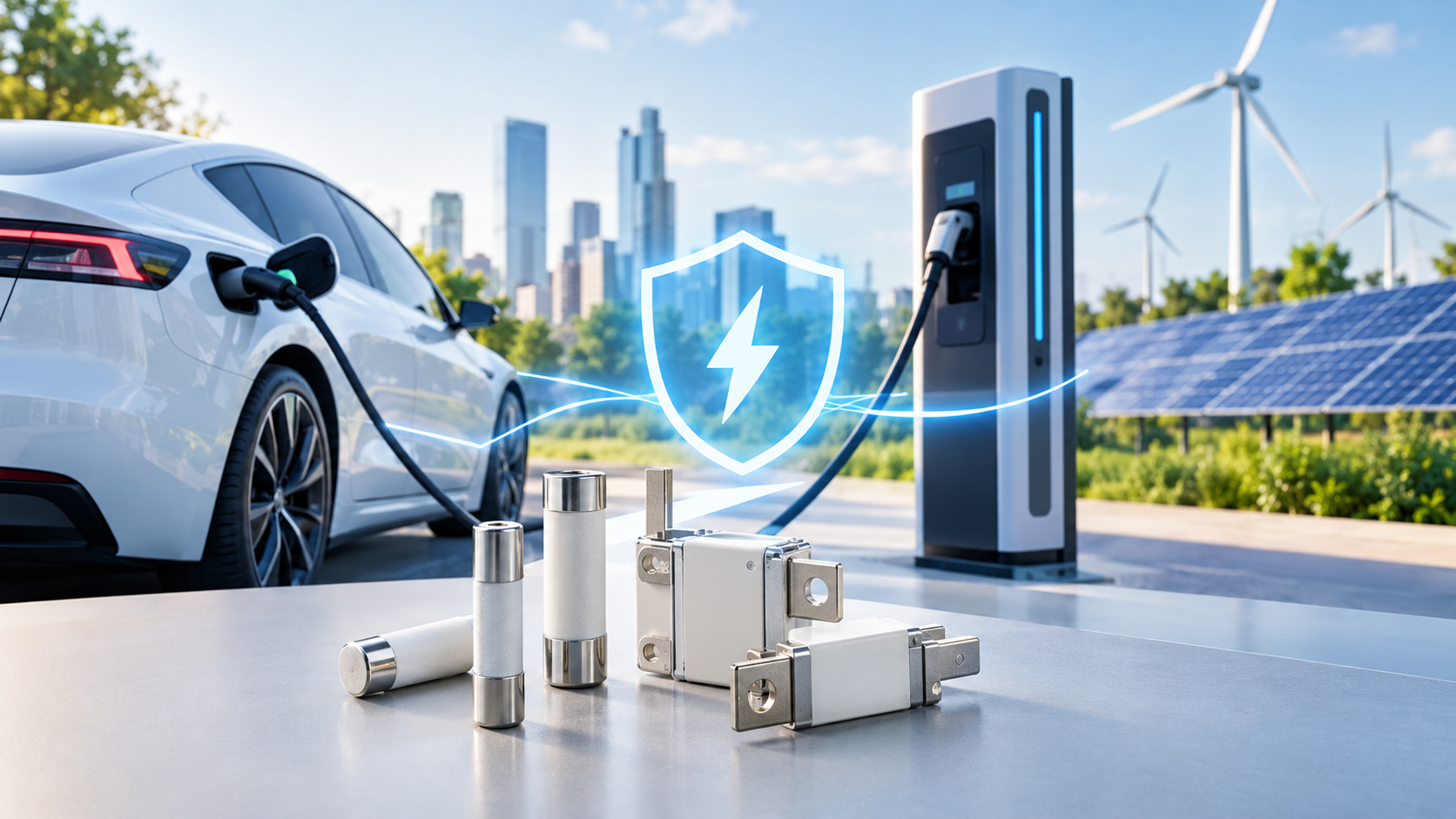
The rapid development of electric vehicles (EVs), hybrid electric vehicles (HEVs), and plug-in hybrid electric vehicles (PHEVs) has increased the importance of electrical safety and system reliability. As vehicle electrical architectures become more advanced, protecting high-voltage battery systems, electric drive units, charging circuits, and auxiliary electrical components has become a critical engineering requirement.
Among the essential electrical protection components, fuses play a fundamental role in preventing damage caused by overcurrent conditions and short circuits. A properly selected fuse can interrupt dangerous fault currents, protect sensitive electrical equipment, reduce the risk of cable overheating, and improve overall vehicle safety.
However, selecting fuses for new energy vehicles requires more consideration than choosing a conventional automotive fuse. High operating voltages, substantial short-circuit currents, temperature variations, mechanical vibration, and complex electrical loads all influence fuse performance.
This guide explores the essential guidelines and practical requirements for selecting fuses in new energy vehicles, including key electrical parameters, fuse types, application scenarios, calculation methods, and common selection mistakes.
1. Why Fuse Selection Is Important in New Energy Vehicles
New energy vehicles rely on high-voltage electrical systems to supply power to electric motors, battery packs, charging equipment, and other critical components. These systems typically operate at voltages significantly higher than those found in conventional vehicles.
Depending on the vehicle architecture, battery system voltages can range from approximately 300V to 1,000V or higher. Some advanced electrical platforms require even greater voltage capabilities.
This creates several important challenges for electrical protection.
1.1 High Operating Voltage
Unlike traditional 12V or 24V vehicle electrical systems, electric vehicle battery systems operate at high DC voltages.
A fuse must have a rated voltage equal to or greater than the maximum voltage of the protected circuit. Otherwise, the fuse may be unable to extinguish the electrical arc generated when interrupting a fault.
Selecting a fuse with an insufficient voltage rating can therefore compromise electrical safety.
1.2 High Short-Circuit Current
Electric vehicle battery packs can deliver extremely high fault currents because of their low internal resistance and substantial stored energy.
During a short circuit, current can increase rapidly, potentially damaging cables, connectors, battery components, and electronic equipment.
A suitable EV fuse must provide sufficient breaking capacity to safely interrupt the maximum prospective short-circuit current.
1.3 Temperature and Environmental Variations
Electric vehicle fuses operate in environments exposed to temperature fluctuations, humidity, vibration, and mechanical stress.
Depending on their installation location, they may experience temperatures ranging from approximately -40°C to 125°C.
The selected fuse must maintain reliable electrical and mechanical performance under the expected operating conditions.
1.4 Different Electrical Protection Requirements
New energy vehicles contain multiple electrical circuits with different load characteristics.
These include:
-
Main battery power circuits.
-
Electric motor drive systems.
-
Battery management systems.
-
Onboard charging equipment.
-
DC fast-charging circuits.
-
Electric air-conditioning compressors.
-
Auxiliary power distribution systems.
Each application requires an appropriate fuse rating and time-current characteristic.
Consequently, fuse selection must be based on the specific requirements of each electrical circuit rather than applying the same fuse specification throughout the vehicle.
2. Six Key Parameters for Selecting EV Fuses
Choosing the right fuse for an electric vehicle requires evaluating several electrical and environmental parameters.
The following six factors provide a practical foundation for effective EV fuse selection.
2.1 Rated Voltage
Rated voltage is one of the most important considerations when selecting a high-voltage DC fuse.
The fuse voltage rating must be equal to or higher than the maximum operating voltage of the protected circuit, including the highest expected charging voltage.
For example:
Consider an electric vehicle battery system with the following specifications:
-
Nominal battery voltage: 750V.
-
Maximum charging voltage: 850V.
-
Maximum system operating voltage: 850V.
In this situation, the selected fuse should have a rated voltage of at least 850V. A suitable 1,000V DC fuse could provide the required voltage rating, subject to verification of its other electrical characteristics.
It is important to remember that DC fuse selection requires particular attention to arc interruption because direct current does not naturally pass through zero as alternating current does.
2.2 Rated Current
Rated current refers to the current a fuse can carry continuously under specified operating conditions without opening.
The fuse rating must accommodate the normal operating current while still providing effective protection against overloads.
When determining the appropriate rated current, engineers should consider:
-
Continuous battery discharge current.
-
Motor operating current.
-
Charging current.
-
Temporary inrush current.
-
Ambient temperature.
-
Installation conditions.
-
Fuse holder and terminal temperature limitations.
A preliminary calculation for a continuously operating circuit may use:
Fuse Rated Current ≥ Continuous Operating Current × 1.25
For example, if a battery circuit has a continuous operating current of 50A:
50A × 1.25 = 62.5A
A 63A fuse may be considered as an initial selection.
However, this calculation is only a preliminary guideline. The final rating must be verified against the manufacturer's temperature derating curves, fuse time-current characteristics, cable ampacity, and applicable application requirements.
For circuits involving significant inrush current, such as motor drives, additional analysis is necessary to prevent unnecessary fuse operation.
2.3 Breaking Capacity
Breaking capacity, also known as interrupting capacity, describes the maximum prospective fault current that a fuse can safely interrupt at its specified voltage and operating conditions.
This parameter is especially important in electric vehicle battery systems because of their high energy storage capacity.
The basic selection principle is:
Fuse Breaking Capacity ≥ Maximum Prospective Short-Circuit Current
For example, assume a battery system has a calculated maximum short-circuit current of 45kA.
The selected fuse must have a breaking capacity of at least 45kA at the applicable DC voltage. An appropriately rated 50kA fuse could be considered if its other characteristics meet the application requirements.
Engineers must not select a fuse based solely on its rated current. A fuse with an appropriate current rating but insufficient breaking capacity may fail to interrupt a severe short circuit safely.
2.4 Time-Current Characteristics
The time-current characteristic describes how quickly a fuse operates at different current levels.
It is essential for balancing two competing requirements:
-
Avoiding unnecessary fuse operation during normal temporary current surges.
-
Interrupting dangerous overloads and short circuits quickly enough to protect the electrical system.
For example, an electric motor may experience a temporary current surge during startup. If the fuse operates too quickly, it may interrupt normal motor operation.
Conversely, if the fuse operates too slowly during a short circuit, excessive energy may pass through the circuit and damage connected components.
Engineers should evaluate the complete time-current curve and consider:
-
Motor startup current.
-
Charging current fluctuations.
-
Short-circuit current levels.
-
Cable thermal withstand capability.
-
Semiconductor protection requirements.
-
Coordination with contactors and circuit breakers.
The fuse must provide sufficient tolerance for normal operating transients while maintaining effective fault protection.
2.5 Temperature and Environmental Performance
Automotive electrical components must operate reliably under demanding environmental conditions.
For EV fuses, important environmental factors include:
-
Operating temperature.
-
Temperature cycling.
-
Mechanical vibration.
-
Humidity exposure.
-
Corrosion resistance.
-
Thermal ageing.
-
Installation orientation.
-
Heat dissipation and enclosure conditions.
High ambient temperatures can reduce the current-carrying capability of a fuse. Therefore, engineers should consider temperature derating when selecting the rated current.
Vibration resistance is equally important because electric vehicle fuses are installed in environments exposed to continuous mechanical movement.
Choosing an automotive-grade fuse with verified environmental performance helps improve long-term system reliability.
2.6 Standards and Automotive Qualification
Compliance with applicable standards is another important part of EV fuse selection.
Relevant standards and qualification requirements may include:
-
IEC 60269: Low-voltage fuse requirements.
-
GB/T 13539: Low-voltage fuse requirements in China.
-
Applicable automotive fuse standards and vehicle manufacturer specifications.
-
Environmental and vibration testing requirements.
-
Electrical performance and short-circuit verification.
The applicable standards depend on the fuse type, voltage level, installation location, and intended application.
Engineers should review the manufacturer's technical documentation and test reports to verify that the selected fuse meets the requirements of the intended vehicle platform.
3. Common Types of Fuses Used in New Energy Vehicles
Different fuse constructions offer different electrical and mechanical characteristics. Selecting the appropriate type depends on the required current rating, voltage rating, breaking capacity, installation space, and protection function.
3.1 Bolt-Type Fuses
Bolt-type fuses are commonly used in high-current electrical circuits because they provide secure mechanical connections and can accommodate demanding electrical applications.
Their main characteristics include:
-
High current-carrying capability.
-
Secure bolted connections.
-
High breaking capacity in appropriately designed models.
-
Suitability for high-voltage DC circuits.
-
Mechanical stability under suitable installation conditions.
Typical applications include:
-
Main battery protection circuits.
-
High-voltage power distribution systems.
-
Electric drive power circuits.
-
DC fast-charging systems.
When selecting bolt-type fuses, engineers should verify terminal dimensions, mounting torque, contact resistance, and heat dissipation.
3.2 Cartridge Fuses
Cartridge fuses feature a compact construction and are available in different sizes and electrical ratings.
Their advantages include:
-
Compact installation dimensions.
-
Straightforward replacement.
-
Various current ratings.
-
Suitability for different auxiliary protection applications.
Typical applications include:
-
Battery module protection.
-
Auxiliary electrical circuits.
-
Selected onboard charging circuits.
-
Low- and medium-current power distribution.
The fuse's voltage rating and DC breaking capacity must be verified before use in high-voltage applications.
3.3 Automotive High-Voltage DC Fuses
High-voltage DC fuses are specifically designed to address the protection requirements of electric vehicle electrical systems.
Their performance characteristics may include:
-
High DC voltage capability.
-
Reliable short-circuit interruption.
-
High breaking capacity.
-
Resistance to mechanical vibration.
-
Stable operation under temperature variations.
-
Compatibility with automotive electrical installations.
Typical applications include battery packs, motor controllers, charging interfaces, and high-voltage distribution units.
The most appropriate fuse type should always be determined by the actual electrical requirements of the protected circuit.
4. How to Select the Right Fuse for Different EV Applications
Different electrical components in new energy vehicles have different operating characteristics. Therefore, fuse selection should be application-specific.
4.1 Main Battery Protection
The main battery circuit is one of the most critical protection points in an electric vehicle.
The fuse must be capable of carrying the maximum expected continuous battery current while safely interrupting the highest prospective short-circuit current.
Important selection considerations include:
-
Maximum battery operating voltage.
-
Continuous discharge current.
-
Maximum prospective short-circuit current.
-
DC breaking capacity.
-
Battery system temperature.
-
Cable and busbar protection requirements.
High-voltage bolt-type fuses are commonly considered for this application because of their secure installation and high-current capabilities.
4.2 Battery Module Protection
Battery module protection helps isolate electrical faults within individual sections of a battery pack.
The selected fuse should provide appropriate protection without unnecessarily interrupting normal battery operation.
Important factors include:
-
Module voltage.
-
Maximum operating current.
-
Available fault current.
-
Installation dimensions.
-
Thermal conditions.
-
Coordination with the main battery fuse.
Compact cartridge or other appropriately qualified fuse designs may be suitable depending on the battery architecture.
4.3 Electric Motor Drive Protection
Electric motor drive systems experience changing current demands during acceleration, deceleration, and normal operation.
Motor startup and rapid load changes can produce temporary current surges.
Therefore, engineers should carefully examine the fuse time-current curve to ensure that normal operating conditions do not cause unnecessary interruption.
At the same time, the fuse must provide sufficient protection against short circuits and other electrical faults.
Coordination with motor controllers, power semiconductors, and other protective devices is particularly important.
4.4 Onboard Charger Protection
The onboard charger converts external AC power into DC power for charging the vehicle battery.
Fuse selection for this application must consider:
-
Input and output voltage.
-
Continuous charging current.
-
Temporary current fluctuations.
-
Power conversion characteristics.
-
Internal fault conditions.
-
Thermal operating conditions.
The fuse must be suitable for the specific AC or DC circuit being protected. AC and DC fuse ratings should never be treated as automatically interchangeable.
4.5 DC Fast-Charging Protection
DC fast-charging systems operate at high power levels and may involve substantial operating currents.
The protection system must account for maximum charging voltage, continuous current, temporary current variations, and potential short-circuit conditions.
A suitable DC fuse should provide:
-
Adequate rated voltage.
-
Appropriate continuous current capability.
-
Sufficient DC breaking capacity.
-
Reliable operation during charging cycles.
-
Compatibility with the charging system's protection architecture.
5. A Practical Five-Step Process for EV Fuse Selection
A systematic selection process helps engineers identify suitable fuse specifications and reduce the risk of electrical protection failures.
Step 1: Determine the System Voltage
Start by identifying the electrical voltage requirements of the protected circuit.
Collect the following information:
-
Nominal battery voltage.
-
Maximum charging voltage.
-
Maximum operating voltage.
-
Possible voltage fluctuations.
-
DC or AC circuit classification.
The selected fuse voltage rating must be suitable for the maximum expected circuit voltage.
For example, if the maximum operating voltage is 850V DC, a suitably qualified 1,000V DC fuse may be considered.
Step 2: Calculate the Required Current Rating
Determine the normal continuous operating current and identify any temporary current surges.
For a battery system, current can be estimated using:
Current (A) = Power (W) ÷ Voltage (V)
For example, consider a 150kW electric drive system operating at 750V:
150,000W ÷ 750V = 200A
This provides an estimated operating current of 200A under the assumed electrical conditions.
The final fuse rating must account for operating current variations, inrush characteristics, ambient temperature, and the manufacturer's specified derating requirements.
Step 3: Verify the Breaking Capacity
Calculate the maximum prospective short-circuit current of the circuit.
A simplified initial estimate can be obtained using:
I = U ÷ R
Where:
-
I = Short-circuit current in amperes.
-
U = Circuit voltage in volts.
-
R = Total effective circuit resistance in ohms.
For example, assuming a 750V system and a total effective resistance of 0.01Ω:
I = 750 ÷ 0.01
I = 75,000A or 75kA
This simplified calculation provides an initial estimate. Actual fault-current analysis must consider battery characteristics, internal resistance, interconnections, circuit impedance, and fault conditions.
The selected fuse must have a verified DC breaking capacity sufficient for the maximum prospective fault current.
Step 4: Evaluate the Time-Current Curve
Review the fuse manufacturer's time-current characteristics to determine whether the fuse can tolerate normal operating transients.
The analysis should include:
-
Motor startup conditions.
-
Charging current variations.
-
Continuous operating loads.
-
Short-circuit interruption requirements.
-
Coordination with other protective devices.
This step is essential for preventing unnecessary fuse operation while maintaining effective electrical protection.
Step 5: Verify Installation and Qualification Requirements
Before finalizing the selection, confirm that the fuse is suitable for the vehicle's physical and environmental conditions.
Check:
-
Automotive qualification documentation.
-
Applicable electrical standards.
-
Terminal and mounting compatibility.
-
Overall dimensions.
-
Contact resistance.
-
Installation torque.
-
Temperature performance.
-
Vibration and humidity resistance.
The final selection should be validated through appropriate electrical, environmental, and vehicle-level testing.
6. Common Mistakes to Avoid When Selecting EV Fuses
Even when the basic electrical parameters appear correct, inappropriate fuse selection can compromise the protection system.
The following mistakes should be avoided.
6.1 Selecting an Incorrect Rated Current
A fuse with an excessively high current rating may not provide adequate protection against overload conditions.
On the other hand, a fuse with an unnecessarily low rating may operate during normal vehicle operation.
Engineers should determine the rated current based on actual load characteristics, cable protection requirements, temperature derating, and time-current performance.
6.2 Ignoring Breaking Capacity
Breaking capacity is a critical safety parameter in high-voltage battery applications.
A fuse with insufficient interrupting capacity may fail to safely interrupt a severe short circuit.
Always calculate or establish the maximum prospective fault current before selecting the fuse.
6.3 Using Unsuitable AC Fuses in DC Applications
DC circuits present different arc-interruption challenges from AC circuits.
A fuse intended for an AC application must not automatically be considered suitable for a DC application.
Engineers should verify the fuse's rated DC voltage and breaking capacity under the actual circuit conditions.
6.4 Ignoring Temperature Derating
High ambient temperatures can affect fuse performance and reduce its continuous current-carrying capability.
Failing to consider temperature derating may result in premature fuse operation or excessive operating temperatures.
Always evaluate the installation environment and relevant manufacturer derating information.
6.5 Overlooking Protection Coordination
Electric vehicle electrical systems often include several protective devices, including fuses, contactors, circuit breakers, and electronic protection systems.
These devices must work together effectively.
Poor coordination may cause unnecessary disconnection or allow excessive fault energy to reach sensitive components.
6.6 Neglecting Mechanical Installation Requirements
Incorrect installation can increase contact resistance and generate excessive heat.
Common problems include:
-
Insufficient terminal tightening.
-
Incorrect mounting dimensions.
-
Poor electrical contact.
-
Inadequate heat dissipation.
-
Exposure to excessive vibration.
-
Moisture and corrosion.
Proper installation and maintenance are essential for maintaining long-term fuse reliability.
6.7 Choosing Products Without Verified Technical Documentation
Fuse specifications should always be supported by reliable technical documentation.
Engineers should examine rated voltage, rated current, breaking capacity, time-current curves, temperature limitations, and relevant qualification reports.
Avoid selecting fuses based solely on advertised ratings or physical appearance.
7. Best Practices for Improving EV Fuse Protection Reliability
Effective fuse selection should be part of a broader vehicle electrical protection strategy.
The following practices can help improve protection performance and system reliability.
Use a coordinated protection strategy: Design main battery, battery module, and auxiliary circuit protection to work together. Consider the selectivity and energy let-through characteristics of each protective device.
Prioritize verified DC performance: Confirm that the fuse has been tested for the required DC voltage and prospective fault current.
Consider the complete operating environment: Evaluate temperature, vibration, humidity, installation location, and heat dissipation.
Protect cables and connected components: Ensure the fuse's operating characteristics are coordinated with the thermal withstand limits of cables, busbars, and connected equipment.
Conduct application-specific testing: Validate fuse performance under representative operating conditions, including overload, short-circuit, temperature, and vibration tests.
Establish an inspection and replacement strategy: Inspect electrical connections for corrosion, overheating, and mechanical damage. Replace operated or damaged fuses with components that meet the original engineering specifications.
8. Future Trends in Fuse Selection for New Energy Vehicles
As electric vehicle technology continues to advance, fuse requirements are also evolving.
Several developments are influencing the design and selection of automotive electrical protection components.
8.1 Higher-Voltage Battery Platforms
The growing adoption of 800V electrical architectures is increasing demand for high-voltage DC protection components.
Higher-voltage platforms require fuses with suitable voltage ratings, reliable arc interruption, and sufficient breaking capacity.
Future vehicle architectures may also require protection solutions rated for voltages beyond 1,000V.
8.2 Increased Battery Capacity
Larger battery packs provide greater energy storage and can create more demanding short-circuit protection requirements.
Fuse selection must therefore account for the available fault current and the energy that may be released during an electrical fault.
8.3 Higher-Power Fast Charging
Increasing charging power creates additional challenges for electrical protection systems.
Fuses must accommodate the expected charging current while maintaining reliable protection against abnormal operating conditions.
8.4 More Integrated Electrical Architectures
Modern electric vehicles increasingly integrate battery management, power distribution, charging, and drive control functions.
This makes protection coordination more important.
Engineers must consider the interaction between fuses, electronic control systems, contactors, and other protective devices to ensure reliable fault isolation.
Conclusion
Selecting the right fuses for new energy vehicles is essential for maintaining battery safety, electrical system reliability, and overall vehicle performance.
Unlike conventional automotive electrical systems, electric vehicles operate with higher voltages, substantial fault currents, and more demanding environmental conditions. These characteristics require careful consideration of rated voltage, rated current, breaking capacity, time-current characteristics, environmental performance, and automotive qualification.
A reliable EV fuse selection process should begin with an accurate assessment of circuit operating conditions, followed by electrical calculations, breaking-capacity verification, protection coordination, and installation compatibility checks.
Most importantly, fuse selection should never rely on current rating alone. The complete electrical protection performance must be evaluated and validated under realistic operating conditions.
As battery capacities increase, charging technologies advance, and high-voltage vehicle architectures become more widespread, appropriately designed and qualified fuse protection solutions will remain essential to the safe development of the new energy vehicle industry.



