
 eaton-bussmann-series-photovoltaic-fuses-catalogue-ca135004en.pdf  | [Eaton Bussmann PV Sicherungen] | 0 kB |
Photovoltaic Fuse Failures Explained: Common Causes, Early Warnings, and Proven Fixes for Solar Projects in Europe
Introduction: Why Photovoltaic Fuse Reliability Matters in Solar Projects
Solar energy has become an essential part of Europe's transition towards renewable energy. From residential rooftop installations to large-scale commercial solar farms, photovoltaic (PV) systems are expanding rapidly across Germany, France, Spain, Italy, the Netherlands, and other European markets.
As solar installations become larger and more technologically advanced, system reliability and electrical safety are becoming increasingly important. While solar panels, inverters, and energy storage systems often receive the most attention, one relatively small component plays a critical role in protecting the entire installation: the photovoltaic fuse.
A photovoltaic fuse is designed to interrupt excessive current and protect solar system components against electrical faults. When correctly selected and installed, it helps prevent equipment damage, reduces fire risks, and supports stable system operation.
However, photovoltaic fuse failures remain a recurring challenge for solar installers, engineering, procurement, and construction (EPC) contractors, and operation and maintenance (O&M) teams.
Overheating, incorrect fuse ratings, poor electrical connections, environmental exposure, and unsuitable components can all contribute to premature fuse failure.
Understanding these problems is essential for preventing unexpected downtime and maintaining the long-term performance of solar installations.
In this guide, we explore the most common causes of photovoltaic fuse failures, the early warning signs engineers should recognise, and practical solutions for improving PV system protection across Europe.
1. Understanding the Role of Photovoltaic Fuses in Solar Systems
Photovoltaic fuses are specialised protective devices used in the direct current (DC) circuits of solar installations.
They are commonly installed in PV combiner boxes, string protection systems, and other DC distribution equipment.
Their primary function is to interrupt excessive current when an electrical fault occurs.
In a typical solar installation, multiple photovoltaic modules are connected in series to create strings. Several strings may then be connected in parallel to increase the overall system output.
Although this configuration improves energy production, it also creates potential reverse-current risks.
For example, if one PV string develops a fault, current from other parallel-connected strings may flow into the affected string. Without suitable overcurrent protection, this reverse current can damage cables, connectors, modules, and other electrical components.
Photovoltaic fuses help reduce these risks by disconnecting the affected circuit when current exceeds the fuse's specified operating characteristics.
Why Are PV-Specific Fuses Important?
Solar installations operate under electrical conditions that differ from many conventional AC applications.
PV systems generate DC electricity, which presents particular challenges when interrupting fault currents because DC arcs do not naturally pass through zero as AC current does.
Consequently, selecting a fuse designed and rated for the intended photovoltaic application is essential.
PV-specific fuse links are generally designed according to the requirements of IEC 60269-6, which addresses fuse links for photovoltaic energy systems.
Using an appropriately rated photovoltaic fuse helps ensure:
- Reliable DC overcurrent protection.
- Improved electrical safety.
- Reduced risk of equipment damage.
- Better coordination with other protective devices.
- Greater operational reliability.
- Lower maintenance costs over the system's lifetime.
2. Common Photovoltaic Fuse Problems in Solar Installations
Photovoltaic fuse failures can occur for several reasons. Some problems develop gradually because of environmental stress, while others result from incorrect component selection or installation errors.
Understanding the most frequent issues helps maintenance teams identify potential weaknesses before they affect system performance.
2.1 Fuse Overheating and Burnout
Overheating is one of the most common problems associated with photovoltaic fuse failures.
Excessive operating temperatures can accelerate material degradation and eventually cause a fuse link to fail.
Common causes include:
- Continuous operation under excessive current.
- Incorrect fuse sizing.
- High ambient temperatures.
- Poor ventilation inside combiner boxes.
- Loose electrical connections.
- Increased contact resistance.
- Incorrect fuse holder installation.
In European solar installations, high summer temperatures can create additional thermal stress, particularly in outdoor combiner boxes installed in southern regions such as Spain, Italy, and Greece.
However, overheating is not necessarily caused by excessive circuit current.
A loose connection or deteriorated contact surface can generate localised heat even when the measured operating current remains within the expected range.
Recommended solution:
Inspect fuse holders, terminals, and contact surfaces during scheduled maintenance. Verify the fuse rating against the system design and investigate abnormal temperature increases.
Thermal imaging can also help identify overheating connections before visible damage develops.
2.2 Frequent or Unnecessary Fuse Tripping
Repeated photovoltaic fuse failures can indicate an underlying system problem.
When a fuse repeatedly operates under apparently normal conditions, replacing it without investigating the cause is not an effective long-term solution.
Potential causes include:
- Incorrect fuse current ratings.
- Inadequate voltage ratings.
- Reverse-current conditions.
- PV string faults.
- Damaged cables or connectors.
- Incorrect system protection coordination.
- High-temperature derating effects.
One particularly important consideration is that PV string current varies with environmental conditions.
Changes in solar irradiance and module temperature influence system operating conditions. Fuse selection must therefore account for the relevant design requirements rather than relying solely on normal operating current.
Recommended solution:
Check the electrical design, calculate the expected maximum circuit current, and verify the fuse's rated voltage, current, utilisation category, and time-current characteristics.
Do not simply install a higher-rated fuse to stop repeated operation. Doing so may compromise cable and equipment protection.
2.3 Premature Fuse Ageing
Photovoltaic installations are expected to operate for many years, often under demanding environmental conditions.
However, repeated thermal cycling, moisture exposure, dust accumulation, and mechanical stress can gradually affect fuse components.
Common contributing factors include:
- High operating temperatures.
- Frequent temperature fluctuations.
- Moisture entering electrical enclosures.
- Corrosion of conductive contacts.
- Mechanical vibration.
- Poor-quality fuse materials.
Premature ageing may affect both the fuse link and its associated holder.
Recommended solution:
Choose components suitable for the installation environment. Ensure that combiner boxes provide appropriate environmental protection and inspect electrical connections regularly.
2.4 Incorrect Fuse Ratings
Incorrect fuse selection is another significant cause of photovoltaic protection problems.
A fuse with an unsuitable current or voltage rating may fail to provide the required protection.
For example, an undersized fuse may operate unnecessarily during normal system conditions, while an oversized fuse may not adequately protect connected conductors and equipment.
Voltage selection is equally important.
The fuse's DC voltage rating must be suitable for the maximum possible system voltage, including the effects of low-temperature increases in PV module open-circuit voltage.
Recommended solution:
Calculate the maximum PV string voltage under the expected minimum operating temperature. Verify the required current rating using applicable design standards and manufacturer specifications.
Also confirm that the fuse's breaking capacity is adequate for the prospective fault current.
3. The Main Causes of Photovoltaic Fuse Failures
Although individual installations have different operating conditions, several underlying factors repeatedly contribute to PV fuse problems.
3.1 Incorrect Fuse Selection During System Design
Fuse selection should be an essential part of the electrical design process.
Unfortunately, some projects focus heavily on inverter capacity, module performance, and cable sizing while giving insufficient attention to overcurrent protection.
This can result in mismatched components and inadequate protection coordination.
Engineers should consider:
- Maximum system DC voltage.
- Maximum continuous operating current.
- PV module short-circuit current.
- Reverse-current characteristics.
- Ambient temperature.
- Cable current-carrying capacity.
- Fuse time-current characteristics.
- Required breaking capacity.
A properly designed protection system considers all these parameters together.
3.2 Using Conventional Industrial Fuses Instead of PV-Specific Fuse Links
Not every DC fuse is suitable for photovoltaic applications.
Solar installations have particular electrical characteristics, especially regarding DC voltage, fault-current behaviour, and reverse-current protection.
Using a conventional industrial fuse without verifying its suitability can create serious protection issues.
For this reason, project designers should select fuse links specifically designed for the intended PV application and verify compliance with the relevant technical standards.
3.3 Ignoring Temperature Derating
Temperature has a significant influence on fuse performance.
In hot environments, a fuse may operate differently from its expected characteristics under standard test conditions.
High ambient temperatures can reduce the available operating margin and increase the likelihood of unwanted fuse operation.
This is particularly relevant for European solar projects installed in regions experiencing high summer temperatures.
Temperature derating should therefore be considered during the fuse selection process.
Engineers should consult the manufacturer's derating curves and installation recommendations rather than applying a universal correction factor.
3.4 Poor Installation and Electrical Connections
Even a correctly selected photovoltaic fuse can experience problems if installed incorrectly.
Loose terminals, unsuitable holders, contaminated contact surfaces, and improper installation torque can increase electrical resistance.
This can result in localised heating, contact degradation, and eventual component failure.
Installation teams should follow the specified torque requirements and ensure that fuse links are compatible with their holders.
3.5 Environmental Exposure
European solar installations experience a wide range of environmental conditions.
For example:
- Southern Europe experiences high temperatures and intense solar radiation.
- Northern Europe often experiences high humidity and frequent rainfall.
- Coastal installations may be exposed to salt-laden air.
- Agricultural and industrial locations may experience increased dust and airborne contamination.
These conditions can affect electrical connections, enclosure integrity, and the long-term reliability of protective components.
Selecting components with appropriate environmental suitability is therefore essential.
4. Early Warning Signs of Photovoltaic Fuse Failure
Photovoltaic fuse failures do not always happen without warning.
In many cases, visual inspections, thermal monitoring, and system performance data can help maintenance teams identify potential problems.
Recognising these warning signs early can prevent more serious electrical faults and unnecessary production losses.
The following table summarises common indicators and recommended actions.
| Warning Sign | Possible Cause | Recommended Action |
|---|---|---|
| Discolouration or darkening | Excessive heat or contact deterioration | Arrange immediate inspection |
| Unusually high temperature | Overcurrent or increased contact resistance | Check current levels and connections |
| Cracked fuse body | Mechanical or thermal damage | Isolate and replace the damaged component |
| Repeated fuse operation | Incorrect rating or underlying electrical fault | Investigate the circuit before replacement |
| Loose terminals | Improper installation or mechanical stress | Check and correct connections |
| Burning smell | Overheating or insulation damage | Arrange urgent inspection |
| Corroded contacts | Moisture or environmental exposure | Inspect and replace damaged components |
| Reduced string output | Fuse operation or other string-level fault | Check string current and protection devices |
4.1 Discolouration and Visible Damage
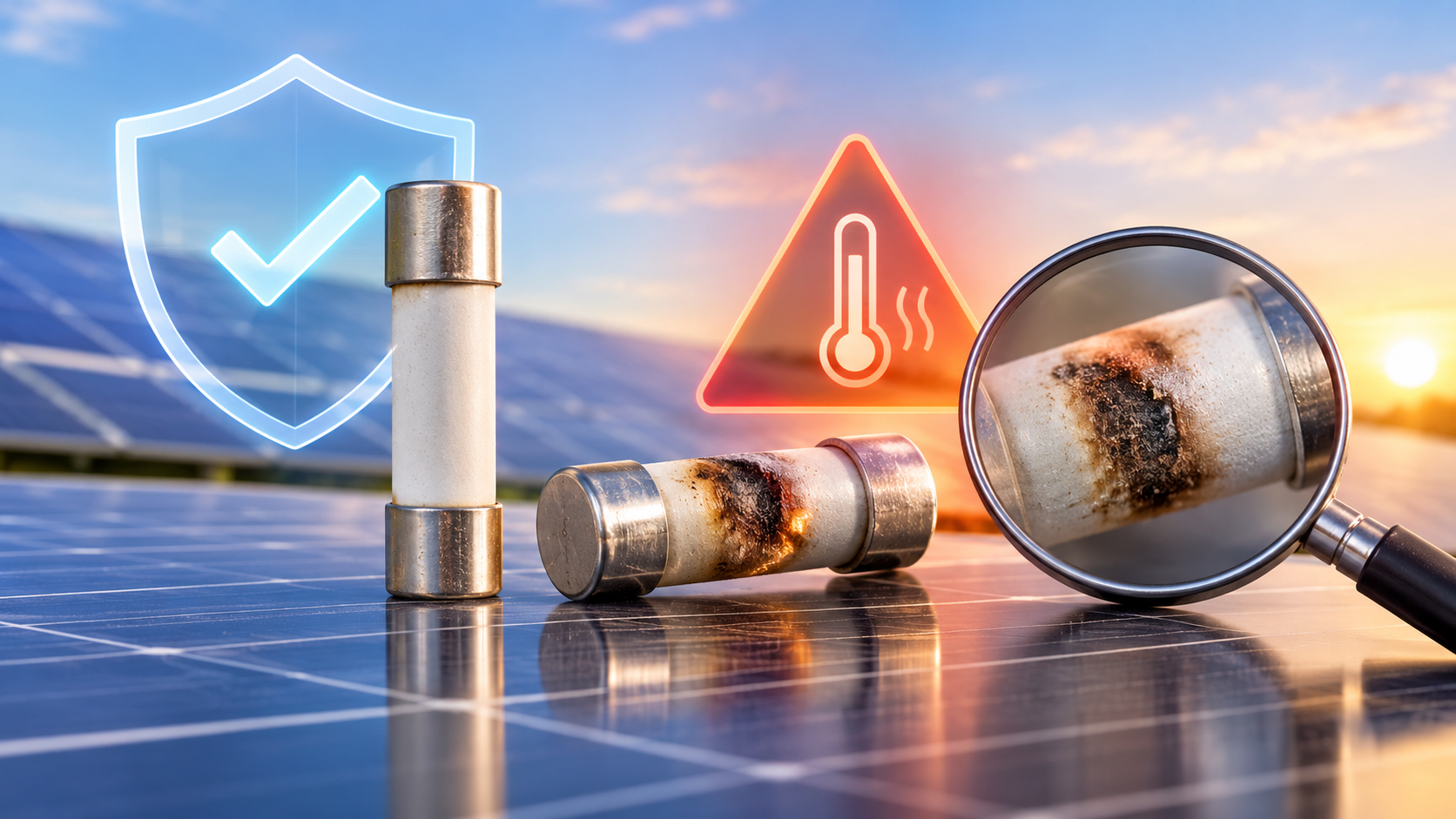
Brown or black marks on a fuse body may indicate excessive heat exposure.
Cracks, chipped surfaces, or visible deformation should also be treated seriously.
Damaged components should not remain in service simply because the solar system continues generating electricity.
4.2 Abnormal Temperature Readings
Temperature monitoring is particularly useful for identifying developing electrical problems.
An unusually hot fuse holder or terminal may indicate poor contact quality or excessive current.
Thermal imaging inspections can help maintenance teams identify these issues without relying exclusively on visual inspection.
4.3 Unexpected Drops in PV String Performance
A failed string fuse can disconnect a PV string and reduce the energy output of the overall installation.
In large solar farms, the effect may be difficult to identify without proper monitoring.
Comparing string-level current measurements and inverter performance data can help identify abnormal operating conditions.
4.4 Repeated Maintenance Alerts
Repeated alarms or fuse replacements should never be treated as routine maintenance.
They may indicate a deeper problem involving system design, environmental conditions, wiring, or component compatibility.
The underlying cause should always be identified before the circuit is returned to normal operation.
Important safety note: PV circuits can remain energised whenever modules are exposed to light. Fuse inspection, testing, and replacement should only be performed by qualified personnel using appropriate isolation procedures and equipment.
5. Proven Solutions to Prevent Photovoltaic Fuse Failures
Preventing photovoltaic fuse failures requires a combination of correct component selection, professional installation, regular maintenance, and appropriate system monitoring.
The following practices can significantly improve solar system reliability.
5.1 Select Photovoltaic Fuses Compliant with IEC 60269-6
Standards compliance should be a fundamental requirement when selecting PV fuse links.
IEC 60269-6 specifies requirements for fuse links used in photovoltaic energy systems.
Selecting products designed and tested for the intended application helps ensure that their electrical characteristics are appropriate for PV protection.
Project engineers should verify:
- Rated DC voltage.
- Rated current.
- Breaking capacity.
- Utilisation category.
- Relevant certification and test documentation.
- Compatibility with the selected fuse holder.
Certification claims should always be checked against the applicable product documentation.
5.2 Calculate the Correct Current and Voltage Ratings
Fuse ratings must match the electrical requirements of the photovoltaic system.
Important design considerations include:
Current rating: The selected fuse must accommodate the expected operating current while providing appropriate protection against excessive current.
Voltage rating: The fuse must be suitable for the maximum possible DC system voltage.
Breaking capacity: The fuse must safely interrupt the prospective fault current under specified conditions.
Temperature derating: Ambient temperature and installation conditions must be considered.
Incorrectly selecting any of these parameters can compromise protection performance.
5.3 Choose Suitable Fuse Materials
Fuse construction materials can influence mechanical durability, handling characteristics, and suitability for different installation environments.
Ceramic and melamine fuse tubes are two commonly discussed options.
| Feature | Ceramic Fuse Links | Melamine Fuse Links |
|---|---|---|
| Weight | Generally heavier | Generally lighter |
| Mechanical properties | Rigid construction | Good impact resistance |
| Handling | Requires careful handling | Convenient handling |
| Thermal performance | Depends on product design | Depends on product design |
| Typical application considerations | Industrial and utility-scale installations | Applications where handling and mechanical properties are important |
It is important to understand that material selection alone does not determine electrical protection performance.
The fuse must still meet the required voltage, current, breaking capacity, and utilisation category specifications.
Engineers should evaluate the complete product rather than selecting components based solely on tube material.
5.4 Use Compatible Fuse Holders
Fuse links and fuse holders must be compatible in terms of dimensions, electrical ratings, and operating conditions.
An unsuitable holder can create poor electrical contact and increase the risk of overheating.
Before installation, verify:
- Correct fuse dimensions.
- Rated operating voltage.
- Rated current.
- Contact quality.
- Terminal compatibility.
- Manufacturer installation instructions.
Properly installed fuse holders help maintain stable electrical connections and simplify future maintenance.
5.5 Improve Environmental Protection
Environmental conditions should be considered throughout the system design process.
For outdoor photovoltaic installations, appropriate enclosure protection can reduce exposure to moisture, dust, and other contaminants.
Additional recommendations include:
- Use suitable electrical enclosures.
- Maintain adequate ventilation.
- Prevent moisture accumulation.
- Inspect seals and cable entries.
- Avoid unnecessary exposure to corrosive environments.
- Follow the manufacturer's operating temperature requirements.
These measures can help extend the service life of PV protection components.
6. Ceramic vs. Melamine Photovoltaic Fuses: Which Is Better?
Choosing between ceramic and melamine fuse links is a common consideration during solar system design and procurement.
Both materials can be used in photovoltaic fuse construction, but their characteristics differ.
Ceramic Photovoltaic Fuse Links
Ceramic fuse tubes are widely used in electrical protection applications.
Their rigid construction and thermal properties make them suitable for many industrial and photovoltaic applications.
Potential advantages include:
- Strong thermal resistance.
- Rigid mechanical construction.
- Established use in electrical protection.
- Availability across different fuse dimensions and ratings.
However, ceramic components can be more susceptible to mechanical damage if dropped or handled improperly.
Melamine Photovoltaic Fuse Links
Melamine fuse tubes offer different mechanical characteristics.
Depending on the product design, they can provide improved resistance to certain forms of mechanical impact and convenient handling.
Potential advantages include:
- Lower component weight.
- Good mechanical durability.
- Convenient installation and transportation.
- Flame-retardant material properties.
However, the actual performance of a melamine fuse link depends on its complete construction and testing.
How Should Engineers Choose?
There is no universal answer.
The most appropriate option depends on the installation environment, mechanical requirements, electrical specifications, and manufacturer test data.
For EPC contractors and solar system designers, the priority should always be selecting a properly tested and rated PV fuse rather than choosing a component based exclusively on material or purchase price.
7. The Financial Impact of Photovoltaic Fuse Failures
Photovoltaic fuse failures may appear to be relatively minor technical problems.
However, their financial consequences can extend beyond the cost of replacing individual components.
Consider a commercial solar installation where several PV strings become unavailable because of repeated fuse problems.
The resulting losses may include:
Reduced energy production: Disconnected strings generate less electricity, directly affecting project revenue.
Increased maintenance costs: Repeated inspections, troubleshooting, and component replacements increase O&M expenditure.
Unplanned downtime: Engineers may need to investigate the underlying problem before safely restoring normal operation.
Equipment damage: Poor overcurrent protection can expose cables, connectors, and other electrical components to damaging fault conditions.
Reduced project profitability: Unexpected maintenance expenses and lost generation can negatively affect the financial performance of the installation.
For large-scale solar farms, preventive maintenance and correct fuse selection can therefore provide substantial long-term economic benefits.
The purchase price of a protective component should always be evaluated against its contribution to system safety and operational reliability.
8. Best Practices for Photovoltaic Fuse Maintenance in European Solar Projects
A structured maintenance programme is one of the most effective ways to reduce unexpected PV fuse failures.
European solar installations operate under different climatic conditions, so maintenance strategies should reflect the specific installation environment.
The following practices can help improve reliability.
Regular Visual Inspections
Inspect fuse links, holders, terminals, and electrical enclosures for:
- Discolouration.
- Cracks.
- Corrosion.
- Signs of overheating.
- Loose connections.
- Moisture accumulation.
Thermal Inspections
Use suitable thermal imaging equipment to identify abnormal temperature differences across fuse holders and electrical connections.
Investigate unusual readings against expected operating conditions and manufacturer specifications.
Electrical Performance Monitoring
Monitor PV string currents, inverter alarms, and system performance data.
Unexpected differences between similar strings may indicate a developing electrical problem.
Correct Replacement Procedures
When replacing a failed fuse:
- Identify the underlying cause of the failure.
- Follow the approved electrical isolation procedure.
- Verify the replacement fuse's ratings.
- Confirm fuse holder compatibility.
- Follow specified installation torque requirements.
- Perform the required inspection and electrical checks before returning the circuit to service.
Never replace a failed fuse with a higher-rated component without reviewing the electrical protection design.
Maintain Accurate Records
Maintenance teams should document fuse replacements, abnormal temperature readings, recurring faults, and inspection findings.
These records help identify repeated problems and support better maintenance planning.
9. How to Select the Right Photovoltaic Fuse for European Solar Projects
Selecting the right photovoltaic fuse requires more than checking its current rating.
Engineers, EPC contractors, and procurement managers should evaluate the complete operating requirements of the solar installation.
Here are six important considerations.
1. System voltage
Identify the maximum DC voltage of the photovoltaic installation, including temperature-related increases in module open-circuit voltage.
2. Current requirements
Calculate the appropriate fuse rating based on module specifications, string configuration, applicable design requirements, and system protection coordination.
3. Standards compliance
Verify that the selected fuse is suitable for photovoltaic applications and complies with relevant standards, including IEC 60269-6 where applicable.
4. Environmental conditions
Consider ambient temperature, humidity, dust, mechanical exposure, and enclosure conditions.
5. Fuse holder compatibility
Ensure that the fuse link and holder have compatible dimensions and electrical ratings.
6. Technical documentation
Request datasheets, test reports, certification documents, and installation instructions before approving components for a project.
A structured selection process helps minimise installation errors and improves long-term protection reliability.
10. Conclusion: Reliable PV Fuse Protection Starts with the Right Selection
Photovoltaic fuse failures can have a significant impact on solar system safety, operational performance, and project profitability.
Although overheating, nuisance tripping, incorrect ratings, environmental exposure, and poor connections are common causes, many of these problems can be prevented through proper engineering and maintenance practices.
For European solar projects, the most effective approach combines:
- Correct photovoltaic fuse selection.
- Compliance with relevant electrical standards.
- Appropriate current and voltage ratings.
- Compatible fuse holders.
- Consideration of environmental conditions.
- Regular inspections and thermal monitoring.
- Professional installation and maintenance.
As Europe's solar capacity continues to expand, reliable DC protection will remain an essential part of successful photovoltaic system design.
Photovoltaic fuses may be small components, but their contribution to electrical safety and system reliability is substantial.
For solar developers, EPC contractors, installers, and O&M professionals, investing in appropriate PV fuse protection is not simply a technical decision. It is a practical investment in long-term system performance, reduced maintenance costs, and greater project reliability.



